Tell Parents: Struggling With GCSE Statistics
Tell parents you're struggling with GCSE Statistics using a calm script, clear evidence and a practical revision plan that avoids lectures at home.
There is a difficult moment in revision when the problem stops being just statistics. You know you are falling behind, but admitting it feels as worrying as the next assessment. You may fear disappointment, extra pressure or a long lecture about working harder.
If you need to tell parents you are struggling with GCSE Statistics, choose a calm time, describe the precise topics causing trouble, explain what you have already tried and ask for one or two practical forms of support. The aim is not to confess failure. It is to turn a private problem into a shared, manageable plan.
Falling behind is evidence that your current approach needs changing, not evidence that you cannot improve.
A quick conversation checklist
Before speaking to your parents or carers, prepare these five things:
- Choose a quiet time, rather than starting the conversation during an argument or rushed morning.
- Name specific difficulties, such as sampling, cumulative frequency, interpreting graphs or explaining conclusions.
- Bring evidence, including a marked assessment, teacher feedback or questions you could not complete.
- Say what you need, whether that is quiet revision time, help contacting your teacher or fewer anxious check-ins.
- Suggest a short plan, with a date when you can review whether it is working.
You do not need a perfect speech. You need an honest opening sentence and a useful next step.
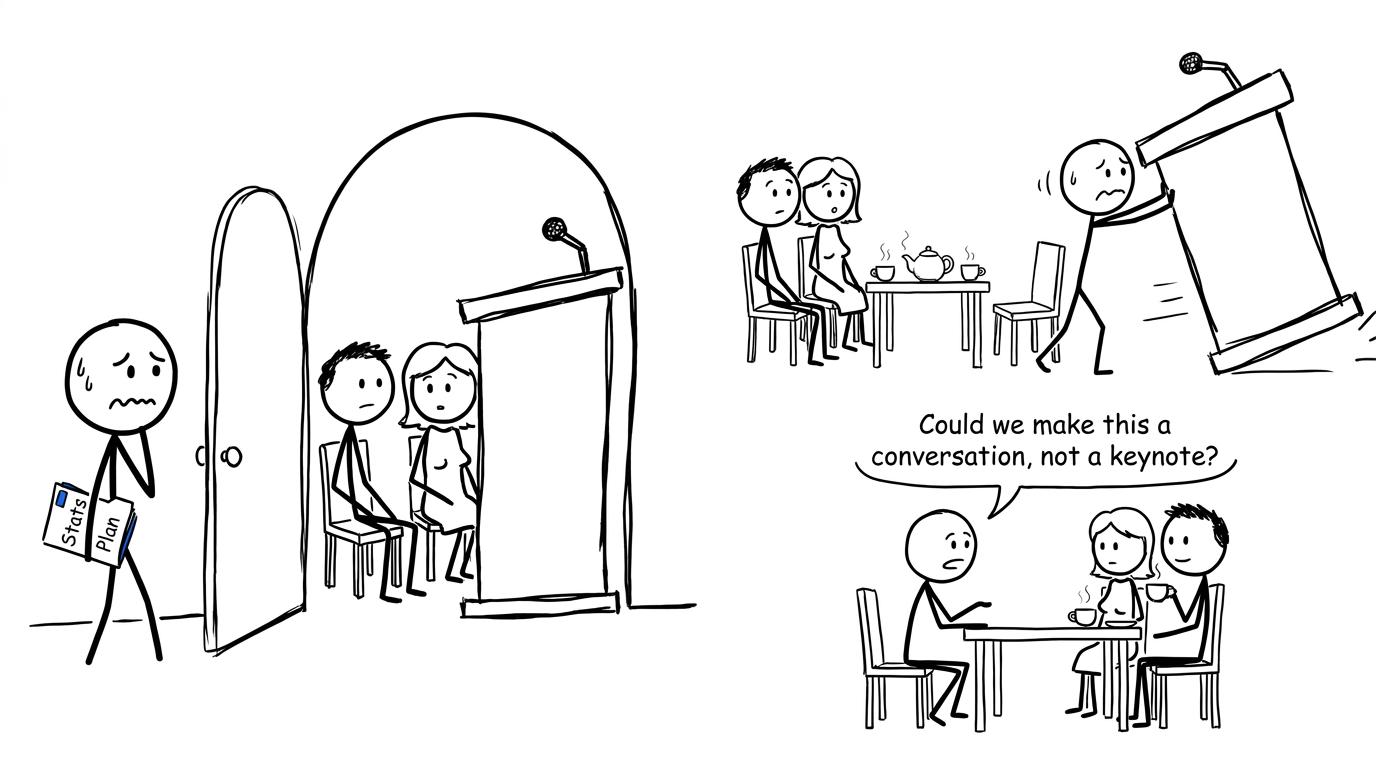 A student replaces a lecture podium with two chairs before discussing GCSE Statistics
Work out what “struggling” actually means
“I am bad at statistics” feels like a complete explanation when you are anxious. Unfortunately, it gives your parents very little information to work with. It may also invite broad advice such as “revise more”, even when you have already been trying.
Make the problem smaller before the conversation. Start at the MathsGenie GCSE Statistics revision hub, select your exam board and compare the available topics with your recent work. Then sort your difficulties into three groups:
- topics you do not yet understand;
- methods you understand slowly or inconsistently;
- exam questions where wording, timing or interpretation costs you marks.
For example, you might understand averages but become uncertain when data is grouped. The averages from frequency tables revision guide can help you identify whether the gap concerns total frequency, midpoints, estimated means or locating the median.
Higher-tier students might discover that the difficulty is narrower still. Perhaps cumulative frequency graphs are manageable until quartiles appear, or histograms become confusing when class widths differ. Use the focused MathsGenie pages for cumulative frequency revision and histogram practice to put an accurate name to the problem.
Specificity changes the emotional temperature. “I cannot do statistics” sounds permanent. “I lose marks when I have to interpret sampling methods and justify conclusions” sounds fixable.
How to tell parents you are struggling with GCSE Statistics
Pick the moment deliberately
Try not to begin immediately after receiving a disappointing mark, when everyone may react before thinking. Choose a time when nobody needs to leave, answer a call or complete another task.
You could say:
“Could we talk about GCSE Statistics later this evening? I am falling behind in a few areas, and I want your help making a plan. I would like you to listen first before we decide what to do.”
That final request matters. Parents often move quickly towards solutions because they are worried and want to help. Asking them to listen first gives the conversation a structure without sounding confrontational.
If speaking face to face feels overwhelming, begin with a message or short note asking for a conversation. The important step is opening the door, not choosing the most impressive method.
Describe facts before fears
Start with observable information:
- which assessment or homework revealed the gap;
- which topics are difficult;
- whether the problem is knowledge, application, timing or confidence;
- what support your teacher has already suggested;
- what revision you have attempted.
Then explain how it is affecting you. You might be avoiding practice because every page feels too broad, spending too long rereading notes or becoming anxious before lessons.
This order helps because the facts give your feelings a clear context. You are not asking your parents to guess what “stressed” means. You are showing them what is happening.
Explain that GCSE Statistics is more than calculation
Parents may remember statistics as averages and simple charts. Current GCSE work can also involve data collection, sampling, probability, comparing distributions and evaluating statistical conclusions. Dedicated GCSE Statistics specifications and the statistics content within GCSE Maths are not identical, while requirements differ between exam boards and tiers.
Tell your parents which qualification, board and tier you are taking. If you are studying the dedicated Edexcel qualification, the Edexcel GCSE Statistics revision page brings its lessons, questions, worksheets and papers together. If statistics is part of your GCSE Maths course, use the GCSE Maths revision hub and choose the correct board.
This prevents the conversation drifting into advice based on the wrong course or an old specification.
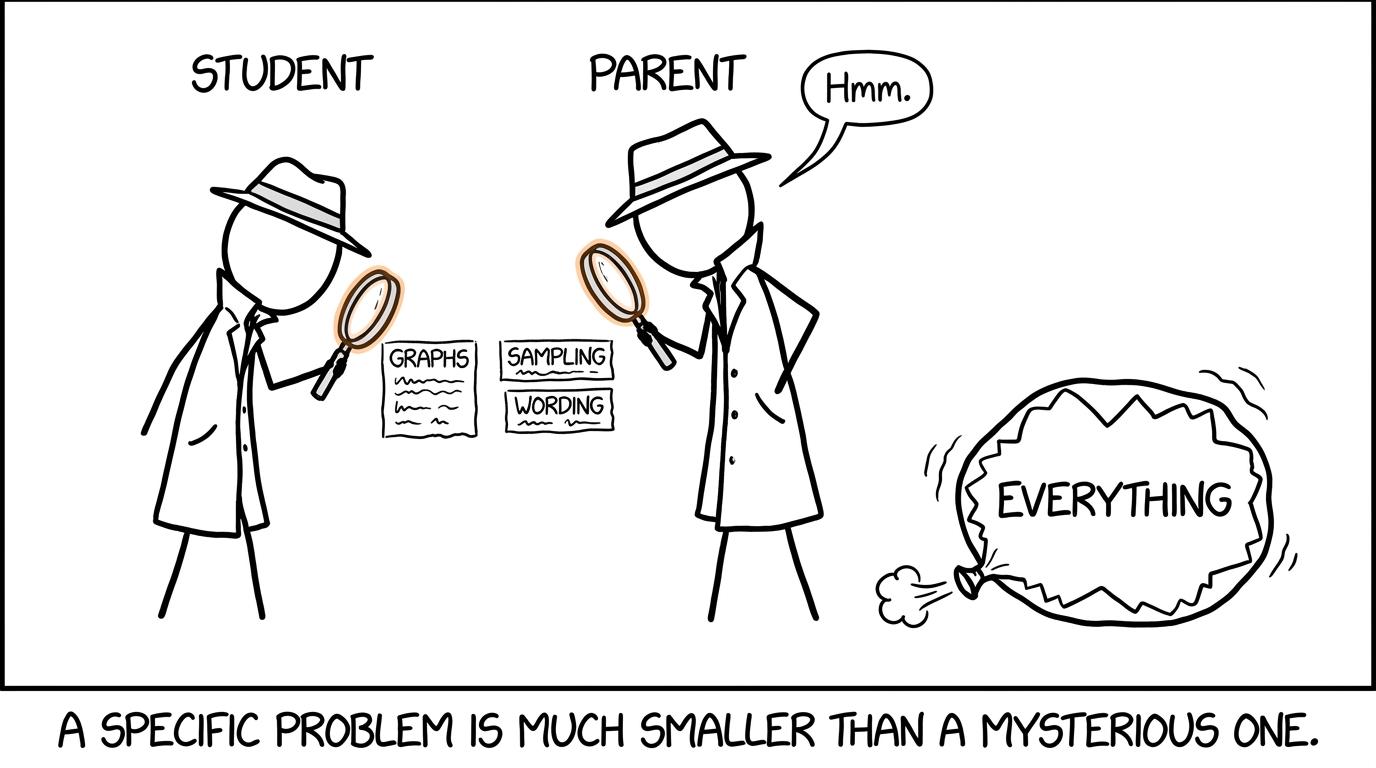 A student and parent investigate specific statistics problems while the monster called everything deflates
Ask for support that has a clear shape
“Help me revise” is difficult for any parent to act on. Instead, ask for something concrete that would make revision easier.
Useful requests might include:
- protecting two quiet revision periods each week;
- helping you contact your statistics teacher;
- checking that you start a planned session, without monitoring every question;
- printing a worksheet or past paper;
- helping you keep your phone elsewhere during a timed task;
- listening while you explain a topic in your own words;
- agreeing not to compare your marks with siblings or friends;
- reviewing the plan once a week rather than asking about revision every day.
Be clear about what does not help as well. You can say, calmly, “Frequent reminders make me panic and avoid starting. One check-in on Sunday would help more.” That is not refusing support. It is giving support better instructions.
Official UK health and education guidance consistently encourages realistic revision schedules, practical family support, open conversation and avoiding unnecessary criticism. It also advises involving school staff when a student needs more help. Your request is therefore reasonable: support should reduce confusion and pressure, not add to them.
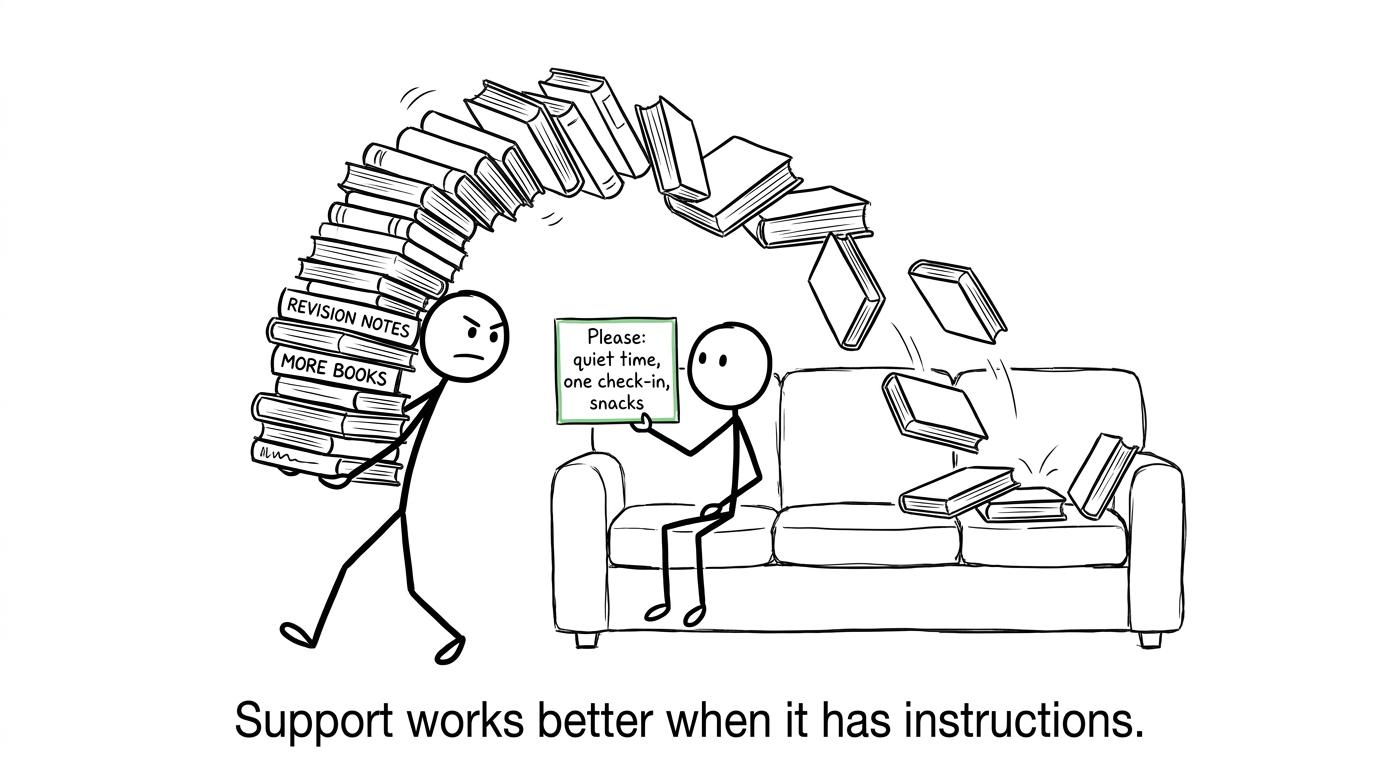 A student gives a parent a small instruction sign while an enormous pile of revision books topples away
Bring a small revision plan to the conversation
Parents are less likely to fill the silence with a lecture when they can see that you are taking the problem seriously. Your plan does not need to cover every week until the exam. Begin with the next seven days.
Choose two weak areas and use this cycle:
- review one revision lesson;
- answer focused practice questions without copying;
- check the mark scheme or solution;
- record the exact reason for each lost mark;
- try a different question on the same skill later;
- finish with a short mixed or timed task.
The guide to finding your weakest GCSE topics explains how to turn lost marks into precise revision priorities. If the whole timetable feels unmanageable, adapt the structure in the GCSE one-month revision plan rather than inventing an ambitious schedule from nothing.
Set a review point with your parents. At the end of the week, discuss whether you completed the planned sessions, whether the selected topics improved and whether the support at home was useful. Judge the plan by what you did and learnt, not by whether anxiety disappeared immediately.
What to do if the conversation starts becoming a lecture
A useful conversation can still wobble. Your parents may focus on missed revision, screen time or an earlier mark. Do not try to win every argument. Bring the discussion back to the purpose.
Try one of these responses:
“I understand why you are worried. Could we finish identifying the support I need before discussing everything else?”
“I am not asking you to ignore the mark. I am asking for help with the next step.”
“Can we choose one action for this week and review it afterwards?”
If emotions rise, suggest a pause and return at an agreed time. Pausing is different from walking away indefinitely. It protects the conversation from becoming something nobody intended.
If your parents dismiss the issue or you do not feel able to approach them safely, speak to another trusted adult. A statistics teacher, form tutor, head of year, pastoral lead or school counsellor may be able to help you explain the academic problem and organise appropriate support.
Common mistakes when talking about falling behind
Waiting until the night before an assessment
Urgency makes calm planning harder. Raise the issue when there is still time for topic practice, feedback and another attempt.
Making the problem sound universal
Phrases such as “I understand nothing” hide useful detail. Bring two or three examples of where marks are being lost.
Asking parents to solve the subject
Your parents do not need to know how every statistical method works. They can help create time, routines and communication with school while MathsGenie and your teacher provide subject guidance.
Promising an unrealistic transformation
A plan involving hours of revision every evening may reassure everyone for five minutes, then create another source of guilt. Choose repeatable sessions with clear tasks.
Measuring progress only through grades
A grade may take time to move. Earlier signs of progress include starting questions independently, recognising the correct method, improving explanations and making fewer repeated errors.
Hiding serious stress behind revision language
Exam nerves are common, but seek further help if anxiety or low mood is severe, persists or interferes with everyday life. Tell a trusted adult, your school or a health professional. Revision resources are valuable, but they are not a substitute for wellbeing support.
Turn one honest conversation into steady progress
Telling your parents that you are struggling can feel like making the problem official. In reality, the problem already exists; the conversation simply gives you more options.
Be specific. Ask to be heard before solutions are offered. Request practical support and bring a small plan that can be reviewed. You are not required to promise perfect marks or instant confidence. You are agreeing to take the next useful action.
Start with the MathsGenie GCSE Statistics hub. Choose the correct exam board, diagnose two weak topics and use the free revision lessons, practice questions, worksheets, mark schemes and video solutions to repair them. Then progress to mini tests, past papers and predicted papers when available. Put each task into your revision planner and show your parents the plan.
A difficult conversation becomes easier when it ends with something concrete: one topic, one session and one chance to improve.