

Can You Switch GCSE Modern Hebrew to Arabic?
Switch GCSE Modern Hebrew to Arabic mid-year with this practical guide to school approval, exam entries, course gaps, speaking tests and revision planning.
Changing a GCSE after the course has started can feel like changing trains after the doors have closed. You may know where you want to go, but there are timetables, tickets and other people involved.
The short answer is that it may be possible to switch GCSE Modern Hebrew to Arabic mid-year, but you cannot make the change alone. Your school must approve it, confirm that it can teach or support GCSE Arabic, arrange the correct exam entry and decide whether you can realistically catch up. The later in the course you ask, the harder the switch becomes.
This guide explains what the change actually involves, which questions to ask and how to protect the rest of your GCSE revision, especially maths, while catching up.
Mid-year switching checklist
Before leaving Modern Hebrew, confirm all of the following:
- Your school allows changes at this stage of the course.
- It can offer the correct GCSE Arabic specification.
- A suitable Arabic teacher or speaking-test conductor is available.
- The exams officer can enter you with the relevant exam board.
- You have enough Arabic knowledge to cover the missed content.
- Your foundation or higher tier entry is appropriate.
- Any late-entry cost or administrative restriction has been explained.
- Your new workload will not damage preparation for maths, English or science.
- You have completed a proper Arabic skills assessment rather than relying on conversational confidence.
- The change has been confirmed in writing by the school.
Until those points are settled, continue attending your current lessons and completing the work set. An informal conversation is not the same as an approved subject change.
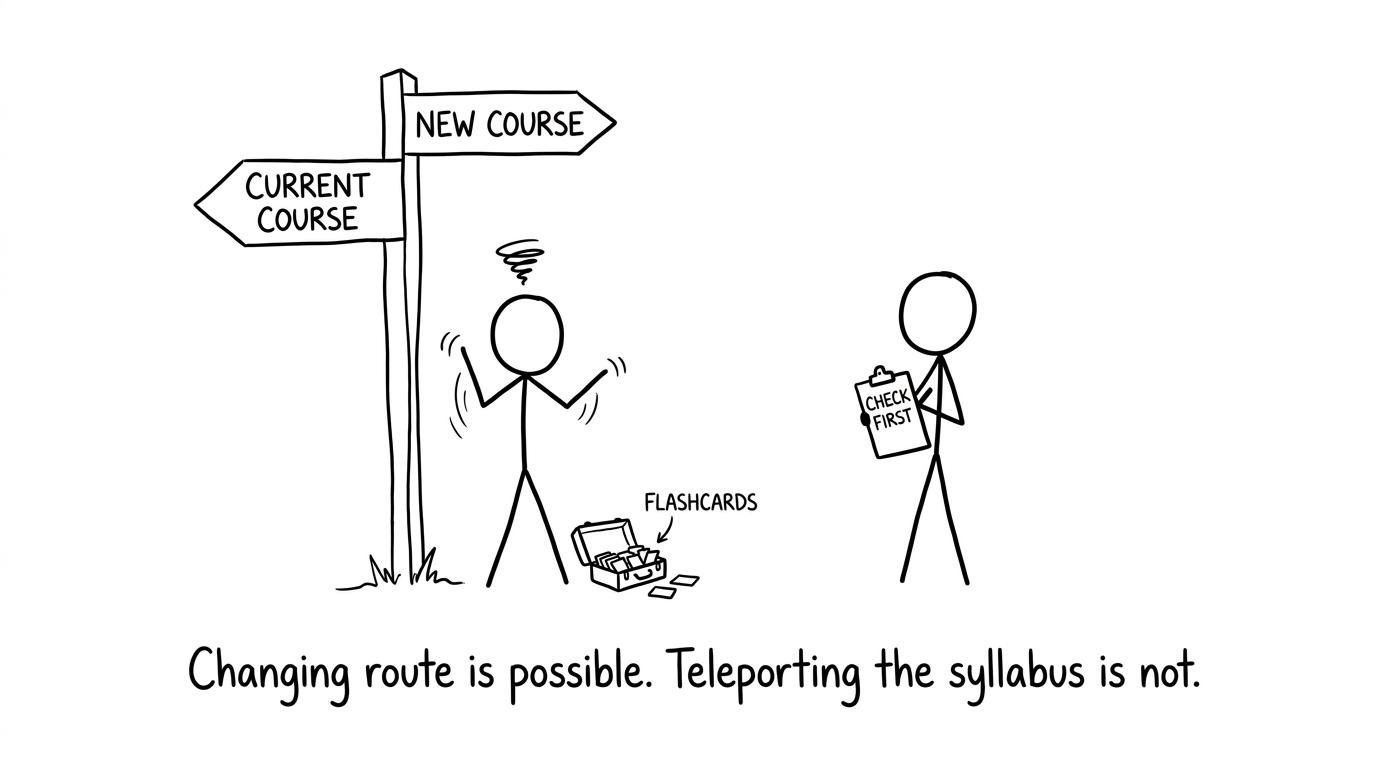 A student choosing between current and new GCSE course routes
Is switching GCSE languages legally or academically possible?
There is no general rule saying that every student has an automatic right to change GCSE subjects mid-year. Subject changes are normally decisions for the school, based on its curriculum, staffing, timetable and assessment arrangements.
That means the answer depends less on whether Arabic exists as a GCSE and more on whether your centre can deliver it properly.
GCSE Arabic is currently available through Pearson Edexcel under specification code 1AA0. GCSE Modern Hebrew is available through AQA under specification code 8678. Moving between them is therefore not merely changing language classes. It may also mean changing exam board, specification, entry code, teacher and assessment administration.
A school might approve the switch if it already teaches Arabic, has an appropriate teacher and believes you can close the knowledge gap. It may decline if Arabic clashes with another subject, no suitable speaking-test arrangements exist or too much content has already been missed.
If your school does not teach Arabic as an ordinary timetable subject, ask whether it supports heritage-language entries. Some centres enter students who learn a language outside school, but this is not guaranteed. The centre still has responsibilities for entries, identity checks, exam security and the speaking assessment.
What GCSE Arabic requires
Pearson Edexcel GCSE Arabic assesses four skills:
- listening;
- speaking;
- reading;
- writing.
Each contributes 25%25\%25% of the qualification. Students take all four components in the same examination series and must be entered for one tier across the entire qualification. Mixed-tier entry is not permitted.
Foundation tier is targeted at grades 111 to 555, while higher tier is targeted at grades 444 to 999. Choosing higher simply because you hope for a high grade is not enough. Your teacher needs evidence that you can manage the vocabulary, grammar, reading and independent written communication required.
The Arabic course covers themes including identity and culture, local area and travel, school, future study and work, and international issues. Knowing how to speak Arabic at home can be a major advantage, but it does not automatically provide exam readiness. You may still need to develop:
- accurate formal writing;
- knowledge of specification vocabulary;
- translation skills;
- understanding of standard spoken Arabic;
- responses that address every bullet point;
- familiarity with role-play and picture-based speaking tasks;
- control of grammar across different time frames.
Pearson states that there is no formal prior-learning requirement for GCSE Arabic. That makes entry technically accessible, but it does not make a late start easy. Exam feasibility and learning feasibility are different questions.
What transfers from GCSE Modern Hebrew?
Modern Hebrew and Arabic are distinct languages. Studying one does not remove the need to learn the vocabulary, grammar and assessment demands of the other.
Some broader language-learning habits may transfer. You may already understand how to build vocabulary systematically, prepare for an oral assessment, infer meaning while reading and structure longer written answers. Both courses assess listening, speaking, reading and writing, with each skill worth 25%25\%25%.
However, you should not assume that familiarity with a right-to-left writing system makes the academic switch small. You are changing the language itself, and potentially moving from AQA assessment conventions to Pearson Edexcel conventions. The themes may overlap, but the required words, structures and task details do not simply carry across.
Your first useful question is therefore not, “Which language do I prefer?” It is, “What can I already do in Arabic under GCSE exam conditions?”
What the school must arrange
A successful switch requires several people to agree on the practical details.
Curriculum approval
Your head of languages, subject lead or senior leader must decide whether the change is academically sensible. They may consider your current attainment, prior Arabic experience, attendance, timetable and the amount of content missed.
A diagnostic assessment
Ask for separate checks of listening, speaking, reading and writing. A student can speak confidently with family but find formal writing difficult; another may read accurately yet struggle to respond spontaneously.
The assessment should be matched to the intended tier and specification. Its purpose is not to catch you out. It is to reveal the size of the catch-up task before the decision becomes expensive or difficult to reverse.
Examination entry
The exams officer must enter you for the correct qualification and tier. Entry deadlines vary by examination series, and schools often set internal deadlines earlier than the awarding organisations.
For context, the standard entry deadline for the June 2026 GCSE series was 21 February 2026. That date should not be reused for another year without checking current JCQ and exam-board information. After the relevant deadline, amendments may involve late fees or additional restrictions. Ask your exams officer for the date applying to your own series.
Speaking assessment arrangements
The speaking component cannot be improvised privately. The centre needs an appropriate person to conduct it, suitable recording arrangements and a secure assessment process within the official window. Pearson externally assesses the recorded work, but the test is conducted by the centre.
This is often the decisive practical issue. A school may be willing to enter a written paper but unable to support the full language qualification unless it can conduct the speaking assessment correctly.
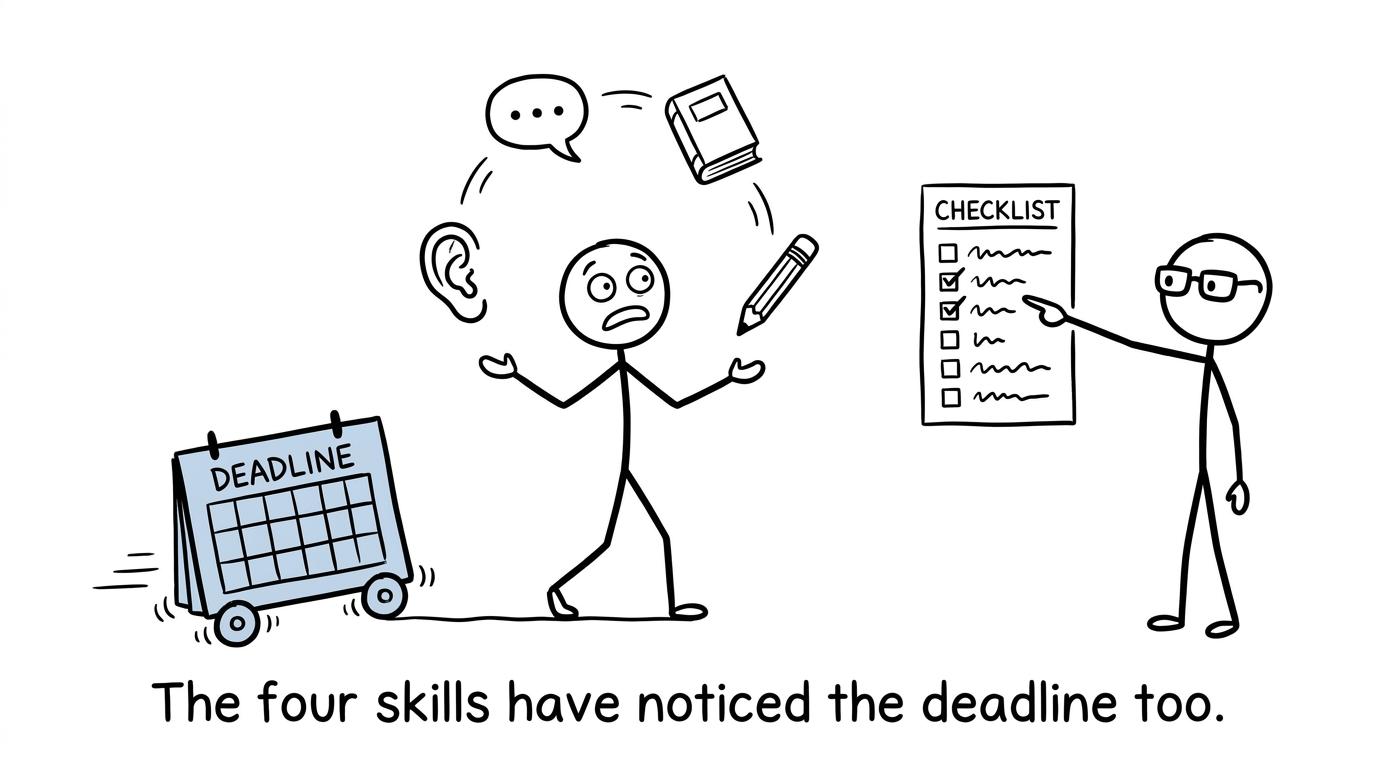 A GCSE student juggling the four language skills as a deadline approaches
When is the switch realistically manageable?
A change is more realistic when:
- you already read and write Arabic securely;
- you can understand standard spoken Arabic;
- your school already offers the qualification;
- a teacher can assess and supervise your progress;
- you are switching early enough to cover every theme;
- your other GCSE subjects are stable;
- you can follow a weekly catch-up timetable.
It becomes riskier when the decision is based only on finding Modern Hebrew difficult. A different language may feel more familiar, but GCSE assessment exposes gaps that ordinary conversation can hide.
Timing matters too. A switch during the first term of Year 10 is very different from one made shortly before the speaking assessment in Year 11. The nearer you are to the examination entry deadline and speaking window, the more likely administration and preparation will become obstacles.
Build a catch-up plan without sacrificing maths
A subject switch creates an obvious temptation: give every spare hour to Arabic until the backlog disappears. The problem is that GCSE maths knowledge also fades when practice stops.
Start with a weekly plan that separates Arabic catch-up into the four assessed skills. Give each session one purpose, such as vocabulary retrieval, listening practice, writing feedback or speaking preparation. Then protect several short maths sessions rather than relying on one long weekend block.
The GCSE maths revision hub gives you free revision lessons, exam questions, flashcards and board-specific materials. On busy days, the 20-minute GCSE maths revision routine can help you keep mathematical methods active while Arabic receives extra attention.
A sensible pattern is:
- schedule Arabic catch-up around the four language skills;
- keep maths practice short, regular and specific;
- use one weekly maths mini test to detect slipping topics;
- mark everything immediately;
- review the timetable with both teachers after two or three weeks.
For a fuller structure, use the GCSE maths revision timetable guide. If you take Edexcel maths, the GCSE maths mini tests are useful when a complete paper would take too much time.
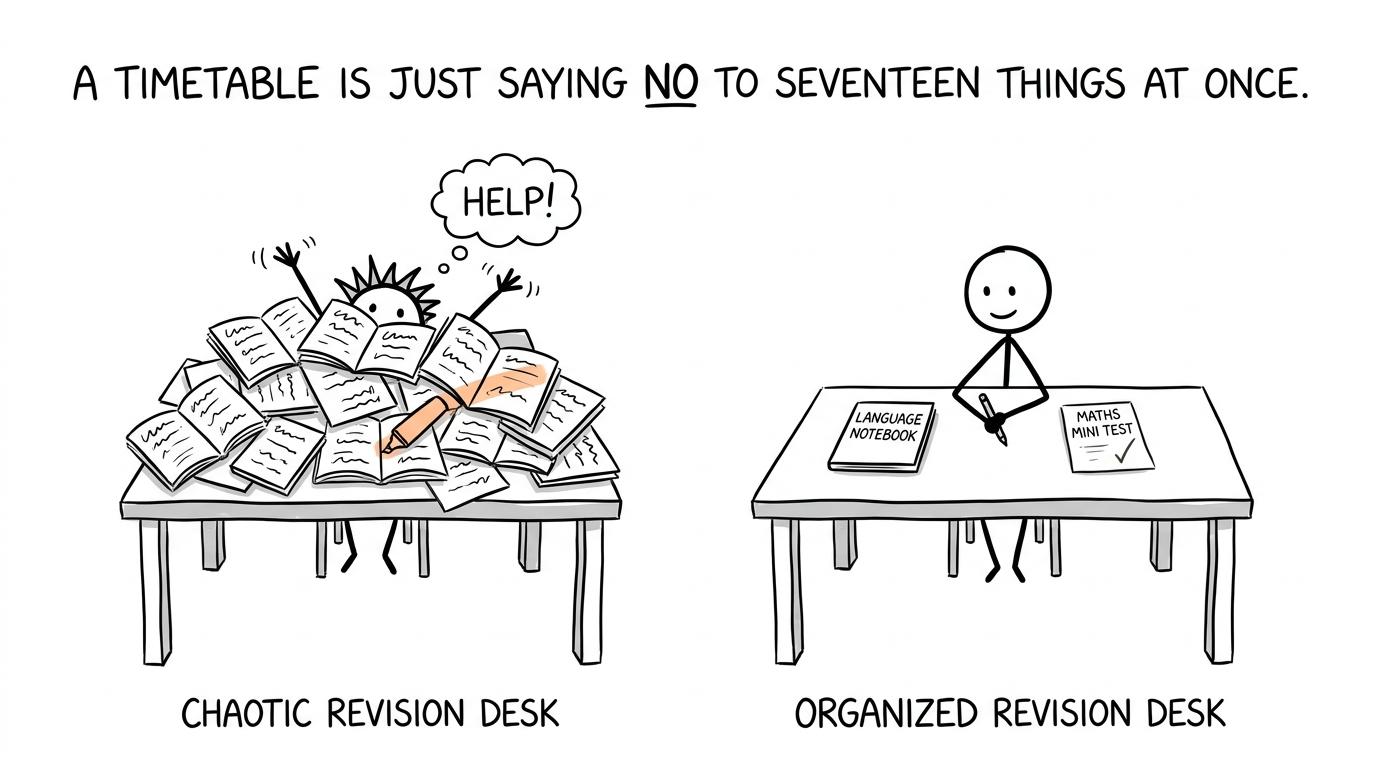 One calm revision desk beside another buried under too many books
A clear decision process
Ask your languages teacher for a meeting involving the examinations officer where necessary. Bring a short written list of questions:
- Which Arabic specification would I take?
- Can the school conduct the speaking assessment?
- Which tier would be appropriate?
- How much content have I missed?
- Who will mark my speaking and writing practice?
- What is the school's internal entry deadline?
- Are there late-entry or tuition costs?
- What happens if the diagnostic assessment shows large gaps?
- Can I return to Modern Hebrew if the trial period is unsuccessful?
If the school proposes a trial, agree on measurable conditions. These might include completing specified topics, submitting regular writing, attending support sessions and taking a timed assessment by a fixed date.
A decision built on evidence may feel slower than a quick yes, but it is safer. You need to know not only that entry is possible, but that success is plausible.
Common mistakes when changing language GCSE
Dropping Modern Hebrew before approval
Keep following your existing course until the school confirms the change. Otherwise, you could create gaps in both subjects.
Treating home fluency as complete preparation
Conversational Arabic is valuable, but the GCSE also tests formal reading, accurate writing, translation and performance under timed conditions.
Ignoring the speaking assessment
The oral component is a quarter of the qualification and requires proper centre arrangements. Confirm this before investing months in catch-up work.
Assuming the tier can vary by paper
GCSE Arabic candidates must use one tier across all four papers. Your entry decision needs to reflect your overall profile, not just your strongest skill.
Forgetting the rest of the GCSE timetable
Arabic catch-up should not quietly consume maths revision. Continue using targeted practice and then return to timed papers. MathsGenie's Edexcel GCSE maths past papers include mark schemes and solutions, while the GCSE predicted papers provide fresh exam-style practice nearer the examination period.
Waiting for an informal promise
A teacher saying that the switch “should be fine” is not final confirmation. Check the specification, entry, tier, speaking arrangements and timetable in writing.
Make the decision with evidence, not panic
It can be possible to switch from GCSE Modern Hebrew to GCSE Arabic mid-year. What makes it possible is not enthusiasm alone. It takes school approval, a capable examination centre, secure speaking arrangements, the correct entry, an honest assessment of your Arabic and enough protected time to catch up.
If those pieces are in place, build a precise plan and review it regularly. If they are not, staying with Modern Hebrew may be the more reliable route, even if Arabic feels more familiar outside the classroom.
Whichever decision your school reaches, keep the rest of your revision steady. Start at the MathsGenie GCSE hub, learn weak topics through free revision lessons, practise with exam questions and mini tests, and build towards past papers and predicted papers. Use the mark schemes and video solutions to turn each mistake into a clear next action. A course change creates uncertainty; a repeatable revision routine gives you some control back.











