

Switch Exam Board GCSE Arabic: What Happens?
Switch exam board GCSE Arabic with confidence: learn what schools can change, what may differ, and how to rebuild your revision plan without panic mid-course.
A course can feel solid until one announcement changes the map. Your teacher says the school may use a different qualification, familiar resources suddenly look uncertain, and the first thought is often: does all my previous revision still count?
If your school plans to switch exam board GCSE Arabic partway through the course, the short answer is that an administrative change may be possible before final entries and assessments. However, the school must have a suitable current qualification to move to, become approved where necessary, meet the new awarding organisation's requirements and enter every student correctly. Students cannot change boards simply by choosing a different paper on exam day.
There is an important detail here. Current qualification information identifies Pearson Edexcel's GCSE Arabic as the established GCSE Arabic specification in England. A proposed move described informally as an "exam board switch" may therefore be a change between GCSE Arabic and an International GCSE or another type of qualification. Your school should tell you the exact qualification title and specification code, not merely the name of a board.
Your immediate checklist
Before changing how you revise, ask your teacher or exams officer for:
- the full name and specification code of the old qualification
- the full name and specification code of the new qualification
- confirmation of whether it is a GCSE or International GCSE
- the examination series in which you will be entered
- the papers, skills and assessment tasks you will complete
- your Foundation or Higher tier, if the new qualification is tiered
- the speaking assessment format and window
- a topic, vocabulary and grammar comparison
- new specimen papers, past papers and mark schemes
- confirmation that any access arrangements remain correctly recorded
Do not rely on rumours between lessons. One precise page from the new specification is more useful than ten anxious conversations.
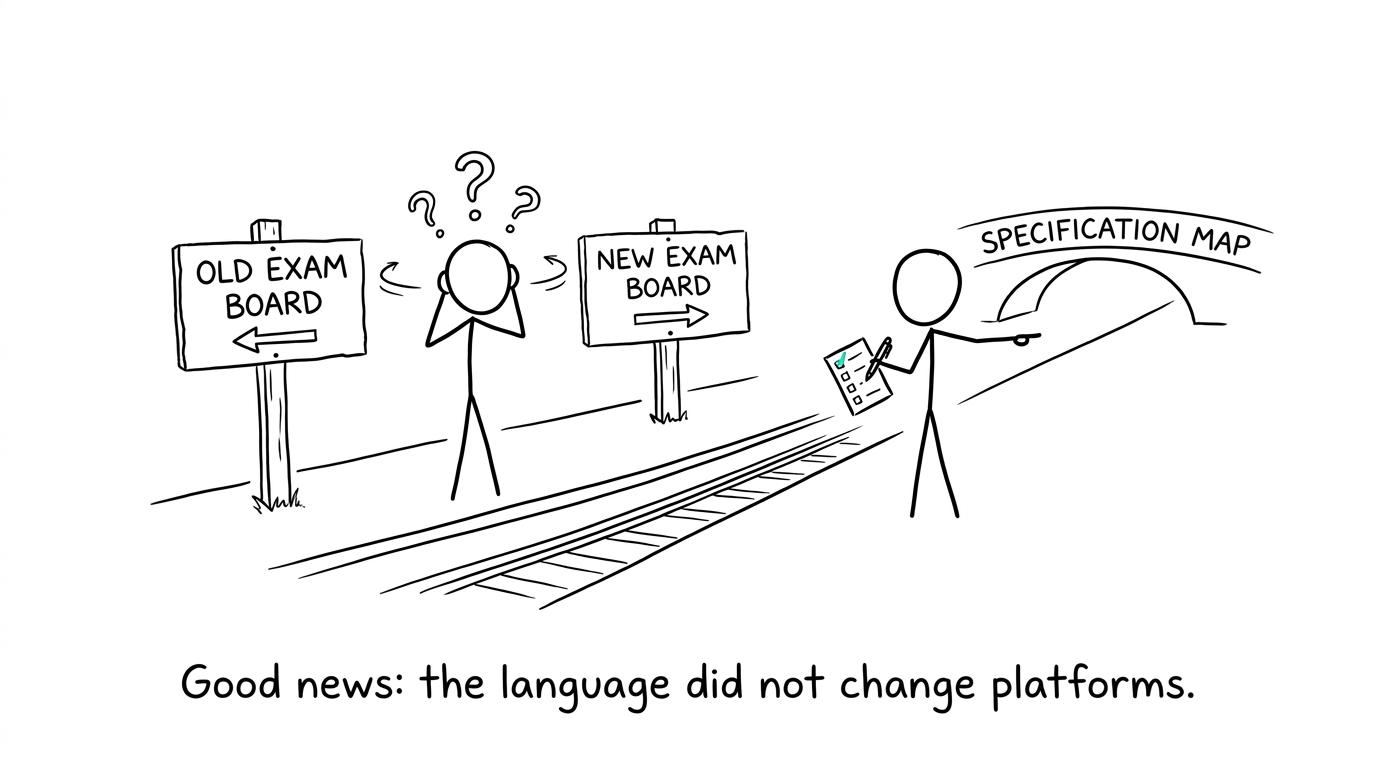 A student choosing between old and new exam-board platforms while a teacher points towards a specification map
Can a school switch GCSE Arabic exam board mid-course?
In principle, a school can change the qualification it intends to enter before the relevant administrative deadlines, provided the replacement qualification is available and the centre can deliver it properly. In practice, the later the decision is made, the more difficult and potentially costly it becomes.
The school must consider far more than whether the subject is still called Arabic. It may need to arrange centre approval, train teachers, obtain secure speaking materials, change entries, check timetable implications and provide suitable preparation for a different assessment model. Late entries or amendments can also attract fees. Exact dates and procedures depend on the examination series and awarding organisation, so the school's exams officer must check the current official guidance.
If entries have already been submitted, they may sometimes be amended before the awarding organisation's final cut-off. That does not make the change automatic. Once a speaking assessment has been taken, secure materials have been opened or an assessment window has begun, the situation can become substantially more complicated.
The decision belongs to the school or registered examination centre because it is the centre that enters candidates. You should still be told promptly and given a reasonable transition plan.
Check whether the qualification itself is changing
"Changing boards" and "changing qualifications" are not always the same thing.
Pearson Edexcel's current GCSE Arabic specification has four compulsory externally assessed components: listening, speaking, reading and writing. Each skill contributes an equal share of the qualification. The papers are available at Foundation and Higher tier, and a candidate must be entered for the same tier across all four components. The speaking assessment is conducted at the centre and externally marked.
A different Arabic qualification may organise those skills differently. It could have three papers rather than four, combine reading and writing, use different speaking tasks, remove tiering or assess a different vocabulary framework. International GCSE and GCSE are distinct qualification routes even when both use grades 9-1.
Ask your school to clarify:
- Is the replacement regulated and recognised for the purpose for which you need it?
- Does it use grades 9-1?
- Is it tiered?
- Are all assessments taken in the same examination series?
- How is speaking recorded, submitted and marked?
- Are dictionaries permitted in any component?
- Which past papers genuinely match the new specification?
That last question matters. A paper with "Arabic" on the cover is not automatically suitable practice.
What changes for your revision?
The comforting part is that your Arabic has not disappeared. Reading fluency, accurate grammar, pronunciation, listening comprehension and the ability to communicate ideas remain valuable. What changes is the route by which those skills earn marks.
Think of the transition as a gap analysis, not a complete restart.
Compare content
Your teacher should map the themes, subtopics, vocabulary and grammatical structures from the old course against the new specification. Divide them into three groups:
- content appearing in both specifications
- familiar content assessed in a different way
- genuinely new content
Keep revising the first group, adapt your technique for the second and prioritise teaching time for the third. This prevents students from spending weeks relearning material they already know.
Compare question types
A change in question style can matter as much as a change in content. Check whether the new papers use role play, picture-based discussion, translation, extended writing, short responses, multiple-choice questions or questions written in Arabic.
Then inspect the mark schemes. They reveal whether marks depend mainly on communication, accuracy, range of language, pronunciation, interaction or coverage of required details. Revision should reflect what the new assessment rewards.
Replace resources carefully
Old resources remain useful when they develop transferable language skills, but they should no longer control your final exam practice. Label folders and digital files clearly with the qualification and specification they match. Use the new specification's sample assessment materials first, followed by relevant past papers and official mark schemes.
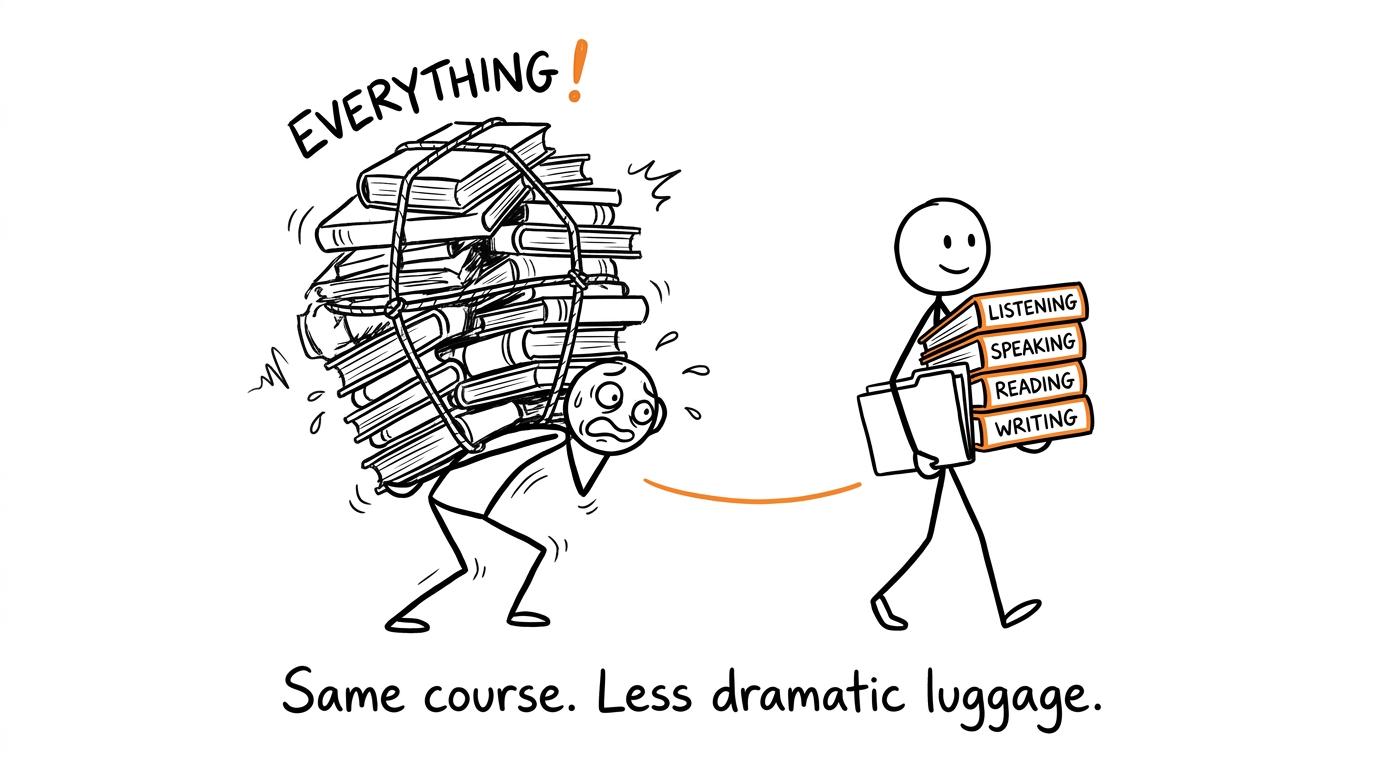 One student carrying everything while another organises revision into four manageable skill folders
Build a transition plan without abandoning maths
A late course change can absorb every spare evening. That is risky if you are also preparing for GCSE maths, English and science. The answer is not to give Arabic unlimited time; it is to make the extra work visible and contained.
For the first week, concentrate on diagnosis. Obtain the new specification, identify unfamiliar tasks and complete a short baseline activity for each assessed skill. From the second week, use brief, repeated sessions to close the most important gaps. Include at least one timed task each week once the format is familiar.
Keep your maths revision running alongside this plan. The GCSE Maths Revision hub organises free lessons and exam questions so you can maintain progress without creating another complicated system. A short session from the GCSE mini tests collection can protect maths fluency during a busy transition week.
The same feedback loop works in both subjects:
- attempt a task without notes
- mark it using the correct mark scheme
- identify the precise reason marks were lost
- revise that weakness
- retest it with a different question
The guide to using GCSE past papers properly explains why completing paper after paper is less effective than marking, fixing and retesting. If the board change exposes many gaps at once, use the method in finding your weakest GCSE topics to decide what deserves attention first.
What your school should provide
A responsible transition should include more than a new textbook. Students need clear written information, teaching that addresses specification gaps and access to the correct assessment materials.
Your school should explain why the change is happening, what has changed, what has stayed the same and how missed content will be taught. It should also confirm entries, tiers and speaking arrangements through the exams officer.
If you have approved access arrangements, ask for confirmation that they have been considered for every relevant component. Do not assume arrangements move automatically between qualifications or assessment formats.
Students should also be given realistic practice with the new timing and instructions. Teachers may need to run a revised mock assessment, particularly where speaking tasks or paper structures differ significantly.
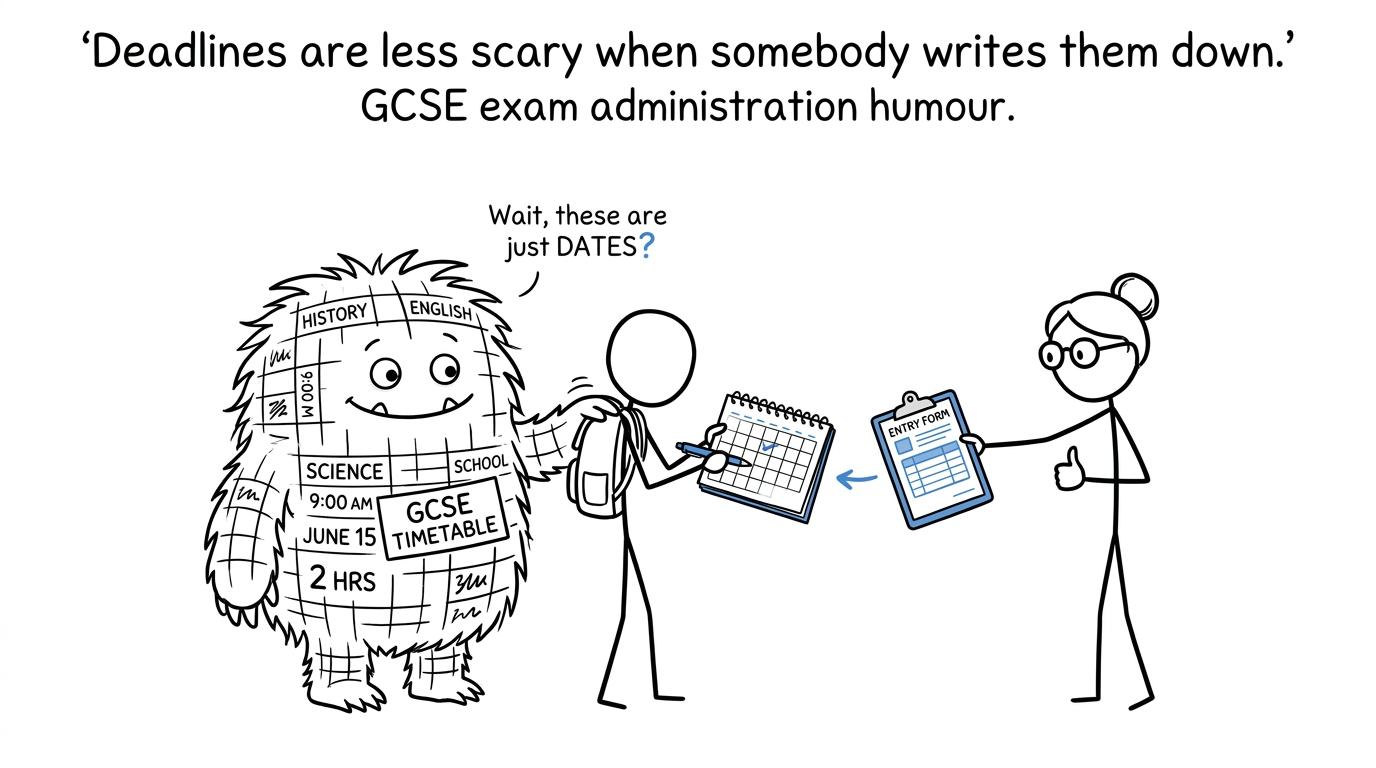 A student and teacher calmly taming a deadline monster with a calendar and entry form
Common mistakes after an exam board change
Assuming the syllabus is basically identical
Shared language skills do not guarantee identical themes, vocabulary lists or tasks. Compare the actual specifications line by line.
Revising from the wrong past papers
Old-board papers can support general language practice, but they should not be used to predict the exact structure or timing of the new examination.
Ignoring speaking until the written exams approach
Speaking assessments commonly take place before the main summer written papers. Confirm the window immediately and practise the precise task format early.
Confusing GCSE with International GCSE
These are different qualifications with potentially different structures and administrative arrangements. Always use the complete title and specification code.
Trying to relearn the entire course
Most language knowledge remains transferable. Focus on missing content and altered assessment demands rather than restarting every topic.
Letting other subjects disappear
A board change feels urgent, but your other GCSEs still matter. If maths has slipped, follow a manageable one-month GCSE maths revision plan or use the best order for learning GCSE maths topics to rebuild momentum systematically.
A change of map is not a loss of progress
An exam board or qualification change is unsettling because the destination looks less familiar. Yet much of the journey remains intact. The vocabulary you can recall, the passages you can understand and the ideas you can express are still yours.
Your next step is simple: obtain the exact new specification, confirm the assessment and entry details, map the gaps and revise from materials that genuinely match the paper you will sit. Ask questions early, especially about speaking arrangements, tiering and deadlines.
Then keep the rest of your revision steady. MathsGenie gives you a free base for GCSE and A Level maths revision, with revision lessons, practice questions, mini tests, past papers, predicted papers, mark schemes and video solutions. Use that structure to protect your maths progress while your school guides you through the Arabic transition. A changed plan is manageable when every next action is clear.










