Structure Question English Language GCSE Guide
Structure question English Language guidance made simple: learn shifts in focus, openings and endings with an original extract and clear model answer.
A structure question can feel vague because you are being asked to explain something you cannot underline as easily as a simile. You can see individual words. Structure, however, is the movement behind them.
For a structure question in English Language, track where the reader's attention begins, how it moves and where it finishes. Then explain why the writer has organised the text in that order. You are not searching for every technique. You are following the writer's decisions across the extract.
This guide explains how to analyse structure at GCSE, with particular attention to shifts in focus, openings and endings. It also includes an original extract and a complete model answer suitable for a resit student.
Structure question checklist
Before writing, identify these four things:
- Opening: What does the writer show us first?
- Focus shifts: Where does our attention move next?
- Development: Does the pace, time, perspective or level of tension change?
- Ending: What final image, discovery or unanswered question remains?
Your answer should name a structural choice, use brief evidence and explain its effect in the context of the whole text.
The official AQA assessment objective, AO2, requires students to explain, comment on and analyse how writers use language and structure to achieve effects and influence readers. On AQA Paper 1, the structure question is worth 8 marks. Other exam boards use different questions and mark totals, so check the wording on your paper carefully.
You can find resources for AQA, Edexcel, Eduqas, OCR and WJEC through the GCSE English Language revision hub. If you are sitting AQA, use the dedicated AQA English Language revision page.
What structure means in GCSE English Language
Structure is the order and arrangement of information. Imagine that the writer controls a camera. They decide where it points, when it moves and what it refuses to show.
Useful structural features include:
- a wide opening focus on a place
- a shift from setting to character
- a movement from outside to inside
- a change in time, such as a flashback
- a change of narrative perspective
- information being delayed or withheld
- a quickening or slowing pace
- a contrast between opening and ending
- a cyclical ending that returns to the beginning
- a final revelation or unresolved question
The feature alone earns little credit. The important part is explaining what the movement does. A shift from an empty street to one trembling hand might narrow the reader's attention towards a character's fear. A peaceful opening followed by a sudden interruption might make the change feel more alarming.
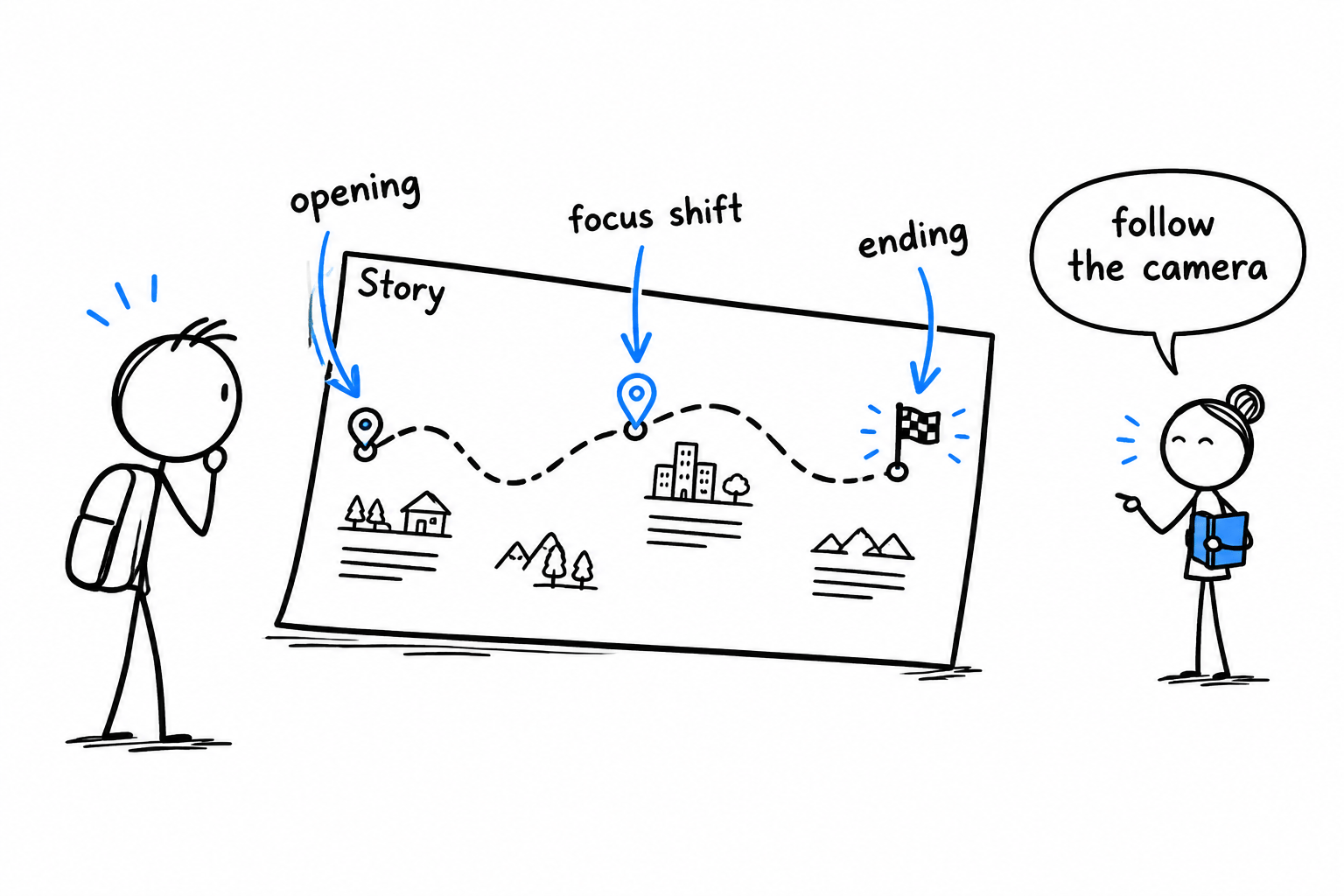 A stick figure uses a story like a confusing sat-nav while a calm teacher suggests following the camera
How to analyse structure GCSE answers clearly
A reliable paragraph follows three connected steps:
- Identify where you are in the extract.
- Describe how the focus or pace changes.
- Explain the effect created by that change.
A useful sentence pattern is:
At the beginning, the writer focuses on... This establishes... Later, the focus shifts to... This changes the reader's understanding because...
Do not treat this as a rigid formula. Its purpose is to keep your explanation attached to the text's movement.
Try to cover more than one part of the source. An answer that only examines the opening cannot explain how the extract develops. Moving through the beginning, middle and ending usually gives you a clearer view of the writer's design.
Understanding openings and endings
What does the opening establish?
An opening controls our first assumptions. A writer might begin with the setting to establish atmosphere, with a character to create immediate interest, or in the middle of an event to create urgency.
Ask:
- Is the first focus broad or narrow?
- What information is initially withheld?
- Does the situation appear calm, dangerous or uncertain?
- What expectations does the opening create?
Why does the ending matter?
The ending is the last information the writer chooses to give us. It can resolve a problem, reveal something new, return to an earlier image or leave uncertainty behind.
Compare it with the opening. If a busy family home becomes silent and abandoned, the contrast may emphasise loss. If the final sentence repeats an image from the first paragraph, the cyclical structure might suggest that nothing has truly changed.
Avoid claiming that every repeated idea is cyclical. A genuinely cyclical structure returns clearly to an important element of the opening.
Original extract for structure practice
Read this original extract, in which Mara is waiting at a rural railway station:
At twenty minutes to six, Bracken Station seemed to belong only to the rain. Water silvered the empty tracks, gathered beneath the benches and ran in thin streams from the ticket-office roof. The clock above platform two had stopped.
Mara came through the gate carrying a small red suitcase. She checked the silent clock, then her phone, then the handwritten label tied to the suitcase handle. The name on the label was not hers.
Across the tracks, something moved behind the dusty window of the signal box. Mara looked up. For a moment, she saw the outline of a person standing perfectly still. Then the light inside went out.
The rails began to hum. A white glow appeared beyond the bend and spread across the wet platform. The train rushed in. Brakes screamed. Doors opened.
Mara entered the nearest carriage and placed the red suitcase on the luggage rack. Only then did she notice the other case waiting there. Same size. Same colour. This one carried a label with her name on it.
A suitable question would be:
How has the writer structured the text to create a sense of unease?
Model answer: shifts in focus, opening and ending
At the beginning, the writer uses a wide focus on the deserted station rather than introducing Mara immediately. Details such as the “empty tracks” and the stopped clock establish isolation and stillness. This makes the setting appear abandoned, creating unease before the reader knows who will arrive or what will happen there.
The focus then narrows from the station to Mara and, more specifically, to the suitcase label. The information that the name “was not hers” is placed at the end of the second paragraph, delaying an explanation and introducing a mystery. The focus subsequently shifts away from Mara to the signal box across the tracks. This movement makes the reader look beyond the character towards a possible watcher. However, the figure disappears when the light goes out, so the writer withholds confirmation and leaves both Mara and the reader uncertain.
Near the end, the pace quickens as the train approaches. The movement from the earlier stillness to the rapid sequence “Brakes screamed. Doors opened” signals that the situation is changing and builds anticipation. The final focus is inside the carriage, where the second red suitcase is revealed. This ending connects with the earlier label but reverses the mystery: Mara has brought somebody else's case, while her own appears to be waiting for her. Ending on this discovery provides no explanation and therefore leaves the reader questioning who arranged the exchange and whether Mara is being watched.
Why the model answer works
The answer follows the extract instead of listing disconnected techniques. It discusses the wide opening, the narrowing focus, the movement towards a possible observer, the faster arrival of the train and the final revelation.
It also explains effects precisely. Rather than repeatedly saying the reader wants to continue reading, it identifies isolation, uncertainty, anticipation and unanswered questions. These effects are connected to particular structural decisions.
Notice that the quotations are short. Structure analysis does not require copying whole sentences. Evidence simply helps the examiner locate the moment being discussed.
Language and structure are not the same
Language analysis examines the writer's choices within the words and phrases. You might analyse imagery, verbs, adjectives or personification.
Structure analysis asks why information appears where it does. For example, “Brakes screamed” contains personification, which is a language point. In a structure answer, the more useful observation is that short statements appear as the train arrives, increasing the pace after the slow opening.
Sentence length can be relevant, but only when you connect it to the organisation or development of the wider text. Keep returning to position, movement and change.
Common mistakes in structure answers
Listing techniques without effects
Spotting a focus shift is only the beginning. Explain what the new focus makes the reader notice and why that matters at that moment.
Retelling the events
A summary says that Mara arrives, sees a figure and boards a train. Analysis explains why the writer moves from an empty setting to Mara, then away from her towards a watcher.
Writing only about language
Do not spend the answer analysing metaphors or individual adjectives. Concentrate on where details are placed and how the text develops.
Ignoring the ending
The final line often changes our understanding of what came before. Leave enough time to compare the ending with the opening or earlier information.
Using vague effects
“The reader wants to read on” rarely explains enough. State whether the writer creates suspicion, surprise, urgency, sympathy or uncertainty, and explain how.
Practising for a resit
Resit revision becomes more useful when each attempt has a specific purpose. First, annotate an extract only for changes in focus. Next, write one paragraph about its opening and one about its ending. Finally, complete the question under timed conditions.
Use AQA English Language past papers and mark schemes to see authentic question formats. The guide to using AQA English Language past papers properly can help you turn each paper into a cycle of attempting, marking and improving.
You can also create your own GCSE English Language practice questions from short extracts. This trains you to recognise structural decisions rather than memorise one model response.
A structure question is not asking you to discover a secret technical term. It is asking you to notice the journey the writer designed for the reader. Start with the opening, follow every meaningful shift and inspect what the ending leaves behind. Then use MathsGenie's free revision resources, practice questions, past papers and mark schemes to repeat that process until it feels familiar.