Make Own GCSE English Language Practice Questions
Make own GCSE English Language practice questions from your notes, match your exam board and assessment objectives, then build smarter revision habits.
A page of English Language notes can feel reassuring. The headings are neat, the techniques are highlighted, and nothing seems unfamiliar. Then an unseen extract appears in the exam and recognition is no longer enough.
So, is it worth trying to make own GCSE English Language practice questions? Yes, provided that you use them alongside official past papers rather than as a replacement. Writing a question forces you to decide what a text reveals, which assessment objective is being tested and what a strong answer would need to include. That thinking can teach you almost as much as answering the question.
The process is especially useful for students who already use question-led revision in maths. You are applying the same underlying habit: turn notes into a task, attempt the task, check the result and repair the gap.
The short answer and your checklist
Making your own questions is worthwhile when you:
- confirm your exam board and current specification;
- copy the style, not the exact content, of official questions;
- connect each question to the correct assessment objective;
- use a suitable unseen fiction or non-fiction extract;
- write a brief answer checklist before attempting it;
- compare your wording with official past papers and mark schemes;
- ask a teacher to check a small sample when possible;
- continue completing genuine exam-board papers under timed conditions.
Unlike GCSE maths, GCSE English Language is not divided into foundation and higher tiers. However, AQA, Pearson Edexcel, OCR and Eduqas do use different paper structures, source combinations, mark totals and question wording. A homemade question must therefore match your board.
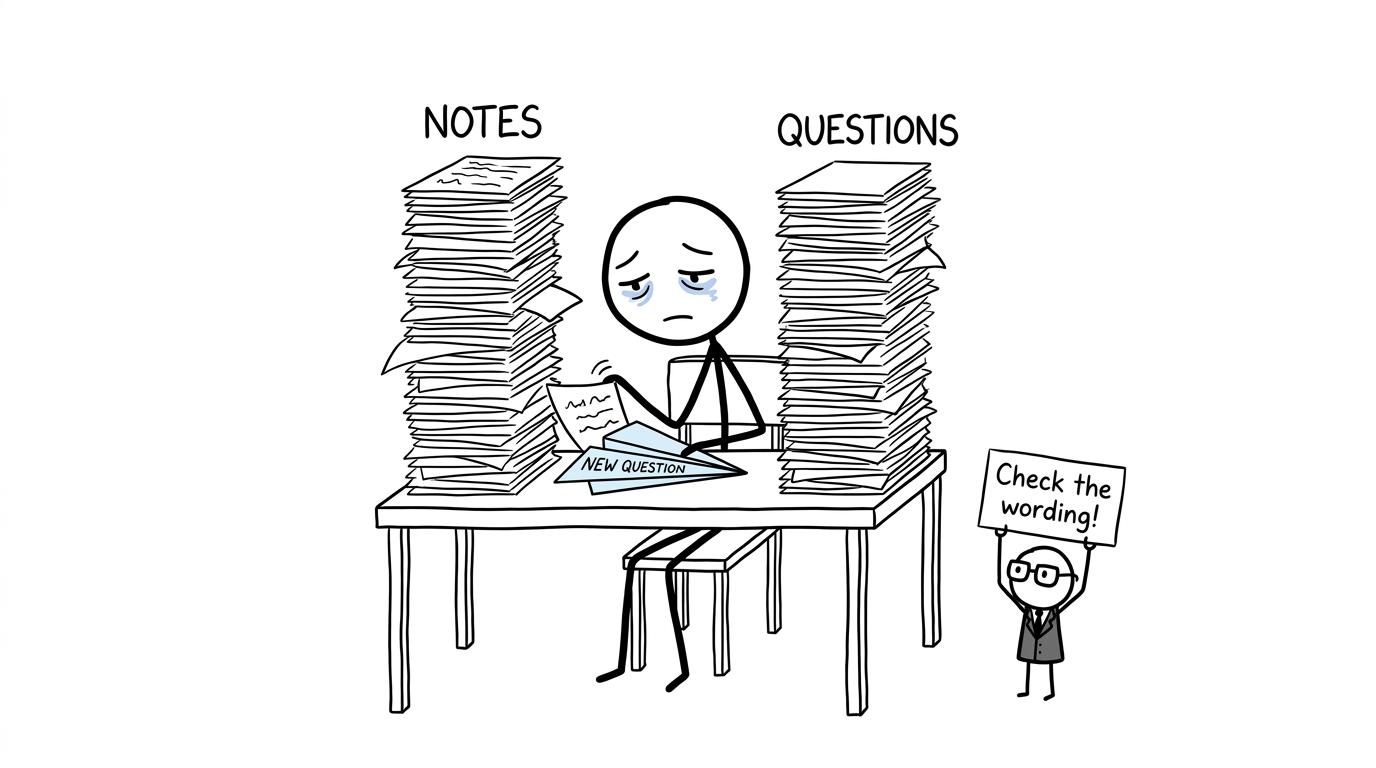 A student turns a tower of notes into a new practice question
Why writing questions changes how you read
Answering a question asks, “What can I say?” Writing one asks a more revealing question: “What is actually worth noticing here?”
Suppose your notes list language methods, structural choices, inference, comparison and evaluation. It is easy to reread those labels without testing whether you can recognise them in an unseen text. To create a useful question, you must inspect the extract and decide which skill it can genuinely support.
That makes you read with more purpose. You begin noticing whether:
- an idea is explicit or implied;
- a quotation contains enough detail to analyse;
- the focus changes across the extract;
- two writers offer meaningfully different perspectives;
- a judgement can be supported with textual evidence;
- a writing prompt establishes a clear form, purpose and audience.
There is another benefit. Question writing exposes vague notes. If a page says only “analyse language”, you may struggle to turn it into a precise task. That struggle is useful feedback: the note needs to explain what analysis involves, such as selecting evidence, examining choices and connecting those choices to effects or meanings.
Start with the assessment objective, not a clever idea
GCSE English Language reading and writing are assessed through common regulated objectives. Broadly, AO1 covers identifying, interpreting and synthesising information; AO2 covers analysing language and structure; AO3 covers comparison; AO4 covers critical evaluation; AO5 covers effective communication and organisation; and AO6 covers vocabulary, sentence structures, spelling and punctuation.
The exact distribution across questions depends on the exam board. This is why an imaginative question is not automatically an exam-style question.
Start by writing one assessment objective at the top of the page. Then ask:
- AO1: Does the source contain clear information or reasonable implications to identify?
- AO2: Are there meaningful language or structural choices to analyse?
- AO3: Do the two sources provide perspectives that can genuinely be compared?
- AO4: Can a student form and support a critical judgement?
- AO5 and AO6: Does the prompt make its purpose, audience and form clear enough for sustained writing?
Do not try to test everything at once. Official questions usually have a controlled focus. Your homemade version should do the same.
How to turn GCSE English Language notes into questions
Select one small section of your notes
Choose a single skill rather than an entire paper. Good starting points include inference, language analysis, structure, comparison, evaluation, descriptive writing or viewpoint writing.
Rewrite the note as a practical success checklist. For language analysis, that checklist might require relevant evidence, close attention to words or phrases, accurate terminology where useful, and a developed explanation of meaning or effect.
You have now moved from “content I have seen” to “performance I can check”.
Find an appropriate source
Use a short extract that gives the chosen skill room to operate. Fiction may support atmosphere, characterisation and structural movement. Journalism, letters, speeches, essays or travel writing may support viewpoints, comparison and persuasive writing.
Respect copyright and use material you are permitted to access. You do not need to reproduce or distribute an entire published text to create private revision notes. If your teacher has supplied an extract, follow the school’s instructions for using it.
Keep the source manageable. A long extract can turn a focused revision task into a reading-endurance exercise.
Borrow the grammar of official questions
Open a specimen or past paper from your own exam board and study how its questions are built. Look for:
- the command word;
- the lines or source section named;
- whether one or two texts are required;
- the stated focus;
- the form, audience and purpose of a writing task;
- the number of marks and expected breadth.
Then create fresh wording around your chosen source. Do not guess the marks merely because a question looks difficult. Match the mark value and wording pattern used for that question type by your board.
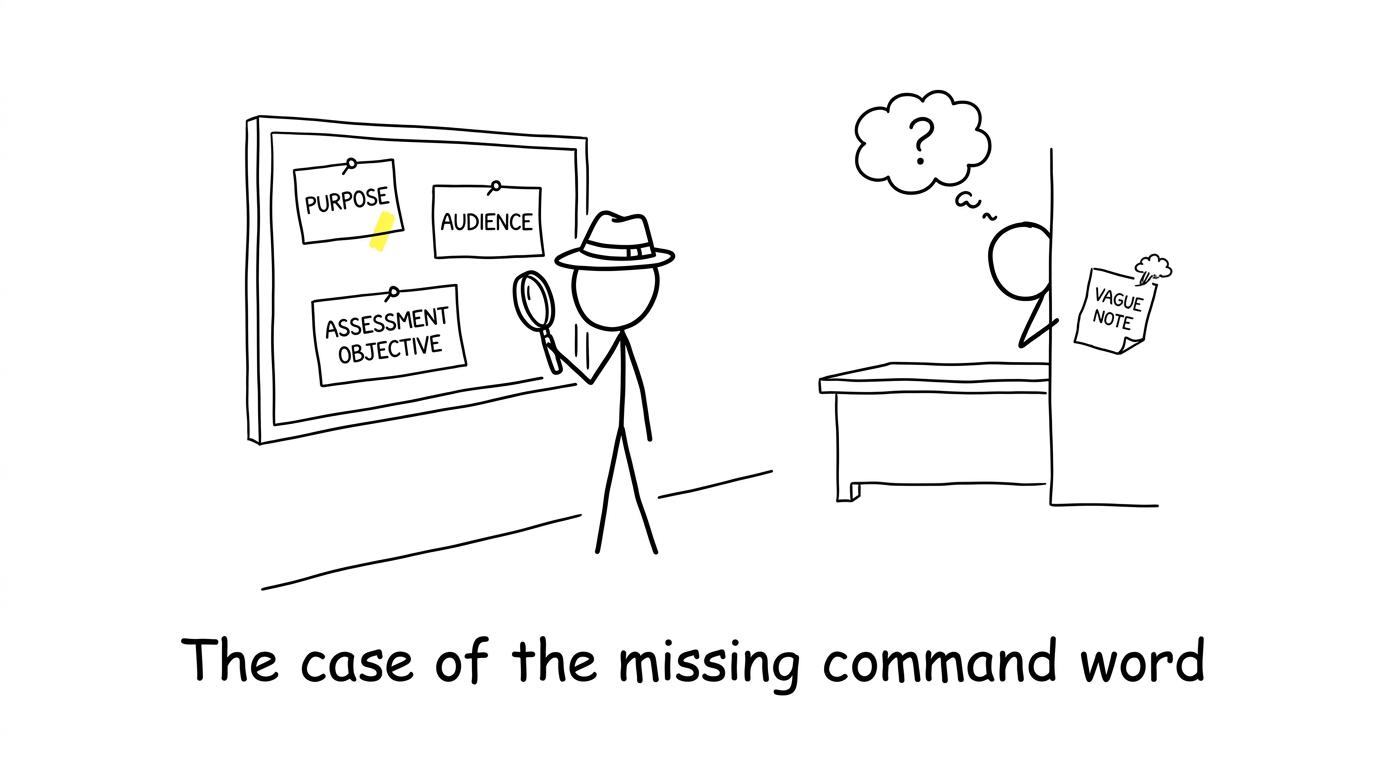 A revision detective investigates purpose, audience and assessment objectives
Build an answer checklist before answering
A homemade question becomes much more useful when it has a checking tool. You are unlikely to reproduce an examiner’s mark scheme accurately, but you can prepare a concise checklist based on the official assessment objective and your board’s published descriptors.
For a reading task, record possible evidence, defensible interpretations and the main skill being assessed. For a writing task, record the required form, purpose, audience, tone, organisation and technical-accuracy checks.
Keep this checklist separate until you finish. Afterwards, compare your response with it and then consult an official mark scheme for the same type of question. The goal is not to pretend you are an examiner. It is to make your next attempt more precise.
Test and refine the wording
Leave the question for a day if possible, then return to it without the notes. If you cannot tell exactly what it wants, revise the wording.
Ask:
- Is the command word recognisable from official papers?
- Is the source range clear?
- Does the question test one intended objective?
- Is there enough evidence for a developed response?
- Could another student understand the task without my explanation?
If possible, exchange questions with a classmate or ask your teacher to check one. Five carefully checked questions are more valuable than a folder of uncertain ones.
A revision routine that works across English and maths
Students preparing mainly for maths exams may recognise the structure here. In maths, copying a method can create familiarity without proving that you can apply it. In English, highlighting techniques can do the same. Questions reveal what notes conceal.
Use this cross-subject routine:
- Learn: review one method or assessment skill.
- Create: turn the notes into one focused question.
- Attempt: answer without looking back.
- Check: use a mark scheme, checklist or video solution where appropriate.
- Repair: write one specific improvement.
- Retest: attempt a fresh question later.
For your maths sessions, the GCSE Maths revision hub provides free revision lessons, worksheets, exam questions and paper resources organised by exam board. The MathsGenie revision planner can help you balance English practice with foundation or higher tier maths without letting either subject consume the entire week.
Short practice also matters. A single homemade English question can sit beside an Edexcel GCSE Maths mini test in a manageable evening session. Both give you something concrete to mark and improve.
When homemade questions are not the best choice
Do not spend most of your revision time acting as a question writer. You still need official specimen papers, past papers, published mark schemes and teacher feedback because these show the real wording, level descriptors and demands of your qualification.
Homemade questions are best for filling three gaps:
- you have run short of fresh questions for a particular skill;
- your notes feel passive and need turning into retrieval or application;
- you want to understand why an exam question has been designed in a particular way.
Near the exam, timed official papers should carry more weight. The same principle applies to maths: using GCSE past papers properly means marking, diagnosing and repairing errors, not simply collecting scores. For Edexcel students, GCSE maths predicted papers can provide additional fresh practice after official papers have established the correct standard.
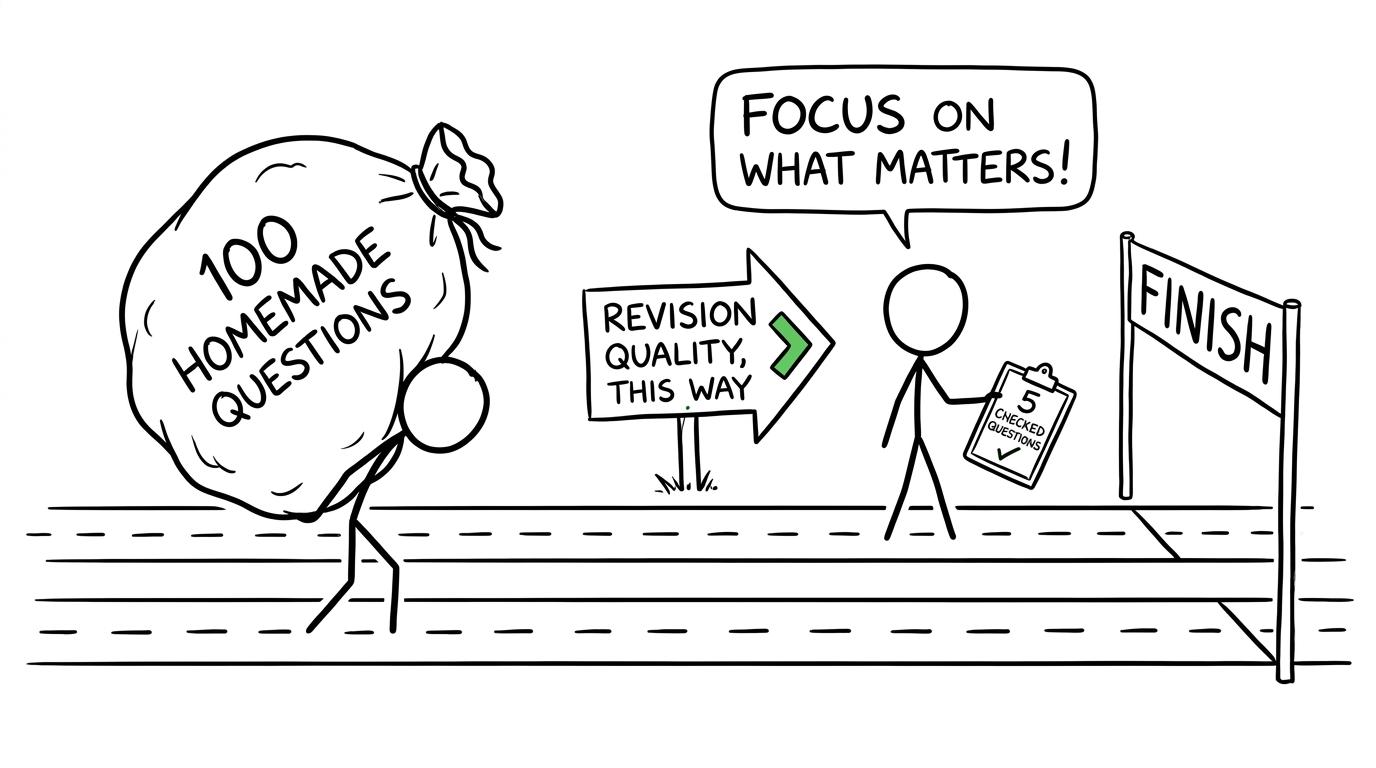 Five checked questions calmly defeat a huge sack of unchecked questions
Common mistakes when making practice questions
Mixing exam-board formats
AQA, Edexcel, OCR and Eduqas assess the regulated core skills, but their papers are not interchangeable. Do not attach one board’s command wording or marks to another board’s structure. Check the logo and specification code on your school materials.
Writing questions that only test terminology
Finding a metaphor is not the same as analysing how language shapes meaning. A useful task should require interpretation, evidence and explanation rather than a list of devices.
Choosing an unsuitable source
If the extract contains no meaningful shift, it may not support a strong structure question. If two texts express nearly identical viewpoints, comparison may become repetitive. Choose the source for the skill, not merely because you like it.
Making the task too broad
“Analyse this text” gives too little direction. Official-style wording usually establishes a source range, focus and command. Precision makes practice fairer and feedback more useful.
Trusting your own mark scheme too much
Your checklist is a revision aid, not an official judgement. Use published mark schemes and teacher guidance to calibrate it. Never estimate a GCSE grade from one self-written task.
Creating questions but never answering them
Design can deepen understanding, but performance still matters. Every question should lead to an attempt, feedback and later retest. If remembering content is a wider problem, the MathsGenie guide to making GCSE revision stick explains how retrieval and repeated practice can support your maths routine too.
Turn notes into something that can change
Good notes preserve information. Good questions make you use it.
That is why creating your own GCSE English Language practice questions can be worthwhile. The value is not the size of the question bank. It lies in deciding what the examiner is testing, noticing what a source can support and seeing where your understanding remains vague.
Keep the method modest: one skill, one source, one board-matched question and one honest review. Then return to official papers for calibration.
For maths, build the same disciplined cycle with MathsGenie. Start at the free GCSE Maths revision hub, learn through revision lessons and video solutions, practise with topic questions and mini tests, then test your progress using past papers, predicted papers and mark schemes. Your notes are the starting point. The question is where revision begins to become evidence.