How to Stop Procrastinating: GCSE English Language
Stop procrastinating GCSE English Language revision with a practical plan for starting small, practising exam skills and balancing maths without guilt.
The hardest part of GCSE English Language revision is often not analysing a text or planning an argument. It is opening the page.
If you want to stop procrastinating GCSE English Language tasks, make the first action smaller and more specific: choose one exam skill, work on it for 101010 minutes and finish with visible evidence of what you did. Do not begin with “revise English”. Begin with “identify three language choices”, “plan one writing response” or “improve one paragraph”.
That distinction matters. A vague task creates room for avoidance; a concrete task gives you somewhere to start. This guide explains why English Language can feel unusually easy to postpone, what breaks the pattern and how to protect your GCSE maths revision at the same time.
The quick anti-procrastination checklist
Use this whenever English Language keeps slipping to tomorrow:
- Check your exam board and the exact question or skill you are practising.
- Shrink the task until it can be started in under 222 minutes.
- Set a short timer for 101010 to 202020 minutes.
- Put your phone in another room or beyond arm’s reach.
- Produce something visible: annotations, a plan or a paragraph.
- Compare your response with teacher feedback or the relevant mark scheme.
- Write one next action before stopping.
- Keep maths moving with one small, scheduled task rather than abandoning it for the evening.
The goal is not to feel perfectly motivated. It is to make beginning easier than avoiding.
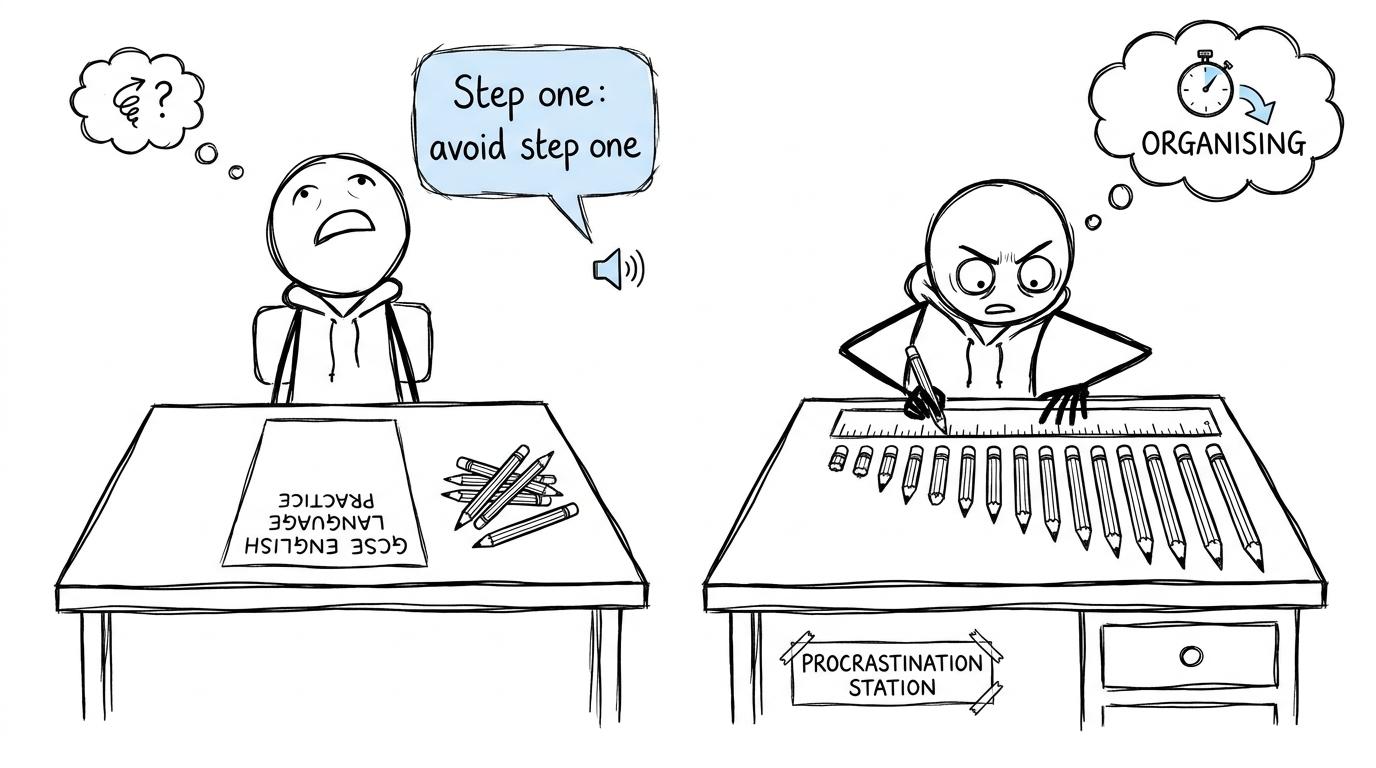 A student avoids starting English revision by arranging pencils
Why GCSE English Language gets procrastinated on
Some students find English Language harder to start than subjects with a visible list of facts or methods. There are several understandable reasons.
The subject can feel vague
In maths, a revision session might have a clear boundary: practise simultaneous equations, mark the questions and record the errors. English Language can sound less definite. “Get better at analysis” offers no obvious first step and no clear finishing point.
Yet the qualification is built around identifiable skills. Across the regulated GCSE English Language specifications, reading accounts for 50%50\%50% of the written qualification and writing accounts for 50%50\%50%. The assessment objectives cover finding and interpreting information, analysing language and structure, comparing viewpoints, evaluating texts, communicating effectively and writing accurately.
That means “English revision” can always be converted into a smaller skill. Your exam board, AQA, Edexcel, OCR or Eduqas, determines the paper structure and question wording, so use the specification and materials provided by your school rather than borrowing another board’s routine.
There is no set text to hide behind
English Literature allows you to revise particular plays, novels, poems and quotations. English Language examinations use unseen material. You are preparing transferable reading and writing skills rather than memorising the answer to a known extract.
This can create the mistaken feeling that revision is impossible. In reality, the unseen text changes, but the process does not: read the question precisely, select evidence, explain choices, develop an interpretation and manage the available time.
Writing feels personal
A wrong calculation can feel separate from you: the method went wrong. A paragraph can feel more exposed because it contains your vocabulary and ideas. Perfectionism then disguises itself as preparation. You reorganise notes, watch another video or wait until you can produce a “good” response.
But practice writing is supposed to be imperfect. Its purpose is to reveal the next improvement.
Maths may feel easier to measure
For students balancing English with GCSE maths, maths can become productive procrastination. Completing questions feels useful because the feedback is immediate. Maths revision certainly matters, but using it to avoid English creates an unbalanced plan.
Keep the clarity that makes maths easier to start. The GCSE Maths revision hub organises work by board and resource type. Apply the same logic to English: one skill, one task and one review point.
What actually breaks the procrastination pattern
Procrastination is not always a time-management problem. It can be a way of escaping the discomfort attached to a task: uncertainty, boredom, fear of doing badly or the sense that the work is too large.
Research on anti-procrastination interventions is mixed, so no timer or slogan should be treated as a guaranteed cure. The useful principles are more modest: reduce the size of the first step, add clear time structure, remove obvious distractions and review real work rather than waiting for confidence.
Replace intentions with a physical first action
“Do English later” is an intention. “At 6.006.006.00 pm, put the paper on the desk and underline the command word” is an action.
Choose a starting cue that already exists in your day:
- after dinner, open the question booklet;
- after arriving at the library, set a 151515-minute timer;
- after finishing maths, write one English paragraph before taking a break.
This is sometimes called an if-then plan. Evidence for implementation intentions specifically reducing academic procrastination is not conclusive, but a precise cue still removes a decision at the moment when avoidance usually begins.
Make the task small without making it meaningless
A tiny task should still practise an assessed skill. Useful starting tasks include:
- annotate one short section for language choices;
- select evidence for one reading question;
- plan an opening, development and ending;
- write one analytical paragraph;
- edit one response for punctuation and sentence control;
- spend 101010 minutes comparing your work with feedback.
Avoid tasks that merely look like revision, such as decorating headings or repeatedly copying assessment objectives.
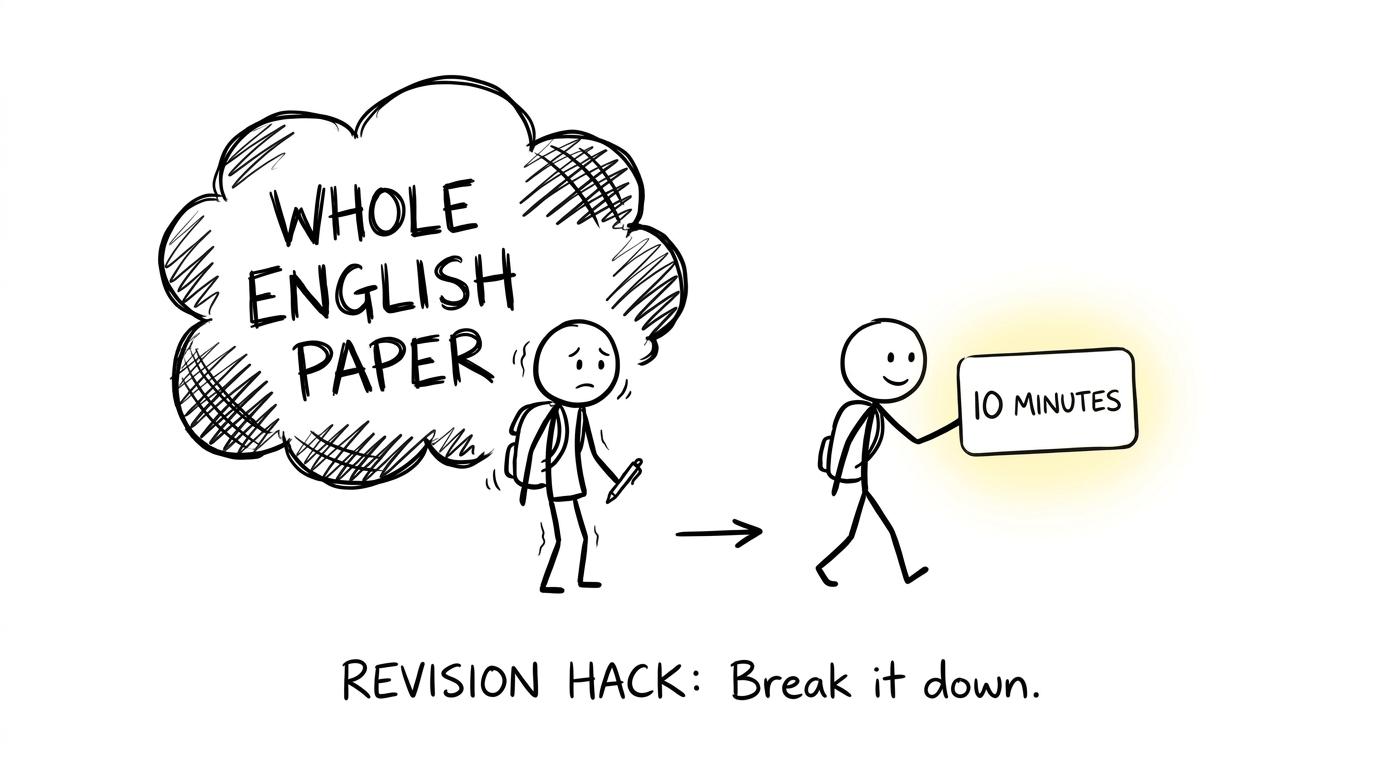 An intimidating whole paper becomes a manageable ten-minute task
Lower the standard for starting, not finishing
Your first draft does not need to be exam-ready. It needs to exist. Once something is on the page, you can improve its evidence, explanation, organisation or technical accuracy.
This is particularly important for writing. Accuracy matters: the national assessment objectives require spelling, punctuation, vocabulary and sentence structures to contribute 20%20\%20% of the qualification overall. However, trying to make every sentence perfect before writing the next one often prevents sustained practice.
Draft first. Then edit with one narrow focus.
End every session with feedback
Completion alone can create false confidence. After a short response, ask:
- Did I answer the exact question?
- Is my evidence relevant?
- Have I explained how the writer’s choice affects meaning?
- Does each paragraph have a clear purpose?
- Which single change would improve the response?
Mark schemes describe what is rewarded, but teacher feedback is especially valuable for extended English responses because quality cannot always be reduced to a simple right-or-wrong answer.
Maths follows the same principle. MathsGenie’s guide to using GCSE past papers properly shows why marking, repairing and retesting matter more than simply completing another paper.
Build an English routine that protects maths revision
You do not need to choose between English and maths. You need boundaries.
A repeatable weekday pattern could contain:
- 202020 minutes of one English Language skill;
- a short break;
- 252525 to 353535 minutes of targeted maths;
- 555 minutes to record the next action for each subject.
These are adjustable blocks, not compulsory timings. If your English mock is closer, give English more time. If a maths paper is approaching, reverse the balance. The important point is that each block has a specific output.
For maths, choose a task from the GCSE Maths topics by board and tier guide, then use a revision lesson, practice questions or a short test. Unlike maths, GCSE English Language is not divided into Foundation and Higher tiers, so do not waste time searching for an English tier.
A weekly revision planner might include:
- two short English reading sessions;
- two short English writing sessions;
- two or three targeted maths sessions;
- one timed English response;
- one maths mini test or paper section;
- one catch-up space that can remain empty if everything is complete.
Use the GCSE maths revision timetable guide to build a realistic planner around school, rest and other subjects. A timetable should reduce decisions, not fill every free minute.
Use visible progress instead of mood
Motivation is unreliable because it often arrives after starting, not before. Track actions you can see:
- questions attempted;
- paragraphs written;
- feedback points corrected;
- timed responses completed;
- maths topics retested.
Do not measure success only by hours. A focused 151515-minute paragraph followed by a useful correction may be more valuable than an hour of passive reading.
The same principle powers MathsGenie’s approach to finding your weakest GCSE topics. Evidence tells you what to do next. Mood does not.
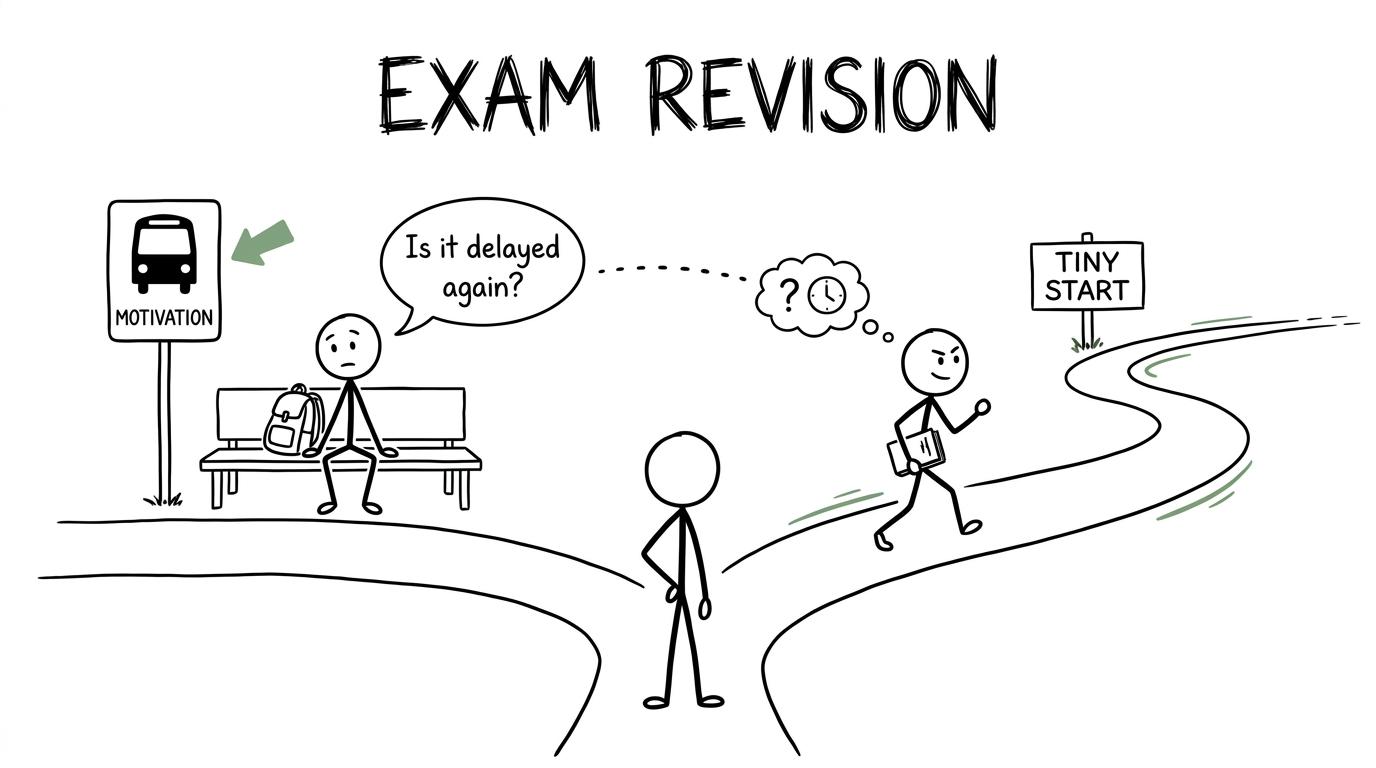 One student waits for motivation while another begins with a tiny action
Common mistakes when trying to stop procrastinating
Planning an entire new personality
A complicated timetable, colour system and early-morning routine may feel like progress. Usually, it creates another project to avoid. Change the next session first. Improve the wider routine only after you have repeated it.
Starting with a full paper
A complete paper can be valuable once you have built some stamina, but it is a poor default when starting is the main difficulty. Begin with one section or question. Expand later.
In maths, the equivalent is using Edexcel GCSE Maths mini tests before jumping into a whole paper. Students on other boards should select the corresponding resources through the main GCSE hub.
Leaving marking until another day
Delayed feedback makes revision feel unfinished and weakens the connection between the attempt and the lesson. Reserve time to review your work immediately, even if you only identify one improvement.
Using maths to avoid English
Completing another comfortable maths worksheet is not balance if the English task is repeatedly postponed. Put a firm end time on maths, then make English’s first step extremely small.
When maths is the task being avoided, reverse the order. Start with a targeted question set and later progress to board-appropriate papers, such as the Edexcel GCSE Maths past papers.
Treating one missed session as failure
A missed day is a scheduling problem, not proof that you cannot revise. Do not attempt to repay every lost minute. Restart with the next small task. Consistency is built through returning.
Start before you feel ready
To stop procrastinating on GCSE English Language, reduce the distance between deciding and doing. Open one question. Set a short timer. Produce one piece of work. Review it. Write down the next action.
Then keep your maths preparation equally concrete. MathsGenie gives you a free route from a structured one-month revision plan to revision lessons, practice questions, mini tests, past papers, predicted papers, mark schemes and video solutions.
Choose one English Language skill and one maths task now. Make both small enough to begin today. Progress rarely starts with a dramatic burst of motivation. More often, it starts with a page finally opened.