

Spaced Repetition for GCSE Astronomy: Start Simply
Spaced repetition GCSE Astronomy made simple: build a paper-based revision routine that strengthens recall, maths skills and exam confidence.
Revision can become complicated remarkably quickly. There are apps to configure, colour-coded timetables to perfect and hundreds of cards waiting to be created. Yet none of that guarantees that you will remember Kepler's laws, stellar evolution or how to interpret astronomical data under exam pressure.
A simple spaced repetition GCSE Astronomy routine needs only questions, paper and a calendar. Learn a small group of ideas, test yourself without notes, check your answers and revisit weaker material after gradually longer gaps. The method matters more than the technology.
This guide shows you how to begin without building an elaborate system. It also explains how to include the mathematical skills that connect Astronomy with GCSE Maths revision.
Your simple spaced repetition checklist
Start with these essentials:
- Divide the Astronomy specification into small, clearly named topics.
- Create questions rather than copying pages of notes.
- Answer from memory before checking any source.
- Review new material tomorrow, then after roughly 333 days, 777 days and 141414 days.
- Return incorrect or incomplete answers to the shortest interval.
- Include calculations, graphs and data interpretation alongside factual recall.
- Use past questions regularly so recall develops into exam performance.
Those intervals are a practical starting point, not a scientific law. If a topic keeps disappearing from memory, shorten the gap. If recall becomes consistently accurate, extend it.
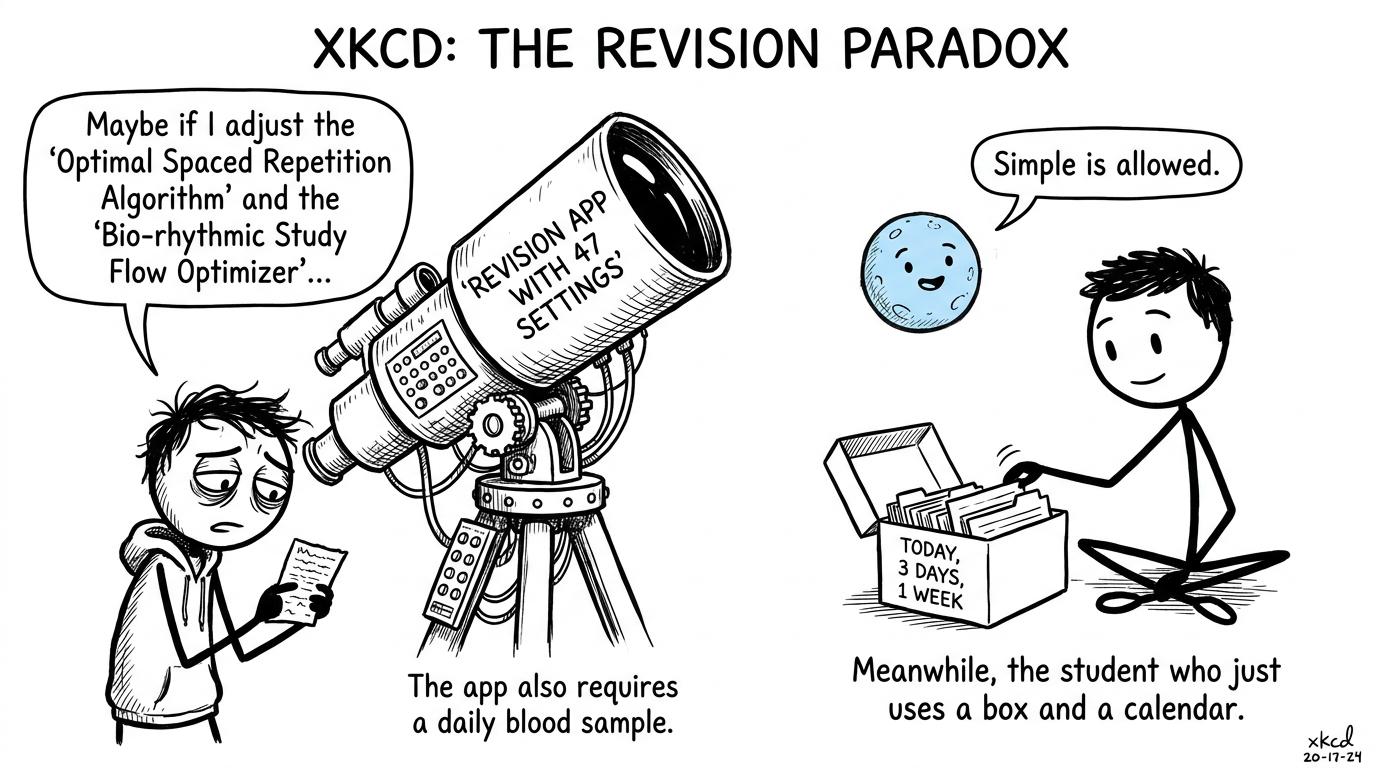 A student choosing simple paper flashcards over an enormous revision app
What spaced repetition actually means
Spaced repetition means returning to learning across separate sessions rather than completing all the revision at once. It is the opposite of cramming.
The second ingredient is retrieval practice. Instead of immediately rereading your notes, you try to bring an answer back from memory. Only then do you check it and correct mistakes. Research reviews distinguish this active attempt from passive familiarity: recognising a sentence on a familiar page is not the same as producing the idea independently.
Together, spacing and retrieval create a useful cycle:
- encounter an idea;
- leave a gap;
- retrieve it without support;
- receive feedback;
- revisit it later.
The attempt should feel slightly demanding. That difficulty is not proof that revision has failed. It is information about what your memory can currently produce.
Feedback is equally important. An unchecked answer can preserve a misconception, so compare your response with your class materials, specification or mark scheme after every retrieval attempt.
Why the method suits GCSE Astronomy
The current Pearson Edexcel GCSE Astronomy specification contains 161616 topics. Topics 111 to 888 are assessed in Paper 111, Naked-eye Astronomy, while Topics 999 to 161616 are assessed in Paper 222, Telescopic Astronomy. Each examination lasts 111 hour 454545 minutes and is worth 100100100 marks.
That breadth creates a predictable revision problem. You may understand planetary motion in one lesson, move on to cosmology and discover weeks later that the earlier detail has faded. Spaced repetition deliberately brings old material back before it becomes completely unfamiliar.
It can cover several kinds of knowledge:
- Facts: astronomical units, features and definitions.
- Sequences: stages in stellar evolution or steps in an observation.
- Comparisons: refracting and reflecting telescopes, or geocentric and heliocentric models.
- Explanations: why particular observations support a model.
- Mathematical choices: selecting data, equations, units or graph features.
- Observational judgement: identifying limitations, risks and improvements.
Astronomy is not assessed as a list of isolated facts. Pearson allocates assessment across knowledge, application, and analysis or evaluation. Your questions should therefore move beyond prompts such as “define” and include “explain”, “compare”, “predict” and “evaluate”.
Build a paper system in one sitting
You do not need a complicated app. Use index cards, folded paper or a notebook with three sections.
Label the sections:
- Soon: material to revisit tomorrow or within a few days.
- Later: material that was recalled accurately but still needs another check.
- Secure: material answered accurately on several separated occasions.
Place every new question in Soon. During a session, answer aloud or on paper before turning over the card. If the response is wrong, vague or dependent on a hint, keep it in Soon. A complete answer moves to Later. After several successful reviews over longer gaps, it can move to Secure.
Secure does not mean finished forever. Mix a few secure questions into weekly reviews. Memory is not a cupboard where knowledge stays untouched once stored.
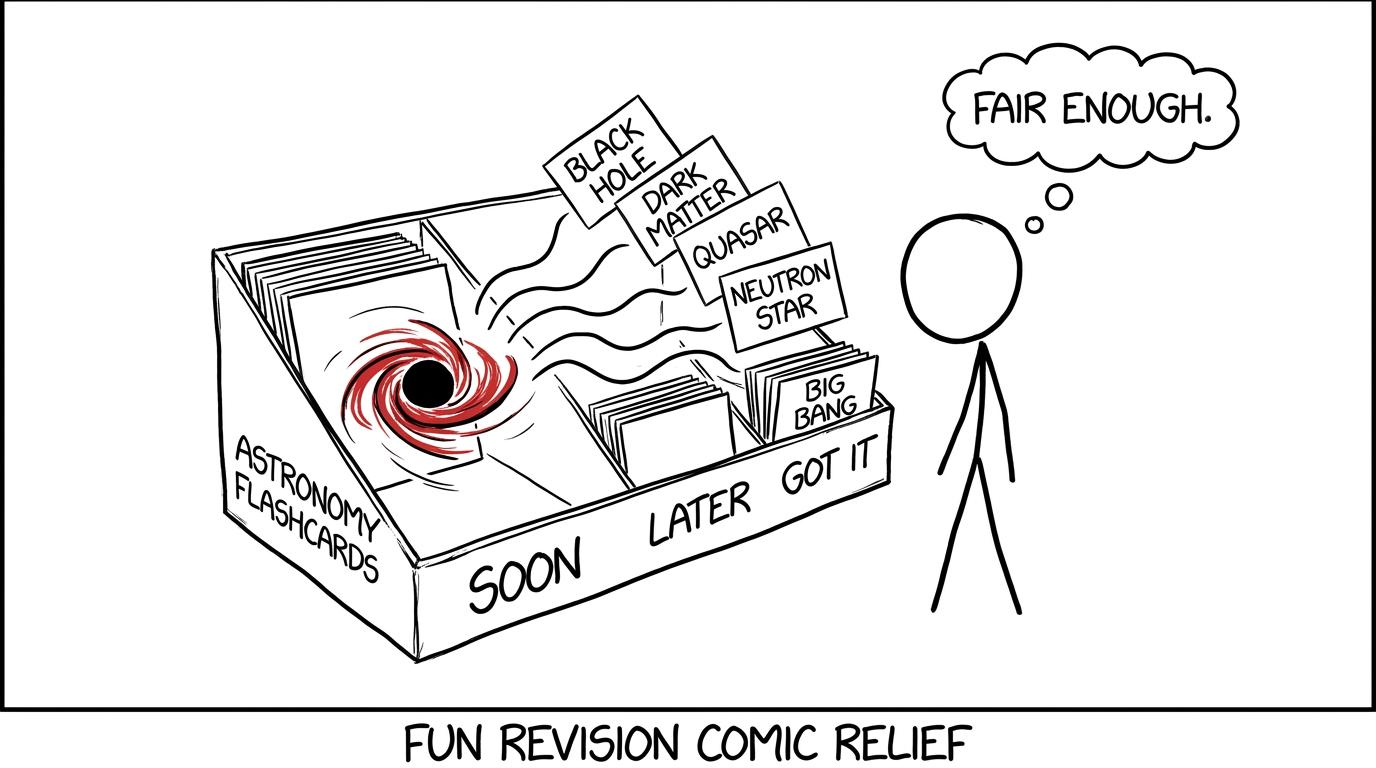 A black hole returning difficult flashcards to the Soon pile
Make Astronomy questions that test real understanding
A good prompt has a specific target. “Revise stars” is a task description, not a retrieval question. Better prompts ask for one explanation, comparison, diagram label, calculation set-up or conclusion from data.
Keep one main idea on each card
If a card asks for six unrelated facts, one missing detail makes it hard to judge the result. Split broad prompts into smaller units. This makes the schedule more honest because weak knowledge returns sooner without dragging secure knowledge with it.
Use both directions
Do not always ask for a term from its definition. Sometimes show the term and ask for its meaning; sometimes provide the description and ask for the term. For processes, ask for the sequence and then ask why one stage leads to another.
Include exam command words
Build prompts around the language used in assessments:
- state;
- describe;
- explain;
- compare;
- calculate;
- determine;
- evaluate.
A question beginning with “state” should usually produce a concise fact. “Explain” requires linked reasoning. “Evaluate” asks you to weigh evidence, limitations or competing conclusions. Practising that distinction helps recall become usable writing.
Add the maths Astronomy actually requires
Mathematical skills account for at least 20%20\%20% of the marks in the written GCSE Astronomy examinations. The official requirements include standard form, ratios, percentages, inverse-square relationships, logarithms, graphs, gradients, angular measure and coordinates.
The examination provides the relevant astronomical formulae and data sheet, so revision should not become a contest to memorise every equation. You still need to recognise which relationship applies, substitute accurately, manage units and explain what an answer means.
Useful retrieval prompts can ask you to:
- identify the correct variables in a supplied equation;
- rearrange a familiar relationship;
- state the meaning of a graph's gradient or intercept;
- recall how degrees, minutes and seconds of arc are related;
- describe how an inverse-square relationship changes;
- check whether an answer has a sensible order of magnitude;
- express astronomical quantities in standard form.
For example, the formula sheet includes relationships such as Hubble's law,
v=H0d, v = H_0d, v=H0d,and the redshift relationship,
λ−λ0λ0=vc. \frac{\lambda-\lambda_0}{\lambda_0}=\frac{v}{c}. λ0λ−λ0=cv.Your cards should test interpretation and selection as well as symbols. Seeing a formula repeatedly is not sufficient preparation for deciding when to use it.
Use the free GCSE Maths revision hub when an Astronomy error reveals an underlying maths gap. Its lessons, practice questions and video solutions can help you repair skills such as standard form, ratio, rearranging formulae and graphs. The GCSE Maths topics by exam board and tier guide can also help you locate the relevant mathematical strand for Edexcel, AQA, OCR or Eduqas Maths.
Follow a realistic weekly rhythm
A manageable routine might contain three short reviews and one longer application session.
During a short session of around 151515 minutes:
- answer cards due that day;
- check every response;
- move cards between Soon, Later and Secure;
- record one recurring mistake.
Once a week, use a longer session to answer mixed exam questions. Flashcards can strengthen recall, but they cannot fully reproduce an extended response, unfamiliar data set or multi-stage calculation.
If scheduling is difficult, adapt the structure in MathsGenie's GCSE Maths revision timetable. The principle is transferable: keep weekday sessions focused, then use a longer weekend block for exam-style practice and review.
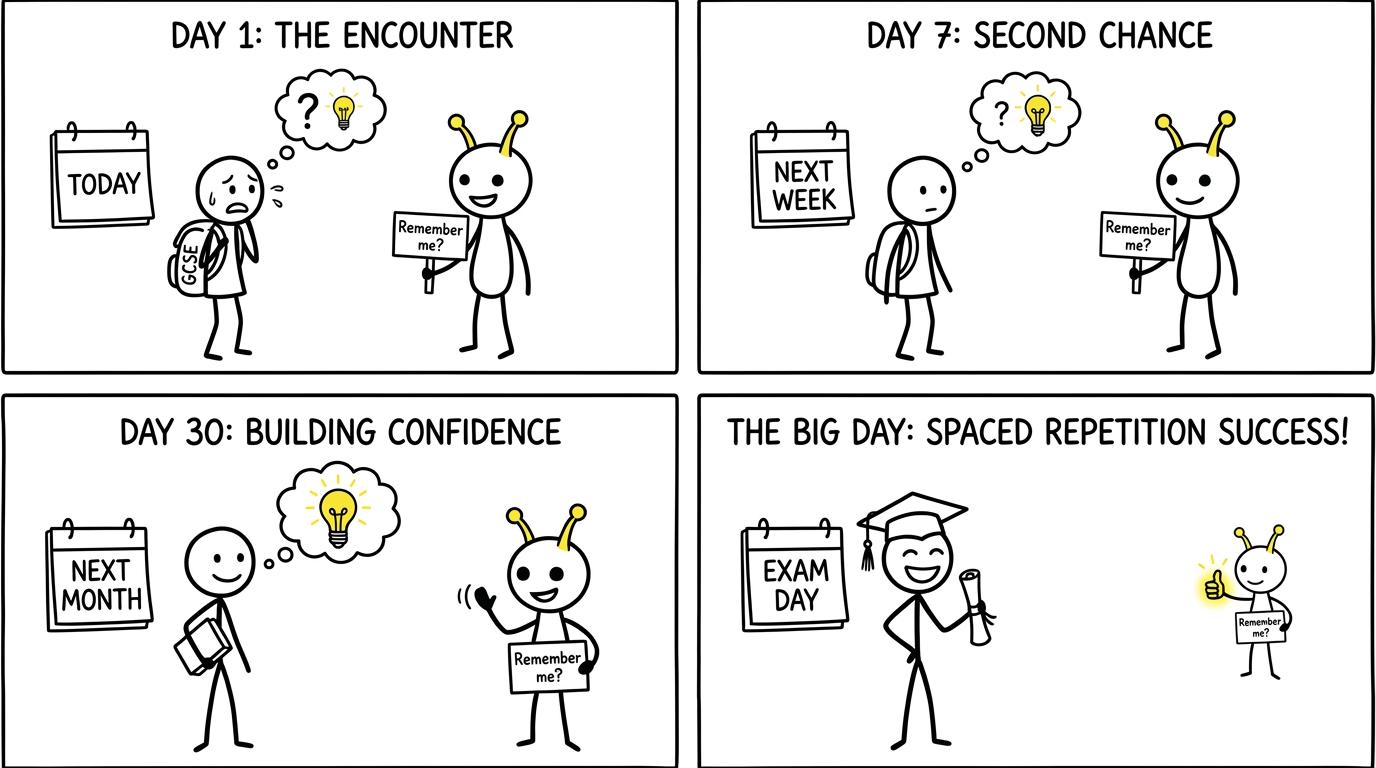 A student meeting the same friendly alien at spaced calendar stops
Turn mistakes into the next review
A mark scheme is not merely a way to produce a score. It tells you what your next retrieval prompt should be.
After checking work, classify each error:
- knowledge: a fact or process was missing;
- application: you knew the idea but could not use it in context;
- mathematics: the equation, units, graph or calculation caused difficulty;
- communication: the answer lacked the detail required by the command word;
- carelessness: information was copied or read incorrectly.
Then create the smallest question capable of testing the repair. MathsGenie's guide to finding your weakest GCSE topics offers a useful approach to logging lost marks rather than revising by instinct.
For mathematical weaknesses, use a MathsGenie revision lesson followed by practice questions. Re-test the skill after a gap, then place it inside mixed paper practice. This movement from diagnosis to focused repair is also explained in the guide to revising Edexcel GCSE Maths without wasting time.
Common spaced repetition mistakes
Creating cards but rarely answering them
Card-making can feel productive because it produces something neat. The learning happens when you retrieve, check and correct. Begin with a small set you can maintain.
Looking at notes too soon
Pause before checking. Even an unsuccessful attempt reveals more than immediate rereading. If nothing comes back, record that honestly and shorten the interval.
Revising only factual definitions
Facts matter, but GCSE Astronomy also assesses application, mathematical skills, observations and evaluation. Include mixed prompts and full exam questions.
Moving cards forward after a vague answer
Judge the response against an accurate source. If a key link, unit or scientific term is absent, correct it and review the card sooner.
Using fixed intervals regardless of performance
The schedule should respond to your memory. Difficult material returns sooner; consistently accurate material waits longer.
Abandoning past papers
Spaced repetition supports paper practice rather than replacing it. As examinations approach, follow MathsGenie's guidance on when to start GCSE past papers. Use timed sections, mark schemes and later reattempts so each paper improves the next one.
Start smaller than you think
The best revision system is not the one with the most settings. It is the one you will still use next week.
Choose one GCSE Astronomy topic today. Write no more than 101010 precise questions, answer them without notes and schedule the uncertain ones for tomorrow. Add calculations and data interpretation as the routine develops. Over time, your box or notebook becomes a record of what memory needs, rather than a monument to how much revision you intended to do.
When Astronomy exposes a weakness in standard form, graphs, ratio or algebra, make MathsGenie your free maths revision base. Start with a revision lesson, complete practice questions, check the mark scheme and revisit the skill after a gap. Then build towards mini tests, past papers and predicted papers, using video solutions when a method still feels unclear.
Simple systems leave less room for avoidance. Open the MathsGenie GCSE revision area, choose the mathematical skill currently costing you marks, and begin your first short retrieval cycle today.










