Sleep Before GCSE German Exam: How Much Is Enough?
Sleep before GCSE German exam: learn why teenagers need 8-10 hours, how rest supports vocabulary and focus, and what to do the night before calmly.
The clock says it is late. There are still vocabulary cards on the desk, a speaking answer you do not quite trust, and several German word endings that seem determined to swap places. At that moment, another hour of revision can feel essential.
But the clearest answer to how much sleep you need before a GCSE German exam is usually 888 to 101010 hours. That is the recommended range for teenagers aged 131313 to 181818, supported by NHS guidance and sleep-medicine research. Sleep does not replace effective revision, but sacrificing it for panicked cramming can weaken the attention, recall and emotional control you need in the exam.
The night before is not the time to learn everything. It is the time to protect what you have already learned.
Your night-before sleep checklist
Use this as a calm final plan:
- Work backwards from the time you must wake up and allow 888 to 101010 hours for sleep.
- Leave roughly 303030 minutes to wind down rather than expecting to fall asleep immediately.
- Finish demanding revision at least 303030 to 606060 minutes before bed.
- Review familiar vocabulary briefly instead of starting a large new topic.
- Pack your equipment, check the exam time and set your alarm.
- Keep your phone away from the bed or switch off notifications.
- Avoid caffeine and energy drinks during the evening.
- If one night goes badly, do not assume the exam is ruined.
This advice applies whether your paper is with Edexcel, AQA, OCR or Eduqas. The precise assessment arrangements differ by specification, but the brain sitting the exam has the same basic need for rest.
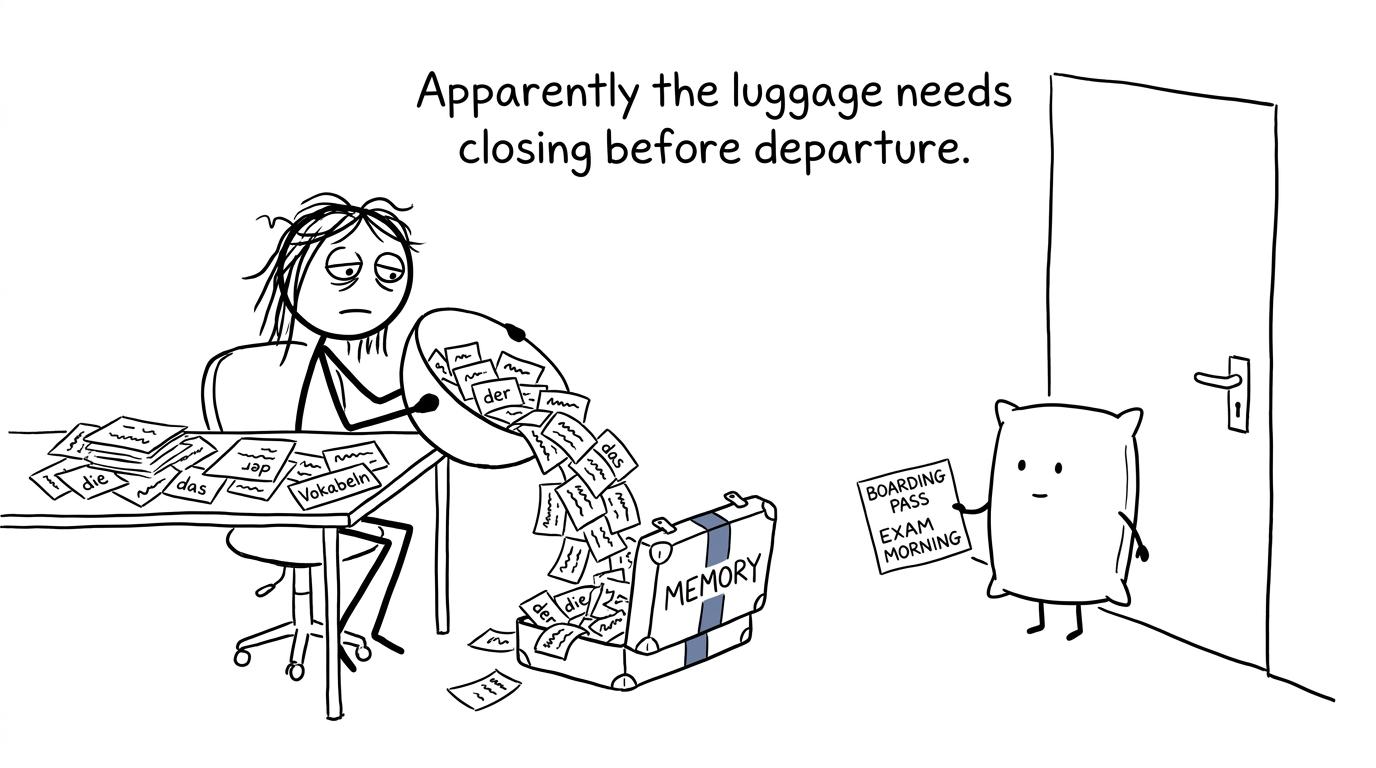 A student discovers that memories need packing before exam morning
What sleep actually does for German vocabulary
German revision relies heavily on declarative memory: vocabulary, meanings, grammatical rules and factual knowledge about themes. You first have to encode that information while revising. It then needs to become stable enough to retrieve later.
Sleep supports this process of memory consolidation. Research indicates that recently formed memories are reactivated and reorganised during sleep, helping them become more stable. Both non-rapid eye movement and rapid eye movement sleep appear to contribute to learning, although sleep science is more complicated than the idea that one particular stage simply “stores vocabulary”.
This is why an extra late-night hour is not automatically an extra hour of useful learning. If it reduces your sleep, you may gain more exposure to the words but give your brain worse conditions in which to retain and retrieve them.
There is also an important limit to what sleep can do. It strengthens learning; it does not create learning that never happened. Seeing a long word list once at midnight and then sleeping will not make it secure. Regular retrieval practice across several days, followed by sufficient sleep, is much more dependable.
A sensible final review could include:
- testing yourself on a small set of high-frequency words;
- checking a few recurring verb forms;
- recalling useful sentence structures without looking;
- reviewing mistakes already identified in previous practice;
- stopping while you are still calm enough to wind down.
The same principle matters in maths. A method becomes more reliable through repeated retrieval and practice, not one exhausted encounter. MathsGenie’s guide to finding your weakest GCSE topics explains how evidence from mistakes can guide revision more effectively than vague worry.
Why sleep matters for focus in the exam
A GCSE German paper asks you to do more than remember isolated words. You may need to sustain attention through audio, notice a negative, distinguish similar expressions, infer meaning from context or organise a written answer while checking accuracy.
Insufficient sleep is associated with poorer attention, learning and behaviour in teenagers. In practical exam terms, tiredness can make it harder to:
- maintain concentration from the beginning to the end;
- hold part of a sentence in mind while processing the rest;
- ignore irrelevant details;
- retrieve known vocabulary promptly;
- monitor spelling, tense and agreement;
- recover calmly after a difficult question.
Sleep also supports emotional regulation. This matters because exams contain uncertain moments. A rested student can still feel nervous, but may be better placed to treat one unfamiliar word as a problem to manage rather than proof that the whole paper is going badly.
That lesson transfers directly to GCSE maths. Missing a minus sign, misreading a command word or giving up too quickly can cost marks even when you understand the topic. The GCSE maths night-before plan focuses on protecting performance rather than extending revision until you are exhausted.
How to calculate a realistic bedtime
Start with the time you need to get up, not the time you would ideally like to fall asleep. Then work backwards.
If your alarm is set for $7.00\text{ am} and you are aiming for 999 hours of sleep, your approximate sleep time is:
You should therefore begin winding down before $10.00\text{ pm} rather than starting to get ready for bed at that point. If falling asleep commonly takes around 303030 minutes, getting into bed at approximately $9.30\text{ pm} gives you a more realistic opportunity to reach your target.
This is planning, not a guarantee. Trying to force sleep by watching every minute pass usually makes the night feel harder. Prepare the conditions, follow a familiar routine and let sleep arrive without turning it into another test.
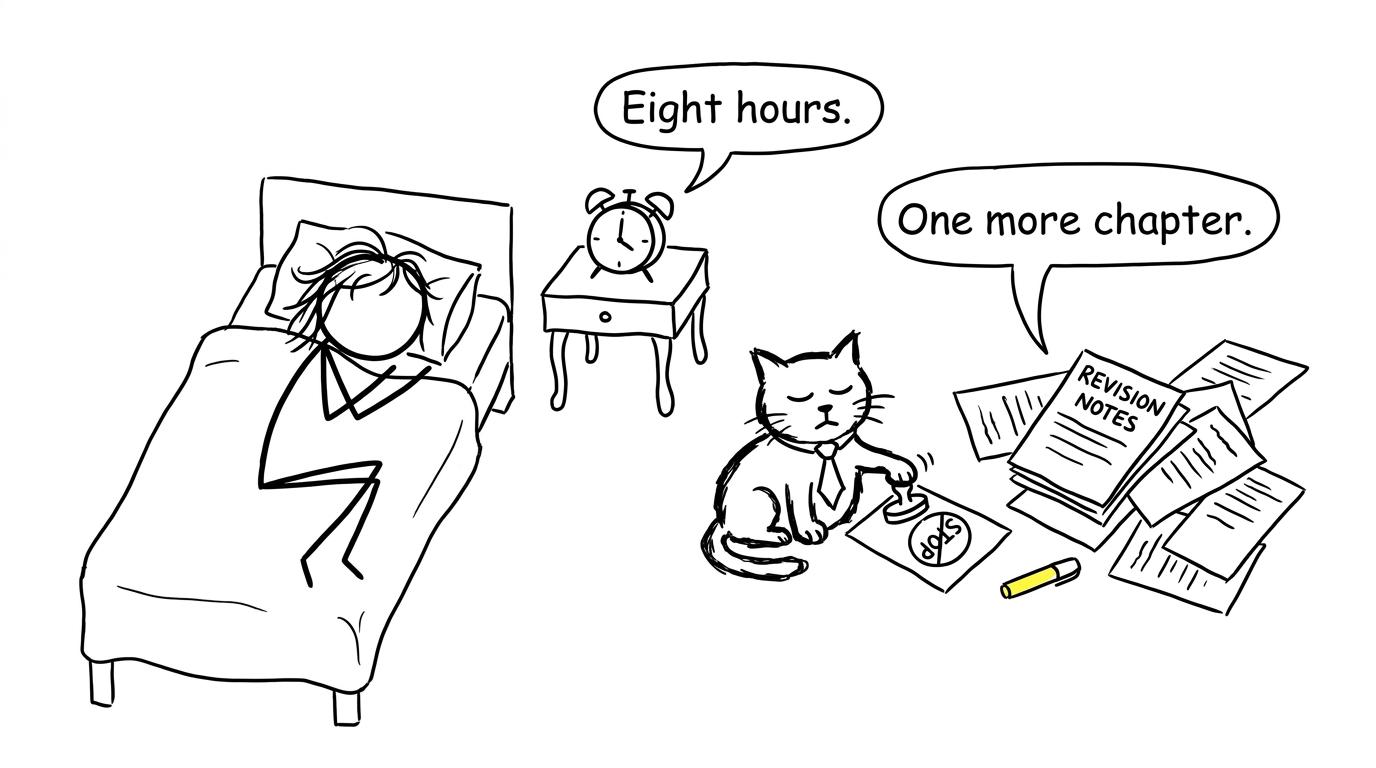 An alarm clock negotiates bedtime with an ambitious pile of revision notes
A sensible revision cut-off
The NHS advises allowing time to wind down between revision, screens and bed. For many students, a useful target is to stop demanding work 303030 to 606060 minutes before bedtime.
Your final evening could look like this:
Earlier in the evening
Complete one focused review session. Test yourself rather than repeatedly reading notes, then check errors. Do not attempt to cover the entire specification.
Before the cut-off
Write down anything you want to revisit later. Pack pens, water where permitted, identification if required and any other equipment your school has requested. Confirm when and where you need to arrive.
During the wind-down
Dim the lights, put away interactive screens and do something quiet. A shower, gentle reading or calm music can help create separation between revision and sleep. Keep the bedroom dark, quiet and comfortably cool where possible.
If you also have maths exams approaching, place unfinished tasks into a structured plan rather than carrying them to bed mentally. The GCSE one-month maths revision plan and MathsGenie revision planner can turn a large workload into specific future sessions.
What if you cannot sleep?
One difficult night does not erase months of learning. The worst response is often to calculate repeatedly how little sleep remains, scroll on your phone and decide the exam has already been lost.
If you are awake, keep the environment quiet and low-stimulation. Avoid restarting intense revision. Write down practical worries if that helps you stop rehearsing them, then return to a calm activity until you feel sleepy. Do not experiment with sleep medicines or supplements without appropriate medical advice.
On the morning of the exam:
- get up at the planned time rather than repeatedly delaying the alarm;
- eat and drink as you normally would before school;
- seek daylight and move around gently;
- use a short familiar review only if it makes you calmer;
- avoid trying to repair the night with excessive caffeine.
If sleep problems happen regularly, affect daytime life or continue despite sensible routines, speak to a parent, carer, GP or another appropriate health professional. Persistent insomnia needs support, not harsher self-discipline.
Why consistent sleep beats one perfect night
The night before matters, but it is not a magic switch. Sleep supports memory both after learning and before the next period of learning. A rested brain is better prepared to take in information, while sleep after revision helps stabilise what was learned.
That makes sleep a revision habit rather than an emergency tactic. During the examination period, aim for a broadly consistent bedtime and waking time. Large swings between very late nights and early school mornings can make a routine harder to maintain.
Your wider revision should be consistent too. Start with the free GCSE maths revision hub, use focused lessons and practice questions, then check your understanding under exam conditions. The guide to revising GCSE maths efficiently shows how to build a repeatable learn, practise, mark and fix cycle.
Past papers belong earlier in that cycle, not at midnight before an unrelated exam. Read when to start GCSE past papers and schedule them while you still have time to act on the mark scheme.
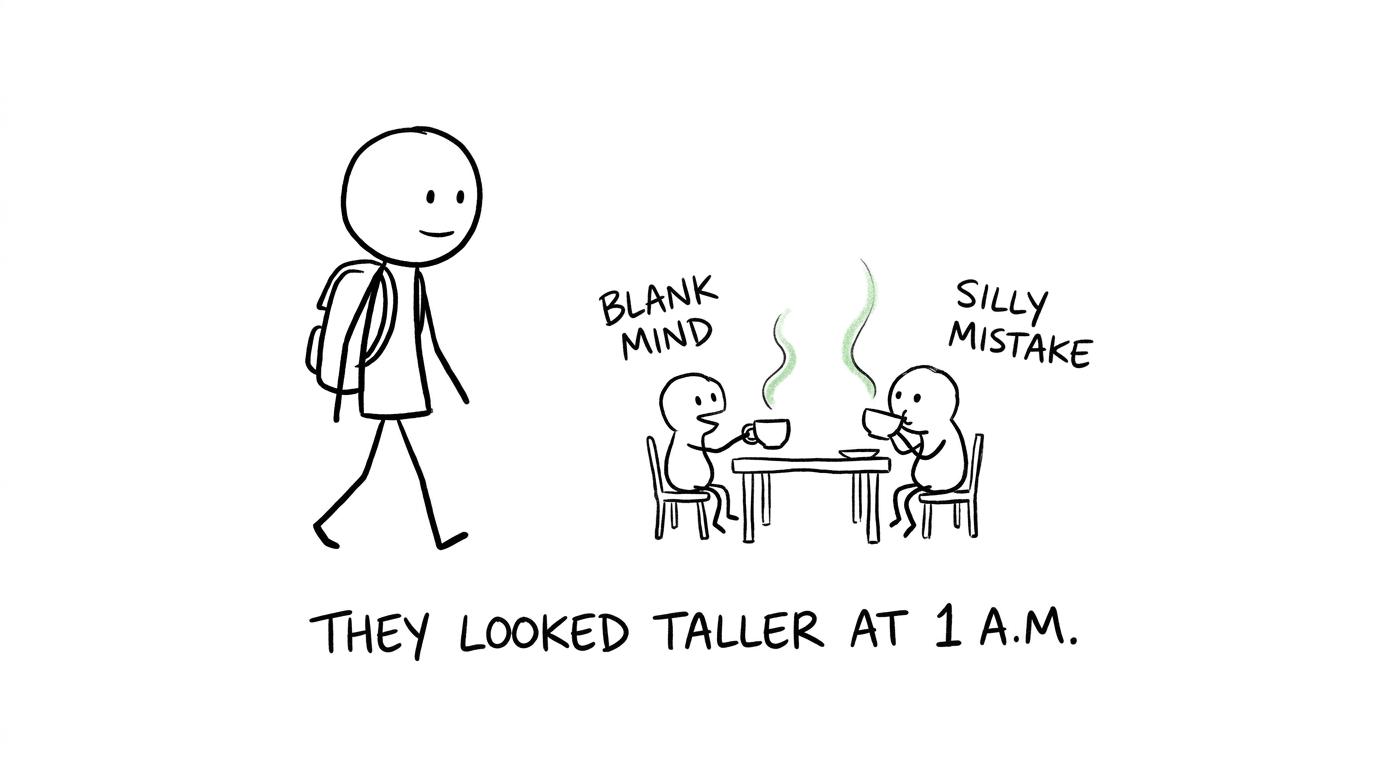 A rested student discovers that exam worries looked much larger at one in the morning
Common mistakes the night before an exam
Treating sleep as unused revision time
Sleep is part of learning and exam readiness. Cutting it short can undermine the memory and attention your revision was supposed to build.
Starting a completely new unit
New material can expose gaps without leaving enough time to repair them. Prioritise familiar, high-value retrieval and mistakes you can realistically correct.
Revising passively
Rereading a page feels reassuring because everything looks familiar. Brief self-testing gives better evidence of what you can actually retrieve.
Using a phone as a wind-down tool
A short check can become a long stream of messages and videos. Light matters, but stimulation and lost time matter too. Put the device beyond easy reach.
Assuming one poor night guarantees failure
It does not. Follow your morning routine, begin the paper carefully and deal with one question at a time.
Saving every exam resource for the final evening
Resources produce their greatest value when there is time to review the feedback. MathsGenie’s guide to self-studying GCSE maths explains how lessons, questions, mini tests and papers can be organised over time.
Protect tomorrow's performance
Aim for 888 to 101010 hours of sleep before your GCSE German exam. Finish demanding revision early enough to wind down, keep the final review short and familiar, and remember that rest supports the vocabulary recall, concentration and emotional control you will need tomorrow.
Then carry the same discipline into your maths preparation. Use MathsGenie’s free revision lessons to understand each method, practice questions and mini tests to strengthen recall, and past papers or predicted papers to rehearse exam conditions. Mark honestly, use video solutions when you are stuck, and return to weak topics while there is still time to improve.
The goal is not to arrive knowing every possible answer. It is to arrive rested enough to use what you know. Start your next revision cycle with the MathsGenie GCSE maths resources, then stop at the bedtime you planned.