

Sleep and Revision: What Actually Matters
Sleep and revision: what actually matters for GCSE and A Level students. Protect rest, make revision time useful and build a schedule you can stick to each week.
Imagine a student looking at an unfinished revision list late in the evening. Their parent suggests bed. The student worries that stopping means falling behind.
Sleep and revision: what actually matters is protecting enough sleep, using revision time actively, and having a reliable stopping point. Most teenagers need eight to ten hours of sleep a night, according to NHS guidance. Regularly cutting that short to fit in more work is a poor foundation for GCSE or A Level revision.
Work backwards from when you need to get up, leave time to wind down, and fit revision into the space before that. An unfinished list needs prioritising rather than an ever-later bedtime.
Here is the checklist:
- Protect a realistic opportunity for enough sleep.
- Give each revision session one specific task.
- Finish with a clear note of what comes next.
- Move unfinished work into a future slot rather than automatically extending tonight.
Sleep supports the learning you have already done
Sleep helps consolidate memories, making recently learned material more stable. Inadequate sleep can also affect attention and the ability to take in information. That matters when revision asks you to follow an explanation, hold several steps in mind or notice an error.
Going to bed will not teach you something you have never practised. You still need to retrieve information, attempt questions and correct mistakes. Sleep supports that work.
Instead of asking how long you can keep going, ask what useful task you can finish before stopping. Correcting a misunderstood method may be more useful than opening another chapter while exhausted.
These principles support learning; they cannot promise a particular grade or predict tomorrow's marks.
Build the evening from its end
A workable revision plan includes a boundary. Without one, every unfinished task can claim another few minutes.
Start with your required waking time and allow enough time in bed for your sleep needs, remembering that getting into bed and falling asleep are different things. NHS exam-stress guidance recommends allowing around half an hour to wind down between revision or screen use and bed.
Then make the evening manageable:
- Put homework, meals, travel and other commitments into the available time first.
- Choose one priority task, such as attempting questions on a weak topic.
- Include time to mark the work and understand errors.
- Reserve a future slot for anything unfinished.
- Stop at the agreed time and record your next task.
“Continue revision” leaves a decision waiting for tomorrow. “Retry the questions I got wrong without looking at the solutions” gives you somewhere to begin.
Build that boundary into your Revision Planner. For the wider weekly structure, the GCSE revision timetable guide provides a planning framework.
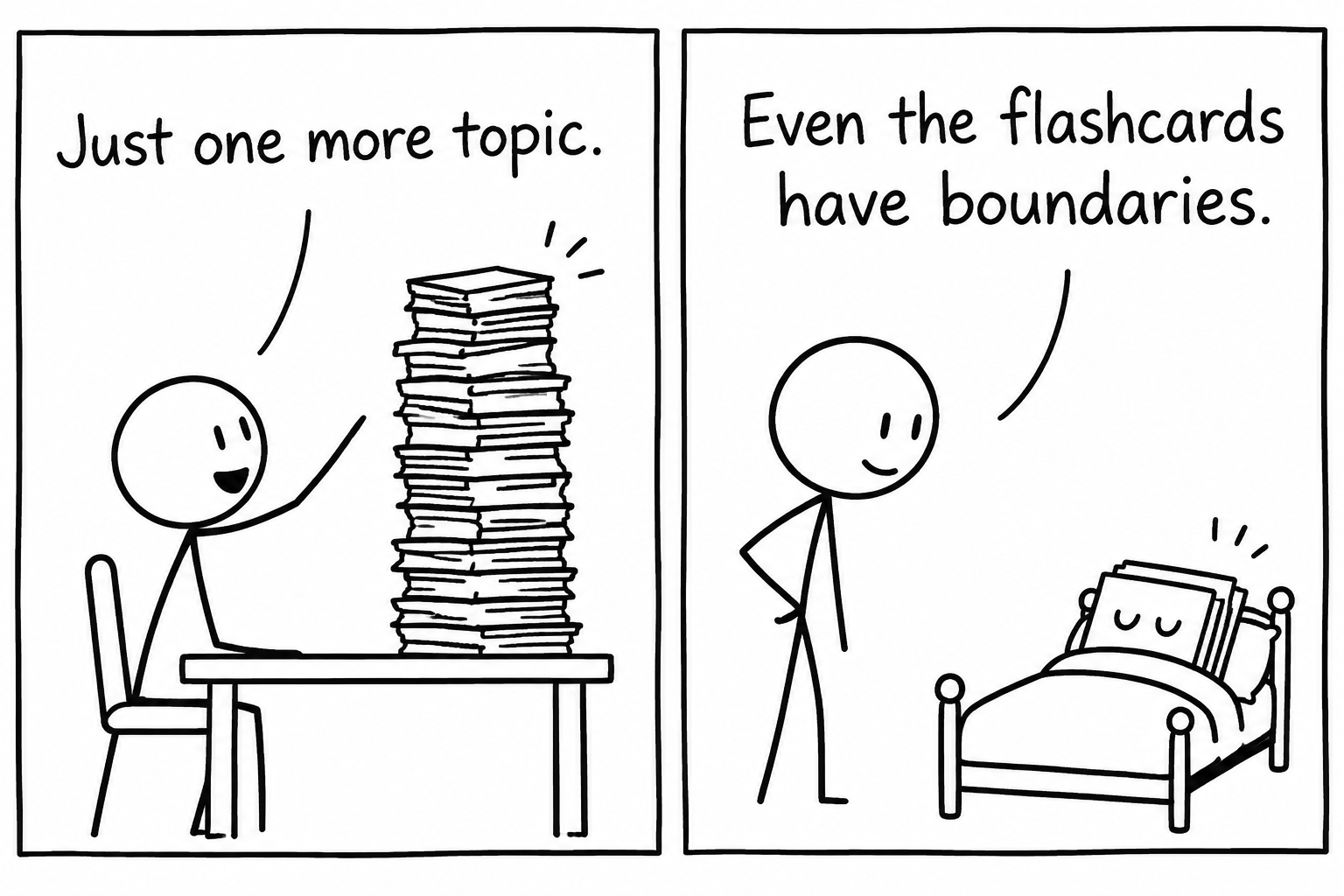 A stick-figure student discovers that even an ambitious pile of revision cards needs a bedtime
Make the time before bed useful
Before opening your notes, decide what you want to be able to do by the end of the session.
For maths, attempt questions independently, check the mark scheme and identify why an answer went wrong. A missing method, a misunderstood question and an arithmetic slip need different responses. MathsGenie's practice questions, revision lessons and video solutions can support that correction process.
For other subjects, recall an explanation or essay plan before checking your notes. Then return to the material in a later session. Leaving a topic for another day is part of revision planning when you have deliberately scheduled its return.
Give a timed past paper enough space for both the attempt and the review. Starting one too close to bedtime creates a predictable conflict between finishing and sleeping.
The guide to GCSE revision hours explores workload further. A useful measure is whether a session revealed or repaired a gap in understanding.
Help sleep happen without making it a project
Keep your waking and bedtime routine reasonably consistent where possible. Leave demanding revision outside the wind-down period, and choose something quieter as you approach bed.
Caffeine can make falling asleep harder. Tea, coffee, cola and energy drinks deserve attention, especially later in the day. NHS children's sleep guidance advises avoiding caffeine after lunch.
If checking messages or comparing progress draws you back into work, leave the phone away from the bed. Aim for a routine you can repeat.
What parents can do at stopping time
In the imagined evening, the parent can ask what will happen to the unfinished task tomorrow. That addresses the student's worry more directly than repeatedly telling them to stop.
Agree a finish time earlier in the day. Help make room for meals, a quieter final half-hour and preparation for the morning. Avoid treating time at the desk as proof of progress.
The guide to supporting revision without nagging develops this approach. For A Level students, offer practical support while leaving them ownership of their work.
Common mistakes that make evenings harder
Borrowing from sleep whenever the plan slips. If this happens repeatedly, reduce or redistribute the workload. The GCSE maths revision timetable guide can help you schedule priority topics.
Counting passive time as progress. Rereading familiar pages may feel reassuring without showing whether you can apply them. Include an independent attempt and a check.
Treating one poor night as a verdict on the exam. A difficult night does not determine your result. Return to your usual routine where possible.
Ignoring persistent difficulties. If sleep problems continue, affect daily life or involve significant anxiety, speak to a GP. Students can also involve a trusted adult or school support team.
The student still has unfinished revision. What changes is that the next task has a place tomorrow, so stopping no longer means abandoning it.
Use MathsGenie's Revision Planner to give your revision a clear place before bedtime.















