

GCSE revision: how parents can help without nagging
GCSE revision without nagging: practical ways parents can support English Lit (and maths) with routines, calm check-ins, and YesGenie resources.
Parents often mean well. They see a countdown to the GCSE exams, they feel the pressure second-hand, and they reach for the only tool that feels available: reminders. But to a tired student, reminders sound like judgement. If you are revising for GCSE maths while also juggling English Literature essays, it can feel like you are being asked to sprint two marathons at once, and being told to sprint faster.
This guide is a way out of that loop. It shows how parents can support GCSE English Literature revision without nagging, while still helping you protect time for maths revision (because you do not want a great quote analysis to cost you easy marks in algebra). The aim is calm structure, not constant commentary.
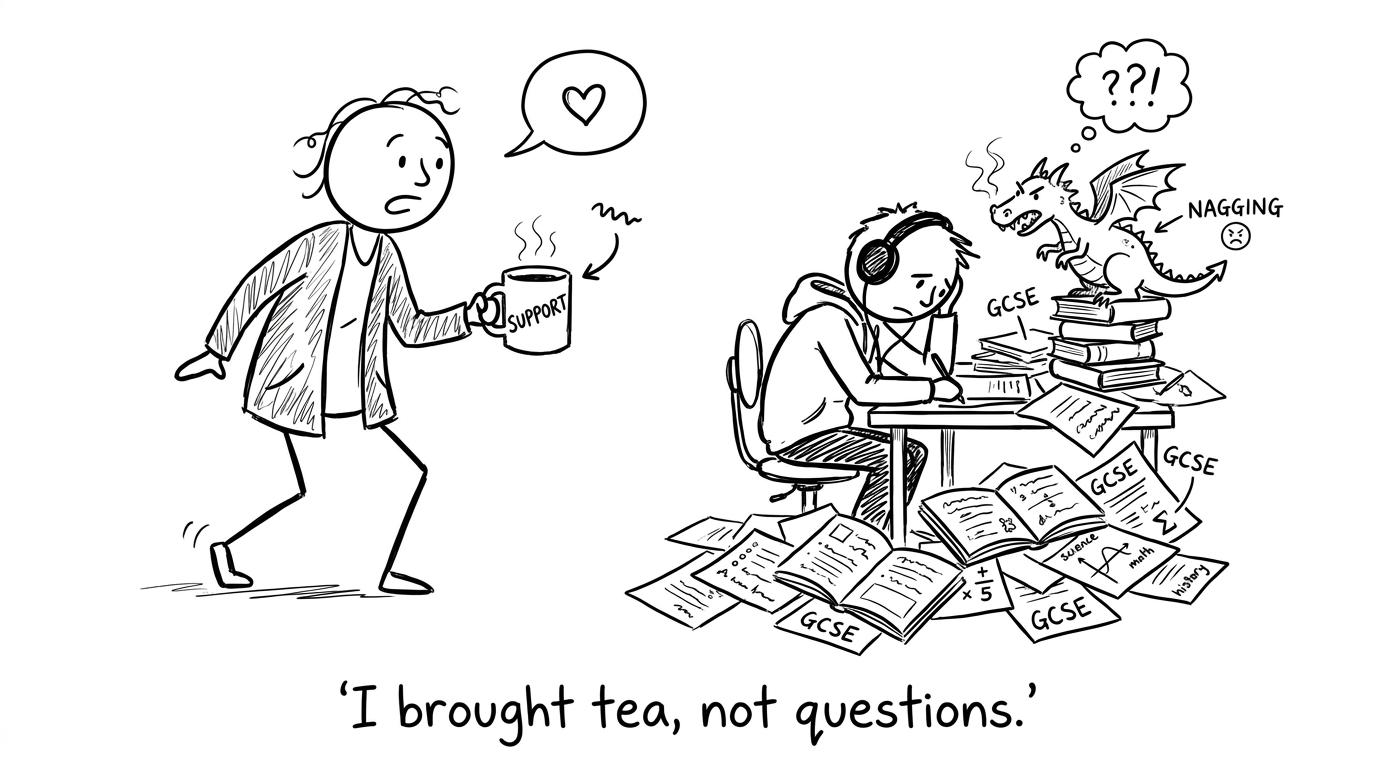 A parent arrives with tea, not questions
The non-nagging support checklist (parents can screenshot this)
If your parent asks what “helpful” looks like, give them this list. It is simple on purpose.
- Agree a revision window (start time, end time, and breaks) rather than a vague “do more”.
- Ask one good question per day, not ten small ones.
- Make revision visible (a plan on the fridge) and keep conversation low-pressure.
- Encourage active recall and exam practice, not endless rereading.
- Use mark schemes as feedback, not as a weapon.
- Protect sleep and routines in the final stretch.
- Treat English Literature and maths like different sports with different training.
Why nagging backfires (and what to do instead)
Nagging usually fails for one quiet reason: it targets intention, not friction. Most GCSE students already intend to revise. The problem is the tiny obstacles: not knowing where to start, feeling behind, feeling judged, or not having a clear next step.
A better parent script is to reduce friction. That means offering practical help that makes the next action easier. For English Literature, that might be printing a blank essay plan or timing a 25-minute paragraph sprint. For maths, that might be opening a topic page and saying, “Pick one mini test to do now.”
If you are the student, you can set the terms. “Please ask me at 19:3019:3019:30 what I am doing tomorrow, not every hour today.” A boundary is not rudeness. It is revision hygiene.
The best support sounds like choices, not commands
The difference between support and pressure is usually a single word: “which”.
Instead of “Have you revised?” (which invites defence), a parent can ask:
- “Which text are you focusing on today?”
- “Which question type feels hardest?”
- “Which small win would make tonight feel successful?”
And for maths revision, the same works:
- “Which topic are you targeting on YesGenie?”
- “Which paper will you do this weekend?”
When you hear choices, your brain stays in problem-solving mode. When you hear commands, it goes into self-protection.
A two-subject plan that stops English taking over your maths
English Literature revision expands to fill the time you give it. Essays are never “finished”, quotes are never “enough”, and you can always reread one more chapter.
Maths is different: it rewards targeted practice and clear feedback. So if you are revising both, you need a plan that respects how marks are earned.
A simple weekly balance looks like this:
- 444 short maths sessions (skills and accuracy)
- 222 longer English Literature sessions (planning and timed writing)
- 111 mixed session (maths paper + English paragraph)
Parents can support by protecting the time blocks rather than policing the content.
For maths structure, use YesGenie’s:
- Edexcel GCSE Maths Lessons for bite-sized learning when you are stuck
- Edexcel GCSE Maths Revision Guides when you need a clear summary and method
- GCSE Past papers when you need exam reality
Worked example: turning “revision time” into a plan you can actually follow
Parents often ask for “a plan”. Students often hear “a trap”. The compromise is a plan that is specific, short, and changeable.
Say you have 141414 days until a maths mock, and you want to complete 666 mini tests and 222 full papers.
Total tasks: 6+2=86 + 2 = 86+2=8.
If you revise on 888 different days, that is 111 task per day. But most students lose at least 222 days to life (tiredness, other homework, family events). So build in slack.
Plan for 101010 revision days:
Tasks per day=810=0.8 \text{Tasks per day} = \frac{8}{10} = 0.8 Tasks per day=108=0.8That tells you something useful: most days should be “one small thing”, and a couple of days can be rest or catch-up.
A parent can help by saying, “Do you want your 0.80.80.8 task today to be a mini test or a paper section?”
For the “small thing”, YesGenie mini tests are ideal:
How parents can support English Literature revision without nagging
English Literature feels personal. You are writing about themes like power, guilt, love, ambition. When someone interrupts you mid-thought, it is not just annoying; it is like being pulled out of a film.
Here are support behaviours that work, without turning into pressure.
Create a “quiet default” in the house
A quiet home is not silent. It is predictable. Parents can agree on a household signal: headphones on means “do not speak unless urgent”. A closed door means “knock once, then leave”. A kitchen timer means “break time”.
This matters because deep work has a start-up cost. Every interruption makes you pay that cost again.
Help with inputs, not outputs
Outputs are essays, paragraphs, quotes memorised. Inputs are pens, space, printing, and time.
Parents can ask: “What would make it easier to start?” That might be:
- printing a past question
- making a snack
- setting a 252525-minute timer
They should not ask to read your work unless you offer. That is the line between help and surveillance.
Use “one check-in” per day
Pick one time, same every day, and keep it short: 222 minutes.
A strong check-in question is: “What is tomorrow’s first task?” If you can answer that, you are organised. If you cannot, you have found the real problem.
Keeping maths moving while English feels heavy
A lot of students drift into English because it feels like “effort”, while maths feels like “being wrong”. The trick is to make maths smaller and more frequent.
If you are stuck on algebra, do one focused lesson and one focused set of questions, then stop.
For example, if simplifying algebra is a weakness, run a short loop:
- Learn the method
- Do a few questions
- Check the method against solutions
YesGenie pages to make that easy:
Worked example: a quick maths method you can do between English paragraphs
You do not need a full hour to make progress in maths. Here is a 666-minute win: collecting like terms.
Simplify:
3x+7−2x+5 3x + 7 - 2x + 5 3x+7−2x+5Group like terms:
(3x−2x)+(7+5) \left(3x - 2x\right) + \left(7 + 5\right) (3x−2x)+(7+5)Compute:
1x+12=x+12 1x + 12 = x + 12 1x+12=x+12That is it. Small, clean, banked.
Parents can support this by respecting “micro-sessions”: “Do you want a 666-minute maths win now, or after your next English paragraph?” Not “Have you done maths today?”
Use exam practice as the shared language (not motivation speeches)
Motivation speeches are fragile. Exam practice is solid.
For maths, exam practice means past papers, predicted papers, and mark schemes. You do not need to guess whether you are improving; you can see it in marks and timing.
Use:
- Edexcel GCSE Maths Past Papers
- Edexcel GCSE Maths Predicted Papers
- YesGenie Resources hub to find predicted papers and other revision tools
A parent’s role here is practical: printing papers, giving you a quiet hour, and helping you review what happened after (without blame).
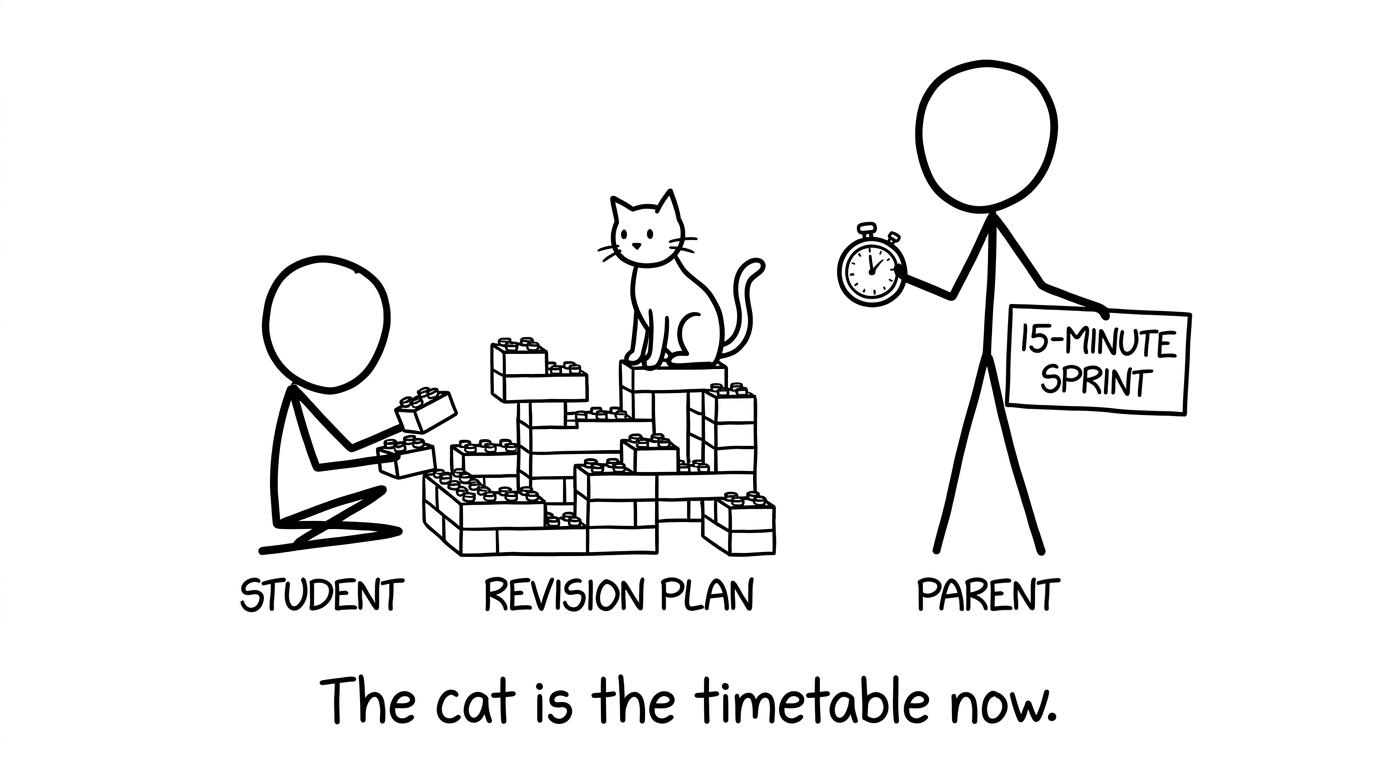 A student builds a revision plan, then the cat sits on it
Common mistakes (what “help” accidentally becomes)
- Turning every conversation into a progress check. If every chat becomes “revision talk”, students start avoiding the kitchen.
- Confusing time spent with marks gained. Two hours highlighting is not the same as 303030 minutes of exam questions.
- Fixing the mood instead of the next step. Anxiety is not solved by “calm down”; it is solved by a clear first action.
- Comparing siblings or friends. GCSE grades 999-111 are not a personality test, and comparison kills motivation.
- Overloading weekends. A Saturday packed with revision collapses by Sunday evening; pacing wins.
- Helping with English by correcting everything. English Literature needs confidence and voice. Too much correction feels like takeover.
- Ignoring foundation vs higher tier realities in maths. The right papers and question styles depend on tier and exam board.
A quiet agreement that improves GCSE revision fast
If you only take one idea from this, make it this: replace repeated reminders with one agreed routine. That routine gives parents peace (because something is happening), and it gives you breathing room (because you are not being constantly checked).
And if you are a GCSE maths student reading this: protect your maths marks with the same seriousness you give to English essays. Use YesGenie to keep your revision focused: learn methods through revision lessons, practise with topic questions and mini tests, then move into past papers and predicted papers with mark schemes and video solutions.
Build momentum the simple way: pick one topic today, one paper this weekend, and keep going. Your future self will not remember the nagging. They will remember the calm plan that finally made revision feel possible.










