

GCSE ICT Tutor: Do You Really Need One?
GCSE ICT tutor advice: learn when one-to-one support may help, how to measure progress, and what to check before choosing a safe, suitable tutor.

A difficult mock can make tutoring feel like the obvious next step. Yet a low mark does not always mean you need more teaching. Sometimes you need the correct specification, better practice or a revision plan that gives weak topics enough attention.
A GCSE ICT tutor may help when you have persistent, identifiable gaps that lessons and independent revision have not resolved. The right tutor should diagnose those gaps, teach them clearly and make you increasingly independent. But if the real problem is missing resources, inconsistent practice or unclear feedback, you may be able to fix it without paying for tuition.
The decision is less about whether tutoring is “good” and more about whether it solves your particular problem.
First, check what qualification you actually take
Students often use “GCSE ICT” as a general name for several different digital qualifications. Depending on your school and location, your course may officially be called GCSE Computer Science, GCSE Digital Technology or another digital or vocational qualification.
That distinction matters. Current courses offered by boards such as AQA, Pearson Edexcel, OCR, Eduqas and WJEC do not all assess identical content in identical ways. A course might include programming, algorithms, data representation, computer systems, networks, cyber security, digital applications, written examinations, on-screen tasks or non-examined assessment.
Before contacting a tutor, write down:
- the exact qualification title and specification code;
- your exam board;
- your examination year;
- the components or units you take;
- any permitted programming language;
- your latest teacher feedback and mock results.
Do not hire someone merely because their profile says “ICT”. They must understand the precise qualification you are preparing for. Specifications can change, and arrangements may differ between England, Wales and Northern Ireland, so confirm everything with your school and the current exam-board specification.
A quick GCSE ICT tutor decision checklist
Tutoring is worth considering if several of these statements are true:
- You repeatedly get stuck on the same defined topics.
- You cannot explain why marks were lost after reading the mark scheme.
- Your teacher has identified a substantial knowledge or programming gap.
- You understand ideas in class but cannot apply them to unfamiliar questions.
- You need structured feedback that school support cannot currently provide.
- Independent revision has been consistent but has produced little improvement.
- A tutor can teach your exact board, course and assessment format.
Try self-directed revision first if the main issue is that you rarely practise, have not checked the specification, avoid marking work or revise passively. A tutor cannot make practice optional. They can improve its direction.
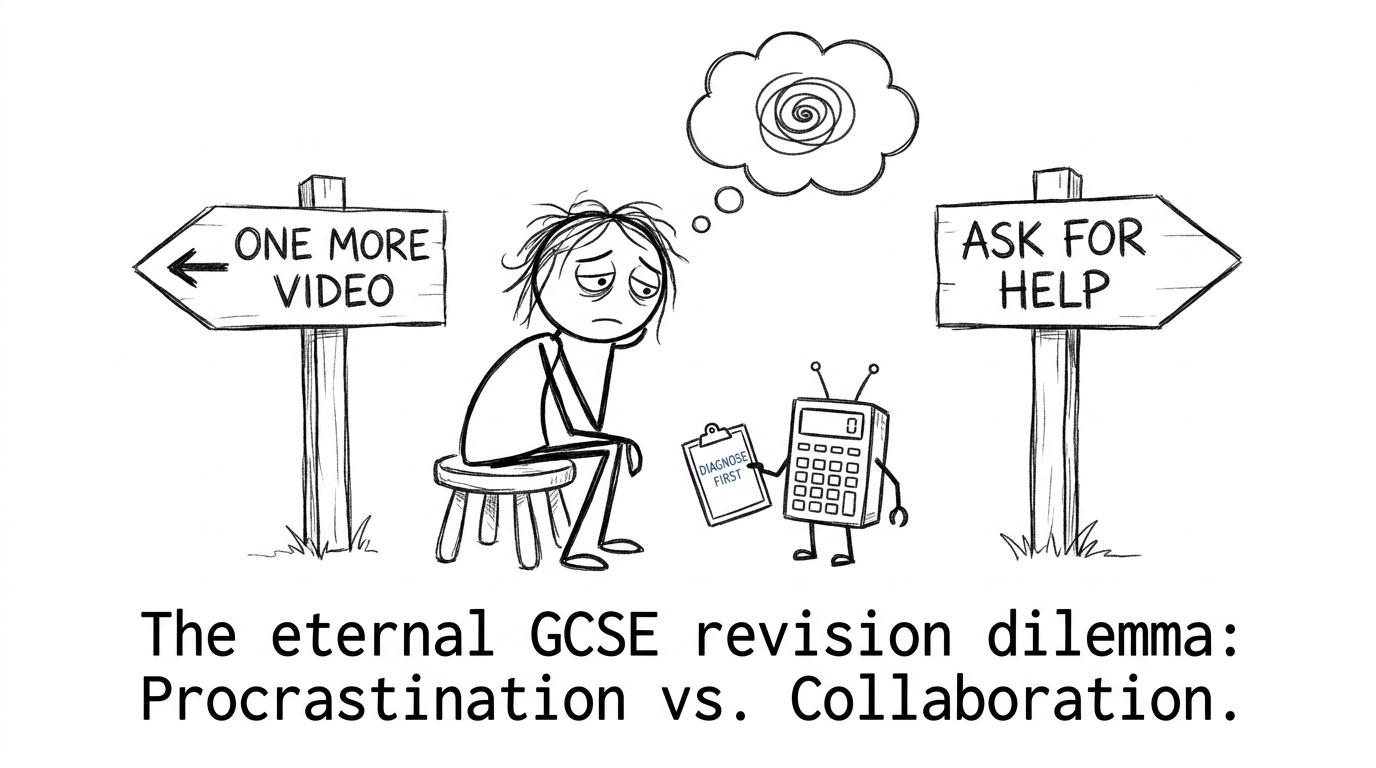 A student choosing between another video and asking for targeted help
How to tell whether a tutor would actually help
Identify the bottleneck, not just the disappointing mark
A total mark hides several different problems. Review recent assessments and sort lost marks into categories:
- Knowledge: you did not know the required fact or concept.
- Application: you knew the content but could not use it in context.
- Programming: you struggled to design, trace, write, test or debug code.
- Exam technique: your answer lacked sufficient detail or precise terminology.
- Timing: you knew what to do but could not finish.
- Revision habits: the material had not been practised or revisited.
Tutoring is most useful when the tutor can act on the category. “I am bad at ICT” is too vague. “I cannot trace loops accurately” or “I lose extended-response marks because my explanations lack context” gives a tutor something teachable.
This diagnostic approach also protects your maths revision time. If GCSE ICT is taking over your week because every topic feels equally urgent, use the same evidence-led process you would use in maths. MathsGenie’s guide to finding your weakest GCSE topics demonstrates how marks can be converted into a manageable repair list rather than a general feeling of panic.
Run a short independent trial
Before committing to ongoing tuition, spend a defined period following a stricter routine:
- choose one weak area;
- review the relevant specification statements;
- retrieve the ideas without notes;
- answer suitable exam-style questions;
- mark the work carefully;
- record the precise cause of each error;
- revisit the same area later without support.
If you improve, your problem may have been structure rather than access to a tutor. If you remain stuck despite honest, regular practice, targeted teaching becomes a more reasonable next step.
For maths, you can run this trial using the free GCSE Maths revision hub, where board-specific lessons, questions and papers make weaknesses easier to identify. The Edexcel GCSE Maths mini tests are particularly useful when you want a short diagnostic rather than another full paper.
Ask what the tutor will change
A good prospective tutor should be able to describe a process. It might involve an initial assessment, a topic plan, targeted practice, marked independent work and regular reviews of progress.
Be cautious if the plan is simply to “go through the course” from the beginning. That may waste time on material you already understand. Effective tuition should be specific enough that you can answer three questions after each session:
- What weakness did we address?
- What can I now do that I could not do before?
- What must I practise independently next?
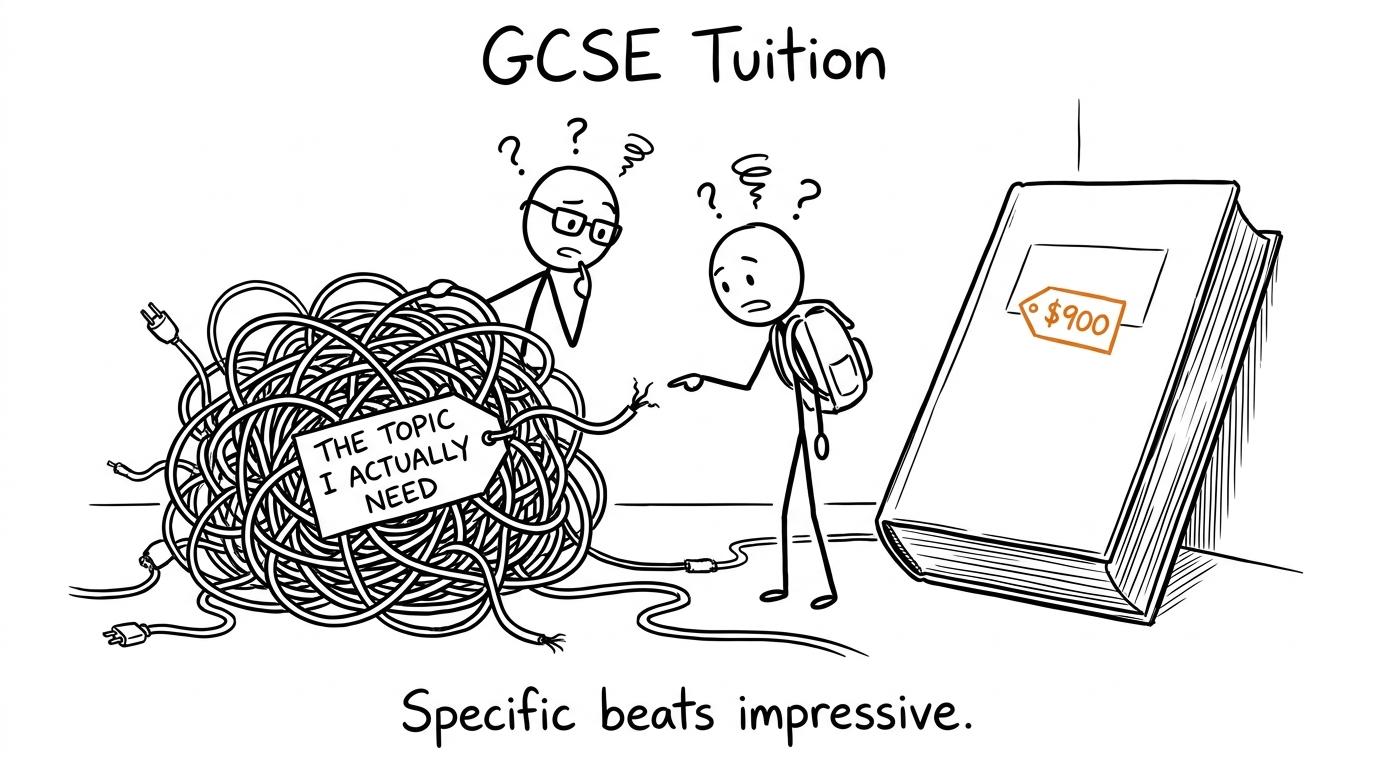 A tutor and student finding the specific topic hidden in a tangled cable
What to look for in a GCSE ICT tutor
Exact specification knowledge
Ask which boards and qualification versions the tutor currently teaches. They should be willing to check your specification rather than assuming every course is interchangeable.
If programming is assessed, ask which languages they teach and how they develop code tracing, problem decomposition, testing and debugging. If your course includes extended written responses or assessed digital work, ask how they teach those particular demands without completing work for the student.
Clear teaching followed by independent practice
A tutor who talks fluently for an hour may appear impressive while giving you little opportunity to think. Look for sessions that combine concise explanation, questioning, independent attempts and feedback.
The aim is not to become good at following the tutor. It is to perform without the tutor in an examination. That is the same principle behind productive maths revision: learn the method, practise it, mark it and return to it later. MathsGenie’s Edexcel GCSE Maths revision pathway is built around that movement from explanation to independent questions.
Evidence of progress
Agree on what improvement will look like. Useful evidence might include greater accuracy on unseen questions, stronger explanations, fewer repeated coding errors or improved completion under timed conditions.
Do not judge progress only by whether sessions feel comfortable. Learning can feel smooth when help is available and disappear when it is removed. Periodic unaided tasks give you better evidence.
A simple review cycle is:
- diagnose a weakness;
- teach and practise it;
- complete an unseen check without prompts;
- record remaining errors;
- decide whether to continue, adapt or stop tuition.
Safeguarding, identity and references
Private tutoring is not a single uniformly regulated profession, so a parent or carer should check suitability rather than relying on an advertisement. Ask about identity, relevant qualifications, recent references, safeguarding arrangements and the appropriate criminal-record check for the tutor’s role and UK nation.
In England and Wales, DBS eligibility and check levels depend on the activity and circumstances. A certificate is useful evidence at a particular time, not a guarantee of safety. Parents should consider the whole picture, including professional boundaries, references and transparent lesson arrangements. Scotland and Northern Ireland use different checking systems.
For online tuition, agree which platform will be used, how communication will take place and whether a parent or carer can monitor arrangements. Sessions should occur in an appropriate shared or observable environment, not through private, informal accounts hidden from adults.
A trial lesson without a long commitment
A trial should reveal whether the tutor listens, adapts explanations and gives you enough thinking time. Afterwards, ask whether the tutor identified a specific weakness and proposed a credible next action.
Avoid a large advance commitment before you understand the teaching style, cancellation terms and safeguarding arrangements. A suitable tutor should be confident enough to let the quality of the plan speak for itself.
Protect your maths revision while getting ICT support
Students preparing for several GCSE exams face an allocation problem: every extra hour spent on one subject is unavailable to another. Tuition should therefore reduce confusion, not simply add another appointment to an overcrowded week.
Keep subject plans separate. Your ICT tutor should address defined digital-course needs, while your maths revision should continue to follow your board and tier. If you take Edexcel, use the Edexcel GCSE Maths past papers to collect evidence about lost marks. The guide to when you should start GCSE past papers can help you balance topic repair with timed practice.
Nearer the maths exams, GCSE predicted papers can provide fresh mixed practice. They should supplement official past papers, not replace them. Use mark schemes and video solutions to understand errors, then return to the relevant revision lesson or practice questions.
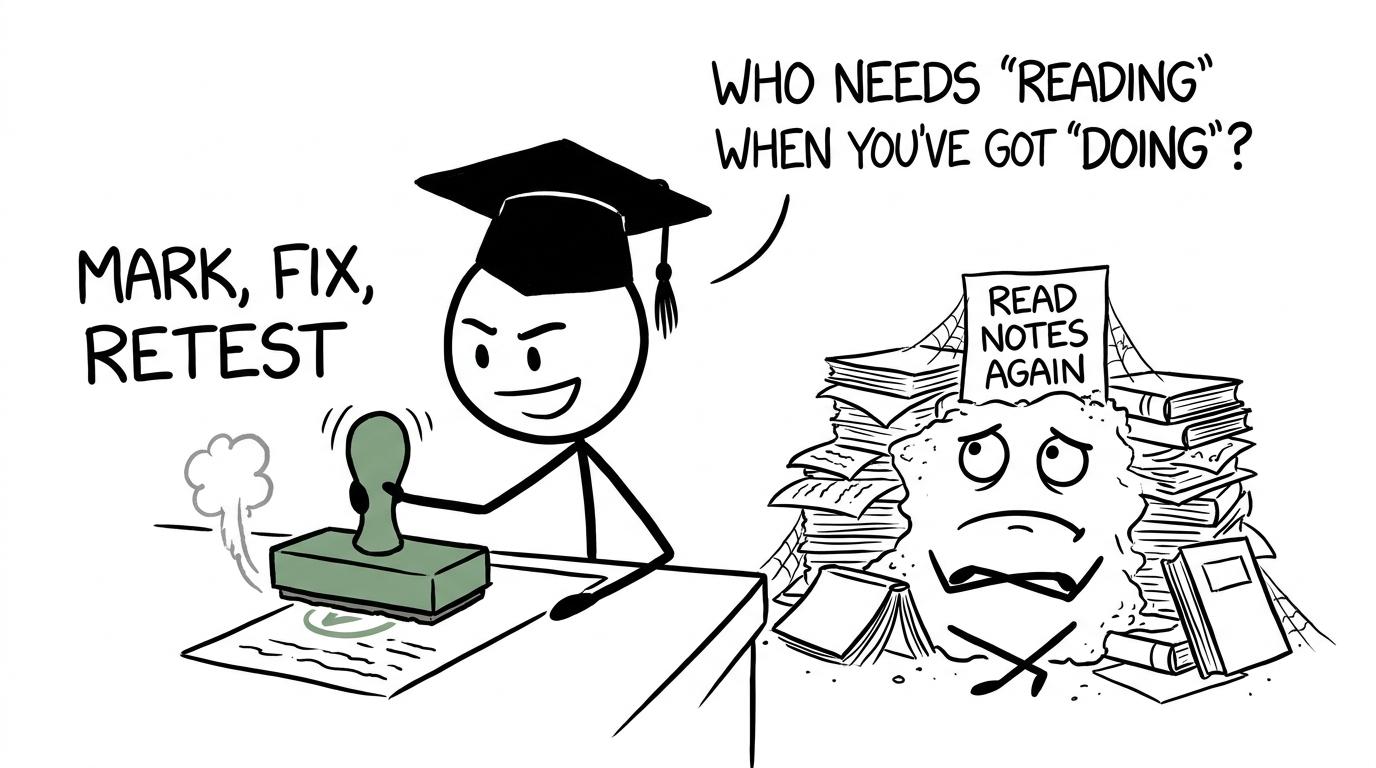 A student stamping mark, fix and retest while old notes gather dust
Common mistakes when choosing ICT tuition
Hiring before diagnosing the problem
A tutor cannot target a weakness that nobody has defined. Review assessments and teacher feedback first.
Choosing a general computer expert
Professional technical experience can be valuable, but it does not automatically mean someone understands GCSE specifications, command words or mark schemes. Subject expertise and qualification-specific teaching are different skills.
Ignoring the exact course title
“GCSE ICT” may not be the formal name of your qualification. Hiring for the wrong board or course can lead to irrelevant content and misleading exam advice.
Letting the tutor do too much
If every task is completed with hints, polished by the tutor or corrected immediately, apparent progress may vanish in the exam. Insist on unaided checks and independent work between sessions.
Measuring attendance instead of improvement
Completing many sessions is not evidence that tuition works. Review unseen work, repeated error patterns and feedback from school. If progress stalls, change the plan rather than automatically booking more lessons.
Neglecting safeguarding checks
A friendly profile or personal recommendation does not replace identity checks, references, suitable criminal-record information and transparent arrangements. Parents and carers should remain involved.
Make the decision from evidence
You do not need a tutor simply because GCSE ICT feels difficult. You may benefit from one when the difficulty is persistent, specific and resistant to well-structured independent practice. Choose someone who understands your exact qualification, teaches towards independence, measures progress and takes safeguarding seriously.
Then keep the rest of your revision steady. For maths, start with MathsGenie’s free GCSE Maths revision resources, use revision lessons and practice questions to repair individual skills, and build towards mini tests, past papers and predicted papers. Mark each attempt with the available mark schemes and use video solutions when you need to see where a method changed.
The best support does not make you dependent on more support. It helps you recognise the next step, and eventually take it alone.










