Short Breaks vs Long Break: GCSE Panjabi Revision
Short breaks vs long break GCSE Panjabi: what research suggests, how to plan focused revision, and when a longer rest is wiser during exam season.
Revision can fail quietly. You are still at the desk, the book is still open, but the last few lines have stopped becoming memories. When students compare short breaks vs long break GCSE Panjabi revision, the practical answer is that several planned short breaks will usually support concentration better during a long session. A longer break becomes more useful after demanding work or between separate sessions.
The important word is planned. Research does not identify one perfect break formula for every student, and evidence specifically involving GCSE Panjabi learners is limited. However, studies of self-directed learning, micro-breaks and spaced practice offer a sensible starting point: work in focused blocks, stop before fatigue takes control, and return with a specific retrieval task.
That principle transfers directly to GCSE maths revision, where sustained attention matters just as much as time at the desk.
The short answer
A balanced approach looks like this:
- Use focused revision blocks of roughly 202020 to 303030 minutes when learning vocabulary, grammar or mathematical methods.
- Take a short break of around 333 to 777 minutes between blocks.
- Make the break genuinely restorative: stand up, move, drink water or look away from the screen.
- After several blocks, or after an especially demanding task, take a longer break of around 151515 to 303030 minutes.
- Revisit material on later days rather than trying to finish an entire topic in one sitting.
- Test yourself after the break instead of simply rereading.
Treat these durations as a starting experiment, not a scientific law. The quality of the work and the break matters more than copying a fashionable timer exactly.
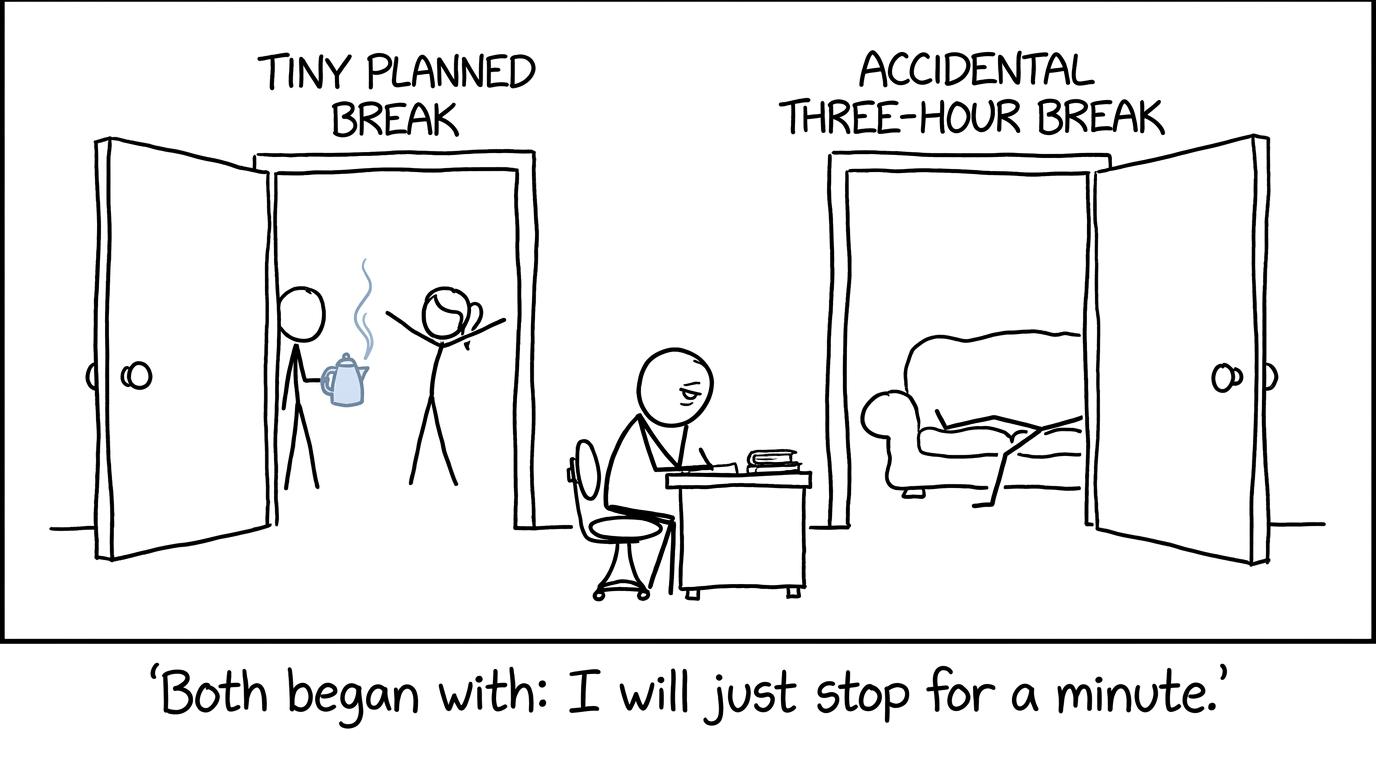 A student discovers how a one-minute break can become an afternoon
What the evidence suggests about revision breaks
The evidence gives a more nuanced answer than “short is always better”. Several short breaks can protect attention and reduce fatigue, but demanding work may sometimes require a more substantial recovery period.
A 202320232023 experiment involving university students compared self-chosen breaks with two systematic patterns: a 333-minute break after 121212 minutes of work, and a 666-minute break after 242424 minutes. Students using predetermined breaks reported better concentration, less fatigue and less distraction than those deciding for themselves when to stop. Task completion did not differ significantly, so the result supports planned breaks without proving one precise schedule is superior.
A meta-analysis of micro-breaks lasting up to 101010 minutes found small benefits for energy and fatigue. It did not find a reliable improvement in overall task performance, and more cognitively demanding tasks appeared to need longer recovery. That distinction matters. A quick vocabulary check is not mentally identical to writing an extended response or completing a difficult higher-tier problem.
More recent classroom research has also reported stronger attention and quiz performance with frequent micro-breaks, but much of this research involves university students rather than GCSE candidates. It is therefore best used as guidance, not as a promise about grades.
Break frequency and spacing are different ideas
A break separates two blocks within the same revision session. Spacing means returning to material after a longer gap, often on another day.
Spacing has the stronger and broader evidence base for long-term retention. Government education guidance and research reviews consistently support revisiting knowledge over time and retrieving it from memory rather than relying on massed rereading.
For GCSE Panjabi, that might mean returning to vocabulary, script recognition, grammar and productive language across the week. For GCSE maths, it means revisiting algebra, ratio or geometry after you have begun to forget the method. MathsGenie’s GCSE maths revision hub makes this easier by organising lessons, questions, papers and short topic-focused tests in one place.
Why dense subjects benefit from several stopping points
GCSE Panjabi revision can involve several kinds of mental work: recognising written forms, retrieving vocabulary, applying grammar, interpreting meaning and producing accurate language. Maths creates a similar load in a different form. You may need to recall a formula, identify a method, carry out several steps and check whether an answer is reasonable.
Working memory has limited capacity. When attention fades, students often keep moving their eyes across a page while processing less of it. A short break can interrupt that decline before an entire block becomes unproductive.
Several stopping points also create opportunities to change the kind of retrieval. You might finish one block, take a short break, and then begin by recalling what you learnt without looking. In maths, you can watch a revision lesson, pause, and return to answer practice questions independently. The break is useful because it prepares the next act of thinking. It is not useful merely because the timer rang.
When one longer break is the better choice
Short breaks are not a cure for genuine exhaustion. Choose a longer rest when:
- you have completed several focused blocks;
- you have just finished an extended writing or timed-paper task;
- repeated rereading is no longer producing understanding;
- mistakes are increasing despite knowing the material;
- you are hungry, physically uncomfortable or noticeably tired;
- your next task requires sustained exam-level concentration.
A longer break can also create a clear boundary between subjects. Moving directly from intensive Panjabi writing into a GCSE maths paper may carry fatigue from one task into the next. A proper pause, followed by a clear restart routine, is more sensible than pretending all desk time has equal value.
For longer maths tasks, build stamina gradually. The advice in how to use GCSE past papers properly explains why a paper should be followed by marking, error analysis and targeted repair. Once you begin a full timed paper, however, follow the official conditions rather than inserting extra breaks that will not exist in the examination.
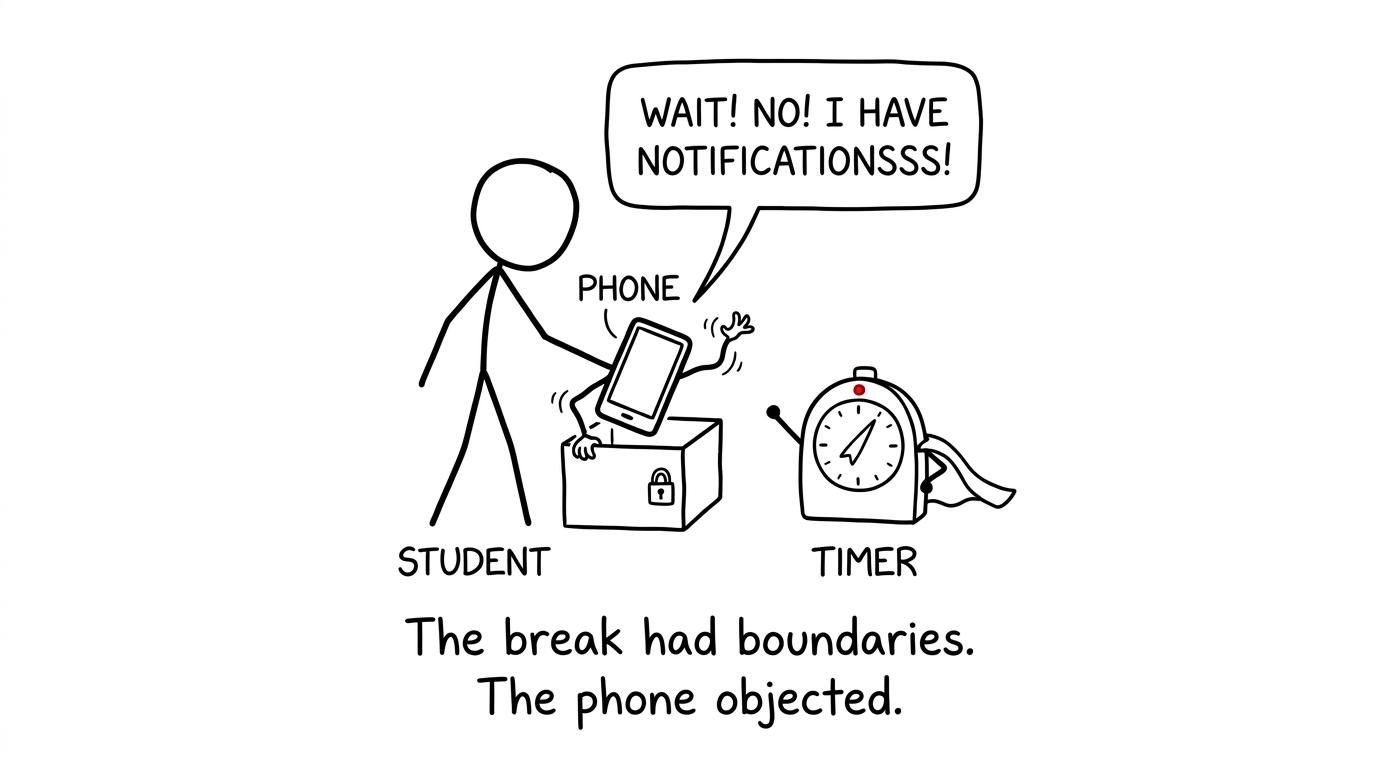 A revision break guarded from an extremely determined phone
A practical rhythm for Panjabi and maths revision
The best schedule is one you can repeat without constantly renegotiating it. Start with a simple pattern and adjust it according to your concentration and the task.
| Revision task | Focus block | Suggested break |
|---|---|---|
| Vocabulary or quick recall | 151515 to 202020 minutes | 333 to 555 minutes |
| Grammar, translation or topic practice | 202020 to 303030 minutes | 555 minutes |
| Difficult higher-tier maths questions | 252525 to 404040 minutes | 555 to 101010 minutes |
| Several completed blocks | About 606060 to 909090 minutes in total | 151515 to 303030 minutes |
| Full timed paper | Follow official paper conditions | Break after completion |
These are flexible ranges rather than universal rules. If you consistently reach the end of a block with good concentration, extend it slightly. If your attention disappears much earlier, shorten the block and remove distractions before assuming that you need more breaks.
A GCSE maths revision timetable can help you place these blocks across the week. Use the MathsGenie revision planner to decide what you will cover, but leave enough space for marking and correcting mistakes. A schedule that allocates every minute to new content leaves no room for learning from errors.
Give every block an outcome
“Revise Panjabi” or “do maths” is too vague. A focused block needs a finish line, such as retrieving a vocabulary set, checking a grammar rule, completing a mini test or correcting questions lost on a previous paper.
For maths, begin with the MathsGenie home page or GCSE hub, choose one weak topic, and connect the lesson directly to practice questions. Foundation and higher-tier students should select material appropriate to the paper they will sit, whether their exam board is Edexcel, AQA, OCR or Eduqas.
Make the restart easy
Before leaving the desk, write down the first action for your return. It might be “test the vocabulary without notes” or “complete the next three algebra questions”. This removes a small but costly decision from the restart.
Keep the required page open, leave the correct equipment ready and set a timer for the break. The easier the first minute of returning feels, the less likely the break is to expand indefinitely.
What to do during a short break
A restorative break should change your physical or attentional state. Useful options include:
- standing and stretching;
- walking briefly;
- drinking water;
- looking into the distance after screen work;
- opening a window or moving to another room;
- taking a few slow breaths;
- preparing the equipment needed for the next block.
Scrolling can feel restful because it is different from revision, but it still demands attention and makes the endpoint difficult to control. If your phone regularly turns a 555-minute break into a much longer one, leave it outside the room or use a separate timer.
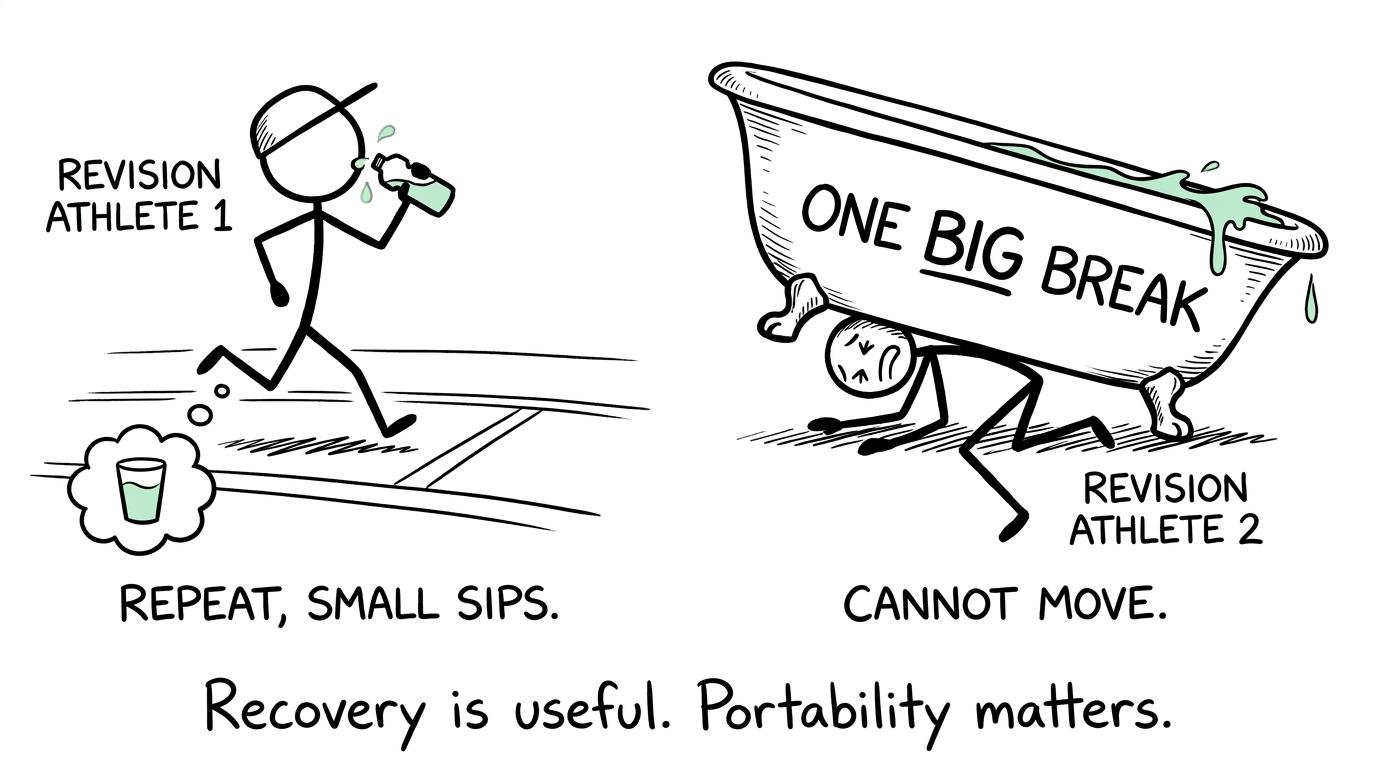 One athlete carries an enormous break while another keeps recovery manageable
Use the return to strengthen memory
The first few minutes after a break are valuable. Do not spend them finding your place and rereading everything. Try to retrieve something before looking at your notes.
For Panjabi, this could involve recalling vocabulary, saying a response aloud or writing what you remember about a grammar pattern. For maths, answer a short question from memory, state the method you need, or return to an earlier error without viewing the solution.
MathsGenie’s mini tests and practice questions are well suited to these short retrieval points. When preparing for longer assessment, follow the paper-mark-fix-retest cycle described in the GCSE past-paper guide. OCR students can also use the OCR past-paper practice guidance to make each completed paper produce a specific revision list.
The same principle remains useful beyond GCSE. A Level students working through Edexcel A Level maths past papers or OCR MEI A Level maths revision need planned recovery, careful marking and spaced reattempts just as much as GCSE candidates do.
Common mistakes with revision breaks
Waiting until concentration has completely disappeared
A break is more effective when it prevents a collapse in attention. Plan stopping points before starting rather than relying entirely on how you feel after fatigue arrives.
Treating the timer as more important than the task
Do not stop halfway through a useful final sentence or a nearly completed question merely because a generic schedule says so. Finish a natural unit of work, then pause.
Using breaks to avoid difficult material
If every challenging question triggers a break, the break has become an escape. Write down what is blocking you, make one serious attempt, and use MathsGenie’s mark schemes or video solutions during the review stage.
Taking breaks without spacing revision across days
Several pauses inside one evening do not replace returning to the material later. Long-term memory benefits from repeated encounters separated by meaningful gaps.
Practising in conditions unlike the examination
Short blocks are excellent for learning and repairing weaknesses. They should not replace occasional full-paper practice. Build towards sustained timed work so that the real examination is not the first time you have concentrated for that long.
Build a rhythm you can trust
The comparison between short breaks and one long break is not really about finding a magical number. It is about managing attention honestly. Several planned short breaks are generally the stronger default for maintaining concentration during dense revision, while a longer break is appropriate after sustained or highly demanding work.
Start small: choose one clearly defined Panjabi or maths task, work for a focused block, take a bounded break, and return with retrieval. Then repeat the material on another day.
MathsGenie gives you the structure for the maths side of that routine: free revision lessons, practice questions, mini tests, past papers, predicted papers, mark schemes and video solutions. Open the GCSE maths revision hub, choose one weakness, and plan both the work and the recovery that will help it stick.