GCSE: Use OCR Past Papers Properly (for Maths Students)
GCSE OCR past papers can transform revision if you use them well. Learn a simple method, mark-scheme strategy, and how to link it back to maths.
If you have ever opened an OCR GCSE Chemistry past paper and felt your confidence leak away in the first two questions, you are not alone. The paper feels like a judgement, not a resource. But a past paper is only scary when you treat it like a final performance. Treat it like practice, and it becomes a map.
This matters even if you are here for maths. Your GCSE season is one timetable, one brain, one set of habits. The way you use OCR past papers in Chemistry is the same skill you need for maths: planning, timing, error-spotting, and learning from the mark scheme.
Along the way, I’ll show you a method that works for OCR GCSE Chemistry past papers, then translate it into the maths habits that actually move your grade from “stuck” to “steady”.
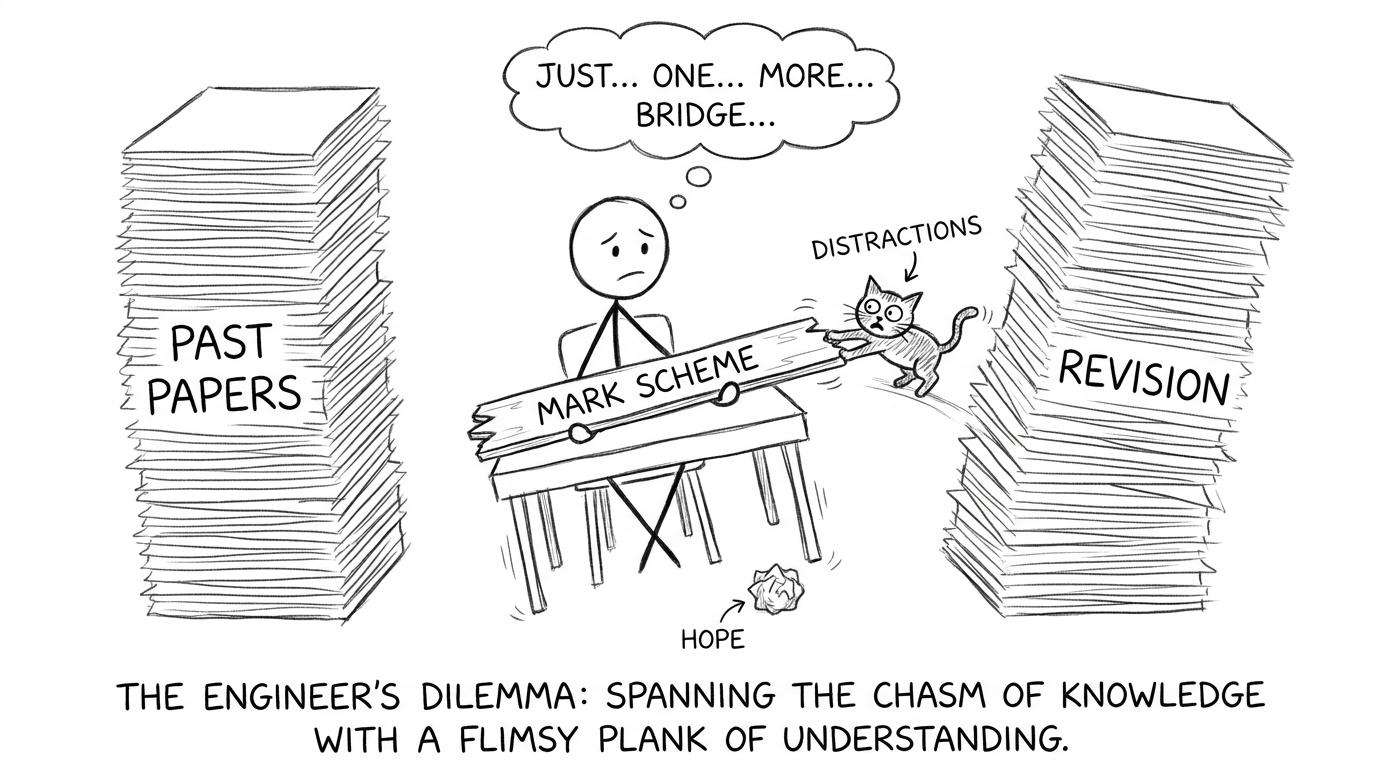 A student building a bridge between past papers and revision using a mark scheme plank
The quick checklist for using OCR GCSE Chemistry past papers
Keep this simple. The best GCSE revision systems are boring in the best way.
- Pick the right paper (OCR, correct year, correct paper). Don’t mix exam boards casually.
- Sit it like an exam first (timed, quiet, no notes).
- Mark it properly with the official mark scheme and be strict.
- Turn mistakes into actions: a short list of skills to practise.
- Re-attempt the same questions a few days later, without looking.
- Cycle: paper, mark, fix, repeat.
For maths, that “fix” step is where YesGenie shines: you can jump straight into topic lessons, practice questions, mini tests, and then back to full papers.
Useful YesGenie pages to keep open in another tab:
- GCSE Past papers
- OCR GCSE Maths revision
- Edexcel GCSE Maths revision
- Edexcel GCSE Maths past papers
- Eduqas GCSE Maths revision guides
Why OCR GCSE Chemistry past papers still help your maths grade
GCSE revision is not just content. It is behaviour.
Chemistry past papers force you to practise:
- Reading precision (what is the question really asking?)
- Writing for marks (method marks, working marks, conclusions)
- Timing (not spending 121212 minutes chasing 111 mark)
- Checking (units, significant figures, sensible answers)
Those are exactly the same levers that lift a maths paper.
A student who marks their OCR GCSE Chemistry paper properly is often the same student who starts getting more method marks in maths, because they stop hiding their thinking.
The “three-pass” method for OCR GCSE Chemistry past papers
When students say they “did” an OCR GCSE Chemistry past paper, they usually mean they looked at it, answered a chunk, then checked the answers. That is not a method. It is hope.
Here is a method.
Pass one: sit it like an exam (even if it’s messy)
- Use the correct time limit.
- No notes, no videos, no mark scheme.
- If you get stuck, write something: definitions, rearrangements, units, a diagram.
This is not about feeling good. It is about collecting honest data.
Pass two: mark like an examiner, not like a friend
Use the OCR mark scheme and apply it literally. Examiners award marks for what you have shown, not what you meant.
Two rules that work across GCSE subjects:
- If there is a method mark, you need visible method.
- If the mark scheme says “accept” or gives a range, you must match that.
Pass three: convert every lost mark into a “next action”
Write a short list:
- Content gap (I don’t know this topic)
- Process gap (I know it, but I don’t do it under time)
- Careless gap (I rushed, misread, wrong unit, calculator slip)
Your goal is to shrink the list each week.
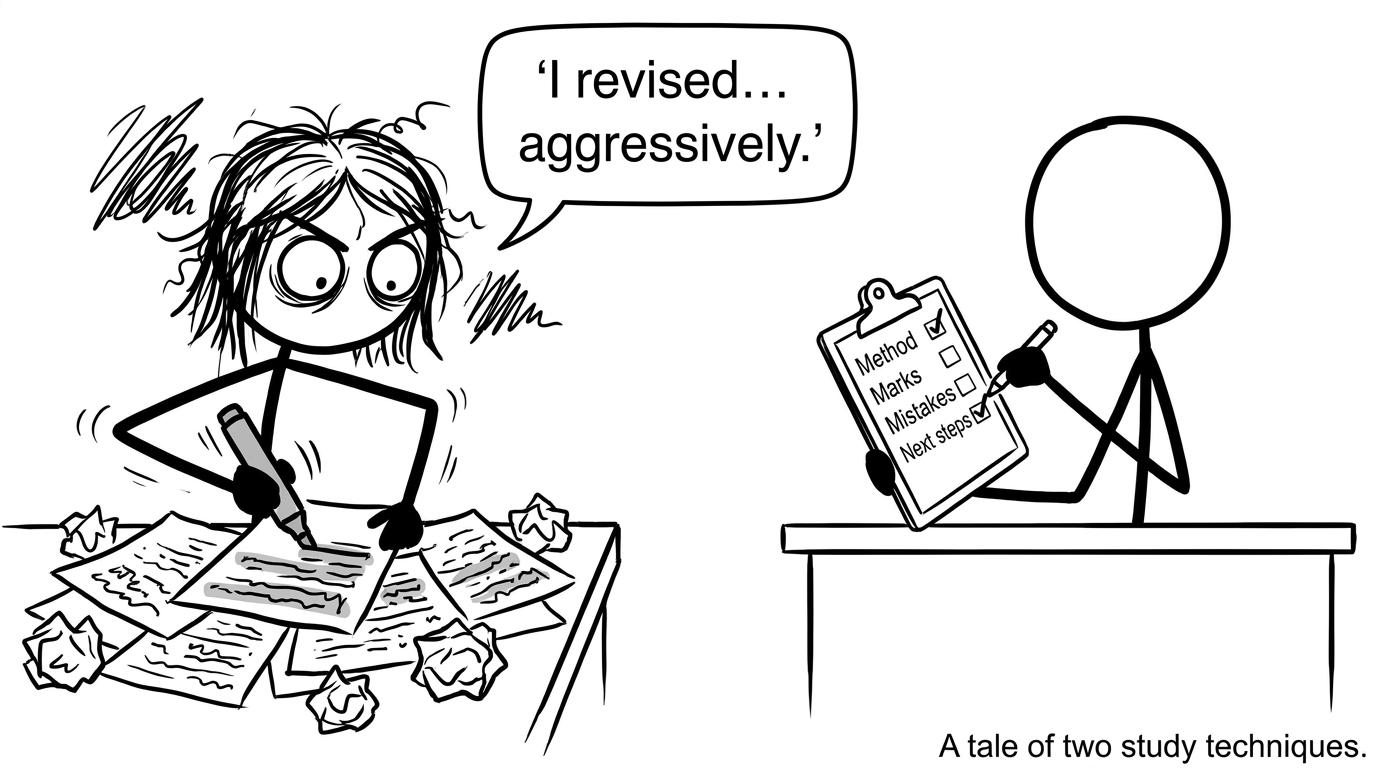 Two students: one highlights everything, one uses a calm checklist
How to use the mark scheme properly (and why most GCSE students don’t)
The mark scheme is not an answer key. It is a set of rules for how marks are awarded.
A powerful GCSE habit is this: for every wrong question, write the mark scheme’s “minimum winning version” of the answer.
In Chemistry, that might mean learning the exact phrasing for required practicals, or the key words for a six-marker.
In maths, it often means learning what counts as method. For example, if you solve a quadratic and only write the final answers, you can lose method marks if the examiner cannot see a valid route.
Worked maths example: method marks are visible marks
Suppose a maths question is: solve x2−5x+6=0x^2 - 5x + 6 = 0x2−5x+6=0.
A full-method solution could be:
x2−5x+6=0 x^2 - 5x + 6 = 0 x2−5x+6=0 (x−2)(x−3)=0 \left(x-2\right)\left(x-3\right)=0 (x−2)(x−3)=0 x=2 or x=3 x=2 \text{ or } x=3 x=2 or x=3If you jump straight to x=2,3x=2,3x=2,3 with no working, you risk losing marks depending on the mark scheme. This is exactly the same logic as OCR GCSE Chemistry: you do not get marks for thoughts you keep in your head.
To practise this in a structured way, use topic practice before returning to full papers:
Timing: how to stop OCR GCSE past papers turning into endurance tests
A GCSE paper is not a test of who can suffer longest. It is a test of who can allocate time wisely.
Use a simple timing rule:
- If a question is worth kkk marks, aim for about kkk minutes.
So a 666-mark question gets about 666 minutes. If you are still stuck, park it, move on, and return later.
Worked maths example: the “park and return” technique
Imagine a question: “A train travels 848484 km in 1.51.51.5 hours. Find the speed in km/h.”
You can set up:
speed=distancetime=841.5 \text{speed} = \frac{\text{distance}}{\text{time}} = \frac{84}{1.5} speed=timedistance=1.584Now calculate:
841.5=8432=84×23=56 \frac{84}{1.5}=\frac{84}{\frac{3}{2}}=84\times\frac{2}{3}=56 1.584=2384=84×32=56So the speed is 565656 km/h.
If you freeze on the decimal division in the exam, you lose time and confidence. But if you park it and come back, you often spot the fraction trick calmly. This is a GCSE skill that transfers directly from OCR Chemistry timing practice.
Build a two-week cycle that uses OCR GCSE Chemistry papers and boosts maths
Here is a routine that respects real life. It is designed for GCSE students doing multiple subjects.
Week one: diagnose and repair
- Day 1: Sit an OCR GCSE Chemistry past paper (timed).
- Day 2: Mark it, build your “next actions” list.
- Days 3-5: Repair the list.
- For maths repairs, use YesGenie lessons and practice sets.
- For paper-style conditioning, use past papers.
Keep these open:
Week two: re-attempt and raise the ceiling
- Day 1: Re-attempt only the questions you dropped marks on (no notes).
- Day 2: Sit a maths paper section (or a full paper if you can).
- Day 3: Mark and repair again.
If you are also doing A Level, keep your paper skills sharp by occasionally timing a section from:
The point is not to do “more”. The point is to do feedback loops.
 A calculator arguing about degrees vs radians
Common mistakes when using OCR GCSE Chemistry past papers
Doing papers too early, too often
If you do OCR GCSE Chemistry past papers before you have built basic knowledge, each paper becomes a confidence hit. Use papers to test learning, not to replace learning. In maths, it is the same: if you do full papers without topic revision, you mostly rehearse your mistakes. A better pattern is topic practice first, then paper practice.
Marking leniently
Giving yourself “basically right” is comforting but expensive. GCSE marks are awarded for exactness: key words, units, correct rounding, clear method. Mark like an examiner, then learn how the examiner thinks. You will feel stricter for a week and then suddenly you will feel calmer in the exam.
Not turning mistakes into a plan
A pile of completed OCR GCSE Chemistry past papers is not revision if you never revisit errors. The same applies to maths: if you never redo the question, you did not learn it, you only experienced it. Keep an error log with short headings like “units”, “rearranging”, “graphs”, “ratio”. Then choose the correct YesGenie lesson or practice set and fix it.
Ignoring command words and structure
Chemistry uses command words like “describe”, “explain”, “calculate”. Maths has its own versions: “show that”, “hence”, “prove”, “estimate”. In both cases, marks are allocated to structure. Practise writing the shape of a good answer, not just the final line.
Bringing it back to YesGenie (and your next GCSE session)
OCR GCSE Chemistry past papers are not just a Chemistry tool. Used properly, they teach you how to behave in an exam: how to allocate time, how to write for marks, how to learn from a mark scheme, and how to turn mistakes into a plan.
That is the same engine that drives maths progress. If you want that engine to run smoothly, build your loop on YesGenie: revise a topic, practise questions, check worked solutions, then move to full papers and predicted-style practice when you are ready.
Start here and make it your routine:
Pick one paper this week. Sit it properly. Mark it properly. Fix what it reveals. That is how GCSE revision stops feeling like guessing and starts feeling like progress.