

Short Breaks vs Long Break for GCSE Latin Revision
Short breaks vs long break GCSE Latin: explore the evidence, plan an effective revision rhythm and protect focus across Latin and GCSE maths practice.
Revision can fail quietly. You remain at your desk, turn the pages and feel busy, yet fewer words are staying in your memory. Dense subjects make this particularly obvious. After a long stretch of Latin vocabulary, grammar and translation, concentration can disappear before motivation does.
So, in the debate over short breaks vs long break GCSE Latin, what should you do? The evidence supports taking several planned short breaks to reduce fatigue and refresh attention. However, short breaks are not proven to improve performance in every cognitively demanding task, and they should not replace occasional longer recovery. A sensible approach is to combine focused revision blocks with breaks of roughly 555 101010 minutes, followed by a longer break after several blocks or whenever genuine mental fatigue persists.
That is not a universal scientific formula. It is a practical starting point which you should adjust using the quality of your recall, translation and maths practice.
The short answer and revision checklist
For most GCSE students, several short breaks are more useful than working continuously and saving one long break until the end. They interrupt accumulating fatigue and make it easier to begin the next task. The best revision plan, however, uses both kinds of break.
- Work towards a specific outcome, not merely a number of minutes.
- Try a focused block of around 252525 to 404040 minutes.
- Take a deliberate break of around 555 to 101010 minutes.
- After 222 or 333 demanding blocks, consider a longer break of 202020 to 303030 minutes.
- Test yourself before deciding that a session was successful.
- Extend the break if concentration remains poor after difficult translation or exam practice.
- Keep your phone from turning a short pause into an unplanned disappearance.
- Protect sleep, meals and movement rather than treating breaks as compensation for exhaustion.
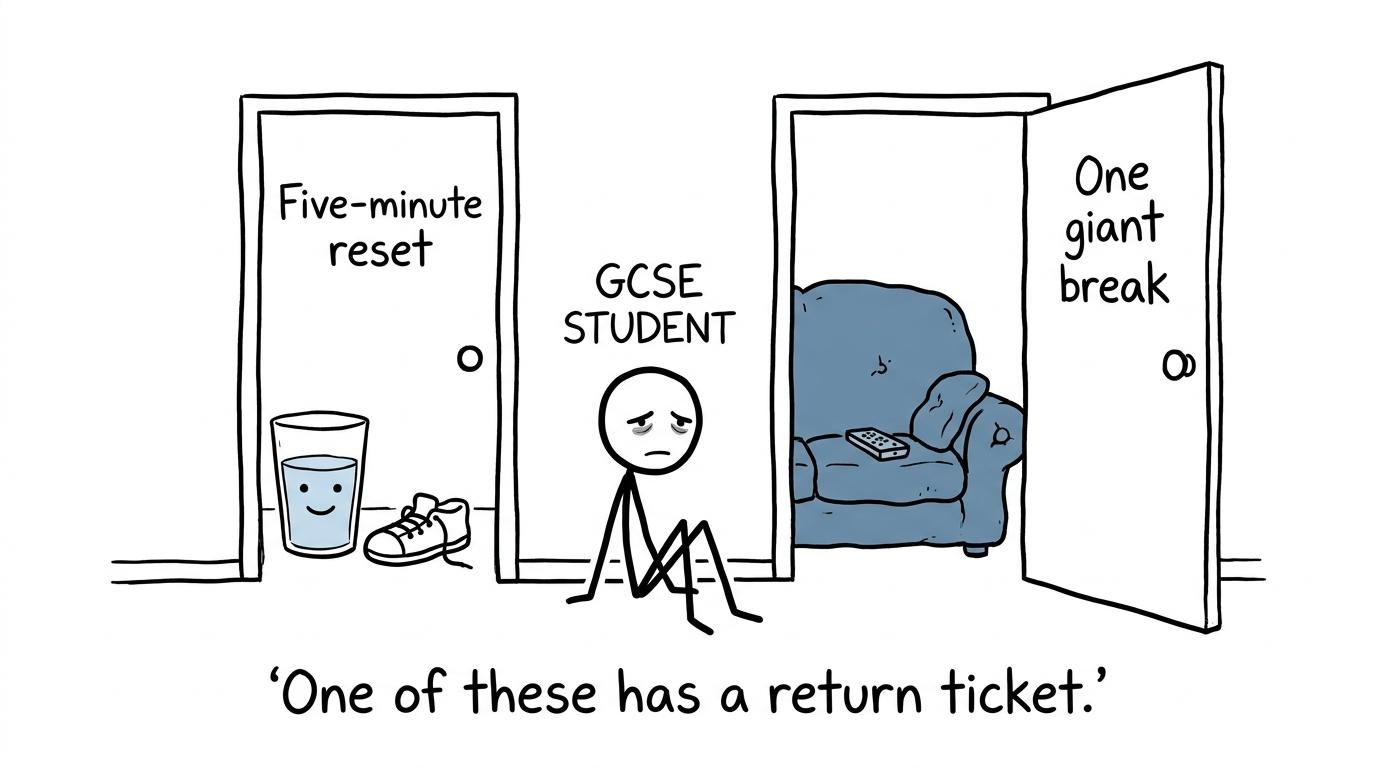 A student choosing between a short reset and a sofa monster
What the evidence actually suggests about revision breaks
There is no definitive trial establishing one perfect break schedule for GCSE Latin. Claims that every student must work for an exact period before resting go beyond the available evidence. Research can still give us useful boundaries.
A 2022 systematic review and meta-analysis examined micro-breaks lasting no more than 101010 minutes. Across 222222 independent samples involving 2,3352{,}3352,335 participants, these breaks produced small improvements in vigour and reductions in fatigue. The review did not find a statistically significant improvement in overall task performance. Longer micro-breaks tended to be associated with better performance, while recovery from highly demanding cognitive work appeared to require more than a very brief interruption.
That distinction matters. Feeling fresher is valuable, but it does not automatically mean that you have learnt more. Latin translation, grammatical analysis and unfamiliar maths problems all place substantial demands on working attention. A two-minute glance away from the page may help your eyes without fully restoring your thinking.
A later study of university seminars reported that more frequent micro-breaks helped students sustain quiz performance more consistently than a traditional break arrangement. It is relevant, but it involved university students in classes rather than GCSE pupils revising Latin independently. It should inform your plan, not dictate it.
The fairest conclusion is therefore modest: short breaks are useful tools for managing fatigue, but break length should reflect the difficulty of the task and your actual state of concentration.
Why GCSE Latin can make breaks especially important
Current OCR and Eduqas GCSE Latin specifications require more than remembering isolated definitions. Depending on the board and component choices, students may need vocabulary, accidence, syntax, unseen translation, comprehension, prescribed literature and cultural knowledge. OCR students complete the compulsory language component and two further components, while Eduqas has its own assessment structure and prescribed material. Always plan from the current specification and materials for your examination series.
These activities create different kinds of mental load.
Vocabulary needs retrieval
Reading a vocabulary list repeatedly can feel fluent because every answer is visible. The useful test is whether you can retrieve the meaning or Latin form after closing the list. A short break can separate an initial attempt from a second retrieval attempt, revealing what has genuinely stayed in memory.
The break itself does not create the memory. The attempt to recall does. This is the same principle explored in MathsGenie's guide to turning GCSE notes into active recall: close the source, produce an answer, check it and revisit what failed.
Translation requires sustained attention
Translation asks you to hold several possibilities in mind while checking endings, agreement, tense, syntax and English expression. If you have begun guessing every word from its most familiar meaning, a short break may reset attention. If you remain unable to follow the sentence after returning, take a longer pause or switch to a less demanding retrieval task.
Literature revision needs both knowledge and analysis
Knowing the content of a set text is different from explaining language, themes or effects. You might use one block to retrieve content, another to annotate a passage and a third to plan responses. Breaks create clear boundaries between those purposes, reducing the temptation to spend an hour passively rereading.
A practical short-break rhythm for Latin and maths
A revision rhythm should be easy enough to repeat on an ordinary school evening. Start with this flexible structure:
- Focus block: 303030 minutes of one clearly defined task.
- Short break: 555 to 101010 minutes away from the task.
- Second focus block: 303030 minutes of retrieval or exam-style practice.
- Longer break: 202020 to 303030 minutes if you are changing subject or feel mentally depleted.
The precise times matter less than the boundaries. Before each block, write a finish line such as “test these vocabulary items twice”, “translate one passage and correct it” or “complete and mark one algebra topic set”. “Revise Latin” and “do maths” are too vague.
When Latin shares an evening with maths, place the longer break between subjects. You could complete a Latin translation block, pause properly, then use the GCSE Maths revision hub to choose material for your exam board and tier. Foundation and higher-tier practice should match the paper you will actually sit.
For a larger weekly plan, MathsGenie's guide to the best order for learning GCSE maths topics helps you sequence revision rather than choosing randomly each evening.
What to do during a short break
A useful break creates psychological and physical distance from the task without making it difficult to return. Good options include:
- standing up and walking briefly;
- drinking water or having a planned snack;
- looking away from close work;
- stretching gently;
- opening a window or moving to another room;
- preparing the materials for the next block.
The aim is recovery, not stimulation. Social media, short videos and games are designed to hold attention. They can turn a planned 555-minute pause into a much longer interruption, while leaving your mind busier than before.
Use a timer if needed. Place the next task visibly on your desk before leaving. Returning becomes easier when you do not have to make another decision.
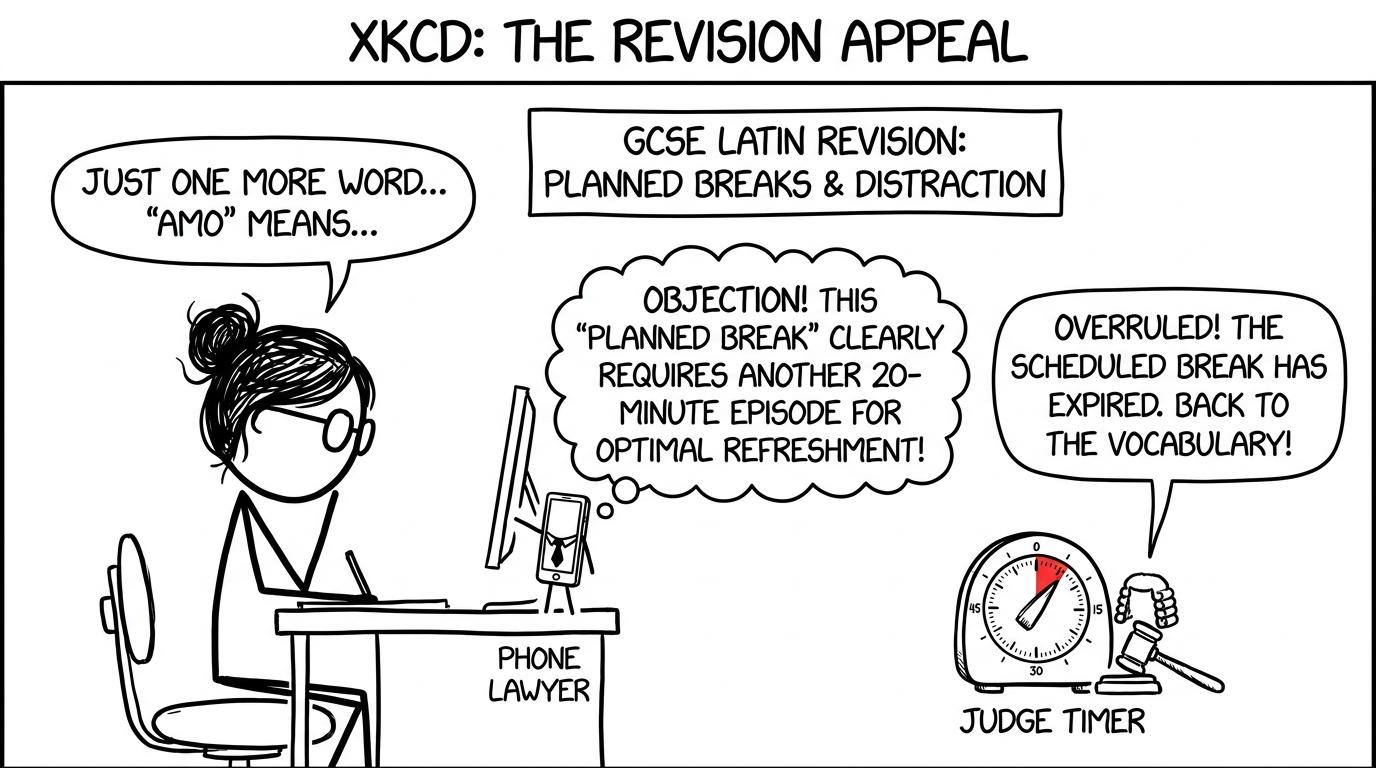 A phone arguing that a revision break needs another episode
When one longer break is the better choice
Several short breaks are not always enough. Choose a longer break when:
- you reread the same sentence without understanding it;
- accuracy has declined sharply across several questions;
- you cannot recall material that was secure earlier;
- you feel physically uncomfortable or unusually irritable;
- a brief pause has not restored purposeful attention;
- you have finished one demanding subject and are moving to another.
A long break is most useful when it is planned and has an end point. It is less useful as a reward postponed until you are exhausted. Think of it as maintenance rather than escape.
There is also a difference between a long break and stopping for the day. If it is late, repeated errors may indicate tiredness rather than a weak topic. MathsGenie's GCSE night-before revision plan emphasises focused practice, correcting a small number of mistakes and setting a sensible stopping time. Sleep cannot be replaced by increasingly elaborate break schedules.
Judge the schedule by learning, not endurance
A timer records attendance. It does not record learning.
At the end of each focus block, use a brief check:
- Can you retrieve the Latin words without seeing the list?
- Can you explain why a noun or adjective has that form?
- Can you summarise the passage or identify the evidence for an interpretation?
- Can you complete a fresh maths question without copying the method?
- Can you explain an error after reading the mark scheme?
For maths, short marked tasks make this feedback immediate. Begin with the MathsGenie GCSE maths resources, then move from revision lessons to practice questions and mini tests. When you need longer timed practice, use board-appropriate papers such as the Edexcel GCSE Maths past papers, complete them under suitable conditions and study how the mark scheme awards marks.
The same loop works across subjects: attempt, check, diagnose, practise and return later. The break supports the loop; it is not the loop itself.
Common mistakes with short and long revision breaks
Treating the timer as a law
Stopping halfway through productive thinking can be disruptive. If you are close to completing a coherent translation or solving a question, finish that small unit before resting. Equally, do not force another 202020 minutes when your attention has already collapsed.
Taking breaks without defining the work
A vague session has no clear ending, so every break feels premature. Give each block a visible task and an achievable finish line.
Confusing passive rereading with low energy
Sometimes the problem is not fatigue but method. Rereading notes can become dull because it asks little of you. Switch to retrieval, translation, practice questions or self-quizzing before assuming that you need a longer rest.
Letting every break involve a screen
A change of screen is not necessarily a change of mental demand. Choose at least some breaks involving movement, water and distance from notifications.
Saving all rest until the end
One long break cannot repair every mistake made during an exhausted final hour. Earlier short pauses may help preserve the quality of the work leading up to it.
Using breaks to extend revision too late
A beautifully organised late-night timetable is still a late-night timetable. Set a stopping time and protect the next day's attention.
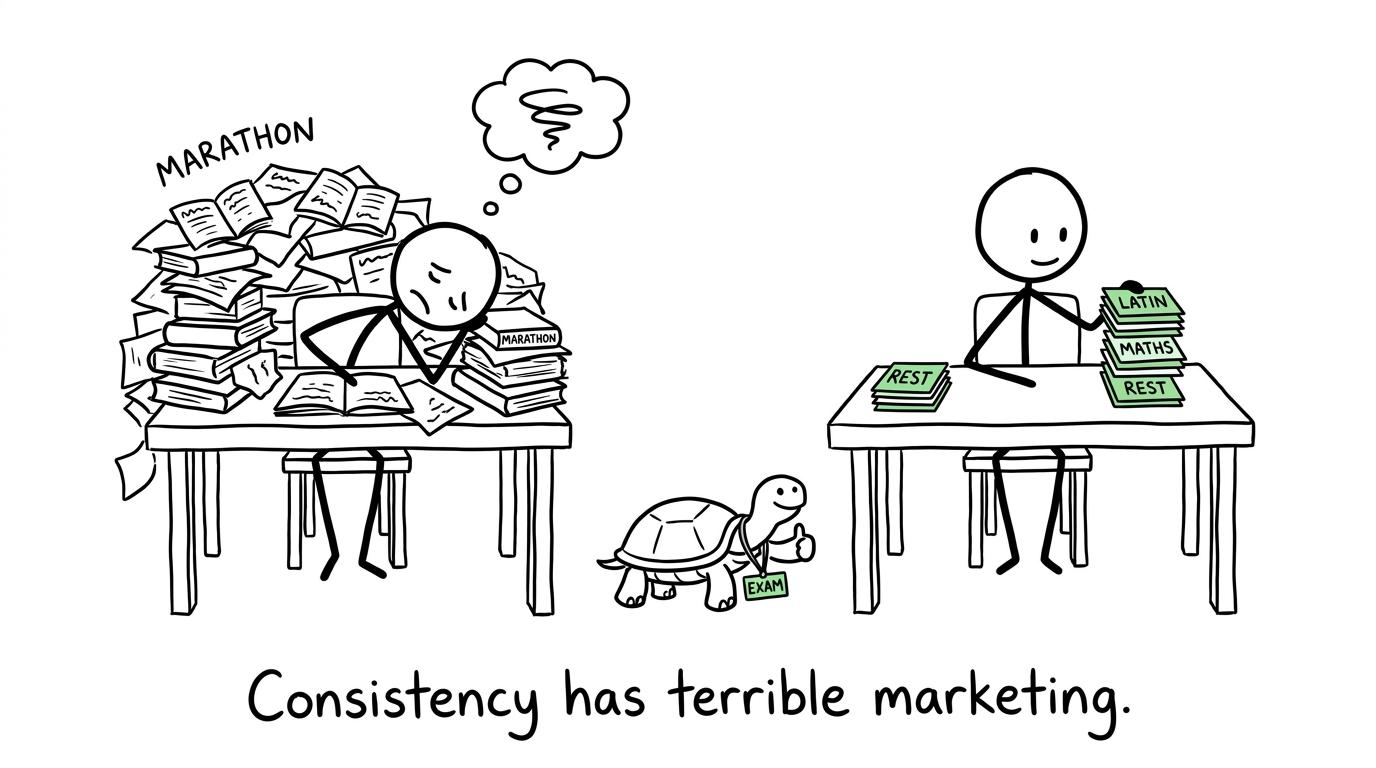 A calm revision rhythm competing with a dramatic marathon
Build a rhythm you can repeat
The useful answer to short breaks versus one long break is not a victory for either extreme. Several short breaks usually offer better protection against accumulating fatigue, while a longer break becomes important after demanding blocks, between subjects or when a brief reset no longer works.
Test the pattern for a week. Record the task completed, not merely the time spent. If recall and accuracy remain strong, keep it. If every return feels foggy, shorten the work blocks or lengthen the recovery. If breaks repeatedly expand, make them simpler and remove the phone.
MathsGenie can provide the structured half of that routine for your maths exams. Start with free GCSE maths revision resources, use revision lessons and practice questions in focused blocks, then build towards mini tests, past papers and predicted papers. Mark every attempt carefully and use video solutions when a method remains unclear.
A good revision plan does not ask how long you can remain at a desk. It asks how often you can return with enough attention to do honest, useful work.










