Short Breaks vs Long Break for GCSE English
Short breaks vs long break GCSE English Language and Literature: discover what the evidence suggests and build a revision routine that protects focus.
A familiar revision session begins with good intentions. You open a novel, plan an essay, read two pages and realise that your attention has quietly moved elsewhere. The question behind short breaks vs long break GCSE English Language and Literature revision is therefore practical: which pattern helps you stay focused and remember more?
The evidence does not identify one perfect timer for every student. However, several purposeful short breaks will usually serve a long revision session better than postponing all rest until the end. Short pauses can reduce fatigue and reset attention. After particularly demanding work, though, a longer recovery break may be necessary. The most sensible approach is a hybrid: focused blocks, brief breaks and a longer pause after several blocks.
That conclusion matters to maths students too. English essays and maths problems make different demands, but both require sustained attention, self-monitoring and the ability to retrieve knowledge under pressure.
The short answer and practical checklist
Use this as a starting point rather than a rigid scientific rule:
- Work for roughly 252525 to 404040 minutes on one clearly defined task.
- Take a purposeful break of about 555 to 101010 minutes.
- Repeat for two or three blocks.
- Then take a longer break of around 202020 to 303030 minutes.
- Shorten the work block if your accuracy or comprehension drops sharply.
- Keep phones, games and social media from turning a short pause into an unplanned long break.
- Test whether the routine works by checking recall, essay quality or marks, not merely by recording time at a desk.
This pattern is deliberately flexible. A student annotating a difficult unseen extract may need an earlier pause than someone organising quotations they already understand. Likewise, a demanding Higher tier maths problem set may require more recovery than reviewing familiar formulae.
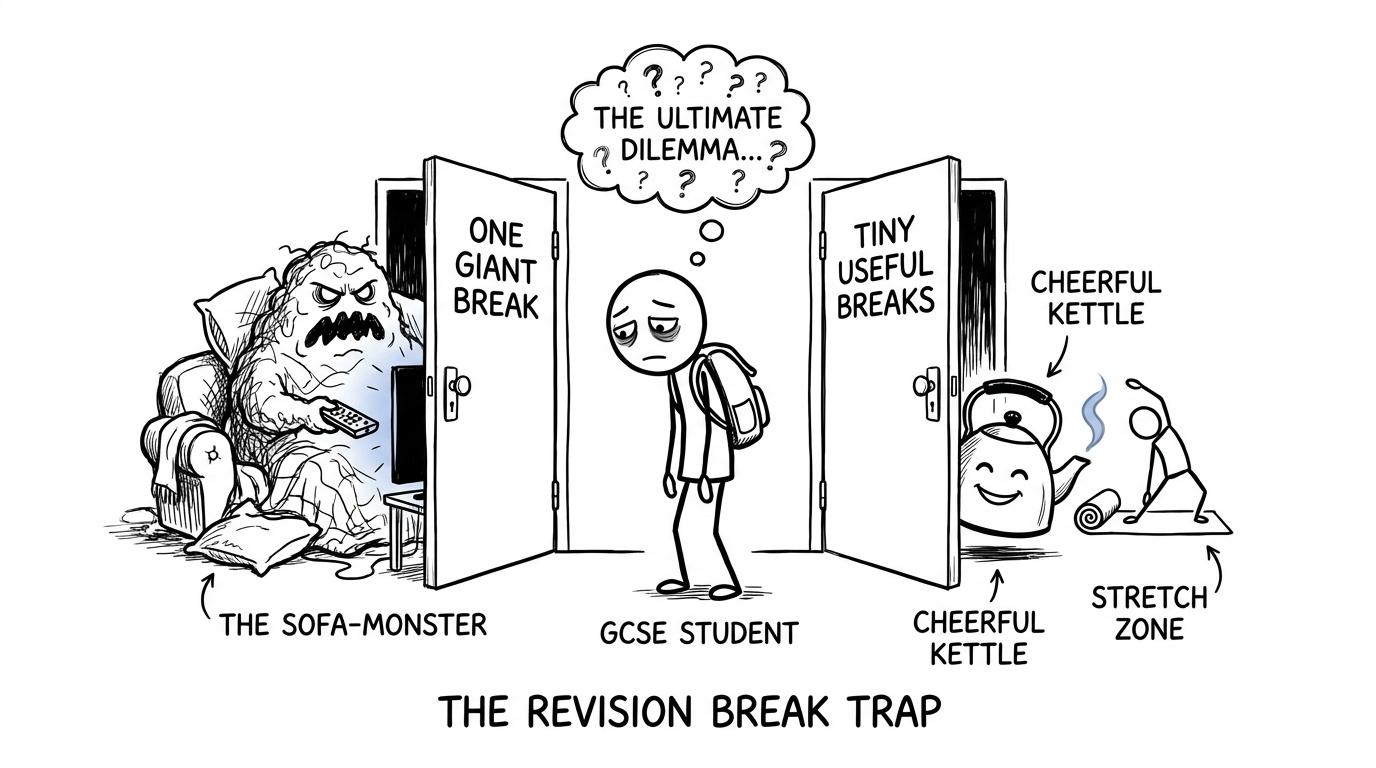 A student choosing between tiny useful breaks and a sofa monster
What the evidence actually suggests about revision breaks
Research on breaks is useful, but it needs careful interpretation. There is no large body of evidence directly comparing precise break schedules among GCSE English Language and Literature students. Studies often involve adults, university students, workplace tasks or general classroom activities. They can guide a routine, but they cannot prove that one schedule is universally best for GCSE revision.
A systematic review and meta-analysis of micro-breaks, defined as pauses lasting no more than 101010 minutes, found small benefits for energy and reduced fatigue. The overall improvement in task performance was not statistically clear. Longer micro-breaks tended to be associated with better performance, and highly demanding tasks appeared likely to require more than a very brief pause.
That distinction is important. A short break may make you feel fresher without automatically improving the essay or answer that follows. Rest helps create the conditions for good revision; it does not replace retrieval, feedback or deliberate practice.
A more recent study involving university seminars compared frequent 909090-second breaks with a conventional break later in the session. Students receiving the frequent pauses maintained stronger quiz performance. This is promising evidence for break frequency, but it involved university teaching rather than independent GCSE English revision. It should inform experimentation, not become a universal prescription.
Reviews of active classroom breaks have also reported mixed or heterogeneous findings. Some studies suggest benefits for attention or concentration, while others find no clear overall effect. Claims that everyone has an exact attention span of 202020 or 252525 minutes therefore go beyond what the evidence can safely establish.
Why dense English revision benefits from interruption
GCSE English Language combines unseen reading, interpretation, evaluation and controlled writing. GCSE English Literature adds detailed knowledge of studied texts, quotations, themes, characters, context and extended analytical responses. The exact paper structure varies across AQA, Pearson Edexcel, OCR and Eduqas, so students should always follow their own specification.
These tasks are dense because they ask you to hold several things in mind at once. While planning a paragraph, you may be selecting evidence, analysing language, linking to the question and monitoring technical accuracy. In Literature, you may also be connecting an extract to the wider text.
A useful break interrupts fatigue before shallow work takes over. Shallow work can look productive: rereading the same quotation, highlighting another page or copying notes. Yet little is being retrieved or applied.
Short blocks also create natural stopping points between different forms of practice. You might use one block to retrieve quotations, another to plan a response and a third to compare your writing with assessment criteria. The break is not the learning technique. It is the hinge that helps you move deliberately from one technique to the next.
Short breaks vs one long break: where each helps
Several short breaks protect repeated focus
Frequent pauses are most helpful when you need to sustain quality across a long session. They can:
- reduce the build-up of subjective fatigue;
- provide a moment to notice that you have stopped understanding the text;
- make an intimidating session easier to begin;
- separate retrieval, planning and writing;
- encourage you to return with a specific next action.
They are particularly suitable for quotation recall, short analysis tasks, paragraph planning and targeted maths practice. MathsGenie’s short GCSE maths revision routine shows how a small block can still include recall, exam questions and feedback.
A longer break supports deeper recovery
One longer break becomes valuable when a task has been genuinely depleting. After writing a timed essay, completing a substantial English Language paper section or sitting a full maths paper, 555 minutes may not be enough to recover.
A longer pause also allows food, movement and a proper change of setting. It can mark the boundary between subjects, preventing the demands of Literature from spilling into the next maths session.
The weakness of relying on only one long break is timing. If it arrives after 909090 minutes of fading concentration, much of the session may already have become ineffective. Conversely, taking only tiny pauses throughout an exhausting afternoon can leave you technically working but mentally depleted.
The answer is not to choose one side forever. Use short breaks to prevent avoidable fatigue and a longer break to recover after several blocks or a demanding timed task.
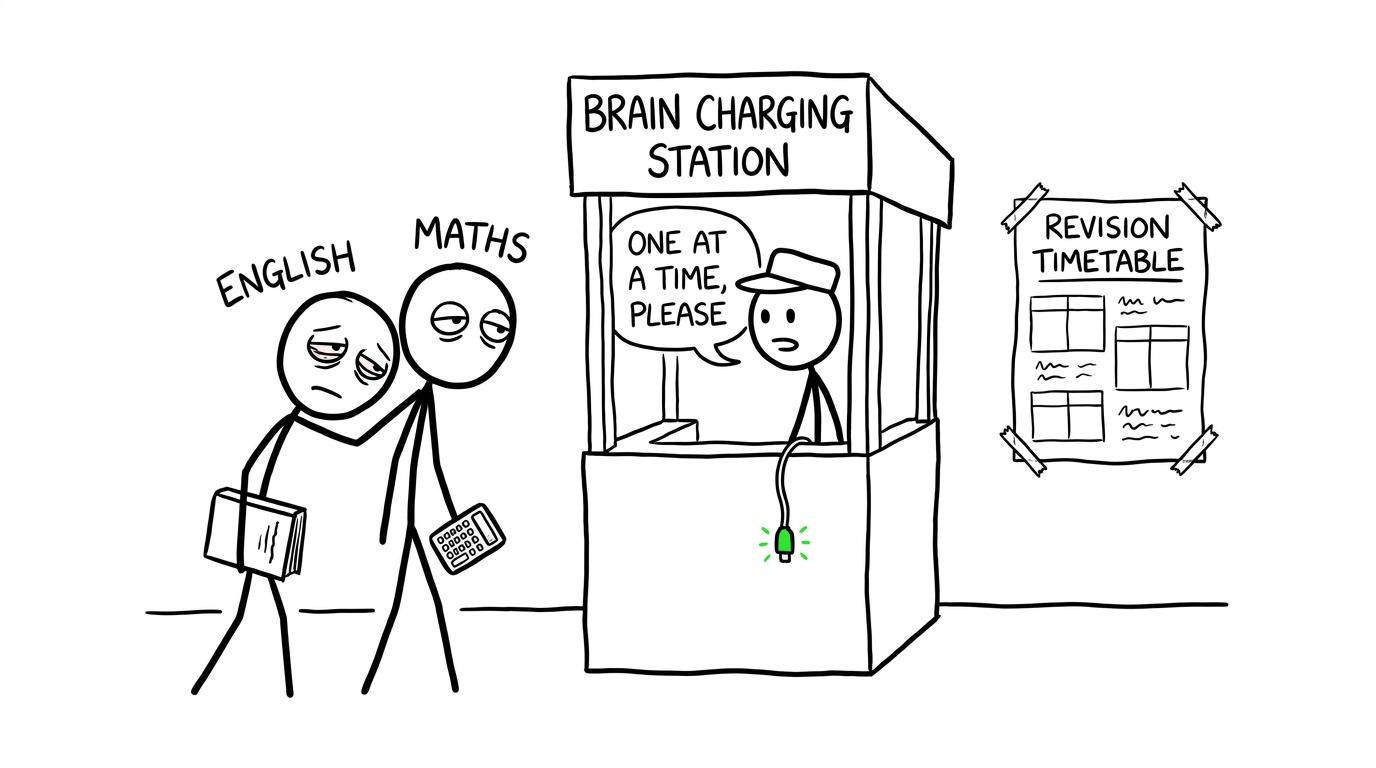 English and Maths waiting at a tiny brain charging station
A revision structure that works across English and maths
Begin each block with an outcome you can check. “Revise English” is too vague. “Plan two arguments for the poetry comparison” is observable. In maths, “do algebra” is equally vague; choose a precise topic and a defined question set instead.
A balanced cycle could look like this:
- Block one: retrieve knowledge without notes.
- Short break: stand up, drink water and look away from the page.
- Block two: apply that knowledge to an exam-style task.
- Short break: move briefly and avoid opening an endless digital feed.
- Block three: mark, compare or improve the response.
- Longer break: eat, walk or change rooms before starting another subject.
The marking stage matters. The Education Endowment Foundation’s guidance on metacognition emphasises planning, monitoring and evaluating learning. A timer can support that cycle, but the evidence of progress comes from your work.
For maths, use the GCSE maths revision hub to choose board-appropriate lessons and questions. Then follow a simple loop: attempt, mark, diagnose and retest. The guide to finding your weakest GCSE topics helps turn dropped marks into the focus for your next block.
Do not confuse breaks within one session with spacing across days. A 555-minute pause may restore attention; revisiting material tomorrow or next week supports longer-term retention. Both can belong in a realistic GCSE maths revision timetable.
What should you do during a short break?
A good break changes the demand being placed on your attention. Useful options include:
- standing and stretching;
- getting water;
- looking out of a window;
- walking briefly;
- resting quietly;
- preparing the materials for the next block.
The aim is not to make every second productive. It is to return when planned.
Phone use is risky because many apps are designed around continuous novelty. A student intending to check one notification can lose the boundary around the break. If this repeatedly happens, leave the phone in another room or set a separate timer.
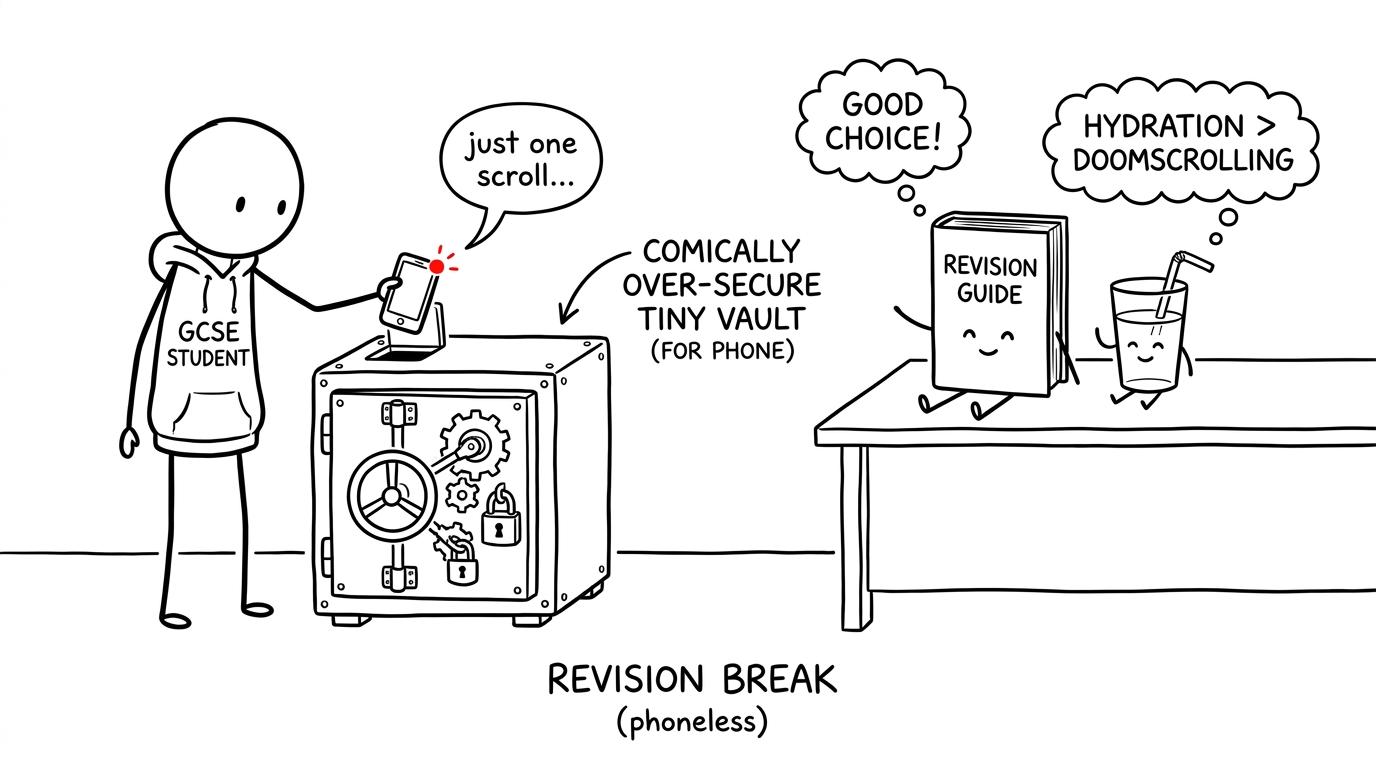 A phone protesting from inside a revision-break vault
How to find your own effective break length
Treat your schedule as a small personal trial rather than a personality label. Use one routine for several comparable sessions and record:
- whether you completed the planned task;
- how many marks you earned;
- which mistakes appeared near the end;
- what you could recall later without notes;
- whether each break ended on time.
Then alter one feature. You might compare 252525-minute blocks with 404040-minute blocks while keeping the task and break behaviour similar. Do not change the subject, difficulty, timer and break activity simultaneously or you will not know what helped.
When practising maths, shorter assessments make this easier. Use MathsGenie’s GCSE predicted papers as later-stage exam rehearsals and Edexcel GCSE maths past papers when that matches your board. Students following AQA, OCR or Eduqas should select the corresponding resources from the main GCSE hub.
A full paper should usually be completed under authentic exam conditions without revision breaks. Break routines train the learning that comes before the exam; they should not create a habit of pausing whenever a question feels uncomfortable.
Common mistakes with revision breaks
Treating the timer as the strategy
Completing four timed blocks does not guarantee learning. Each block still needs retrieval, application or feedback. Passive rereading inside a sophisticated timetable remains passive rereading.
Taking a break whenever work becomes difficult
Difficulty is not always fatigue. Sometimes it is the productive effort of recalling a quotation or beginning a challenging problem. Pause when attention or accuracy is deteriorating, not simply when the task stops feeling easy.
Letting every short break expand
A break without a defined return point can swallow the session. Decide the duration before leaving your desk and make the next action obvious.
Using one schedule for every task
Quotation recall, timed essays and full maths papers impose different demands. Adjust the work block to the task rather than forcing every subject into an identical template.
Sacrificing sleep to create more revision blocks
Break optimisation cannot rescue chronic tiredness. Meta-analytic evidence indicates that sleep deprivation before or after learning harms memory. A sensible stopping time is often more valuable than another late session. MathsGenie’s one-month GCSE revision plan can help spread work before the final night.
Build a routine you can repeat
The evidence on short breaks vs a long break is more nuanced than a viral timer rule. Brief, planned pauses can reduce fatigue and help sustain repeated attention. A longer break becomes useful after several blocks or a particularly demanding task. Neither improves grades by itself.
What matters is what surrounds the pause: retrieval before it, focused practice after it and honest feedback at the end. For maths, learn a method through MathsGenie’s free revision lessons, complete practice questions, check mark schemes and video solutions, then retest with mini tests. Build towards past papers and predicted papers when you are ready for exam conditions.
Start with one manageable block today. Choose a weak topic, remove the phone, decide when you will stop and let the work, rather than the timer, tell you whether the routine is succeeding. For a complete paper-review process, follow MathsGenie’s guide to using GCSE past papers properly.