Short Breaks vs Long Break for GCSE Engineering
Short breaks vs long break GCSE Engineering: discover what evidence suggests and build a focused revision routine for dense maths-based topics.
Revision can fail quietly. You remain at your desk, the engineering notes stay open, and time passes, yet the difference between stress and strain has somehow become less clear than it was half an hour ago.
For students comparing short breaks vs long break GCSE Engineering revision, the practical answer is this: several planned short breaks will usually make a demanding revision session easier to sustain than one long break taken after concentration has already collapsed. However, the evidence does not identify one perfect timetable, and a longer recovery break can be useful after an especially demanding task.
The goal is not to maximise minutes at a desk. It is to protect the quality of the thinking you do there.
The short answer
Use this as a starting checklist:
- Work for about 252525 to 353535 minutes on one clearly defined task.
- Take a planned break of roughly 555 minutes.
- Complete two or three focused blocks before taking a longer break.
- Move away from the screen, stretch or get a drink during short breaks.
- Test your recall and accuracy rather than judging revision by time alone.
- Extend a break when fatigue remains high after a particularly difficult task.
- Adjust the schedule using evidence from your own concentration and marked work.
This is a framework, not a biological law. A student completing familiar unit conversions may need a different rhythm from one interpreting an unfamiliar graph or rearranging a multi-stage engineering formula.
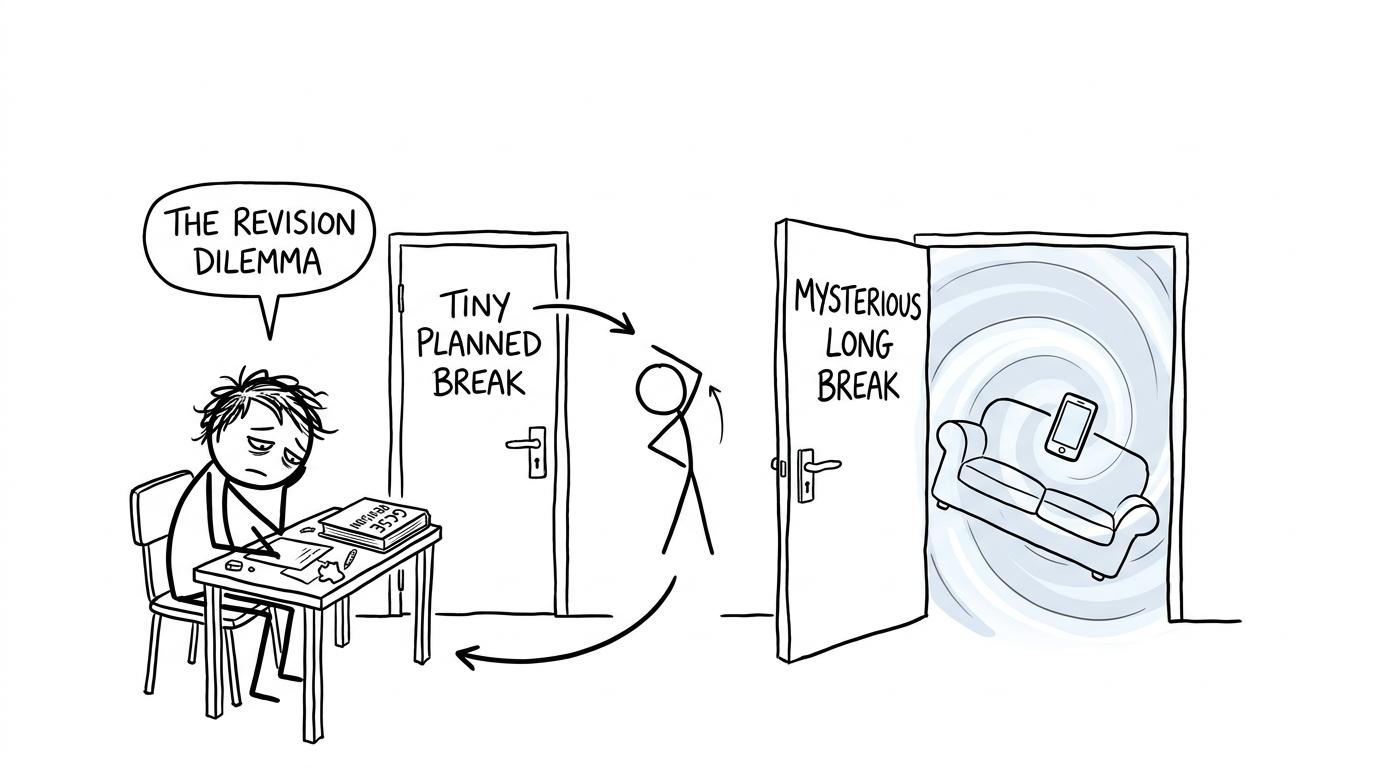 A student choosing between a planned stretch break and a mysterious sofa vortex
What the evidence actually suggests about revision breaks
Research into breaks is more nuanced than popular productivity advice sometimes implies. There is no strong evidence that every student must stop after one universally correct number of minutes.
A meta-analysis of micro-break research found that breaks lasting up to 101010 minutes produced small improvements in energy and reductions in fatigue. The overall improvement in task performance was not statistically clear, and highly demanding tasks sometimes appeared to require more recovery than a very brief pause could provide.
Research with university students has also compared predetermined breaks with breaks chosen entirely by the learner. In one study, systematic schedules, either a 666-minute break after 242424 minutes or a 333-minute break after 121212 minutes, were associated with less fatigue and distraction than self-regulated breaks. Task completion did not differ clearly between the groups, so the finding supports structure rather than a magical timer setting.
Studies of active breaks in educational settings offer some encouraging results for attention, but systematic reviews describe the evidence as limited and varied. Much of the direct experimental research involves adults, university students or classroom activity rather than GCSE pupils revising Engineering at home. It would therefore be too confident to claim that one break pattern has been proved best for every teenager.
The sensible conclusion is narrower: planned short breaks can reduce fatigue and make attention easier to manage, but break length should reflect the difficulty of the task and the student’s condition.
Why GCSE Engineering creates heavy mental demand
Engineering revision is dense because it asks you to move between different kinds of thinking. You may need to recall technical knowledge, interpret a diagram, select a formula, convert units and explain why a material or process is suitable.
AQA’s GCSE Engineering specification, for example, integrates mathematical understanding into engineering content. Relevant skills include ratios, percentages, standard form, trigonometry, Pythagoras’ theorem, rearranging formulae, substitution, graphs, gradients and data interpretation. Equations include relationships such as
ρ=mV,σ=FA,I=VR.\rho = \frac{m}{V}, \qquad \sigma = \frac{F}{A}, \qquad I = \frac{V}{R}.ρ=Vm,σ=AF,I=RV.That constant switching creates cognitive demand. If concentration weakens, the first casualty is often not effort but accuracy: a unit disappears, a denominator is inverted or a graph scale is misread.
Maths revision supports this part of Engineering directly. The MathsGenie speed and density revision guide strengthens compound-measure reasoning, while conversions and units revision helps prevent avoidable errors when quantities are expressed in different units.
Several short breaks or one long break?
The better choice depends partly on what problem the break is solving.
| Revision situation | More useful break pattern | Why it may help |
|---|---|---|
| Learning a technical process | Short, regular breaks | Limits uninterrupted overload and creates natural recall checks |
| Completing focused calculation practice | Short breaks between sets | Protects accuracy without losing the method’s thread |
| Sitting a timed paper | No optional breaks during the timed section | Builds realistic exam stamina |
| Reviewing a demanding paper | A longer break before analysis | Allows genuine recovery before careful marking |
| Feeling physically restless | A brief active break | Movement may refresh attention without ending the session |
| Remaining mentally exhausted after a pause | A longer recovery period | A tiny break may be insufficient after sustained effort |
One long break has a hidden cost: restarting. A break that begins without a return time can turn into an entirely new activity. Short, predetermined breaks reduce that decision-making. You know when to stop and when to return.
Yet short breaks can also become interruptions. Stopping halfway through a difficult chain of reasoning may make you reconstruct the whole argument afterwards. Finish the current question or reach a sensible checkpoint where possible, rather than obeying a timer at the expense of understanding.
A practical break schedule for engineering maths
A useful default is a cycle of:
- 303030 minutes of focused revision;
- 555 minutes away from the task;
- another 303030 minutes of focused revision;
- a longer break of about 151515 minutes.
During the first block, learn or retrieve one method. During the second, answer questions and mark them. This separates recognising a method from actually being able to use it.
If 303030 minutes currently feels unrealistic, begin with the MathsGenie 202020-minute GCSE revision routine. A repeatable short session is more useful than an ambitious timetable that survives for one evening.
Give every work block one purpose
Avoid goals such as “revise Engineering”. They are too broad to guide attention. Choose a concrete task instead:
- recall equations and define every symbol;
- practise rearranging formulae;
- interpret engineering graphs;
- check unit conversions;
- answer questions on area, volume or scale;
- mark a paper section and classify errors.
For geometric reasoning, MathsGenie’s similar shapes, area and volume revision provides focused practice without turning the session into a vague tour of the whole GCSE course.
Make the break genuinely different
A short break should reduce the demand being placed on your attention. Stand up, look into the distance, stretch, refill your water or walk briefly.
Scrolling through fast-moving videos may feel restful because it is different from revision, but it still captures attention and makes the return harder to control. If you use your phone as a timer, put it out of reach until the alarm sounds.
Leave a restart note
Before a longer break, write one sentence explaining the next action: “Mark question set and revisit unit conversions” is enough. This removes the small but costly decision that otherwise awaits you on return.
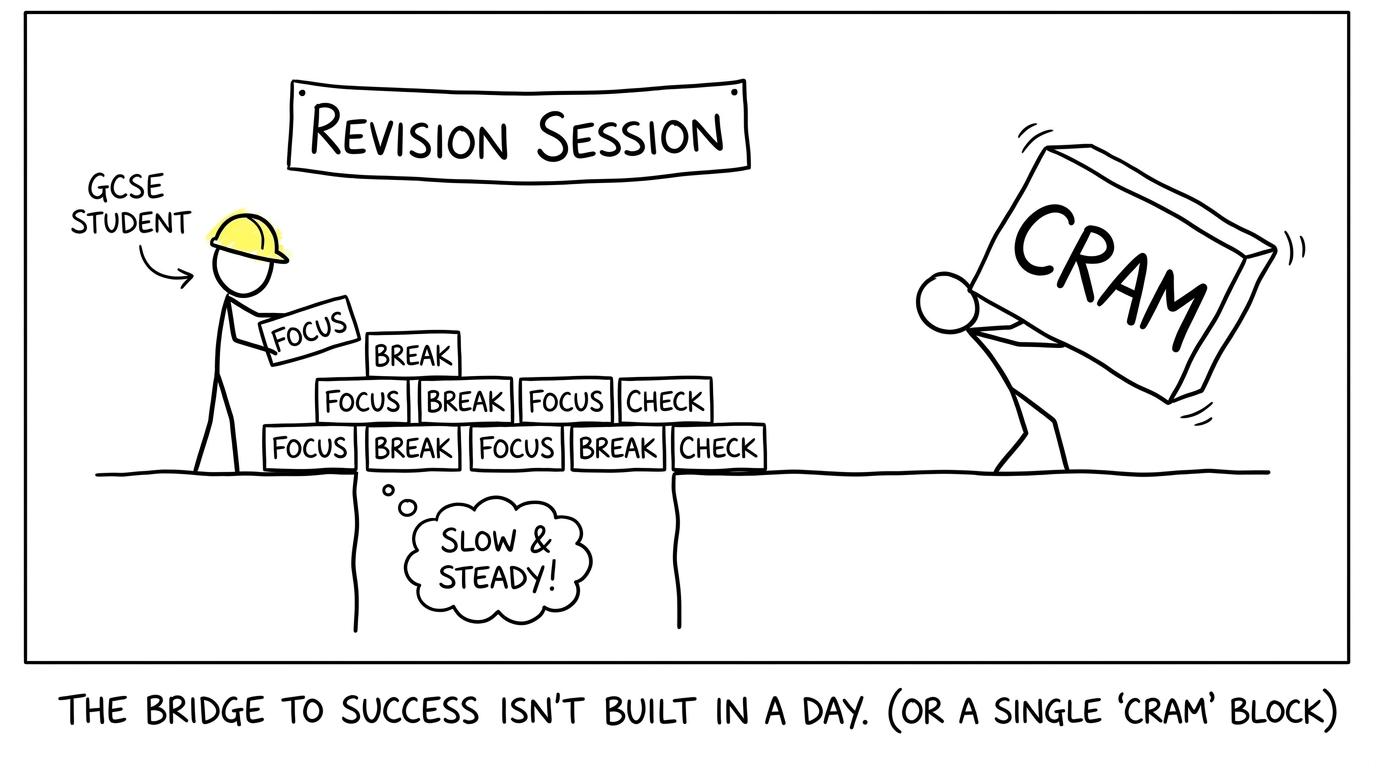 A student building a revision bridge from small stable blocks while one giant cram block wobbles
Break frequency matters less than what happens between breaks
A beautifully organised timer cannot rescue passive revision. Reading the same notes in four short blocks is still rereading.
A stronger cycle is:
- retrieve a formula or method without notes;
- answer a small set of questions;
- check the mark scheme or solution;
- record the exact cause of each lost mark;
- revisit that weakness in a later session.
MathsGenie’s GCSE active recall guide explains how to turn notes into prompts. Short Edexcel GCSE Maths mini tests also fit naturally into focused blocks because they provide a defined endpoint and immediate evidence of what needs attention.
This planning, monitoring and evaluating approach aligns with established guidance on metacognition and self-regulated learning. In ordinary language: decide what you are doing, notice whether it is working, then change the plan when the evidence says you should.
When a long break is the better decision
Sometimes continuing is not discipline. It is simply low-quality repetition.
Take a longer break when:
- you have completed a demanding timed section;
- you repeatedly make errors in skills you normally understand;
- a short break does not restore concentration;
- physical discomfort is distracting you;
- you are switching from an Engineering task to a full maths paper;
- the next block requires careful marking and diagnosis.
Sleep, meals and proper rest are not interchangeable with micro-breaks. Several 555-minute pauses cannot compensate for exhaustion. The purpose of a revision timetable is to make good work sustainable, not to make tiredness easier to ignore.
When preparing for exam conditions, breaks also need to be used strategically. Complete a selected section or full Edexcel GCSE Maths past paper without informal pauses, following the correct conditions. Take the longer break afterwards, then return to mark and repair mistakes.
Common mistakes when planning revision breaks
Waiting until concentration disappears
If you only stop once you are completely drained, the break becomes recovery from collapse rather than prevention. Set a rough stopping point before starting.
Treating every task as equally demanding
Formula recall, calculation practice and full-paper problem solving do not impose identical demands. Keep breaks flexible enough to reflect the work.
Letting five minutes become an hour
Use a timer and decide your first task after the break in advance. Planned freedom is easier to control than an open-ended pause.
Interrupting useful concentration
Do not abandon a productive line of reasoning merely because a timer sounds. Reach a sensible checkpoint, note where you stopped, then take the break.
Counting time instead of checking learning
A session is not successful because it lasted two hours. Check what you can recall, solve and explain. Marks from a mini test or carefully marked question set provide better evidence.
Using predicted papers too early
Predicted papers are most valuable after key methods have been learned. Use Edexcel GCSE Maths predicted papers to sharpen exam readiness, not as a replacement for topic revision.
Build a routine you can actually repeat
Several short breaks are usually the stronger default for dense GCSE Engineering revision because they help manage fatigue before it overwhelms accuracy. But they do not automatically improve learning, and a longer break remains valuable after sustained, demanding work.
Start with a simple rhythm, measure the quality of your answers, and adjust. The best break schedule is not the one that looks most disciplined on paper. It is the one that repeatedly brings you back ready to think.
Use MathsGenie’s free GCSE and A Level revision resources to give each focused block a clear job. Learn with revision lessons, practise with topic questions and mini tests, then build exam stamina with past papers and predicted papers. Mark your work using mark schemes and video solutions, record the mistakes that cost marks, and let those mistakes choose your next session.