Short Breaks vs Long Break GCSE Business Revision
Short breaks vs long break GCSE Business: see what research suggests, choose sensible timings, and build a focused revision routine that lasts for exams.
Revision often begins with an optimistic bargain: work for a long time now, then earn one enormous break later. The problem is that concentration may fade before the reward arrives. When comparing short breaks vs long break GCSE Business revision, the evidence suggests that several planned short breaks are generally better for controlling fatigue and sustaining attention across a normal session. A longer break still has a role after several work blocks or a particularly demanding task.
There is no scientifically perfect timer for every student. Most break studies involve university students, workplace tasks or classroom learning rather than GCSE Business candidates specifically. Still, the broad lesson is useful: do not wait until your concentration has completely collapsed before resting.
The practical answer at a glance
For most GCSE revision sessions:
- Focus for about 202020 to 303030 minutes.
- Take a short break of roughly 333 to 777 minutes.
- Repeat for 222 or 333 focused blocks.
- Then take a longer break of around 151515 to 303030 minutes.
- Shorten the block when the work is unusually dense.
- Keep breaks genuinely separate from revision.
- Test different timings and judge them by recall and completed work, not hours at the desk.
This is a starting framework, not a law. A student reviewing familiar definitions may manage a longer block than one analysing a complicated case study or interpreting financial data.
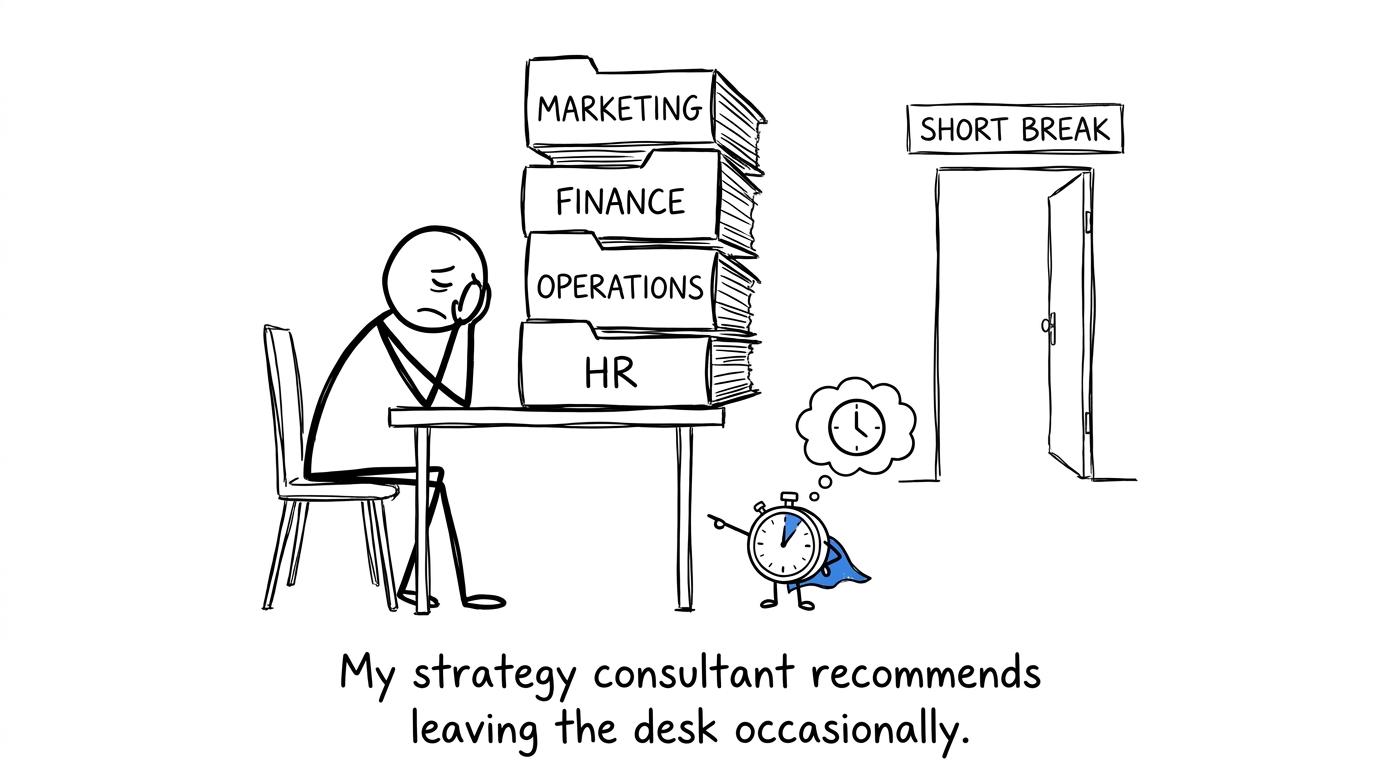 A tiny timer rescues a tired student from a mountain of Business folders
What the evidence says about short breaks
A systematic review and meta-analysis of micro-break research found small but reliable improvements in vigour and reductions in fatigue. It did not find a clear overall performance improvement across every kind of task. The performance benefit was less certain for highly demanding cognitive work, where a break of less than 101010 minutes may not provide enough recovery.
That distinction matters. A short break can make you feel fresher without automatically placing more knowledge into long-term memory. Learning still depends on what happens during the work block: retrieval, application, feedback and correction.
Research into real-life self-revision has also compared predetermined breaks with breaks chosen entirely by students. In one study, systematic schedules such as 242424 minutes of work followed by 666 minutes of rest, or 121212 minutes followed by 333 minutes, were associated with lower fatigue and distraction than fully self-regulated breaks. Task completion did not differ significantly, so the result supports structure rather than one magical ratio.
More recent classroom evidence involving university students found that frequent micro-breaks helped sustain quiz performance and concentration better than a traditional break arrangement. This is promising, but it should not be presented as direct proof that one schedule raises GCSE Business grades. The participants, setting and tasks were different.
The sensible conclusion is modest: regular short breaks can help manage attention and fatigue, but they do not replace effective revision.
Why GCSE Business can feel mentally dense
GCSE Business is not simply a list of definitions. Students must remember concepts, apply them to unfamiliar contexts, analyse consequences, interpret information and make justified judgements. Official subject content also requires quantitative skills involving percentages, averages, revenue, costs, profit, cash flow, profitability ratios and business data.
Those demands compete for attention. You might remember what cash flow means but overlook a unit in a table. You might calculate accurately but fail to explain why the result matters to the business. Mental fatigue makes these slips more likely because careful reading and self-checking are often the first habits to weaken.
Use the GCSE Business revision hub to select your exam board and divide a broad subject into manageable tasks. If numerical material is the problem, the AQA Business calculation resources cover specification-matched quantitative skills. The Business interpretation revision guide then helps connect figures, context and decisions.
That connection also matters for GCSE Maths. Percentages, averages, ratios and graphs appear in Business contexts, so stronger numerical fluency reduces the mental effort needed for each calculation. The free GCSE Maths revision hub provides lessons, practice questions, papers and revision tools across the major exam boards.
When several short breaks are likely to work best
Short breaks are particularly useful when your revision contains repeated, clearly defined tasks. Examples include:
- recalling definitions from flashcards;
- answering short knowledge and application questions;
- completing a focused set of calculations;
- planning analytical chains;
- marking answers and recording one improvement;
- switching from Business revision to a short maths skills task.
The timer creates an endpoint. That matters because an unclear session can feel endless, while a defined block asks only for focused effort until the next pause.
A simple 909090-minute session might contain three 252525-minute work blocks and two 555-minute breaks, followed by a final 555-minute review. The blocks could cover recall, application and marking. This is a schedule rather than a promise: if your concentration remains strong, complete the thought or question before stopping.
MathsGenie's guide to finding your weakest GCSE topics can help you choose a precise target before the timer begins. A specific target such as interpreting percentage change is much easier to manage than “revise finance”.
When one longer break is more useful
A longer break becomes valuable when fatigue has accumulated across several cycles. It may also be appropriate after:
- a full past paper or substantial timed section;
- an extended case-study response;
- several difficult calculation questions;
- an intense school day before evening revision;
- obvious signs that you are repeatedly rereading without understanding.
The micro-break evidence suggests that longer recovery can be more helpful after highly demanding tasks. So the real choice is not short breaks or long breaks forever. A stronger plan uses frequent short breaks to prevent attention drifting, then a longer break to reset after a group of blocks.
During a full mock, however, follow the real examination conditions. Do not insert extra breaks into a paper simply because you use them during ordinary revision. Paper practice is partly about building uninterrupted stamina. The guide to when to start GCSE past papers explains how to progress from mini tests and sections towards complete timed papers.
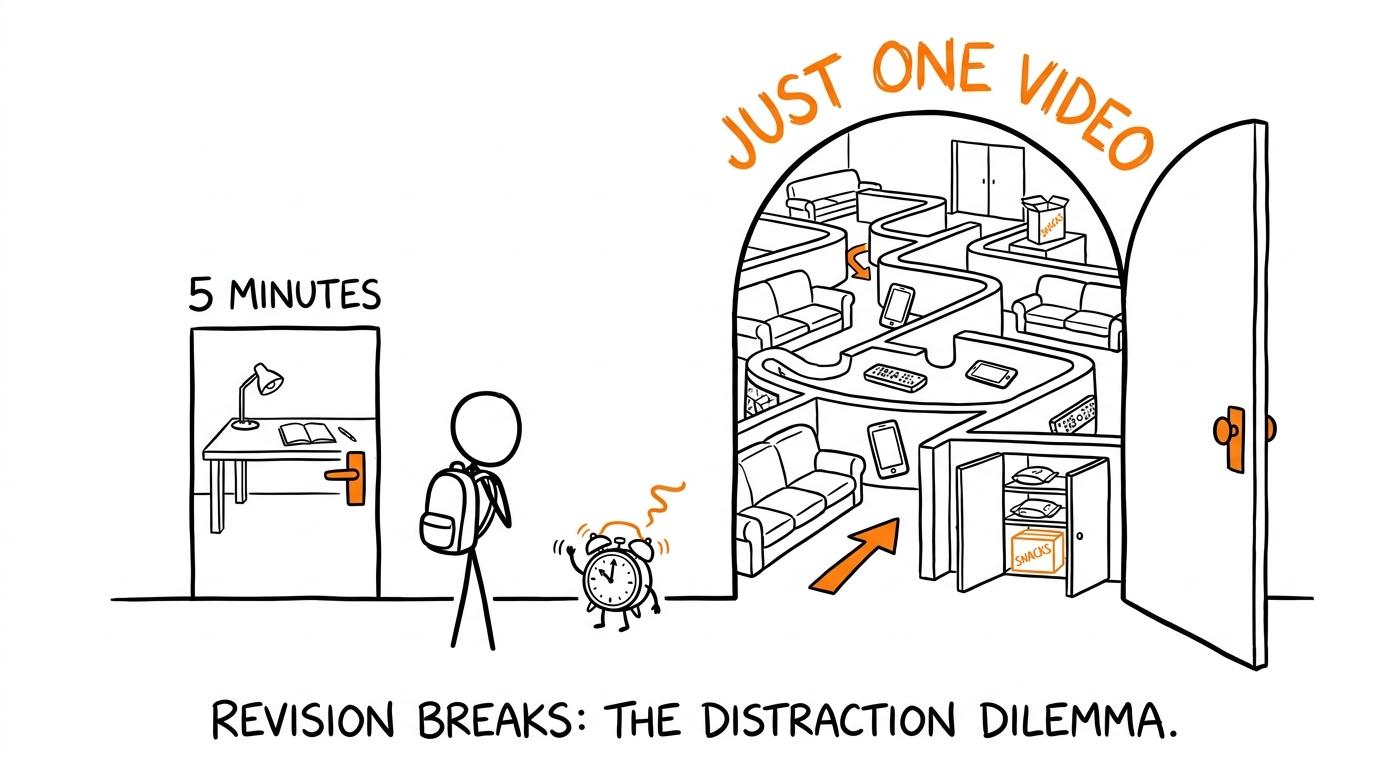 A short break leads back to revision while one video leads into a maze
What to do during a revision break
A useful break reduces the demands placed on the system you have just been using. If you have spent 252525 minutes reading tables and constructing arguments, replacing that with rapid social-media scrolling may change the content without giving your attention much quiet.
Better short-break choices include:
- standing and stretching;
- walking to another room;
- drinking water;
- looking away from the screen;
- opening a window or stepping outside briefly;
- tidying only the materials needed for the next block;
- sitting quietly without starting another information-heavy task.
Research into active breaks is encouraging but mixed. Reviews have found possible benefits for aspects of attention and concentration, while also noting varied study designs and limited evidence. Movement is therefore a sensible option, not a guaranteed performance trick.
Set a separate timer for the break. Otherwise, a planned 555 minutes can quietly become 252525 minutes. If your phone repeatedly causes that problem, leave it beyond arm's reach before the work block begins.
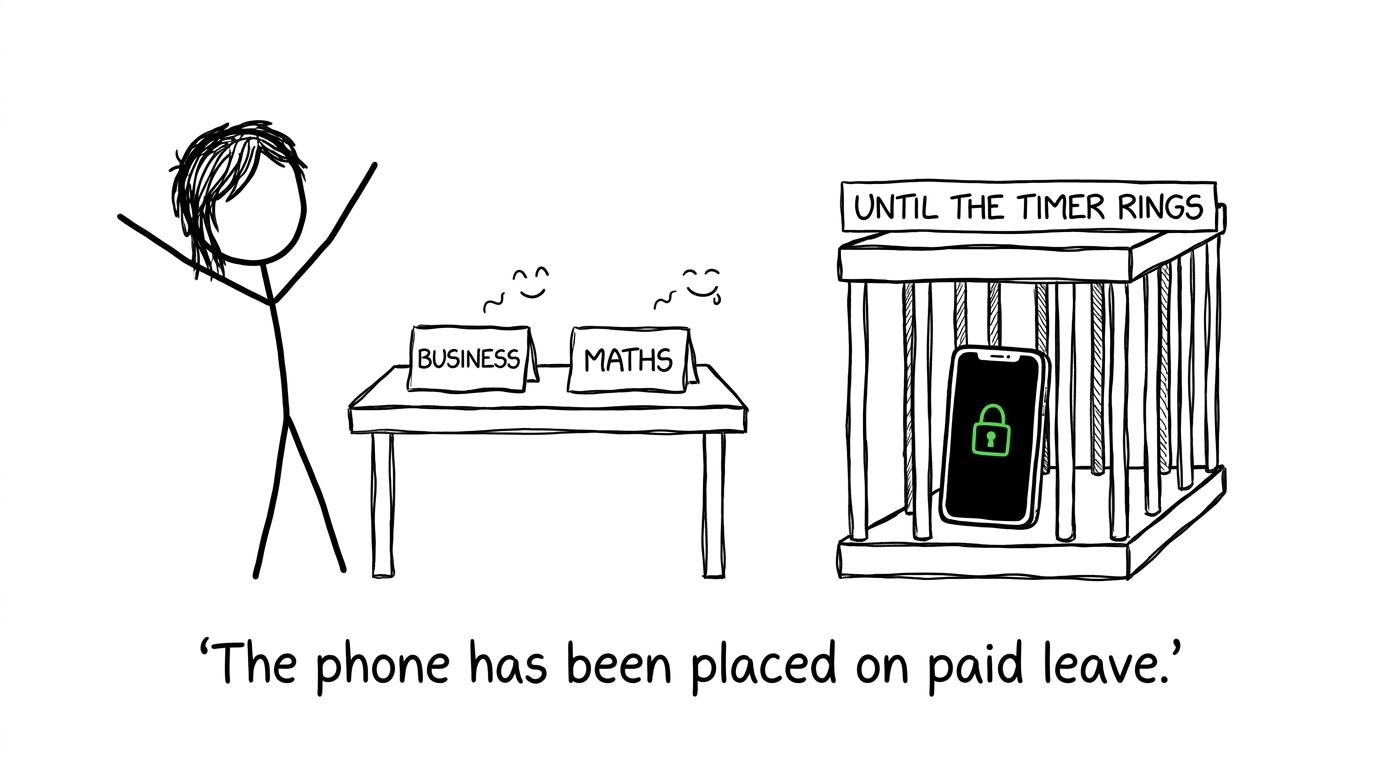 A student's phone takes paid leave while revision materials rest
Make each focus block active
Break timing cannot rescue passive revision. Reading the same page four times may feel calm, but it gives little evidence that you could reproduce the knowledge under exam pressure.
Give every work block a visible output:
- answer questions without notes;
- explain a concept from memory;
- apply a point to a named business context;
- complete calculations and check units;
- mark an answer against the mark scheme;
- rewrite one weak analytical link;
- record the exact reason for every lost mark.
For maths revision, follow the same loop: learn the method, attempt questions, mark the work and correct the error. The GCSE one-week revision plan shows how short blocks can combine topic learning, exam questions and honest marking. When the examinations are close, GCSE predicted papers can provide realistic maths practice alongside mark schemes and solutions.
Common mistakes with revision breaks
Treating the timer as more important than the task
Stopping halfway through a short calculation or analytical sentence can create unnecessary restart costs. Finish the immediate thought, then pause. The schedule should support concentration, not interrupt it mechanically.
Using every break for social media
A phone break can easily become another attention-heavy activity. Notifications also make returning to revision harder. Choose a low-stimulation break for at least some of your pauses.
Taking breaks without defining the next block
If you return to an unclear desk, several minutes disappear while you decide what to do. Before standing up, write the next action in one sentence.
Confusing time spent with learning achieved
Four completed blocks do not prove that the material has stuck. End with a short closed-book check, mini test or exam question. Measure what you can recall and apply.
Avoiding full-paper stamina
Short blocks are excellent for learning and repairing weaknesses, but GCSE exams require sustained attention. Build towards timed papers and use mark schemes afterwards. Do not let a comfortable revision routine protect you from realistic practice.
Build a break pattern you can trust
Try one schedule for several sessions rather than changing it every afternoon. Record three things: what you completed, how accurately you recalled it and when your concentration noticeably weakened. Then adjust the work block or break by a few minutes.
The best pattern is not the one that looks most disciplined. It is the one that repeatedly brings you back to purposeful work.
Start at MathsGenie's free Business or Maths revision hub, choose one weak topic and complete a focused block using revision lessons and practice questions. Take a real break. Then return to mark your work, learn from the solution and reattempt the skill later. As your confidence grows, move into mini tests, past papers and predicted papers with mark schemes and video solutions.
Several short breaks can keep the engine running. One longer break can cool it down. What changes grades is what you do each time you sit back at the desk.