

Revision Plan for a Grade 5 in GCSE Maths
Revision plan for a grade 5 in GCSE Maths: prioritise key topics, divide your time wisely and follow a practical weekly timetable that lasts.

A revision plan for a grade 5 in GCSE maths should do three things: secure the topics you can already answer, repair a small number of important weaknesses, and include regular exam-question practice. It should not ask you to revise every topic equally.
That distinction matters. A student targeting grade 5 can easily spend an evening wrestling with one difficult question while neglecting percentages, equations or area questions that could produce dependable marks. Progress often comes from making familiar methods reliable before chasing the hardest material on the specification.
This guide gives you a weekly structure that works whether you are taking foundation or higher tier. You can then use MathsGenie's GCSE revision planning guide to turn the structure into a schedule running to your exam dates.
Your grade 5 revision checklist
A practical plan should include:
- three focused topic sessions each week
- more time for weak, high-priority topics than obscure questions
- one mixed mini test or set of exam questions
- regular calculator and non-calculator practice
- time to correct mistakes using solutions or mark schemes
- planned returns to topics rather than revising them once
- a gradual move towards timed past papers
Foundation students should remember that grade 5 is at the top of the available grade range, so accuracy across the specification is especially important. On higher tier, grade 5 sits lower in the available range, but secure knowledge of core methods remains essential. Exact content and assessment arrangements can differ between Edexcel, AQA, OCR and Eduqas, so use resources that match your exam board and current specification.
Which topics matter for GCSE maths grade 5?
There is no official list of questions that guarantees grade 5. GCSE papers sample the specification, and grade boundaries can change between exam series. However, some topic families contain many of the methods a grade 5 student is expected to handle confidently.
Number and proportional reasoning
Prioritise fractions, decimals, percentages, ratio, proportion, standard form, estimation and calculations with negative numbers. These skills often appear inside longer questions, so a weakness here can affect several areas of a paper.
Do not stop when you can complete ten nearly identical calculations. Practise recognising when a question requires a percentage change, ratio division or multiplier without being told the method directly.
Core algebra
Aim to become secure with simplifying expressions, substitution, expanding and factorising, solving linear equations, inequalities, sequences and straight-line graphs. Depending on your tier and specification, you may also need methods involving simultaneous equations and quadratics.
Algebra improves through written practice. Watching a video can explain the method, but completing questions reveals whether you can select and apply it independently.
Geometry and measures
Build confidence with angles, perimeter, area, volume, transformations, constructions, Pythagoras and basic trigonometry where required by your course. Learn the formulae your exam board expects you to recall, but also practise identifying the correct lengths and units.
Statistics and probability
Revise averages, range, charts, frequency tables, scatter graphs and straightforward probability. These topics can offer accessible marks, but only when you read scales carefully and give answers in the requested form.
The goal is not to predict the paper. It is to make recurring, reachable skills dependable enough that unfamiliar wording does not hide a familiar method.
Split your time between secure and weak areas
A useful starting split is:
- 60%60\%60% of your time on weak or inconsistent priority topics
- 40%40\%40% on secure topics, mixed practice and retrieval
This avoids two common extremes. Revising only weaknesses can make every session feel difficult and discouraging. Revising only comfortable topics feels productive, but leaves the gaps that limit your mark.
Classify each topic using three labels:
| Status | What it means | What to do |
|---|---|---|
| Secure | You can answer standard questions without help | Revisit through short mixed practice |
| Inconsistent | You know the method but make errors or need prompts | Give this most of your topic-practice time |
| Weak | You cannot yet choose or complete the method | Use a revision lesson, then attempt basic questions |
Keep the labels honest and temporary. A topic moves from weak to inconsistent when you can begin questions independently. It becomes secure only when you can still answer it after a gap of several days.
A weekly GCSE maths revision template
The following template assumes four sessions each week. Sessions of around 303030-454545 minutes are usually easier to sustain than occasional multi-hour blocks, although you can adjust the length around school and other subjects.
| Session | Focus | Suggested structure |
|---|---|---|
| Monday | Weak priority topic | Review the method, answer focused questions and mark them |
| Wednesday | Inconsistent topic | Complete questions without notes, then correct errors |
| Friday | Secure topic plus retrieval | Use a short mixed set covering current and older material |
| Weekend | Exam practice | Complete a mini test or timed paper section and analyse mistakes |
Every session should produce evidence. That might be a marked question set, a mini test score or a short error list. Simply reading notes does not show whether you can solve the problem.
After marking, record no more than three useful actions. For example: practise equations with brackets, check units on area questions, or reread probability wording. Those actions decide what enters next week's plan.
If building and updating this by hand feels like another revision task, use the MathsGenie Revision Planner to build your schedule to exam day.
How the plan should change over time
At the beginning, most sessions should repair topic knowledge. As the exams approach, include more mixed and timed work because exam papers do not announce which method to use.
A simple progression is:
- Early phase: learn or relearn methods and complete focused practice questions
- Middle phase: mix related topics and return to earlier weaknesses
- Final phase: use timed sections, past papers and careful corrections
Past-paper practice matters, but completing papers without reviewing them is only half the job. Use mark schemes and video solutions to identify whether each lost mark came from missing knowledge, a calculation error, misreading the question or incomplete working.
Planning backwards from a fixed exam date is useful across qualifications. MathsGenie's related guides on working backwards from exam day, building a revision timetable and revisiting difficult topics explain the same underlying principle: a plan should change when your evidence changes.
Common revision mistakes
Trying to cover everything once
One encounter with a topic creates familiarity, not necessarily recall. Schedule important topics more than once, with gaps between attempts.
Spending too long making the timetable
A beautiful timetable has no value if it delays the first session. Keep the plan simple enough to update after each mini test.
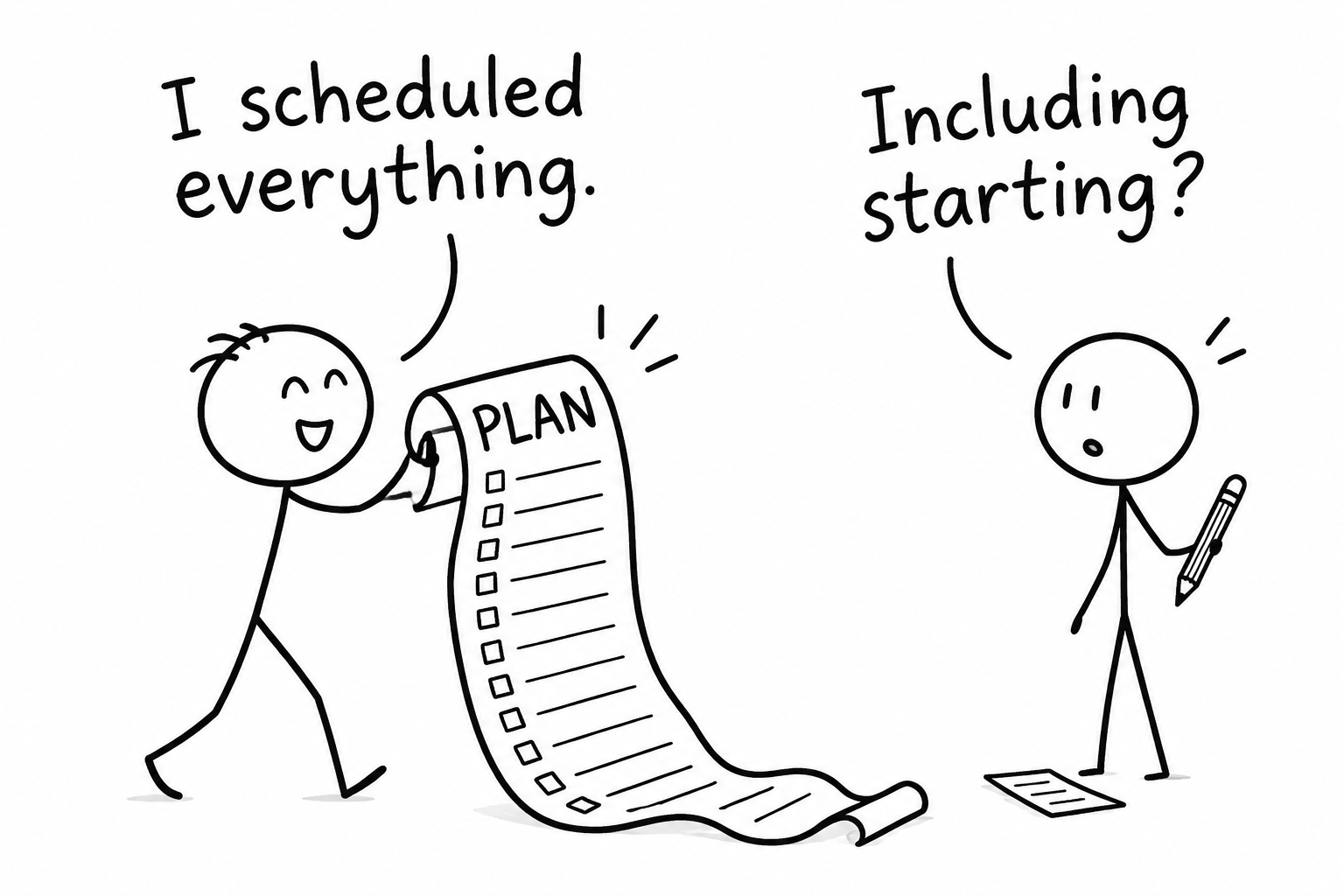 XKCD-style comic showing one student with an enormous revision plan and another asking whether it includes starting
Avoiding secure topics completely
Secure skills fade when they disappear from practice. Keep them alive through short retrieval sets while directing most improvement time towards weaker areas.
Counting questions instead of correcting them
Twenty rushed questions can teach less than ten carefully marked ones. Write corrections in full and attempt a similar question later without copying the solution.
Treating the plan as fixed
Your first plan is an estimate. Test results provide better information, so move time towards the mistakes that continue to cost marks. If you need help getting started, the MathsGenie Help Centre explains how the planner turns exam dates into a day-by-day plan.
Build your route to grade 5
Knowing which topics to revise is only the first step. The harder part is returning to them consistently while balancing school, other GCSEs and fixed exam dates. You have seen how the weekly structure works; now turn it into something you can follow.
Build your grade 5 schedule in the MathsGenie Revision Planner.















