GCSE Art and Design Revision Timetable: Worth It?
GCSE art and design revision timetable worth it? See when a written plan helps, when flexibility works, and how to preserve effective GCSE maths revision.
There is a particular kind of panic that appears when an art deadline and a maths exam begin competing for the same evening. Art feels unfinished because there is always something else you could refine. Maths feels urgent because every practice paper exposes another topic to revisit.
So, is a GCSE art and design revision timetable worth it? Usually, yes, but only if it is short, flexible and based on specific actions. A timetable does not improve outcomes by itself. Its value is that it helps you plan, monitor and adjust your work while protecting regular maths practice. Flexible revision can work just as well when it achieves those same things without relying on fixed hourly slots.
The real choice is not between having a timetable and having no timetable. It is between controlling your workload and repeatedly deciding what to do at the last minute.
The quick answer
A useful combined revision plan should:
- identify genuine art deadlines and supervised assessment dates;
- turn broad intentions into visible tasks;
- reserve recurring sessions for GCSE maths;
- leave spare capacity for unfinished art processes;
- use maths questions, mini tests and papers rather than passive reading;
- be reviewed every week rather than treated as permanent;
- allow missed sessions to be moved without creating panic.
If writing a detailed timetable becomes another form of procrastination, use a flexible weekly task list instead. The format matters less than whether the plan leads to focused work.
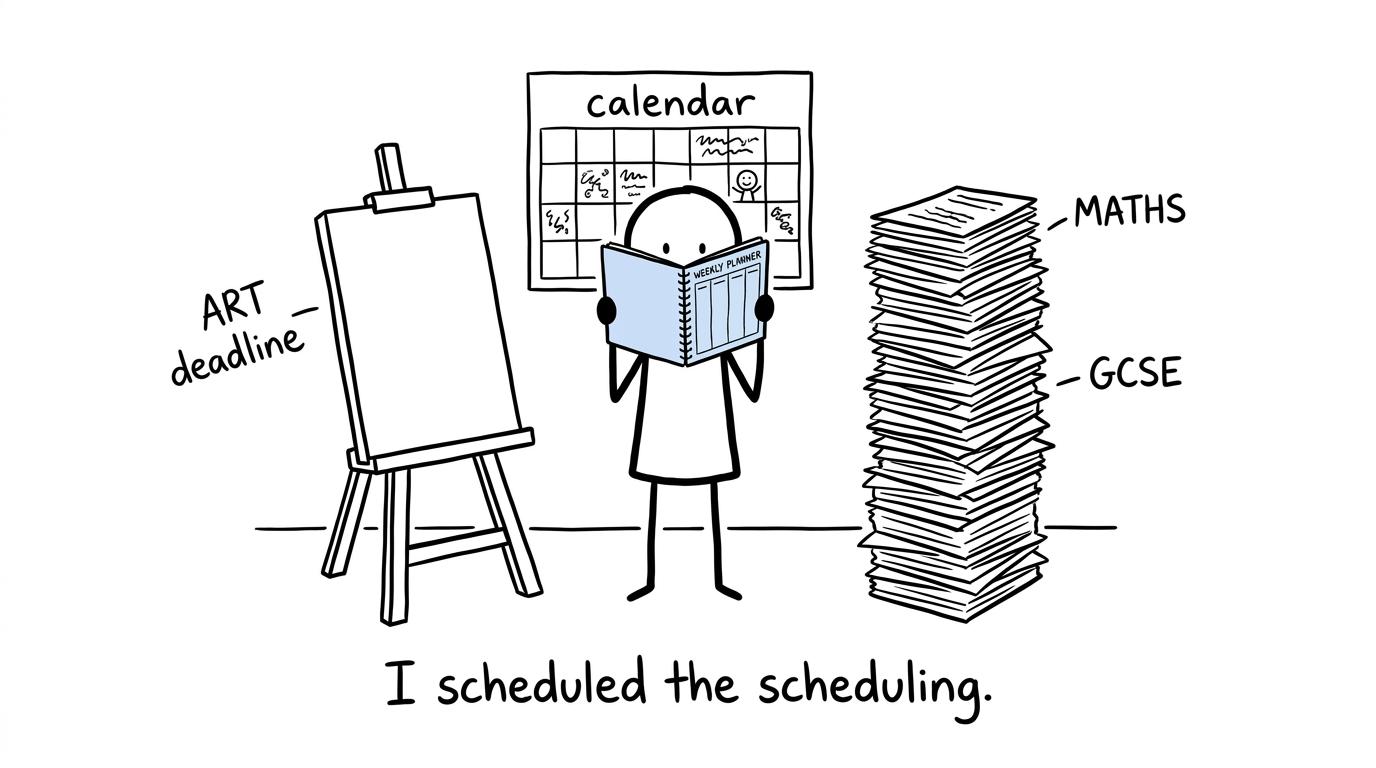 A student caught between an art deadline and a stack of maths papers uses a small planner as a shield
Why GCSE Art and Design needs a different kind of timetable
GCSE Art and Design is not revised in quite the same way as GCSE maths. You cannot prepare for it entirely through flashcards or short recall questions. Progress may involve investigating sources, developing ideas, experimenting with materials, recording observations, refining a response and completing practical work.
For GCSE Art and Design qualifications regulated in England, the four assessment objectives are equally weighted at 25%25\%25% each. In summary, they concern developing ideas, refining work, recording observations and presenting a personal response. Specifications commonly divide assessment between a portfolio worth 60%60\%60% and an externally set assignment worth 40%40\%40%. The externally set assignment includes preparatory work followed by 101010 hours of supervised activity.
Exact instructions and arrangements depend on your exam board, specification and school. AQA, Pearson Edexcel, OCR and Eduqas publish their own requirements, so use the dates and rules given by your teacher rather than copying a timetable found online.
This assessment structure changes what planning should look like. Writing “revise art” beside Tuesday evening is too vague. A useful art block needs an outcome, such as:
- compare two relevant sources;
- photograph and annotate an experiment;
- test a material or technique;
- refine one section following feedback;
- organise preparatory studies;
- check that evidence across the assessment objectives is clear.
These are not guarantees of marks, nor should they replace your teacher’s guidance. They are simply tasks you can start, complete and review.
What a written timetable can genuinely change
There is no good reason to assume that producing a beautiful calendar automatically raises a grade. A timetable is an organisational tool, not a revision technique.
Its potential benefit comes from the behaviours it supports. Evidence-informed guidance on self-regulated learning emphasises planning, monitoring and evaluating learning. Revision guidance also supports spacing work across time and using active retrieval with feedback. A written plan can make those behaviours easier, but it is the behaviour, not the sheet of paper, that matters.
It makes competing deadlines visible
Art tasks often expand to fill the available evening. A drawing can always be adjusted; a page can always contain another annotation. Without a boundary, art may quietly consume the time intended for algebra, geometry or probability.
A weekly plan gives each subject a deliberate place. It does not claim that every task will take exactly as long as expected. It simply prevents one open-ended project from making every other GCSE invisible.
It reduces repeated decision-making
“Should I do art or maths?” sounds like a small question. Asked every evening, it becomes a habit of delay. Deciding in advance that a session will contain a particular art task followed by one maths topic removes some of that friction.
For maths, start with the GCSE Maths Revision hub and select your exam board, tier and weakest area. If you are unsure what belongs on your plan, the GCSE maths topics by exam board and tier provide a structured checklist for foundation and higher tier.
It supports spaced maths practice
Maths improves through repeated contact with methods and problems. One long session followed by a fortnight of silence is usually less useful than several purposeful opportunities to retrieve and apply the same knowledge.
Your timetable might therefore reserve recurring maths sessions without fixing every topic months in advance. After each mini test or paper, the next session can respond to the marks you lost. That is structure with feedback, rather than structure for its own sake.
MathsGenie’s guide to revising GCSE maths efficiently explains how to move from diagnosis to targeted practice, marking and re-testing.
Can flexible revision work just as well?
Yes. Flexible revision can work just as well as a written timetable if it still protects time, prioritises accurately and leads to regular action.
Some students work well with fixed slots. Others have changing homework, access to specialist art materials only at school, caring responsibilities, health needs or unpredictable energy. A rigid timetable may fail because it assumes every day will look the same.
A flexible system could use three lists:
- Must happen: fixed deadlines, supervised sessions and urgent corrections.
- Should happen: weak maths topics and important art development tasks.
- Could happen: valuable extension work if time remains.
You then choose from those lists within protected blocks. The block stays fixed; the exact task can change after feedback.
The test is simple: does your flexible method repeatedly produce completed art actions and marked maths practice? If it does, you do not need an elaborate hourly grid. If important tasks keep drifting, more written structure would probably help.
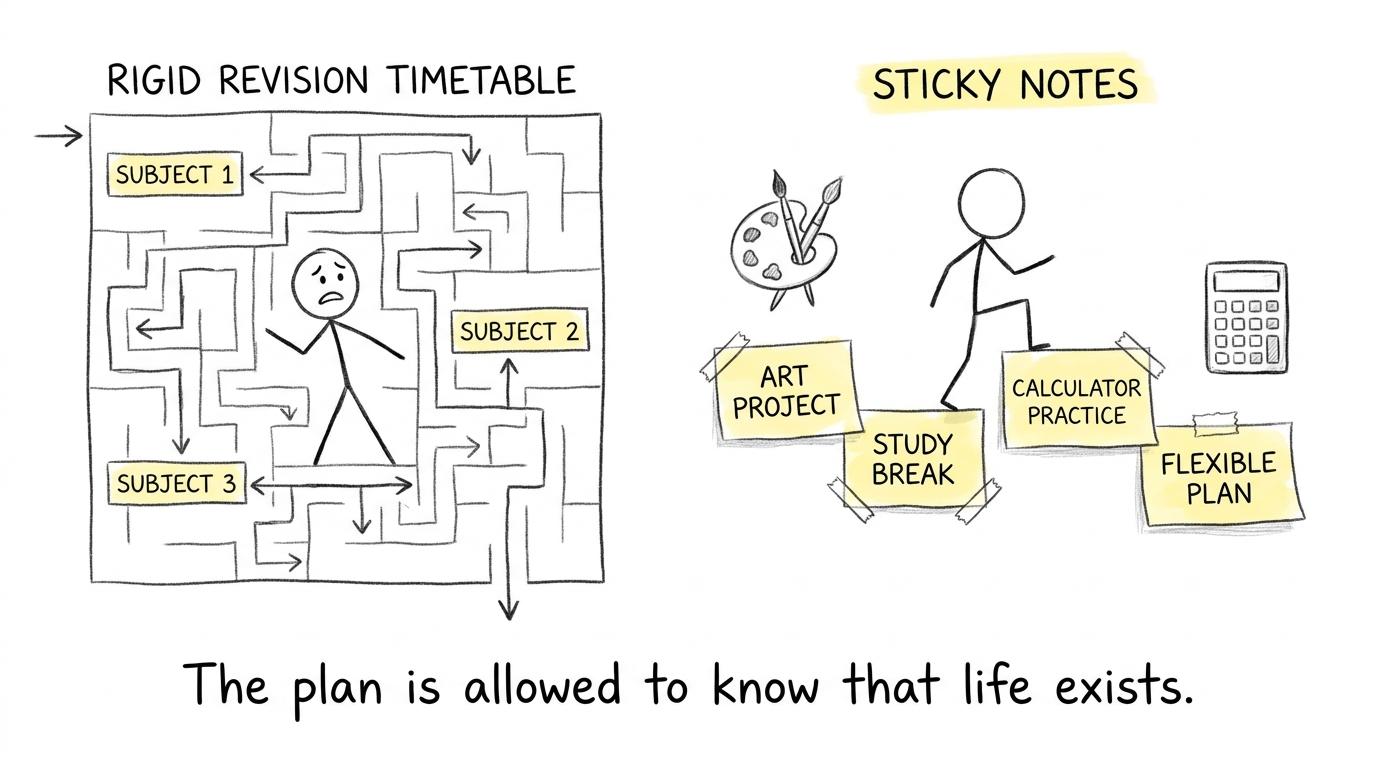 One student is trapped in a rigid timetable maze while another crosses movable sticky-note stepping stones
Build a timetable that survives real life
The best plan is rarely the most detailed. It is the one that remains usable after a difficult day.
Begin with fixed commitments
Add school hours, travel, sleep, meals, activities, art deadlines and confirmed assessment sessions first. Do not plan revision into time that does not really exist.
Next, place a small number of protected maths blocks across the week. Your board and tier matter: foundation and higher students should practise material appropriate to the papers they will sit. The best order for learning GCSE maths topics can help you sequence skills rather than selecting topics randomly.
Plan outputs, not subjects
“Maths for an hour” describes time, not learning. “Complete a mini test, mark it and identify two weak skills” describes an outcome.
Likewise, “finish sketchbook” is likely to be too large and unclear. Choose one manageable stage that contributes to the project’s development. Ask your art teacher which evidence is currently weakest before deciding how to use independent time.
For a shorter maths session, try the Edexcel GCSE Maths mini tests if Edexcel is your board. Students following another specification can use the resources available through the main GCSE hub.
Leave deliberate buffer space
Art processes can take longer than expected. Materials need preparation, digital files misbehave and an experiment may need to be repeated. A timetable with no spare capacity treats ordinary disruption as failure.
Keep at least one movable block each week. It can absorb an unfinished art task, a missed maths session or necessary rest. Flexibility is not evidence that the timetable has failed. It is part of a realistic timetable.
Review the plan using evidence
At the end of the week, ask:
- Which art actions were actually completed?
- What guidance did my teacher give?
- Which maths topics lost the most marks?
- Did I mark every set of questions?
- What needs to be revisited next week?
A revision planner should change when the evidence changes. MathsGenie’s one-month GCSE maths revision plan offers a useful rhythm of diagnosis, targeted questions, mini tests and timed papers that can sit alongside art preparation.
Protect maths from becoming the “later” subject
Practical coursework creates visible unfinished work. Maths weaknesses are less visible until you attempt questions. That makes maths easy to postpone, even when the exam date is approaching.
Build each maths block around an active cycle:
- identify one weak skill;
- use a revision lesson to rebuild the method;
- answer practice questions without copying;
- check the answers or mark scheme;
- record the reason for each lost mark;
- revisit the skill after a delay.
As exams approach, add timed papers. Use the collection for your board, such as Edexcel GCSE Maths past papers, AQA GCSE Maths past papers or OCR GCSE Maths past papers. Mark schemes and video solutions turn a score into information about what to practise next.
Predicted papers can provide further unseen practice, but they should not be treated as forecasts of the exact questions you will receive. Use them after topic revision and alongside official past papers.
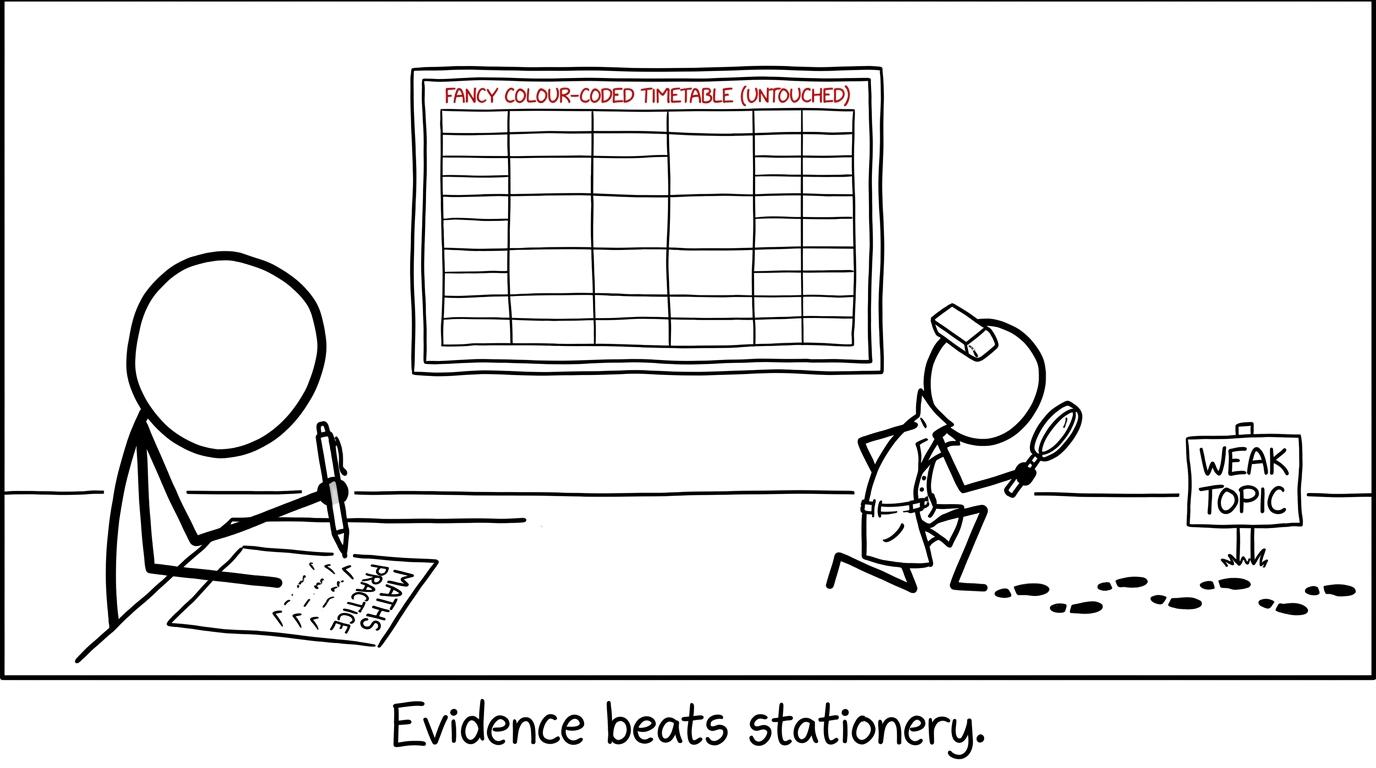 An eraser detective follows evidence towards a weak maths topic while a decorative timetable sits in a museum
Common mistakes when planning Art and Design with maths
Making the timetable instead of doing the work
Colour-coding can feel productive because it creates order without exposing any weaknesses. Limit the set-up time. Once the essential commitments are visible, begin the first task.
Treating every art session as open-ended
Give the session a stopping point. When the planned outcome is complete, record the next action and move on. Do not confuse endless adjustment with purposeful refinement.
Filling every available hour
A plan without breaks, meals, sleep or buffer time is not ambitious; it is inaccurate. Overloading the week makes one missed session feel like a crisis.
Revising maths passively
Watching videos and reading notes may help you understand a method, but they do not show whether you can use it independently. Follow explanation with practice questions, marking and correction.
Refusing to change the plan
Your priorities should move after teacher feedback, mini tests and past papers. A timetable created before you knew your weaknesses should not overrule evidence discovered later.
Ignoring specification differences
Do not assume another student’s art deadlines, supervised arrangements or exam-board rules apply to you. Follow your school’s instructions and the correct specification.
A timetable is useful when it leads to action
A written GCSE Art and Design revision timetable is worth making when it protects deadlines, breaks creative work into manageable actions and preserves repeated maths practice. It is not essential when a flexible weekly system already produces the same disciplined behaviour.
Keep the plan light. Make tasks specific. Leave room for change. Most importantly, judge the system by the work it helps you complete, not by how organised it looks.
Then let MathsGenie make the maths part easier to execute. Open the free GCSE Maths Revision hub, choose your board and tier, and move from revision lessons to practice questions, mini tests, past papers and predicted papers. Use the mark schemes and video solutions to decide what your revision planner should contain next. A good plan cannot earn marks for you but it can keep bringing you back to the work that will.