Revision Order: GCSE English Language and Literature
Revision order GCSE English Language and Literature advice: decide what to tackle first, alternate both subjects and fit English around GCSE maths revision.
Opening a revision timetable can create a surprisingly difficult question: what should come first? If English Language feels unpredictable, you may want to avoid it. If Literature contains several texts and dozens of quotations, you may feel that it must take priority.
The short answer is that revision order for GCSE English Language and Literature does matter, but there is no universal rule that one subject must always come first. Literature knowledge benefits from being revisited across several weeks, while Language skills improve through repeated practice, feedback and timed responses. Your best order depends on your exam dates, current weaknesses and the kind of concentration you have available.
The goal is not to finish one subject before touching the other. It is to alternate them deliberately, giving earlier and more frequent attention to whichever is currently costing you the most marks.
The quick revision order checklist
Before planning your next English session, ask:
- Which English examination comes first on my confirmed timetable?
- Am I weaker at recalling Literature content or applying Language skills?
- Which task has my teacher identified as the biggest priority?
- Have I practised both subjects recently, rather than leaving one untouched?
- Do I need a fresh mind for an essay, or would a short retrieval task suit my energy?
- When will I revisit today’s work?
- Where will maths revision fit without being pushed into whatever time remains?
A sensible default is to begin Literature revision earlier because its texts, themes and quotations take time to retain. Keep Language running alongside it through short, regular reading and writing tasks. As each examination approaches, temporarily increase the share of time given to the nearer paper.
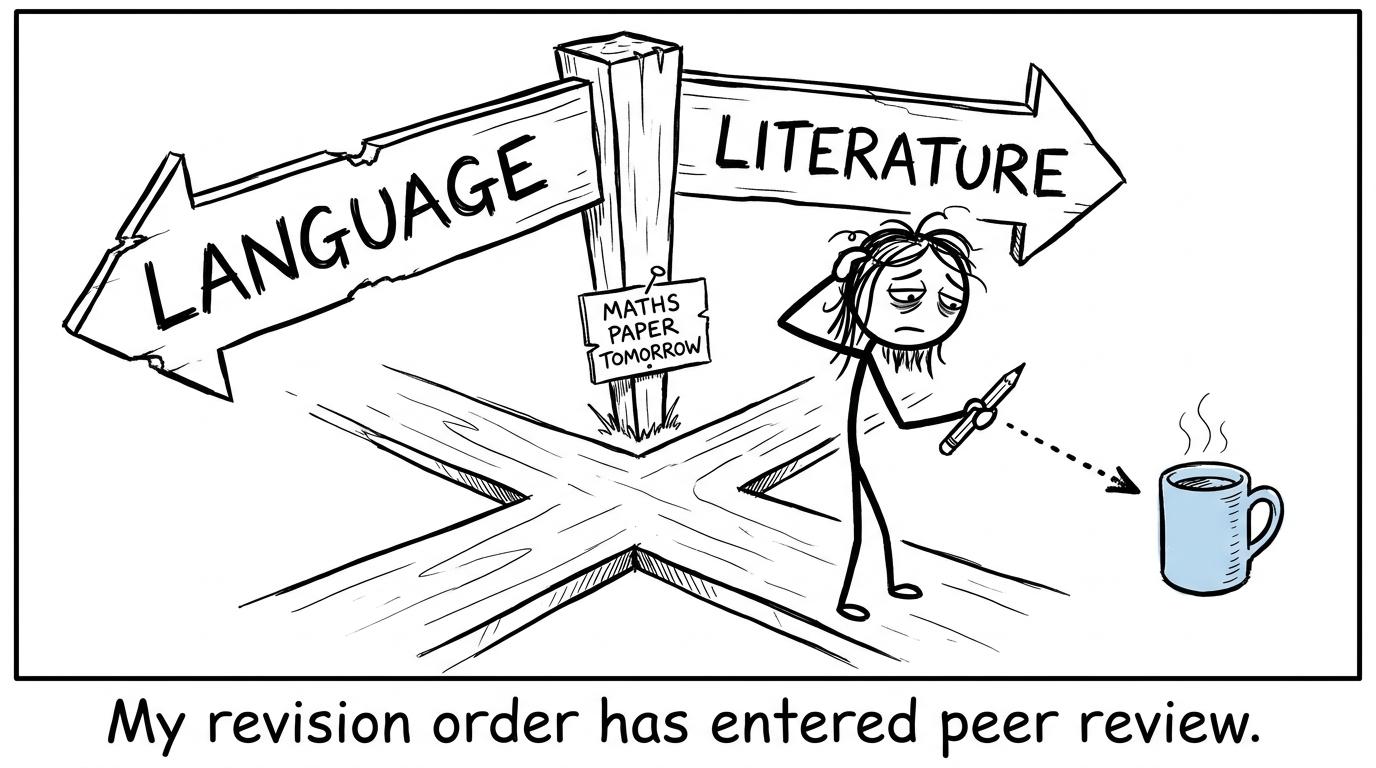 A student consulting a revision timetable crossroads
Why order matters, but not in the way students expect
Order matters because attention, memory and time are limited. It does not matter because English Language must somehow be “completed” before Literature, or vice versa.
Evidence reviewed by the Education Endowment Foundation supports spacing learning across different days and using retrieval rather than relying only on rereading. The practical lesson is simple: several encounters with a text or skill are usually more useful than one enormous block followed by silence.
This makes a timetable such as “finish Literature this week, then do Language next week” fragile. By the time you switch subjects, some of the earlier learning may already be difficult to retrieve. Alternation creates planned returns.
Order also affects the quality of a session. A demanding Literature essay may deserve the first focused period of the evening. A brief quotation check or Language paragraph plan may work later, when concentration is lower. The first task should usually be the one requiring the clearest thinking, not automatically the subject you enjoy most.
English Language and Literature need different revision
The two qualifications overlap, but they are not interchangeable.
English Language is mainly a performance skill
GCSE English Language assesses reading and writing. In the qualifications regulated in England, reading and writing each account for half of the written assessment. Students must interpret information, analyse writers’ choices, evaluate or compare texts where required, and communicate effectively for an audience and purpose.
That means Language revision should involve doing something: annotating an unseen extract, planning a response, writing under time pressure or improving an answer using feedback. Merely reading model answers can create familiarity without proving that you can produce your own.
Language therefore needs regular practice throughout the timetable. You cannot reliably “learn it all” in one early block and consider it finished.
English Literature combines knowledge with analysis
Literature requires secure knowledge of studied texts alongside interpretation and analysis. The required GCSE content in England includes Shakespeare, a nineteenth-century novel, poetry and modern prose or drama, although your precise texts and paper structure depend on your specification.
You may need to retrieve plot details, character development, themes, carefully selected quotations, contextual understanding and methods used by the writer. That volume of connected knowledge is a reason to start Literature early and revisit it repeatedly.
However, recalling quotations is not the whole qualification. Literature answers also need a defensible argument, relevant references and analysis of language, form or structure. Retrieval should therefore lead into plans, paragraphs and timed responses.
What should you revise first?
Use evidence from your own work rather than following a fixed online rule.
Start with Literature when knowledge is insecure
Put Literature first if you cannot recall the important events, themes or textual references needed to begin an answer. Build a usable foundation across all your set texts before polishing isolated essays.
An effective sequence is:
- retrieve the text’s main events and turning points;
- organise characters and themes;
- recall a small bank of flexible references;
- connect each reference to an interpretation;
- plan and write examination responses;
- return later without notes.
Do not wait until every quotation feels perfect before practising analysis. Knowledge and writing should develop together.
Start with Language when execution is the problem
Put Language first if you understand extracts in class but struggle to produce complete answers independently. The priority may be selecting evidence, explaining effects, evaluating a claim, comparing perspectives, organising writing or controlling technical accuracy.
Practise the precise question type causing difficulty. Complete it, check the relevant mark scheme or teacher feedback, identify one improvement and repeat that improvement in a later task.
This is similar to effective maths revision: the useful question is not “Which subject should I do?” but “Which specific performance needs repairing?” MathsGenie’s guide to finding and fixing weak topics applies the same diagnostic principle to maths.
A practical order across the revision period
Your timetable should change as the examinations approach.
Early revision: diagnose and build coverage
Begin by checking your exam-board specification and school guidance. AQA, Pearson Edexcel, OCR and Eduqas papers are not identical, so do not build a timetable around a generic social-media checklist.
During this phase:
- map every Literature text, cluster and question type;
- identify weak Language reading and writing tasks;
- begin short retrieval sessions for Literature;
- complete untimed or lightly timed Language practice;
- keep maths active through topic-based questions.
For maths, the GCSE Maths revision hub lets you choose your board and work through revision lessons, worksheets and exam questions instead of guessing what to cover.
Middle phase: alternate knowledge and performance
Once coverage is secure, use a repeating cycle rather than subject marathons. One session might focus on Literature retrieval and an essay plan; the next might focus on a Language reading response. Return to both within the same week.
Apply the same rhythm to maths: learn or review a method, practise it, mark the work and retest it later. The best order for learning GCSE Maths topics explains why maths has a stronger prerequisite structure than English. Algebraic techniques often depend on earlier number fluency, whereas English Language and Literature can usually be alternated more freely.
Final phase: follow exam proximity
Near the examinations, let the confirmed timetable influence priority. The next paper should receive more attention, but it should not consume every session. Brief retrieval from later subjects protects them from being forgotten.
Increase timed work and use official past papers supplied by your board or school. Practise under the correct conditions, then review the response rather than treating completion as success. The same principle is explored in MathsGenie’s guide to using GCSE past papers properly.
Predicted material should supplement specification coverage and official papers, not replace them. That applies in maths too: GCSE predicted papers are most useful after topic work has revealed and repaired the main gaps.
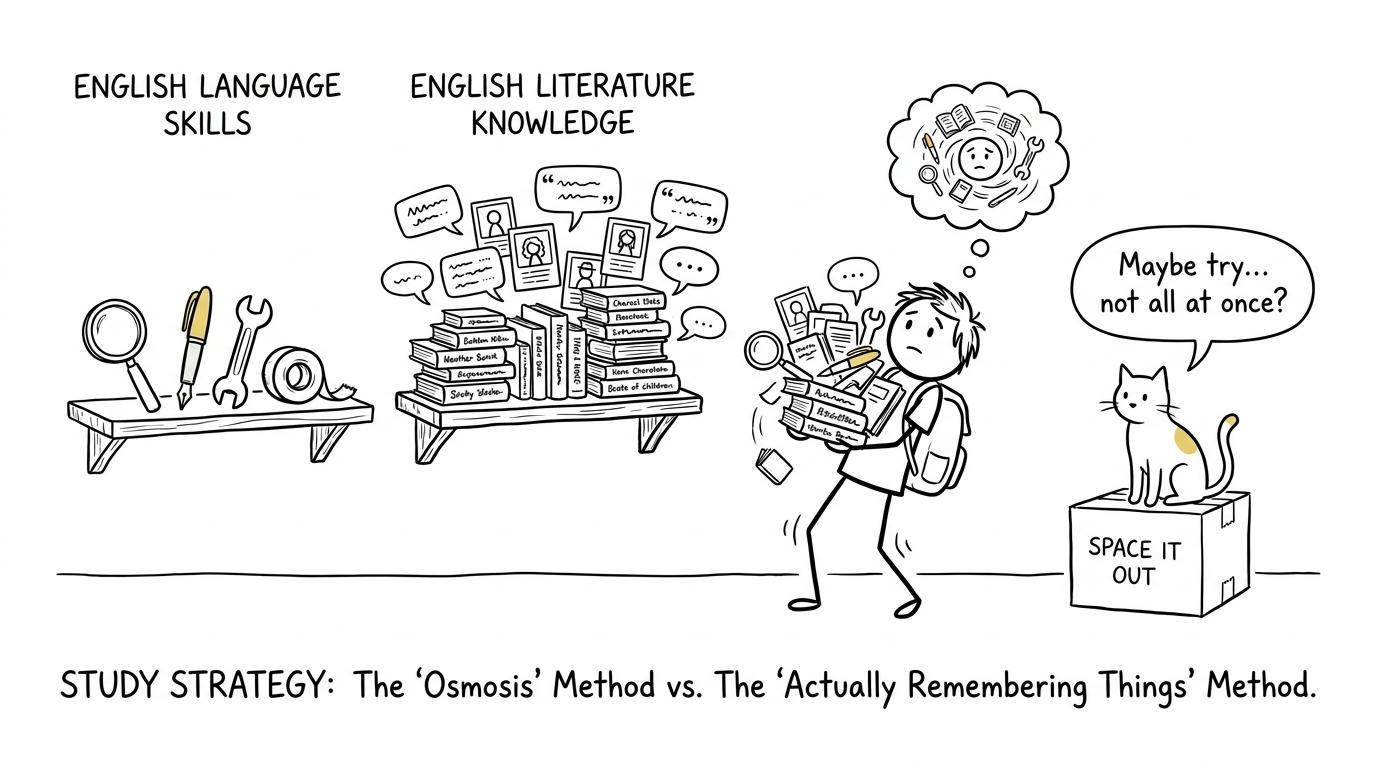 A student balancing Language skills and Literature knowledge
How to order tasks within one evening
When English and maths share an evening, use energy rather than habit to set the order.
A strong pattern is:
- begin with the most cognitively demanding task;
- switch subject after a defined block;
- finish with retrieval, marking or correction;
- record the next action before stopping.
For example, a full Literature response or difficult higher-tier maths topic may need your freshest attention. A quotation retrieval check, error-log review or short set of Language planning prompts may fit later.
Avoid always leaving maths until last because it feels structured, or always starting with it because it is comfortable. Rotate the first position across the week. MathsGenie’s GCSE revision timetable guide can help you build a realistic pattern, while the twenty-minute maths routine is useful on English-heavy days.
Common mistakes with English revision order
Finishing one qualification before starting the other
This removes the planned returns that help learning remain retrievable. Keep both subjects active, even when one temporarily receives more time.
Starting with the easiest task every day
Easy tasks create momentum, but they can also become avoidance. Put an important, demanding task first on at least some days.
Treating quotation memorisation as complete Literature revision
Quotations are evidence, not finished arguments. Practise connecting references to interpretations and writers’ methods.
Revising Language by reading answers
Model answers are useful for comparison, but independent writing reveals whether you can select, organise and explain ideas yourself.
Ignoring the specification
Paper structures, set texts and question demands vary. Confirm your board, specification and examination timetable with your school before allocating time.
Letting English remove maths from the timetable
English essays can expand to fill an evening. Give sessions a clear endpoint so maths remains frequent. If a full paper feels too large, MathsGenie’s forty-five-minute maths tests provide shorter timed practice for Edexcel students.
Build an order that responds to evidence
The best revision order is not a permanent list. It is a feedback system.
Start Literature early enough to revisit its knowledge. Practise Language regularly because performance improves through repeated attempts and feedback. Give extra time to the nearer examination, but keep later subjects alive. Within each day, protect your freshest concentration for the task that genuinely requires it.
Then use the same disciplined approach for maths. Open the MathsGenie GCSE Maths revision hub, choose your exam board and move through revision lessons, practice questions and mini tests before testing yourself with past papers and predicted papers. Mark with the schemes, use video solutions when a method is unclear, and allow each mistake to decide what comes next.
A timetable cannot predict every difficult day. A good one does something more valuable: it makes the next sensible action obvious.