

Revision Order GCSE Bengali: What Works Best?
Revision order GCSE Bengali advice: learn when subject order matters, how to balance Bengali with maths, and how to build a practical timetable that lasts.
Revision timetables can create a strange problem. You begin by trying to organise your work, then spend so long deciding what should come first that little revision happens at all.
The short answer to revision order GCSE Bengali students need is this: there is no universally best position for Bengali in your timetable. Revising it first, last or between other subjects will not automatically improve your grade. Order matters only when it affects the quality, frequency and timing of your practice.
If Bengali requires careful listening or extended writing, place it where you can concentrate. If maths needs your freshest attention, start there and revise Bengali afterwards. What matters most is that both subjects return regularly, weak areas receive priority, and your sessions involve active practice rather than passive rereading.
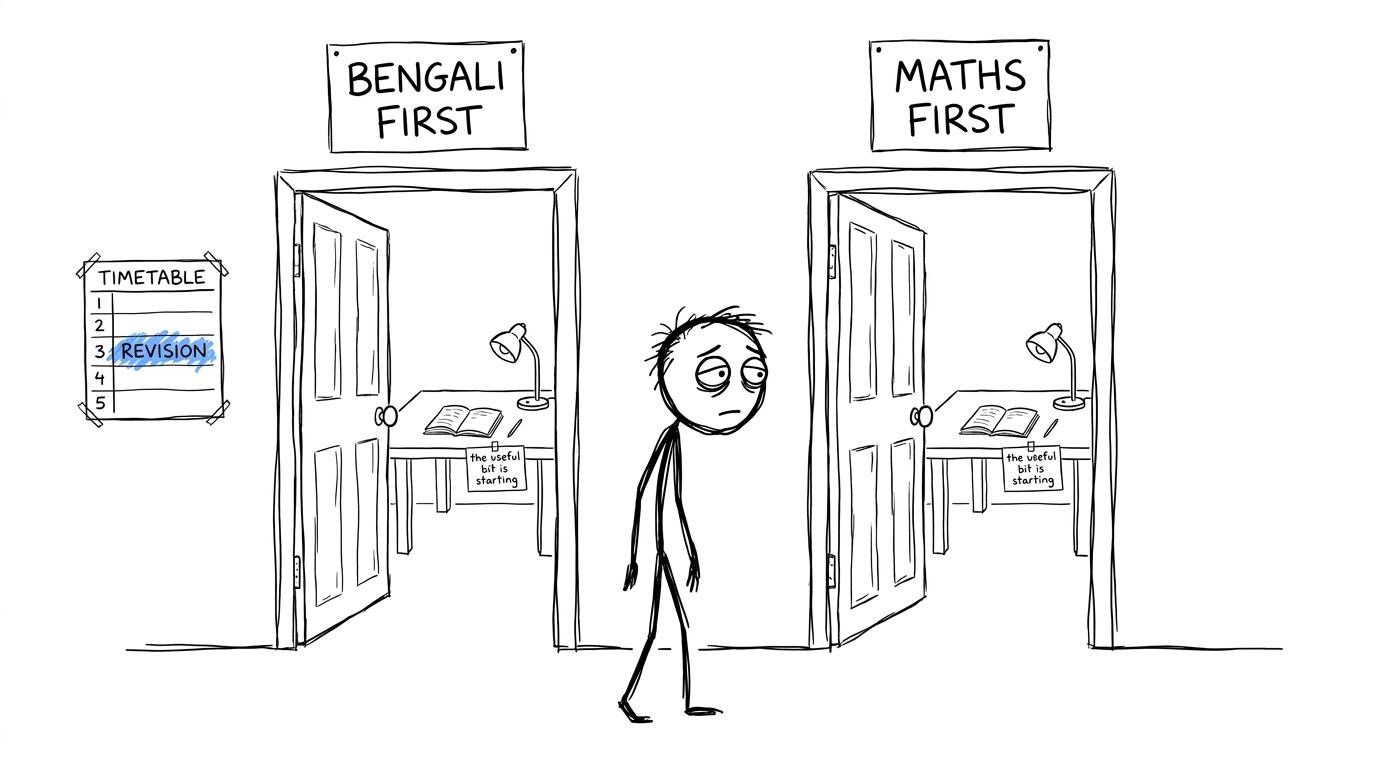 A GCSE student discovers that both revision-order doors lead to the same desk
The quick revision-order checklist
Use these questions whenever you decide what to revise first:
- Which exam is coming sooner?
- Which subject currently costs you more marks?
- Which task needs the most concentration?
- Have you revised this material recently, or is it becoming less secure?
- Can you complete the planned activity with the time and equipment available?
- When will you revisit it?
A good order is therefore personal and changeable. Bengali might come first on a quiet Saturday morning but follow a short maths session on a school night. Consistency is more valuable than protecting one supposedly perfect sequence.
When does revision order matter for GCSE Bengali?
Order matters when one position repeatedly produces better work than another. It does not matter because Bengali has a hidden advantage when placed before maths, science or English.
For the current AQA GCSE Bengali specification, the qualification assesses listening, speaking, reading and writing. Each skill contributes 25%25\%25% of the GCSE. That balance is important: a timetable which repeatedly prioritises comfortable reading practice while neglecting speaking or listening is not balanced, even if Bengali appears frequently.
Students taking an International GCSE Bangla qualification may have a different assessment structure, so always check the exact specification and paper format supplied by your school or exam board. Do not build a plan around somebody else's course.
Put Bengali first when it needs fresh concentration
Starting with Bengali may make sense when you are:
- completing focused listening practice without interruptions;
- preparing spoken responses aloud;
- writing an extended answer under timed conditions;
- reviewing a weak grammar or translation area;
- approaching a Bengali assessment sooner than your other exams.
These tasks require attention and self-correction. If you know that your concentration falls later in the evening, giving Bengali the first focused block is a sensible decision rather than a universal rule.
Put maths first when it is the larger immediate weakness
Maths may deserve the first block if a diagnostic paper has exposed serious gaps, a maths paper comes sooner, or you need a clear head for unfamiliar problem solving. You can use the GCSE Maths revision hub to select your exam board and move from revision lessons into practice questions.
The decision should come from evidence. A useful principle is:
priority=urgency+weakness+concentration needed.\text{priority} = \text{urgency} + \text{weakness} + \text{concentration needed}.priority=urgency+weakness+concentration needed.This is a planning idea, not an exam formula. It reminds you that priority has several causes. A subject does not always deserve first place merely because it feels difficult, nor should it always go last because you enjoy it.
Subject order matters less than spacing
One long Bengali session can feel productive because it creates visible progress. Yet revision must still be available in your memory days or weeks later.
Research-informed guidance from organisations including the Education Endowment Foundation and OCR supports spaced practice, retrieval and carefully mixed revision. In practical terms, revisiting Bengali across several days is generally more useful than placing the same total time into one isolated block and never returning to it.
A repeatable pattern might be:
- retrieve vocabulary or structures without notes;
- check what was accurate;
- practise one of the four assessed skills;
- record a specific weakness;
- revisit that weakness after a gap.
The same principle works in maths. MathsGenie's guide to building a GCSE maths revision timetable explains how to combine topic practice, marking and timed paper work without trying to cover everything at once.
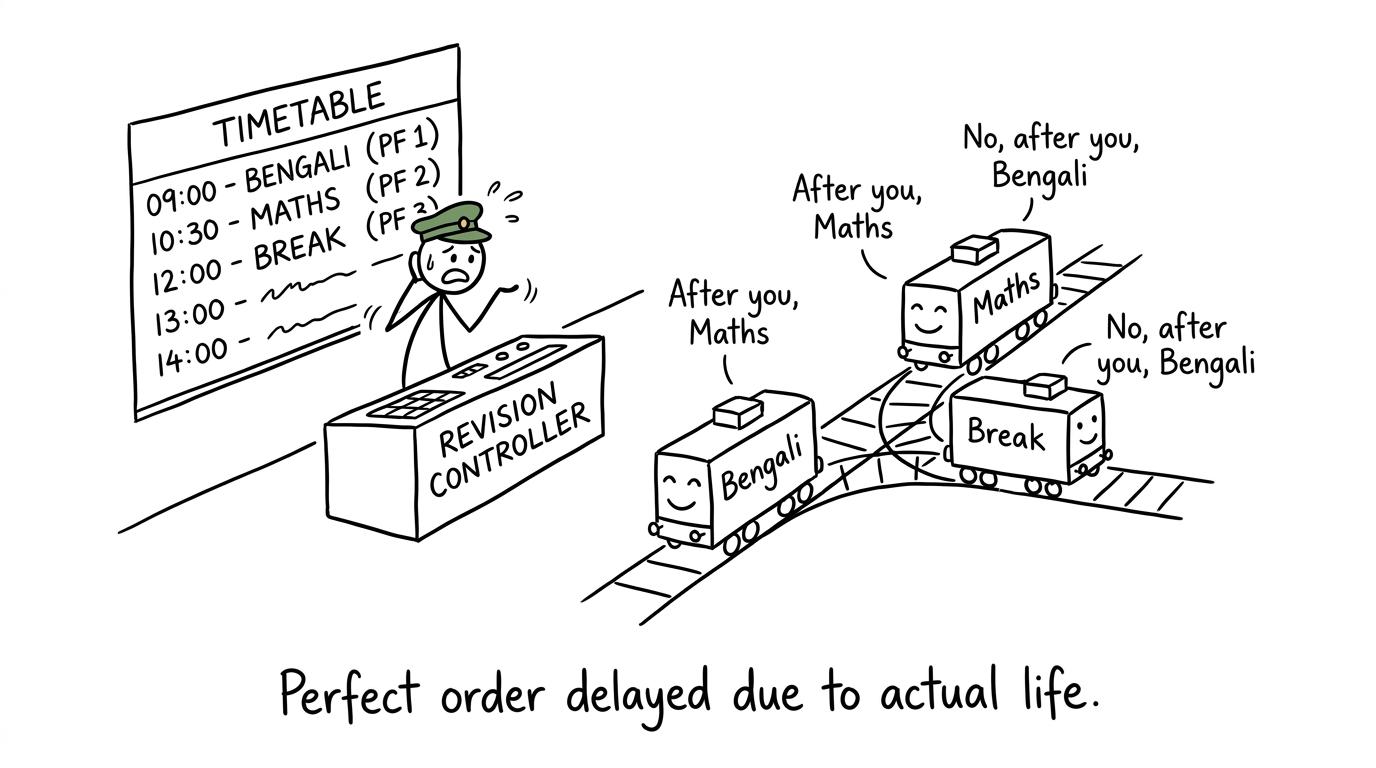 A railway controller learns that real life does not follow a perfect revision timetable
How to combine Bengali and maths in one timetable
Bengali and maths ask your brain to do different things. Language revision may involve listening, vocabulary retrieval, interpretation and extended communication. Maths revision requires recognition, method selection, accurate working and checking.
That contrast can be useful. Switching subjects after a purposeful block may restore attention, provided the switching is planned rather than driven by avoidance.
Match the task to your energy
When energy is high, choose demanding work such as timed Bengali writing, listening practice or unfamiliar maths questions. When energy is lower, use a shorter but still active task: spoken retrieval, vocabulary checking, formula recall or correction of previous errors.
Avoid turning a low-energy session into passive highlighting. A modest task completed honestly is better than an ambitious block spent staring at a page.
For maths, the best order to learn GCSE maths topics is shaped partly by prerequisites: secure number and algebra skills support later topics. Bengali revision is less linear. You do not need to finish all reading before beginning writing, because its skills should develop together.
Use short sessions for maintenance
A shorter session can keep a subject active between deeper sessions. For example, you might use one block for focused maths questions and a separate brief block for Bengali vocabulary retrieval or speaking practice. The purpose is not to squeeze every subject into every day. It is to prevent important skills from disappearing for weeks.
Maths students can use Edexcel GCSE Maths mini tests for targeted timed practice. Equivalent short Bengali tasks could include recording a spoken response, answering a small set of listening questions or retrieving vocabulary before checking it.
Alternate the starting subject
If Bengali always comes last, it may repeatedly receive whatever time and attention remain. Alternating the first subject across the week removes this bias.
One day can begin with Bengali writing and finish with maths correction. Another can begin with maths problem solving and end with Bengali speaking. This variation also shows you when your concentration is strongest, allowing the timetable to improve from evidence rather than guesswork.
Let exam dates and feedback change the order
A revision plan is not a promise carved into stone. It is a working decision based on what you currently know.
As an exam approaches, that subject will usually move higher in the order. But avoid abandoning later subjects completely. Brief maintenance sessions protect earlier learning while you focus on the nearest paper.
Feedback should also change your priorities. In Bengali, separate weaknesses by assessed skill: listening, speaking, reading and writing. In maths, mark a paper and identify the exact topics behind lost marks. MathsGenie's guide to using GCSE past papers properly follows a useful cycle: sit the paper, mark it, identify gaps, repair them and retest.
The MathsGenie past-paper library places papers and official mark schemes together, with worked solutions available for selected papers. This turns mistakes into information rather than a verdict.
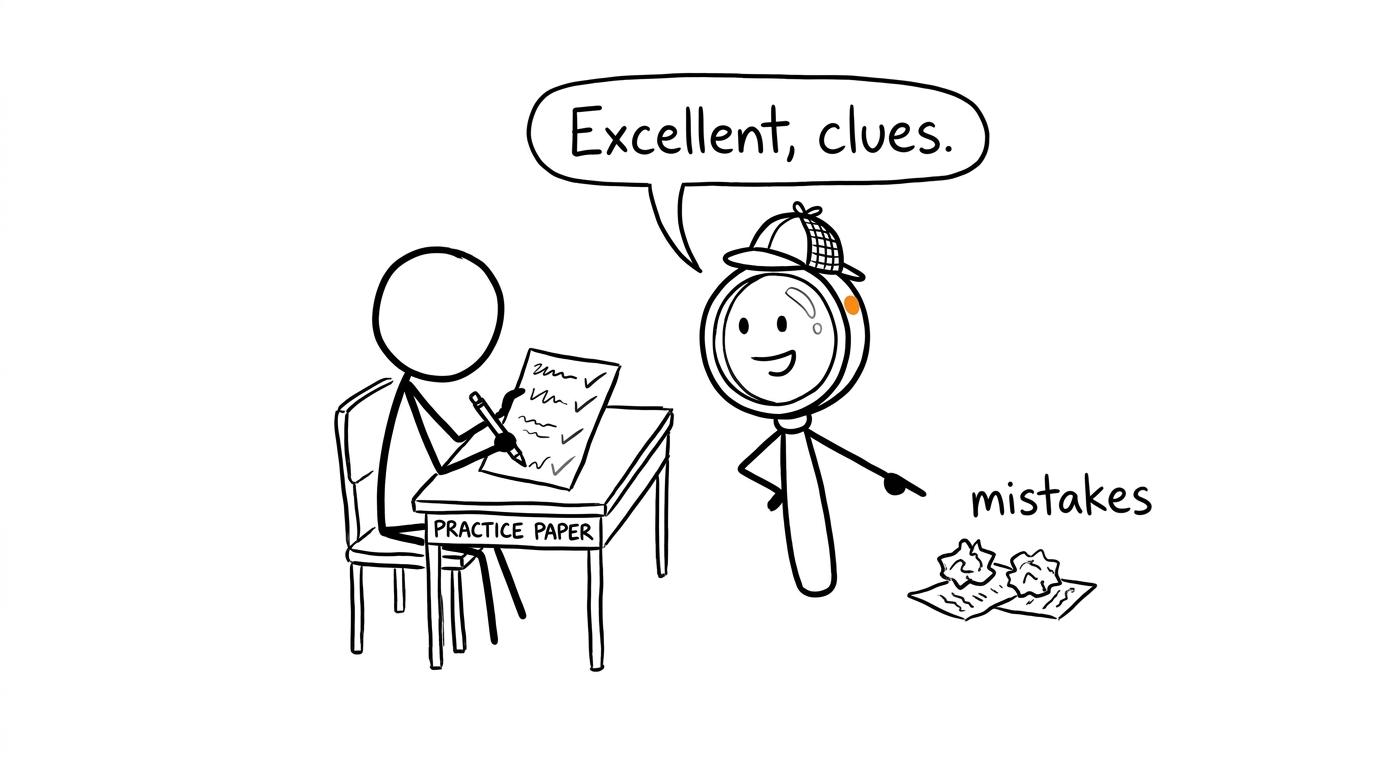 A revision detective treats mistakes as useful clues
Build a timetable you can adjust
Begin with fixed commitments: school, meals, sleep, travel and other responsibilities. Then add realistic revision blocks. A timetable that requires perfect energy every evening will fail for ordinary reasons, not because you lack discipline.
Give each block a precise outcome. “Revise Bengali” is vague. “Complete listening questions and correct every response” is actionable. “Do maths” is equally vague. “Complete an algebra mini test and record each lost mark” tells you when the task is finished.
If your exams are close, the GCSE one-month maths revision plan offers a useful model for moving from diagnosis towards timed practice. Its underlying structure can inform your wider timetable, although Bengali activities must reflect your own specification.
Schedule a brief weekly review. Ask:
- Did Bengali receive balanced coverage across its assessed skills?
- Did maths practice target actual weaknesses?
- Which starting order produced the best concentration?
- Which sessions were repeatedly skipped?
- What should move earlier next week?
That review is where a timetable becomes intelligent.
Common revision-order mistakes
Searching for one perfect sequence
There is no fixed rule that Bengali must come before maths or after English. The best position depends on your deadlines, weaknesses and energy. Endless timetable redesign is often revision avoidance wearing organised clothes.
Always starting with the easiest subject
Easy work creates momentum, but it can also consume your best concentration. If difficult Bengali listening or higher-tier maths is repeatedly delayed, place it earlier on selected days.
Always starting with the hardest subject
The opposite rule can also fail. Beginning every evening with the task you dread may make starting harder. A short, active warm-up can help, provided it has a firm stopping point.
Confusing exposure with practice
Reading vocabulary lists and looking through maths solutions can feel familiar without proving that you can retrieve or apply anything. Close the notes, answer questions, speak, write, mark and correct.
Ignoring the specification
AQA GCSE Bengali students need preparation across four equally weighted skills. International GCSE formats can differ. Likewise, maths revision must match your board and tier. The GCSE maths topics by exam board and tier guide helps you confirm the relevant maths content for Edexcel, AQA, OCR or Eduqas.
Completing papers without repairing mistakes
A completed paper is evidence, not the end of revision. The improvement comes from marking, understanding lost marks and practising the weak skill again. If you are unsure when to introduce this stage, read when to start GCSE past papers.
Choose usefulness over perfect order
So, does the order in which you revise subjects matter for GCSE Bengali? Sometimes, but only because order influences attention, urgency and whether a subject is repeatedly neglected. There is no special academic benefit to always putting Bengali first or always placing it after maths.
Start with the task that most needs your present level of concentration. Revisit each subject across the week, balance Bengali's assessed skills, and let exam dates and marked work change your priorities. A timetable should respond to evidence.
For maths, make MathsGenie your free revision base. Use revision lessons to rebuild methods, practice questions and mini tests to strengthen them, then past papers, predicted papers, mark schemes and video solutions to prepare for exam conditions. Choose one useful task, begin it, and allow tomorrow's order to be decided by what you learn today.










