Revision Breaks: How Long and How Often?
Revision breaks: how long and how often? Plan practical focus blocks and restful pauses for GCSE and A Level revision to manage fatigue and keep momentum.
Imagine revising at the kitchen table. After an hour, the book is still open, but very little is going in. Should you stop or push through?
The practical answer to revision breaks: how long and how often is to start with 252525-454545 minutes of focused revision, followed by a 555-101010 minute break. After two or three blocks, try a longer break of 202020-303030 minutes. These timings are starting points, not universal rules. Adjust them according to your concentration and the task.
Breaks belong in your plan from the beginning. You do not need to earn them by becoming exhausted.
A simple revision break checklist
- Choose one clear task for each focus block.
- Start with 252525-454545 minutes of work.
- Take 555-101010 minutes away from the task.
- After two or three blocks, take 202020-303030 minutes off.
- Decide when each break ends before it begins.
- Adjust the rhythm if concentration or punctuality slips.
The useful measure is whether you can concentrate, return on time and remember what you practised.
How often should you take revision breaks?
A break every 252525-454545 minutes is a practical starting point for GCSE and A Level revision. Unfamiliar problem-solving may suit shorter blocks. Familiar practice may allow longer periods of concentration.
Watch what happens to your work. Repeatedly rereading a line, losing track of a method or making unusual arithmetic errors can signal that you need a pause. Remaining at the desk does not guarantee productive revision.
Try finishing at a sensible stopping point, such as after marking a short question set. Avoid interrupting a productive thought simply because the timer rings, but do not extend every block indefinitely.
The GCSE revision timetable guide can help you fit blocks around school and homework. Compare your overall workload with the guide to how many hours you should revise.
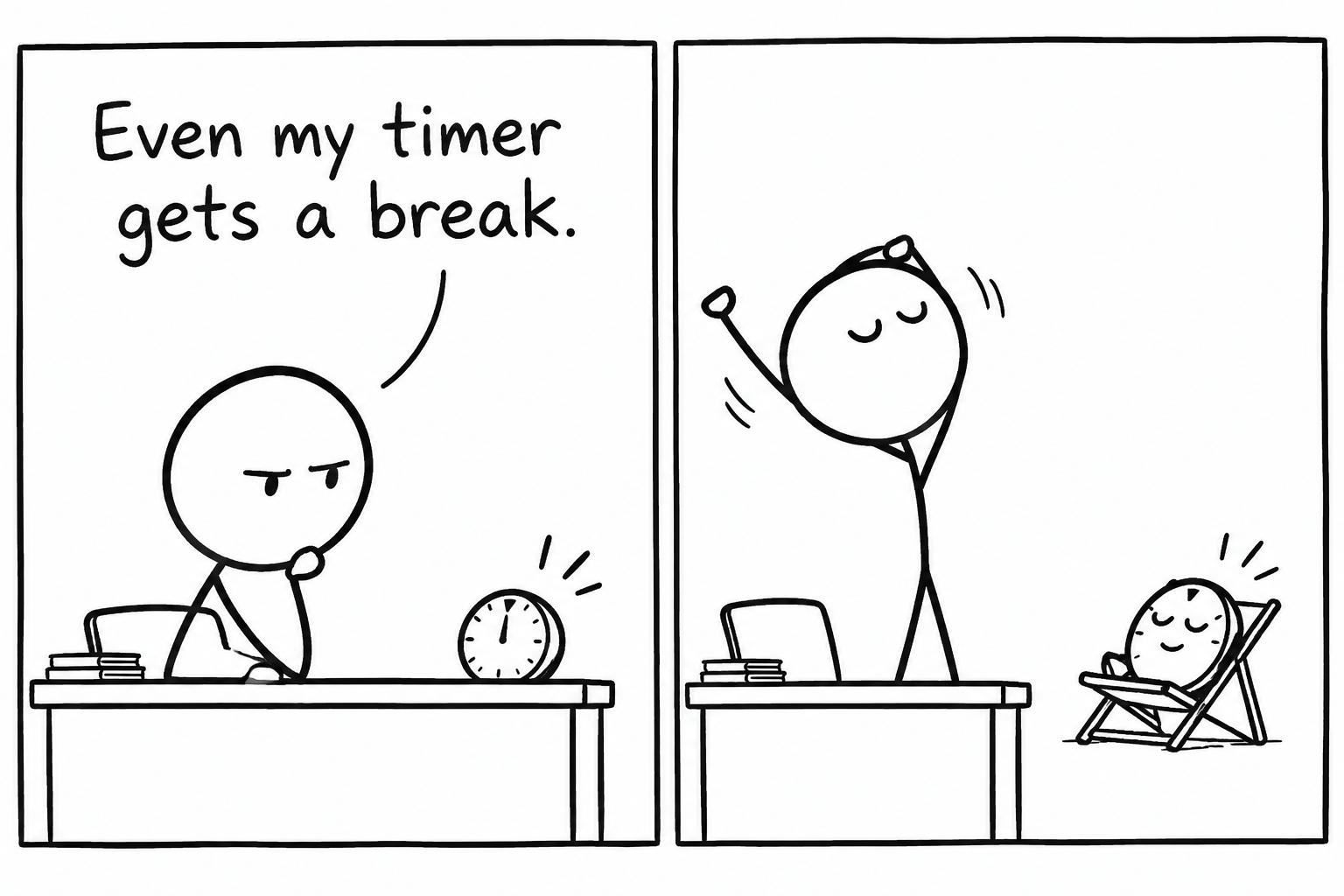 A stick-figure student discovers that even the revision timer needs a break
How long should a revision break be?
A short break of 555-101010 minutes gives you time to move, drink water and change your surroundings without losing the thread of your work.
After two or three blocks, allow 202020-303030 minutes for food, a walk or a fuller reset. During weekend revision, include proper meals and substantial time away from the desk.
A systematic review published in 202220222022 found small improvements in energy and reductions in fatigue from micro-breaks, but no significant overall improvement in performance. Breaks can help manage tiredness; they do not guarantee better marks or replace effective practice.
Set a timer and leave yourself a clear instruction for returning, such as opening the next question set. A predictable restart makes the break easier to finish.
What should you do during a break?
Choose something with a natural stopping point:
- Stand up and stretch.
- Get water or a snack.
- Walk outside or around the house.
- Look away from screens.
- Speak briefly to someone.
Short videos, games and message threads can be harder to stop. If your phone regularly turns 555 minutes into 404040, leave it elsewhere during short breaks.
Parents can help by respecting agreed pauses and asking when the next block begins. The guide to supporting GCSE revision without nagging explains how to keep that support constructive.
Match the rhythm to the task
Learning a topic
Try 252525-353535 minutes for a revision lesson followed by questions that check understanding. MathsGenie's GCSE maths revision resources bring together topic lessons and practice questions, making it easier to give each block a purpose.
Watching a video is only the beginning. Leave time to attempt questions without following the solution.
Answering practice questions
Allow roughly 303030-454545 minutes for a manageable question set. Include marking and corrections, or reserve the next block for them. Use mark schemes and video solutions to identify the first incorrect step, then retry the question independently.
Mini tests can provide a bounded task when you want to check understanding without starting a complete paper.
Completing past or predicted papers
For realistic exam practice, follow the paper's stated duration and your agreed access arrangements. Ordinary revision breaks serve a different purpose from timed exam conditions.
Take a break afterwards before marking. Past papers and predicted papers become more useful when you return to the topics that caused difficulty.
Revising after a busy school day
A short session still counts. The twenty-minute maths revision routine offers a manageable option when homework, travel or other subjects limit your time.
Common revision break mistakes
Counting desk time instead of useful work
Track completed questions, corrected errors and ideas recalled from memory. A long session filled with passive reading can hide weak understanding.
Taking breaks without an end time
Choose the duration before leaving your desk. If you repeatedly return late, change the break activity or use a separate timer.
Stopping whenever a question feels difficult
Before pausing, identify what you know and which method might apply. Leave a brief note about where you became stuck so restarting feels manageable.
Ignoring signs that the plan needs changing
If concentration repeatedly fades early, shorten the next block by 555 or 101010 minutes and narrow the target. If breaks constantly interrupt productive work, extend the block slightly.
The guide to GCSE revision mistakes that waste time can help you remove unhelpful habits before adding extra hours.
Build a revision rhythm you can follow
The student at the kitchen table needs a clear next step: finish a manageable task, pause, then return knowing what comes next.
Start with one evening. Choose your topics, protect your breaks and review what you completed. Use MathsGenie's free lessons, questions and solutions to make each block purposeful, then build your schedule in the MathsGenie Revision Planner.