Edexcel GCSE Maths Grade 3 Boundary: Marks Needed
Edexcel GCSE maths grade 3 boundary explained with dated past marks, tier guidance and a practical revision plan for Year 11 students and parents to use.
A Year 11 student opens a past paper, adds the marks from all three papers and gets 101101101. The immediate question is not about algebra or ratio. It is simpler and more urgent: is that a grade 3?
The honest answer is that the Edexcel GCSE maths grade 3 boundary is not fixed before the exam. It changes between exam series. On Foundation tier, recent June boundaries were 109109109 marks in 2023, 103103103 in 2024 and 105105105 in 2025, all from a possible 240240240.
So 101101101 would have fallen just below those particular boundaries. It is still close enough to make a grade 3 a realistic revision target, especially when the missing marks are found through careful topic practice rather than hopeful prediction.
The short answer
Here is what students and parents need to know:
- Edexcel GCSE Maths has three papers worth 808080 marks each, giving 240240240 marks altogether.
- Foundation tier awards grades 1-5.
- Higher tier is designed for grades 4-9, with a narrow grade 3 safety net.
- In June 2025, the Foundation grade 3 boundary was 105105105 out of 240240240.
- In June 2025, the Higher grade 3 boundary was 363636 out of 240240240.
- The boundary for a future series cannot be known until the papers have been marked and awarded.
- A sensible target should sit above past boundaries rather than exactly on one.
Students can enter individual paper marks into the Edexcel GCSE Maths grade calculator to compare their total with boundaries from previous exam series.
Past Edexcel GCSE maths grade 3 boundaries
These official Edexcel grade boundaries show the minimum total needed for a grade 3 on Foundation tier in three recent summer series.
| Exam series | Foundation grade 3 boundary | Maximum mark | Percentage equivalent |
|---|---|---|---|
| June 2023 | 109109109 | 240240240 | 45.4%45.4\%45.4% |
| June 2024 | 103103103 | 240240240 | 42.9%42.9\%42.9% |
| June 2025 | 105105105 | 240240240 | 43.8%43.8\%43.8% |
The percentage calculation for June 2025 is:
105240×100=43.75%\frac{105}{240}\times 100=43.75\%240105×100=43.75%That does not mean a student must always score about 44%44\%44%. These are historical examples, not promises about a future paper.
It is also the combined mark that matters. A total of 105105105 could come from three equal scores of 353535, but it could also come from marks of 292929, 363636 and 404040. One difficult paper does not decide the final grade by itself.
Which tier should a grade 3 student sit?
For most students working towards grade 3 maths, Foundation is the natural tier. Its available grades run from 1-5, so grade 3 sits securely within its intended range.
Higher tier offers grades 4-9, although grade 3 is available as a narrow safety net for candidates who fall just below grade 4. It should not normally be treated as the main route to grade 3. Higher questions become demanding more quickly, which explains why its raw grade 3 boundary can look surprisingly low.
In June 2025, for example, grade 3 required 105105105 marks on Foundation but 363636 on Higher. This does not make Higher an easier route. The two sets of papers contain questions at different levels of demand, so their raw marks cannot be compared as if the papers were identical.
Tier decisions should be discussed with the school. Teachers can consider classroom performance, mock results and whether a student needs access to grades above 555. For targeted preparation, the Edexcel GCSE Maths revision area organises lessons and questions by grade.
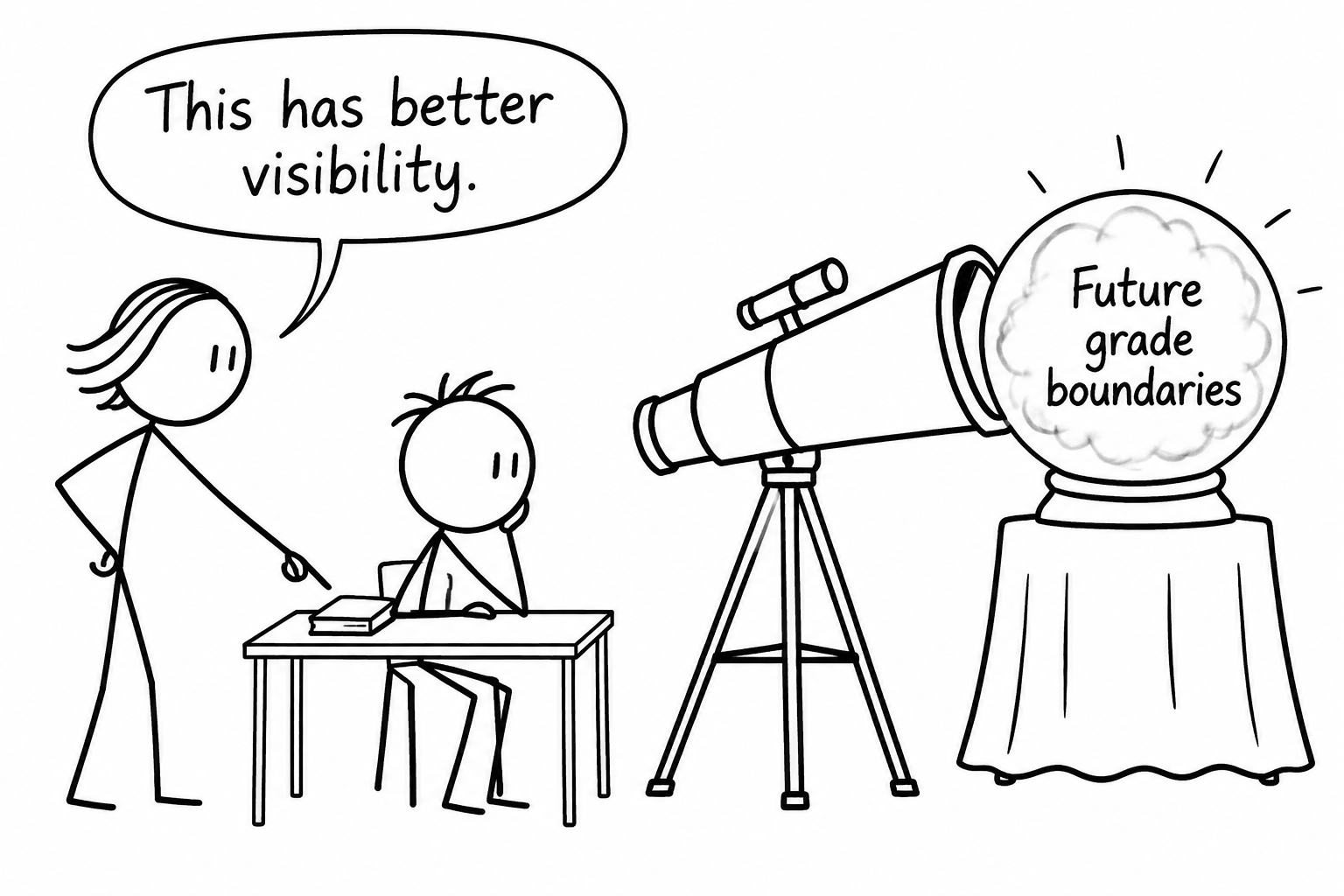 A student uses a telescope to search for future grade boundaries while a parent points towards revision
Why the grade boundary changes
Exam boards cannot make every paper exactly equal in difficulty. One series may contain an unusually accessible ratio question. Another may include wording that makes a familiar percentage problem more demanding.
Grade boundaries compensate for those differences. If a paper is harder overall, boundaries may be lower. If it is more accessible, boundaries may be higher. Pearson sets boundaries after considering the completed papers, how candidates performed and evidence about the standard represented by the marks.
This protects the meaning of the grade. It would be unfair if students needed the same raw mark on a noticeably harder paper simply because that number had been used the year before.
The movement from 109109109 in June 2023 to 103103103 in June 2024, then 105105105 in June 2025, illustrates the point. Boundaries move, but the expected standard is intended to remain comparable.
Following the Year 11 student from 101101101 marks
Return to the student with 101101101 marks. Against the June 2025 boundary, the gap is:
105−101=4105-101=4105−101=4Four marks across three papers is a small gap, but aiming for exactly four more would be fragile. A future boundary could rise, or a student could lose marks through an unfamiliar question or calculator error.
A stronger working target might be around 115115115-120120120 on Foundation practice papers. This is not a predicted boundary. It is a revision buffer based on recent examples.
The student now needs roughly 555-666 additional marks per paper to move from 101101101 towards the lower end of that target. That feels more manageable than trying to transform every part of their maths at once.
The best gains often come from topics that appear in several forms and support later questions. Maths Genie has focused lessons for grade 3 fractions, grade 3 ratio and grade 3 percentages. Each lesson can be followed by practice questions, mark schemes and video solutions.
A practical plan for moving the mark
Start by marking a complete paper honestly. For every lost mark, use one of three labels:
- Knowledge: the method was not known.
- Execution: the method was known, but arithmetic or algebra went wrong.
- Exam technique: working was missing, the question was misread or the answer was not checked.
This turns a score into useful information. A boundary only says where the student finished. The error list shows what to do next.
Choose two weak, frequently useful topics and complete their revision lessons. If percentage multipliers are causing difficulty, the percentage change lesson is a sensible next step after basic percentages.
Then use Edexcel GCSE Maths mini tests to practise one skill under time pressure. Once the method is reliable, move to the Edexcel 45-minute tests to practise switching between topics.
Finally, complete another full paper and compare the error types, not just the total. Maths Genie mark schemes and video solutions help students see where a method mark was available even when the final answer was wrong.
Common mistakes when interpreting the boundary
Treating last year's mark as a guarantee
A past boundary is evidence, not a forecast. No website, teacher or predicted paper can know the exact future boundary in advance.
Dividing the total too rigidly
Aiming for the same mark on every paper can be useful, but it is not required. The final grade uses the combined total across all three papers.
Comparing Foundation and Higher raw marks
A lower Higher boundary does not mean Higher is easier. Its questions are more demanding, and grade 3 exists there only as a safety net.
Revising only grade 3 topics
Marks from grade 1 and grade 2 content count just as much. Securing straightforward number, measure and basic algebra questions can be more reliable than chasing one difficult final question.
Stopping at the historical boundary
A student repeatedly scoring 105105105 is not safely above a boundary of 105105105. Building a buffer makes the result less dependent on one awkward paper.
Turn the boundary into a revision decision
The number matters, but only after it changes what the student does next. Recent Foundation examples suggest that grade 3 has required a little over 100100100 marks out of 240240240, yet the exact mark changes each series.
For the Year 11 student on 101101101, the useful conclusion is not “I missed it”. It is “I am close, and I can identify where the next marks are”.
Start with the Maths Genie Edexcel lessons on fractions, ratio, percentages and core number skills. Use the practice questions, mark schemes and video solutions, then test the improvement. Boundaries cannot be controlled. The quality of the next revision session can.