

Revising Maths in Short Sessions: A Practical Guide
Revising maths in short sessions can fit busy weeks. Use a practical routine to practise questions, fix mistakes and plan GCSE or A Level revision that lasts.

Imagine a student arriving home with twenty minutes before dinner. Their maths folder is on the table, but opening it feels pointless. Surely proper revision needs a whole evening?
Revising maths in short sessions works when each session has one clear target, independent questions, time to check mistakes and a planned return to the topic. Fifteen to thirty minutes is a practical starting point, adjusted to the task and your concentration. It is a suggested routine, not a scientifically fixed attention limit.
For GCSE and A Level students, a small, finished task gives tomorrow’s revision somewhere to begin.
The short-session checklist
Before you start, make sure you have:
- One specific skill to practise, chosen from a recent mistake or lesson.
- Questions and answers ready, with your phone out of reach.
- Time for attempting questions without notes.
- Time reserved for marking and correcting your work.
- A note of when you will revisit the skill.
For the wider weekly structure, use MathsGenie’s GCSE maths revision timetable guide. Here, the focus is what happens inside each slot.
Why revisiting matters more than the timer
Our hypothetical student could spend twenty minutes rereading yesterday’s notes. Everything might look familiar, yet tomorrow’s question could still feel unfamiliar.
Reading a solution lets you follow someone else’s decisions. Attempting a question from memory asks you to make those decisions yourself, revealing what you can actually do.
Spacing adds another opportunity: return to the skill after a delay. The Australian Education Research Organisation’s evidence guidance supports spacing and retrieval practice for longer-term retention. It does not prescribe one perfect session length or interval for everyone.
Revisit topics across different days, attempt questions before checking notes, and correct errors. Dividing passive reading into smaller blocks does not provide the same practice.
A twenty-minute routine for revising maths in short sessions
Choose a narrow target, such as identifying the correct trigonometric ratio at GCSE or selecting an integration method at A Level. “Revise trigonometry” leaves too many decisions for a short session.
| Part of the session | Time | What to do |
|---|---|---|
| Recall | Three minutes | Write what you remember about the method without notes. |
| Attempt | Ten minutes | Work independently on a small set of questions. |
| Check and repair | Five minutes | Mark your attempts and correct the first incorrect step. |
| Leave a starting point | Two minutes | Record the difficulty and choose your next question. |
Prepare questions before starting. GCSE students can use MathsGenie’s GCSE maths revision resources, selecting the correct exam board and foundation or higher tier.
If you cannot begin, review a short explanation. Then close it and try independently. The routine should respond to what you need.
Give these sessions a regular place in your week with the Revision Planner.
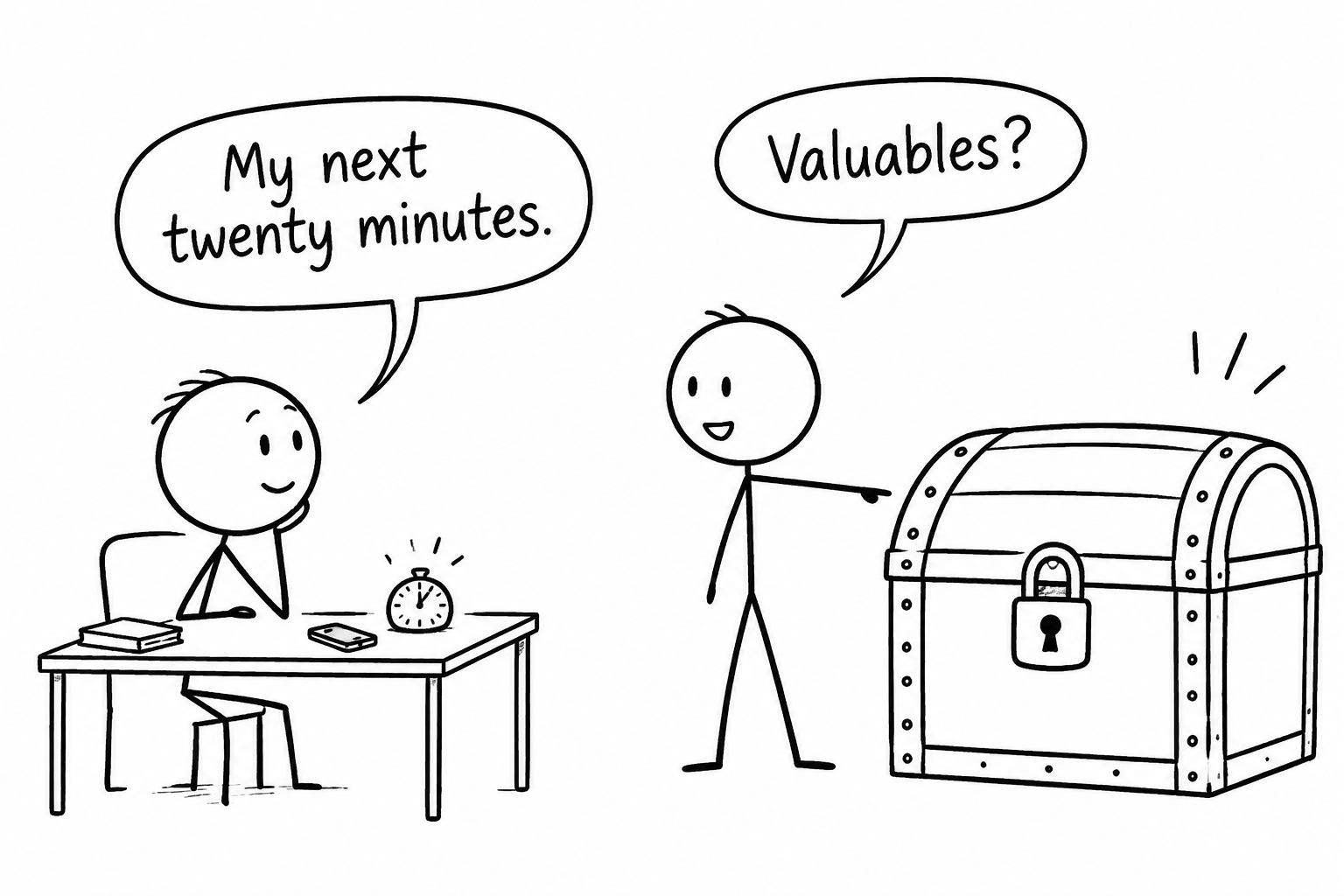 A stick-figure student protects their next twenty minutes by locking their phone in a treasure chest.
Make the next session follow from this one
Suppose the student repeatedly chooses the wrong method. Their next target is clearer: practise recognising which method a question requires.
An error note needs three details: the question, the difficulty and the next action. “Forgot this” is hard to act on. “Could follow the solution but could not choose the first step” tells you what to practise.
Return to that skill later in the week, then again the following week. These are starting intervals, not rules. Revisit sooner if you remain unsure; leave a longer gap when you can solve unfamiliar questions independently.
Once the method feels secure, mix it with other topics. Separate practice helps you learn a method; mixed questions require you to recognise when to use it, as exams often demand.
Fit short sessions into a realistic week
Begin with the week you actually have. Look at homework, travel, meals, clubs and sleep before adding revision slots.
On a busy evening, a fifteen-minute return to yesterday’s mistake may be manageable. On a quieter day, try two focused sessions with a break between them. Avoid turning every spare minute into another obligation.
For overall workload, use the guide to how many hours to revise a day for GCSE. The guide to a GCSE revision timetable you can stick to covers sustainable scheduling.
Parents can protect an agreed slot and ask, “What did today’s questions show you?” That reveals more about learning than counting completed pages.
Keep room for longer exam practice
Short sessions suit focused repairs, recall and small question sets. Longer tasks also need space.
At A Level, a substantial problem may involve several connected stages. If stopping would interrupt useful reasoning, finish the attempt and adjust your next session.
Full timed papers develop pacing, sustained concentration and decisions across a whole paper. Cutting every paper into short pieces leaves those demands untested. Combine short sessions with occasional longer practice, guided by your course and readiness. MathsGenie’s advice on when to start GCSE past papers explores that transition.
Common mistakes that waste small slots
Spending the session choosing resources. Prepare questions beforehand so searching does not absorb your practice time.
Watching without attempting. A revision lesson or video solution can clarify a method. Afterwards, try a question independently.
Marking without repairing. Find where your reasoning first went wrong, correct it and attempt a similar question later.
Making every session too easy. Include questions that expose uncertainty. Repeated blank pages suggest you need a clearer explanation or your teacher’s help.
Treating a missed slot as a failed week. Move the priority task to the next realistic opening instead of rebuilding the timetable.
Turn a spare twenty minutes into a routine
The student at the kitchen table now has a manageable task: attempt questions, repair one difficulty and leave a clear starting point. Choose your next skill, prepare the questions and give it a realistic slot using MathsGenie’s Revision Planner.















