

Revising GCSE English Language With Music
Revising GCSE English Language with music? Learn when lyrics harm focus, when instrumentals may be fine, and how to test what genuinely helps you revise.
There is a familiar moment at the start of revision: you open an English Language paper, put on your favourite playlist and promise yourself that the music will help you settle down. Ten minutes later, you know every word of the chorus but cannot remember what happened in the second paragraph.
So, is revising GCSE English Language with music a good idea? Usually, silence is the safer choice for demanding reading and writing. Research generally finds that music with lyrics can interfere with reading comprehension and verbal memory. Quiet instrumental music appears less disruptive, but there is no strong evidence that it reliably improves performance.
The sensible approach is not to accept a universal rule. Remove lyrics, match the sound to the task and compare your actual work under music and silence.
The quick answer and revision checklist
Use this checklist before pressing play:
- Choose silence for unseen reading, close language analysis and extended writing.
- If silence feels uncomfortable, try quiet, familiar instrumental music.
- Avoid songs with lyrics when reading or composing sentences.
- Keep the volume low and avoid changing tracks during a task.
- Complete some revision in silence because your real examination will not include a playlist.
- Compare accuracy, recall and completion time rather than judging music by how enjoyable it feels.
- Turn notifications off. A playlist does not help if your phone repeatedly pulls you away.
The important distinction is between making revision feel better and making your performance better. Music may make a session more pleasant without improving the quality of your answers. Those are both useful outcomes, but they are not the same outcome.
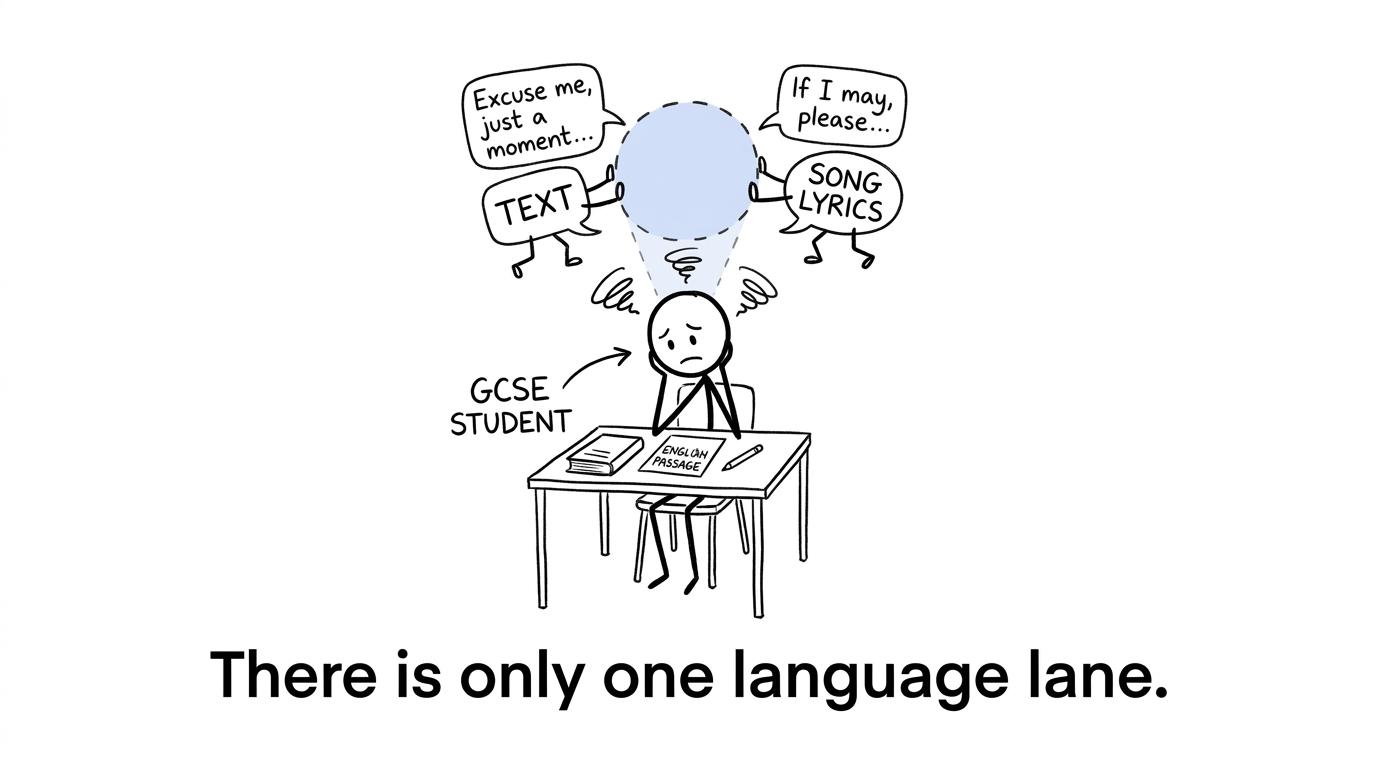 A student caught between a text and song lyrics competing for attention
Why lyrics can disrupt English Language revision
GCSE English Language is a heavily verbal subject. Across boards such as AQA, Edexcel, OCR and Eduqas, students must read unfamiliar material, interpret explicit and implicit ideas, analyse language and structure, evaluate viewpoints and produce coherent writing.
Those tasks require you to hold words and ideas in mind while deciding what they mean. A song with lyrics introduces another stream of language at exactly the same time. Even if you are not consciously singing along, your attention may still process fragments of the words.
A systematic review published in 202220222022, covering research across memory, language, attention and other cognitive tasks, found that background music tended to be detrimental to memory and language-related performance when it had an effect. Music with lyrics was generally more disruptive than instrumental music. The review also found many neutral results, so it would be inaccurate to claim that every kind of music always harms everyone.
A controlled study published in 202320232023 compared silence, instrumental lo-fi music and music with lyrics. Music with lyrics hindered verbal memory, visual memory and reading comprehension, while the instrumental condition did not credibly improve or damage performance. A 202420242024 reading study also reported poorer comprehension with lyrical pop music than with no music.
These studies were not conducted specifically on GCSE candidates, and several involved university-age participants. They cannot predict precisely what will happen to every student. However, their findings are relevant because GCSE English Language depends directly on reading comprehension, verbal memory and written expression.
Music affects different revision tasks differently
The question is not simply, “Does music help revision?” A better question is, “Does this sound help with this task?”
Reading an unseen extract
Silence is the strongest default. You need to follow shifts in tone, notice structural choices, infer motives and retain details from across the passage. Lyrics compete with the same language-processing resources.
Instrumental music may be tolerable, particularly if it is quiet and predictable, but test it rather than assuming it helps. If you repeatedly reread sentences, lose your place or forget earlier details, turn it off.
Planning an answer
Instrumental music may be less problematic while you create a brief plan or organise ideas. However, planning still involves selecting evidence and building a logical argument. Silence remains preferable if the music encourages daydreaming or track-changing.
Writing analytical or creative responses
Extended writing demands control of vocabulary, sentence structure, punctuation, tone and organisation. Lyrics can slip into the mental space in which you are trying to construct your own sentences.
For analytical writing, silence usually gives your argument the clearest runway. For creative writing, music may help some students establish a mood, but atmosphere is not the same as accuracy. If you use music for initial ideas, switch it off when drafting and checking the response.
Marking and organising resources
Music is less likely to matter during low-language administrative tasks, such as filing papers, highlighting completed topics or arranging a revision timetable. These can be useful moments for a playlist because the task carries a lighter cognitive load.
The same principle applies to maths revision. Music may feel harmless while organising worksheets, but unfamiliar problem-solving deserves more attention. Build your wider exam routine through the GCSE maths revision hub, where lessons, exam questions and paper resources are organised by board and topic.
Instrumental music is safer, not magical
Replacing lyrical songs with instrumental music removes the most obvious verbal competition. That does not automatically turn music into a concentration tool.
Tempo, volume, familiarity and personal preference can all change how distracting it feels. A dramatic film score may continually pull your attention towards changes in pace. A familiar instrumental track may be easier to ignore, although familiarity can also prompt memories or anticipation.
If you want background sound, choose something that is:
- instrumental;
- quiet;
- emotionally neutral;
- predictable in volume and tempo;
- long enough that you do not need to select another track; and
- played from a device with notifications disabled.
The aim is not to find music that demands your attention. It is to find sound that becomes unimportant.
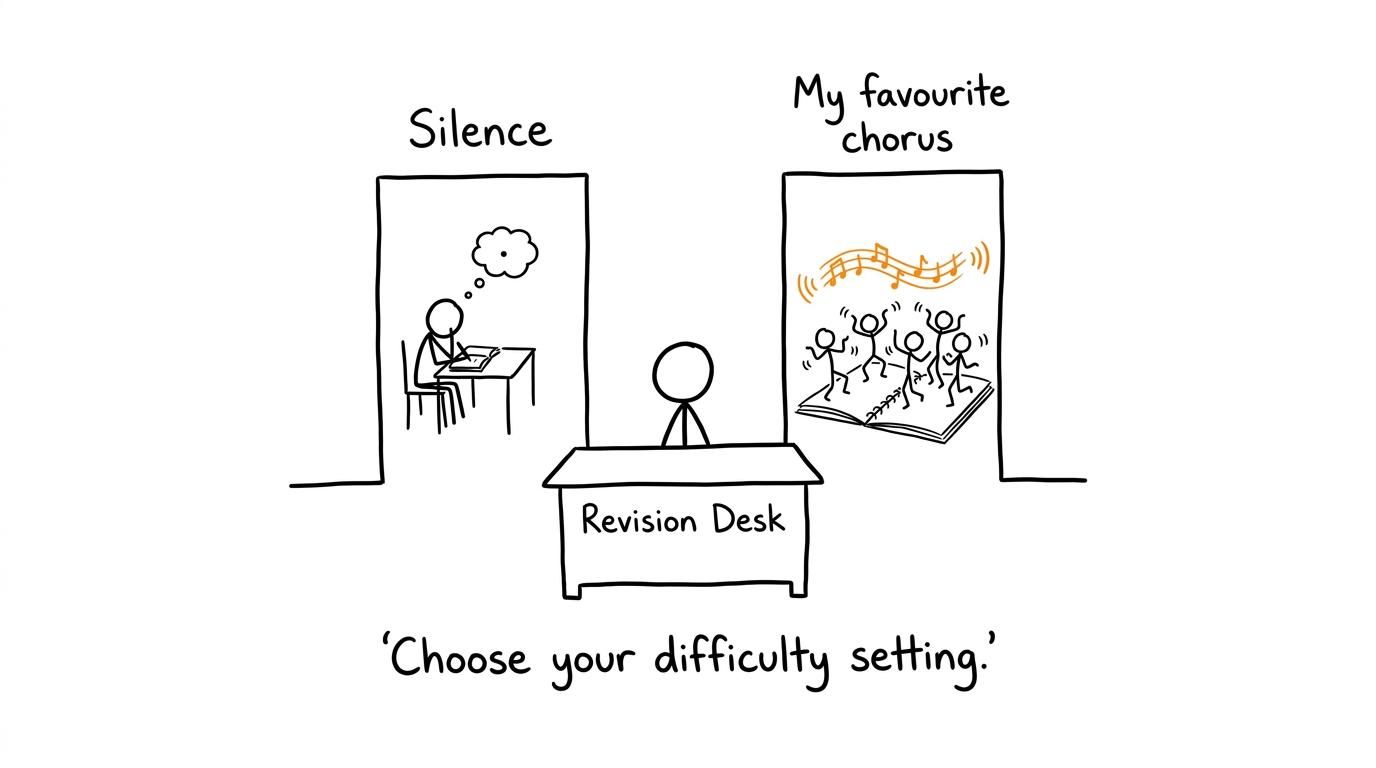 A favourite chorus turning revision into an accidental concert
Test whether music actually helps you
Preference is useful evidence about comfort, but completed work is better evidence about learning. Run a simple comparison across two similar revision sessions.
In the first session, work in silence. In the second, use quiet instrumental music. Keep the task length, difficulty, time of day and access to notes as similar as reasonably possible.
Record:
- how much work you completed;
- how many questions you answered accurately;
- how often you reread the text;
- whether you remembered the main ideas later;
- how frequently your attention wandered; and
- whether your writing contained more unfinished or unclear sentences.
Do not compare silence on a difficult paper with music during easy note-making. That tests task difficulty, not music.
MathsGenie's short twenty-minute revision routine offers a useful structure for controlled sessions. You can also use Edexcel GCSE Maths mini tests when you want a short, measurable task for comparing concentration conditions.
Use music to start, then practise in silence
Sometimes the real benefit of music is behavioural rather than academic. A playlist can make sitting down feel easier. It can mark the transition from scrolling to working and reduce the unpleasantness of starting.
If that describes you, use music as an entrance rather than a permanent companion:
- play one track while setting up;
- choose the precise task you will complete;
- put your phone out of reach;
- turn the music off when the timed work begins; and
- bring it back during the break if you wish.
This preserves the motivational benefit without placing lyrics beside a challenging text.
A repeatable structure matters more than the perfect soundtrack. The GCSE revision timetable guide explains how to build sessions around learning, practising and marking. If you are balancing English with maths, the MathsGenie revision timetable can help you distribute topic work and timed papers across the week.
Why silent exam practice still matters
A revision method should eventually resemble the performance you are preparing for. In an English Language examination, you must sustain attention through unseen reading and extended writing without your normal playlist.
That does not mean every earlier revision session must be silent. It does mean that full sections and mock papers should increasingly be completed under realistic conditions. Silent practice teaches you to manage the moments when concentration dips and no chorus is available to lift your mood.
The same principle is central to maths preparation. Use past-paper timing guidance to move gradually from topic practice to complete papers. Near the examination, fresh Edexcel GCSE Maths predicted papers can add unseen practice after you have worked through official past papers.
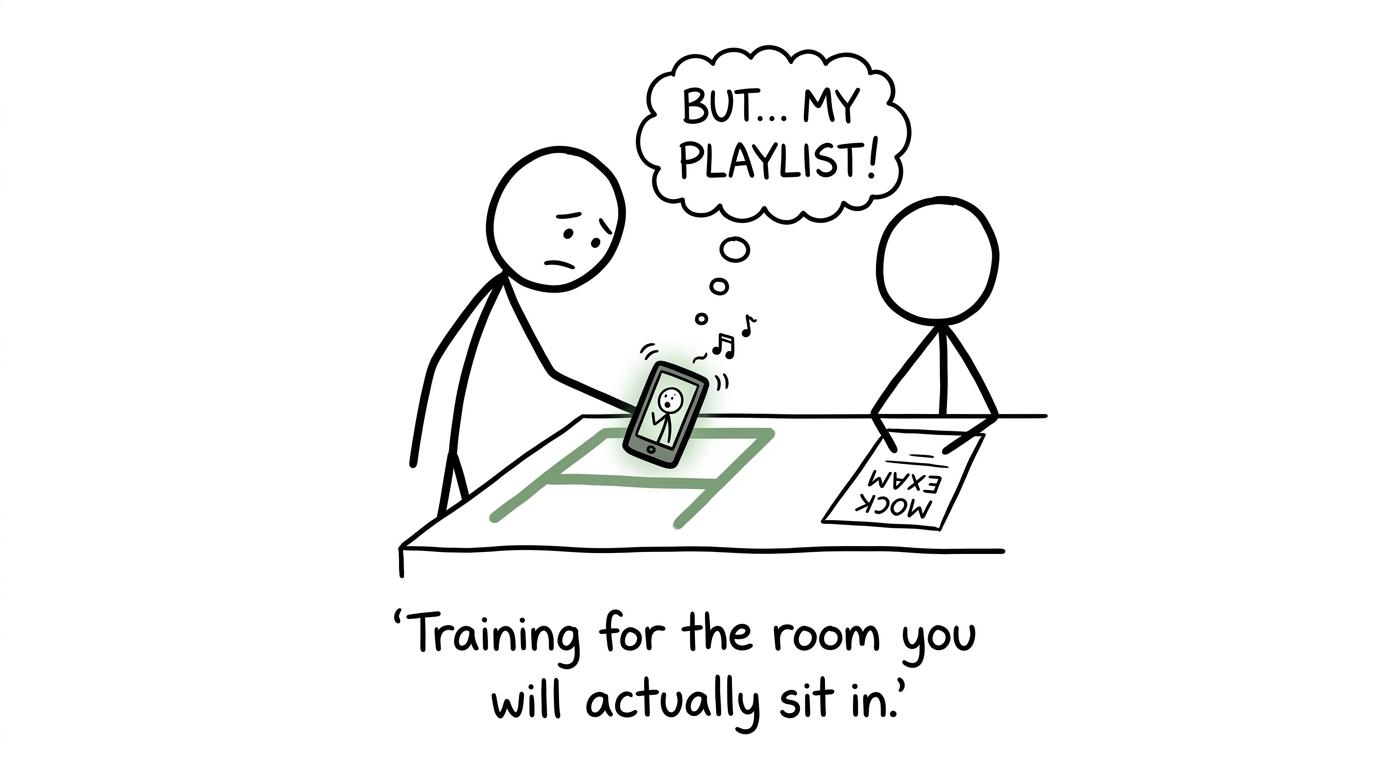 A student parking their phone before realistic exam practice
Common mistakes when revising with music
Assuming enjoyment proves effectiveness
A session can feel quicker because the music is enjoyable. Check the answer quality, not just your mood at the end.
Choosing songs with familiar lyrics
Familiar songs are easy to sing internally and difficult to ignore. They are a poor match for reading comprehension and sentence construction.
Spending revision time managing a playlist
Searching, skipping and checking notifications fragments attention. Prepare one long instrumental playlist beforehand or choose silence.
Using music for every kind of task
Low-demand organisation and complex textual analysis do not make the same demands on attention. Change your environment when the task changes.
Never practising in exam conditions
Comfort-only revision can leave silence feeling strange during a mock or final examination. Include regular silent, timed sessions.
Ignoring the evidence from your own work
If your comprehension falls, your writing becomes less precise or tasks take longer, the music is costing you something. Adjust it even if you like having it on.
A balanced verdict
Revising GCSE English Language with music is not automatically a bad idea, but lyrical music is a risky companion for reading and writing. Research most consistently warns against lyrics, while instrumental music appears more likely to have a neutral effect than a reliable benefit.
Use silence for the hardest verbal work. If background sound helps you begin, choose quiet instrumental music and judge it through completed answers. Above all, practise regularly without music so that concentration in the examination room feels familiar.
Then apply the same disciplined approach across your subjects. Start with the MathsGenie GCSE revision hub, use free revision lessons and practice questions to repair weak topics, and test your progress with mini tests, past papers and predicted papers. Mark every attempt with the available mark schemes and use video solutions when a method is unclear. Music is optional. Useful feedback is not.










