Revising Before Bed GCSE Engineering: Help or Hurt?
Revising before bed GCSE Engineering can support recall, but not if it cuts sleep. Build a calmer night routine for engineering and GCSE maths revision.
It is late. Your notes are open at engineering materials, your calculator is nearby, and bedtime has quietly moved from a sensible plan to a negotiable suggestion. If you are searching for revising before bed GCSE Engineering advice, the short answer is this: a brief, calm review may support memory, but revision becomes harmful when it delays or disrupts sleep.
Sleep helps the brain stabilise recently learned information. Yet sleep cannot consolidate material effectively if you keep sacrificing it for another hour of tired rereading. The best bedtime session is therefore a recap, not a rescue mission.
The quick bedtime revision checklist
Use this decision guide before opening another set of notes:
- Protect enough time for sleep. NHS guidance generally indicates that teenagers need around 888 to 101010 hours, although individual needs vary.
- Finish demanding calculations earlier in the evening.
- Keep the final review to roughly 151515 to 252525 minutes.
- Retrieve information from memory rather than repeatedly reading it.
- Review a small number of formulas, definitions or past mistakes.
- Stop if revision is making you noticeably more alert, frustrated or anxious.
- Put screens away and allow time to wind down.
If your engineering exam is tomorrow, the GCSE maths night-before plan offers a similarly restrained approach: select a few valuable tasks, set a stopping time and avoid turning the evening into an endurance test.
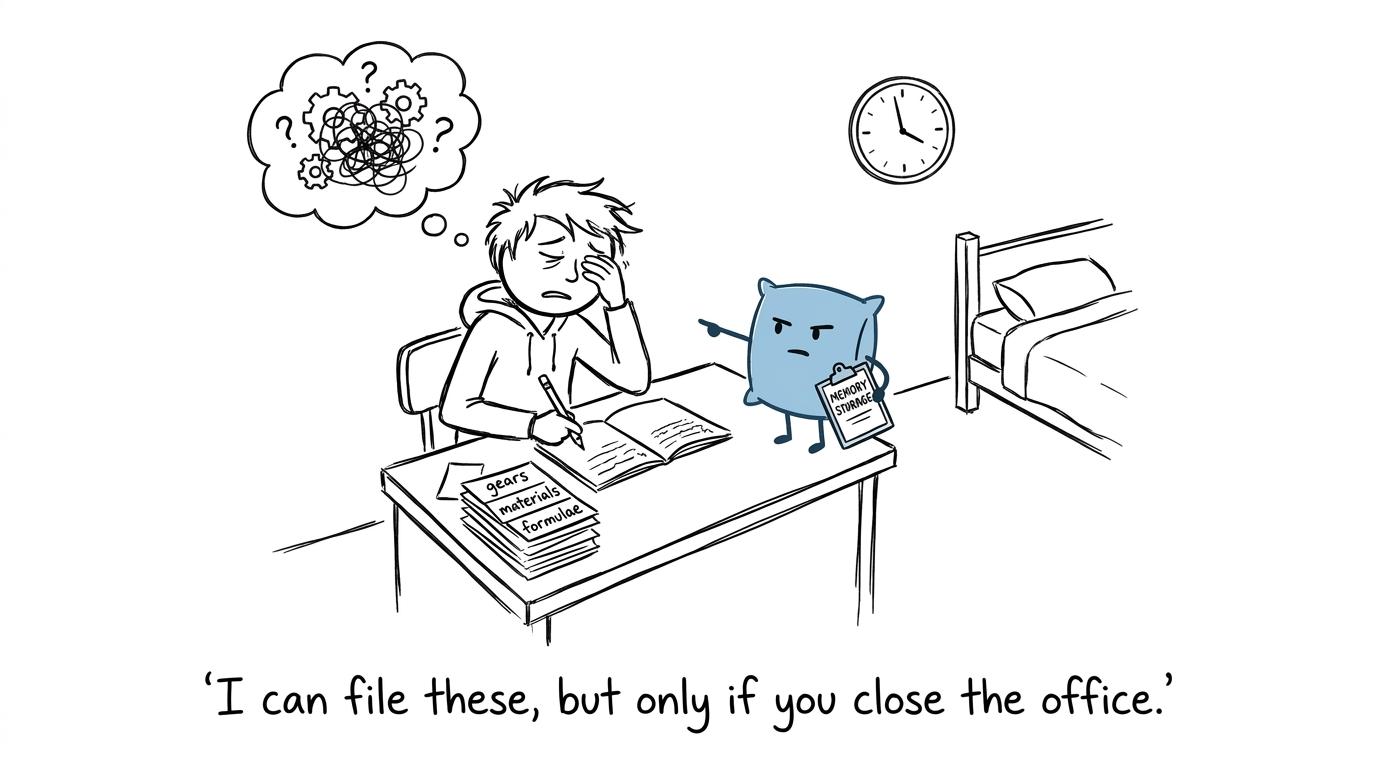 A pillow asks a GCSE student to close the memory office
How sleep affects memory after engineering revision
Learning does not end when you close the book. During sleep, the brain continues processing and reorganising information encountered while awake. This is known as memory consolidation.
Research reviews broadly support the role of sleep in memory, learning and attention. Studies involving adolescents also suggest that information or skills practised before sleep can sometimes be retained well overnight. However, the effect is nuanced. It does not prove that every subject should be revised immediately before bed, nor that late-night cramming produces stronger results.
GCSE Engineering draws on several kinds of memory:
- Declarative memory for properties of materials, manufacturing processes, safety principles and technical vocabulary.
- Procedural knowledge for selecting and following methods.
- Application when interpreting unfamiliar diagrams, systems and engineering contexts.
- Mathematical reasoning when choosing formulas, converting units and checking whether an answer is sensible.
A short review may reactivate these ideas before sleep. The important word is review. Memory consolidation strengthens learning that has already begun; it cannot reliably replace focused learning and practice.
Why losing sleep usually cancels the benefit
Suppose a planned bedtime review expands into several hours. You may encounter more content, but the next day you must work with reduced alertness. Controlled research on adolescent sleep restriction has found effects on areas such as vigilant attention, cognitive flexibility and, in some studies, working memory. Systematic reviews also associate restricted or poor-quality sleep with weaker school-related outcomes, although the size of the effect varies between studies.
Those abilities matter in engineering and maths. A student must hold values in mind, choose a relationship, convert units and monitor each step. For instance, engineering calculations may use relationships such as
ρ=mV\rho=\frac{m}{V}ρ=Vmor
p=FA.p=\frac{F}{A}.p=AF.Remembering a formula is only one part of the task. You must recognise what the symbols represent, use consistent units and rearrange the relationship when necessary. A tired brain may know the content while becoming less reliable at executing it.
That is the hidden cost of late revision: it can create the feeling of effort while weakening the attention needed to turn knowledge into marks.
For extra practice earlier in the day, MathsGenie’s speed and density revision resources connect compound measures with structured GCSE problem-solving. The rearranging harder formulae guide is useful when changing the subject is the real difficulty.
The best material to revise before bed
Bedtime revision works best when the material is narrow, familiar and easy to stop. Choose one of the following.
Definitions and short factual links
Recall a material property, then explain why it affects a design choice. Name a manufacturing process, then identify the type of material for which it is suitable. This is more useful than staring at a highlighted paragraph because retrieval reveals whether the knowledge is actually available.
A small formula set
Cover the formulas and write them from memory. Include units and the meaning of each symbol. Engineering-related maths may involve density, pressure, area, volume, ratios, scale and percentages.
Use the GCSE ratio revision page when mixtures or proportional relationships are causing difficulty. For dimensions and models, the similar shapes, area and volume guide explains the distinction between linear, area and volume scale factors.
Mistakes already made
Look at two or three errors from an earlier question set. Before reading the correction, state what went wrong and what you would do differently. This converts a mistake into a usable rule without beginning a large new task.
A mistake might be recorded as:
- converted the value but not the unit;
- substituted before rearranging and lost accuracy;
- confused a material property with a manufacturing process;
- gave a design claim without linking it to evidence;
- rounded before the final calculation.
One diagram or system
Redraw a simple system, label its parts and explain the flow from input to process to output. Stop after one. Bedtime is not the moment to reconstruct an entire specification from memory.
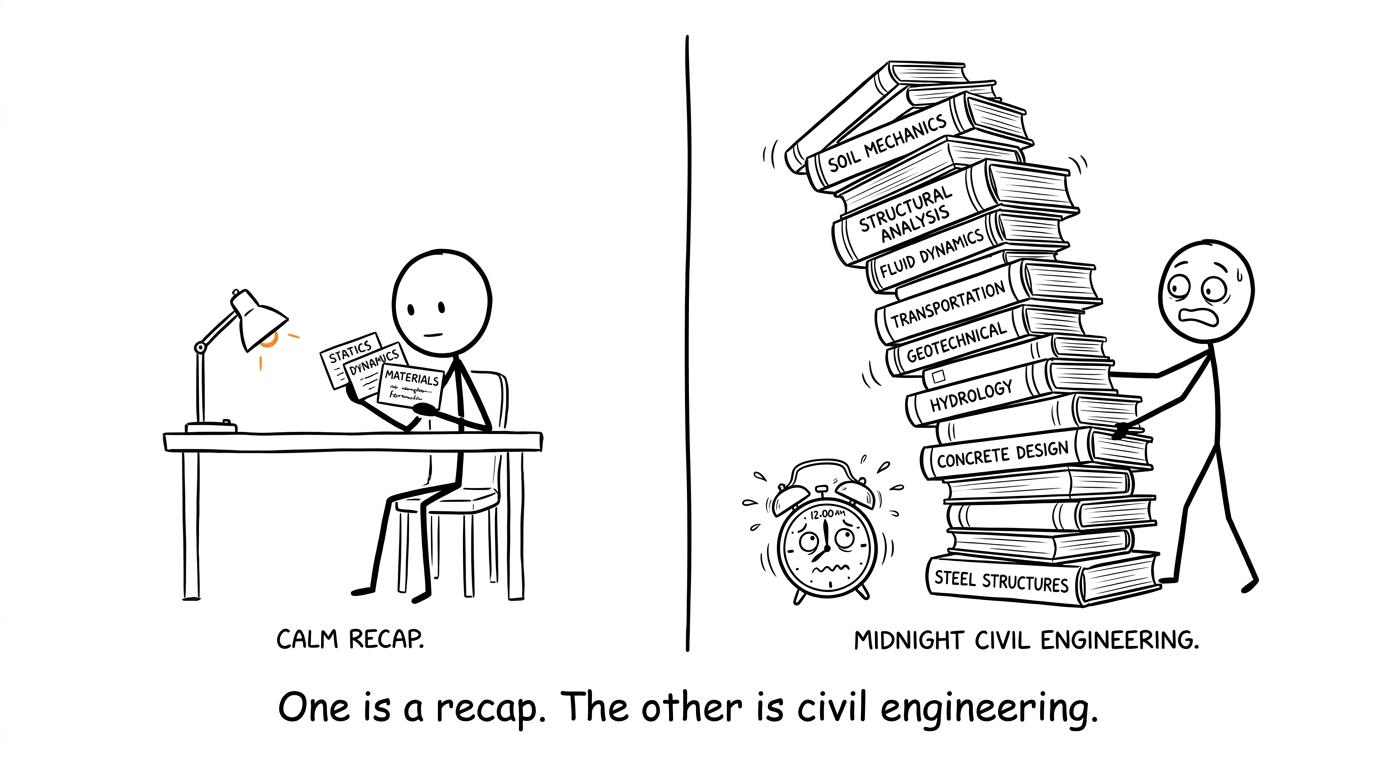 A calm recap competes with a midnight textbook tower
A sleep-friendly evening routine
The most effective routine separates demanding practice from the final wind-down.
Earlier in the evening
Complete calculations, engineering application questions and timed practice while you are alert. Use exam-style material and mark it immediately. If the maths is weak, select your board and tier through the AQA GCSE Maths revision hub or the appropriate MathsGenie board page.
A useful revision cycle is:
- attempt a short question set without notes;
- mark it using the mark scheme;
- label each lost mark by topic and cause;
- revisit the relevant revision lesson;
- answer a fresh question;
- schedule another attempt after a gap.
This is more dependable than rereading because it produces evidence of what you can and cannot do.
During the final review
Set a timer for approximately 202020 minutes. Use paper notes or physical flashcards where possible. Test a few definitions, formulas and corrections, then write tomorrow’s first revision task. A written plan can help prevent unfinished work from circling in your mind.
At the stopping time
Stop even if the session felt productive. NHS sleep guidance commonly recommends a regular routine, a calm bedroom and reduced screen use before bed. Caffeine late in the day can also delay sleep, so an energy drink is not a sensible substitute for rest.
If sleep problems persist or affect daily life, speak to a parent, carer, school pastoral team or GP rather than treating the problem solely as a revision issue.
When revising before bed is likely to hurt
Late revision is probably working against you when:
- bedtime keeps moving later;
- you are attempting a full paper in bed;
- you reread because you are too tired to answer questions;
- mistakes make you panic and open more topics;
- notifications repeatedly interrupt the session;
- you rely on caffeine to continue;
- you plan to recover all the lost sleep after the exam.
The question is not simply whether you spent more minutes revising. It is whether those minutes improved tomorrow’s performance after accounting for the sleep they displaced.
For full timed work, use Edexcel GCSE Maths past papers during an earlier session rather than immediately before sleep. Past papers are most valuable when you still have enough energy to analyse the mark scheme and repair your mistakes.
Common mistakes with late-night revision
Trying to learn an entire topic from scratch
New and difficult material requires sustained attention. Move it to an earlier session and use bedtime only to recap the central ideas.
Confusing recognition with recall
A formula can look familiar without being retrievable in an exam. Close the notes and reproduce it, including units and symbol meanings.
Revising only comfortable content
Familiar topics feel calming, but they may not deserve all your time. Use evidence from mini tests, teacher feedback and papers. MathsGenie’s guide to finding your weakest GCSE topics explains how to turn lost marks into a targeted list.
Marking without correcting
A score tells you what happened. A correction changes what happens next. Record the cause of each error and repeat the skill on another day.
Treating predicted papers as predictions of certainty
Predicted papers provide fresh exam-style practice; they cannot guarantee what will appear. Use them alongside official past papers, specification coverage and targeted questions.
Revising in bed
If possible, revise at a desk and keep the bed associated with sleep. When the timer ends, leave the notes behind rather than taking the unfinished session under the duvet.
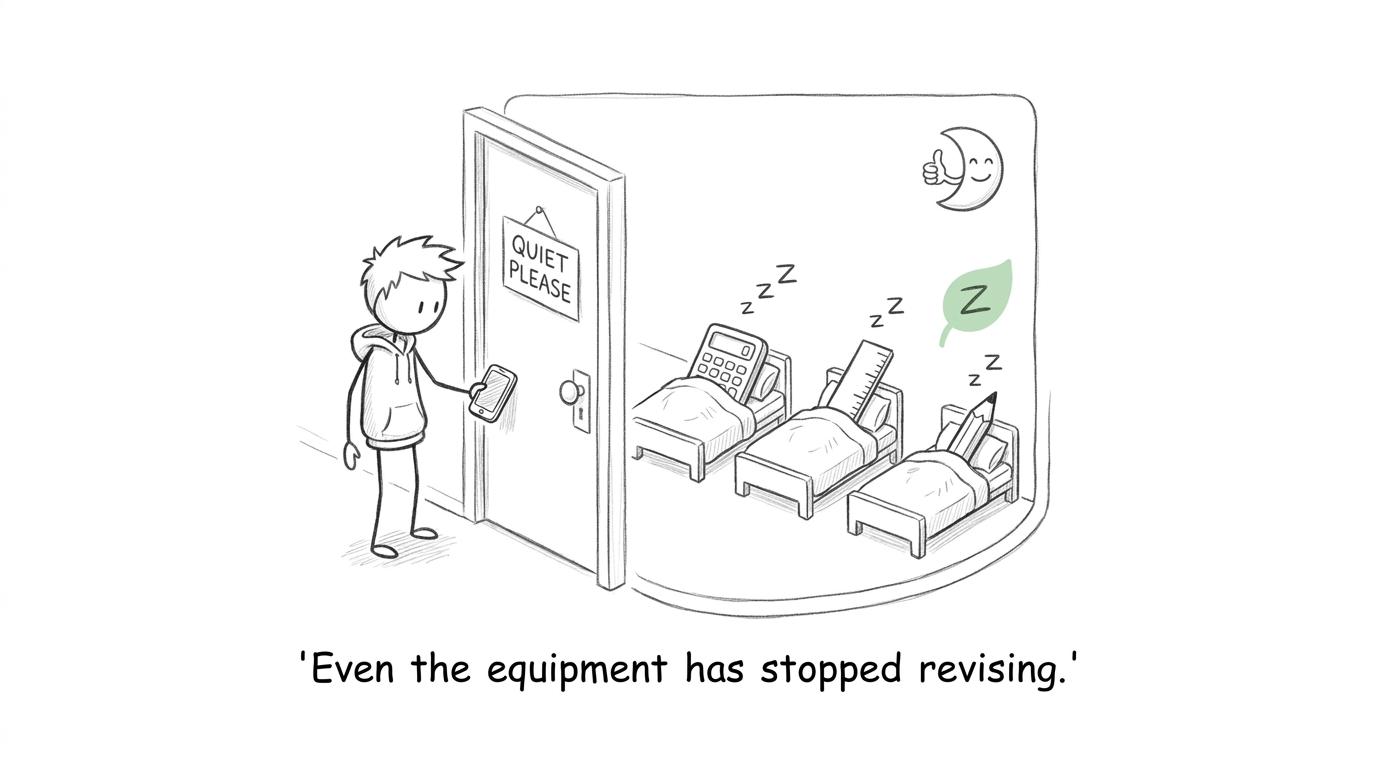 A phone waits outside while revision equipment goes to sleep
The verdict: protect the sleep that protects the learning
Revising before bed can help GCSE Engineering students when it is short, calm and based on active recall. It hurts when it becomes cramming, increases anxiety or removes sleep. The aim is not to work until your brain refuses to continue. It is to finish with a few important ideas freshly retrieved and enough time for proper rest.
Let MathsGenie carry the heavier work earlier in the day. Use free revision lessons and practice questions to rebuild weak maths, mini tests to check progress, and mark schemes and video solutions to understand lost marks. Then move to past papers and predicted papers when you are ready to practise under exam conditions.
Choose one engineering-related maths weakness tonight, plan tomorrow’s MathsGenie session, complete a brief recall review and stop at the time you set. Sometimes the most disciplined revision decision is closing the book.