

Revising Before Bed GCSE Design and Technology
Revising before bed GCSE Design and Technology may aid recall if sessions stay short. Learn when sleep supports memory and when late cramming hurts.
The clock says you should stop. Your notes say there are still polymers, manufacturing processes and sustainability terms left to learn. If you are wondering whether revising before bed GCSE Design and Technology helps, the short answer is: a brief, calm recall session may support memory, but revision that delays or disrupts sleep is likely to hurt more than it helps.
Sleep helps stabilise recently learned information. Yet it cannot rescue material that was barely understood, and staying awake for another hour can reduce the sleep your concentration needs tomorrow. The useful strategy is not simply to revise late. It is to finish with focused retrieval, stop at a planned time and protect a full night's rest.
The bedtime revision checklist
Use this as your decision guide:
- Learn difficult or unfamiliar content earlier in the day.
- Keep the final session to roughly 151515 to 252525 minutes.
- Test yourself rather than rereading pages.
- Choose a narrow topic, such as material properties or production methods.
- Avoid beginning a full practice paper near bedtime.
- Finish with time to wind down away from revision and stimulating screens.
- Do not sacrifice the sleep you need in order to complete the session.
- Recheck the material briefly the following day.
The principle is simple: bedtime revision should be a closing routine, not an emergency rescue operation.
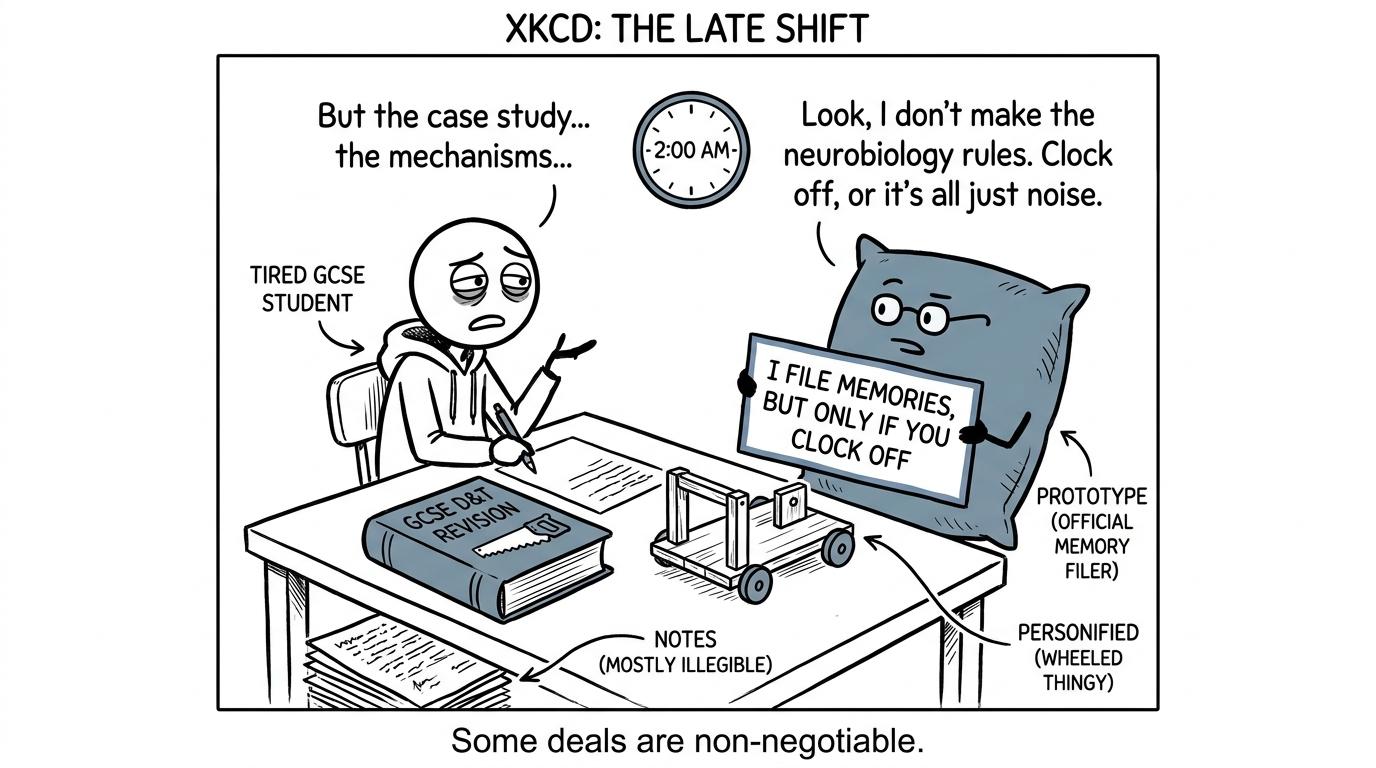 A GCSE student negotiating revision time with a scholarly pillow
How sleep affects memory after revision
Learning does not end when you close the book. Newly encoded memories remain vulnerable, and sleep contributes to the process through which some of that learning becomes more stable. This is called memory consolidation.
Research comparing sleep with an equivalent period awake generally supports the idea that sleep reduces forgetting. Recent research with adolescents has also found benefits for some material learned before sleep. However, the details matter. An adolescent study comparing afternoon and late-evening learning found stronger overnight gains for a procedural task in the evening, while the result for declarative word-pair knowledge favoured afternoon learning and was less robust.
That distinction is relevant to Design and Technology:
- Declarative knowledge includes facts about materials, designers, processes, environmental issues and technical terminology.
- Procedural knowledge concerns how a method or sequence works, such as planning a production process or applying a design procedure.
- Application means selecting that knowledge for an unfamiliar product, user or manufacturing context.
A short pre-sleep review may help keep selected information active before sleep. But there is no dependable rule saying that every fact learned immediately before bed will be remembered better. For substantial factual learning, afternoon or early-evening revision followed by retrieval later is a safer plan.
When revising before bed can help
You are retrieving knowledge you have already learned
Bedtime is better suited to strengthening than discovering. Close your notes and list the properties of a material, recall the stages of an iterative design process or explain why a production method suits a particular scale of manufacture.
Retrieval forces the brain to find the information. That gives you useful evidence: either the idea is available, or it needs attention tomorrow. Quiet rereading can feel reassuring while hiding the fact that you cannot produce an answer independently.
The task is small and clearly defined
A session with an endpoint is less likely to grow into midnight cramming. Pick one specification area and decide what completion means before you start. For example, you might answer five flashcards, label a process sequence from memory or write a short comparison of two materials.
This is the same discipline that improves maths revision. MathsGenie's GCSE Maths revision hub organises lessons and practice by exam board so that students can work on one specific weakness rather than vaguely attempting to “do maths”.
You stop while you are still alert
A useful final review should leave you calmer, not more activated. If you are repeatedly reading the same sentence, making careless mistakes or feeling compelled to cover one more chapter, the productive part of the session has probably ended.
NHS guidance says that most teenagers need around 888 to 101010 hours of sleep and recommends leaving time to wind down after revision or screen use. Individual needs differ, but an all-nighter is not an efficient exchange. You are trading tomorrow's attention for low-quality minutes tonight.
When late revision is likely to hurt
It reduces your total sleep
The phrase “sleep helps memory” can produce a strange mistake: students revise immediately before bed because sleep consolidates learning, then shorten the sleep that performs the consolidation.
The order should be:
focused learning→brief retrieval→sufficient sleep\text{focused learning} \rightarrow \text{brief retrieval} \rightarrow \text{sufficient sleep}focused learning→brief retrieval→sufficient sleepIt should not become:
panicked cramming→short sleep→tired exam\text{panicked cramming} \rightarrow \text{short sleep} \rightarrow \text{tired exam}panicked cramming→short sleep→tired examSleep also supports concentration and mood. Those matter when a question asks you to analyse a design, interpret data or sustain an extended response. Remembering isolated terms is not enough if tiredness makes the question difficult to process.
You are attempting demanding new content
Complex ideas need enough alert attention to be encoded properly. If you have never understood planned obsolescence, material selection or the relationship between tolerances and quality control, the final minutes before bed are unlikely to provide deep learning.
Learn the concept earlier. Then use bedtime only to recall its main structure. Maths students can apply the same boundary: use revision lessons and exam-board resources for difficult learning while alert, rather than attempting an unfamiliar Higher tier method when exhausted.
Revision turns into phone use or worry
A flashcard app may begin as revision and end as messages, videos and lost time. The problem is not only the screen itself. It is also stimulation, distraction and the disappearance of a clear stopping point.
Paper flashcards, a printed specification checklist or a small notebook can make the final session easier to contain. If revision regularly leaves you worried in bed, move it earlier and use a written plan to capture tomorrow's priorities.
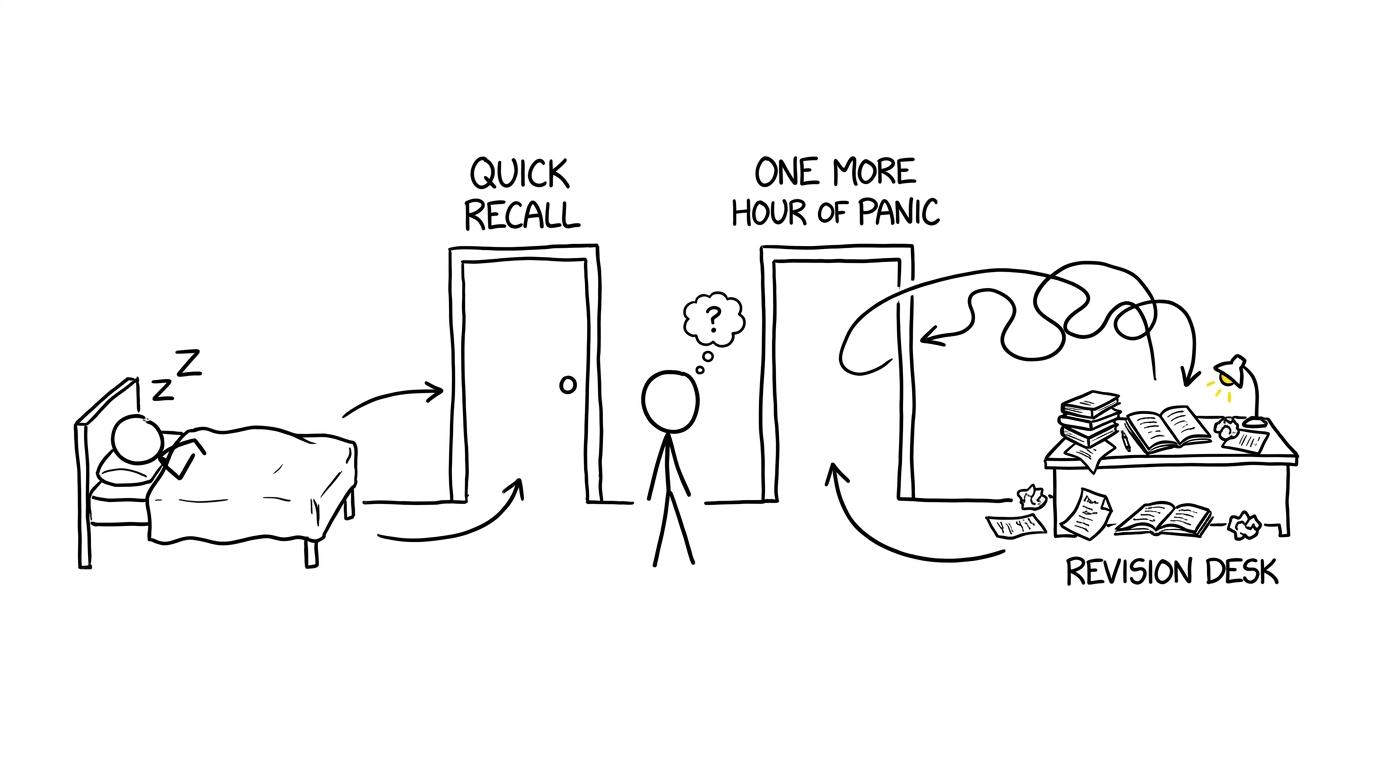 A student choosing between quick recall and another hour of panic
What should a GCSE Design and Technology bedtime session cover?
Design and Technology specifications differ across AQA, Edexcel, OCR and Eduqas, so use your own board's current specification and teacher guidance. Written examinations commonly assess technical principles, designing and making principles, analysis and evaluation. The qualification also includes non-exam assessment.
Some specifications, including AQA and OCR, state that at least 15%15\%15% of the written examination assesses mathematical skills in a Design and Technology context. That makes short recall useful for relationships and units, but calculations need earlier written practice.
Good bedtime topics include:
- key properties and appropriate uses of materials;
- advantages and limitations of manufacturing processes;
- sustainability concepts and environmental effects;
- quality assurance and quality control terminology;
- user needs, accessibility and ergonomics;
- brief formula or unit recall already practised earlier;
- one extended-response plan without writing the full answer.
For D&T calculations involving ratio, scale, percentage change, area or volume, build fluency through proper daytime practice. Relevant MathsGenie resources include the structured Stage 7 geometry and measures material and similar shapes, area and volume revision.
A better revision rhythm across the day
Bedtime works best as one part of a larger cycle:
Earlier in the day: understand
Use lessons, specification headings and teacher materials to learn difficult content. Connect each technical fact to a product, user need or manufacturing decision.
Early evening: apply
Answer exam questions, practise calculations and plan extended responses. Check the mark scheme and identify what the command word required. This is where substantial progress happens.
Before bed: retrieve
Spend a short period recalling selected material without notes. Mark uncertain items and place them on tomorrow's list. Do not restart the entire topic.
The next day: check again
A morning check reveals what survived rather than what merely felt familiar. Recalling information across separate sessions is more dependable than one long block.
If several GCSE subjects are competing for attention, use a realistic timetable. MathsGenie's GCSE revision timetable guide and one-month revision plan show how to combine retrieval, focused practice and paper review without allowing every evening to become a marathon.
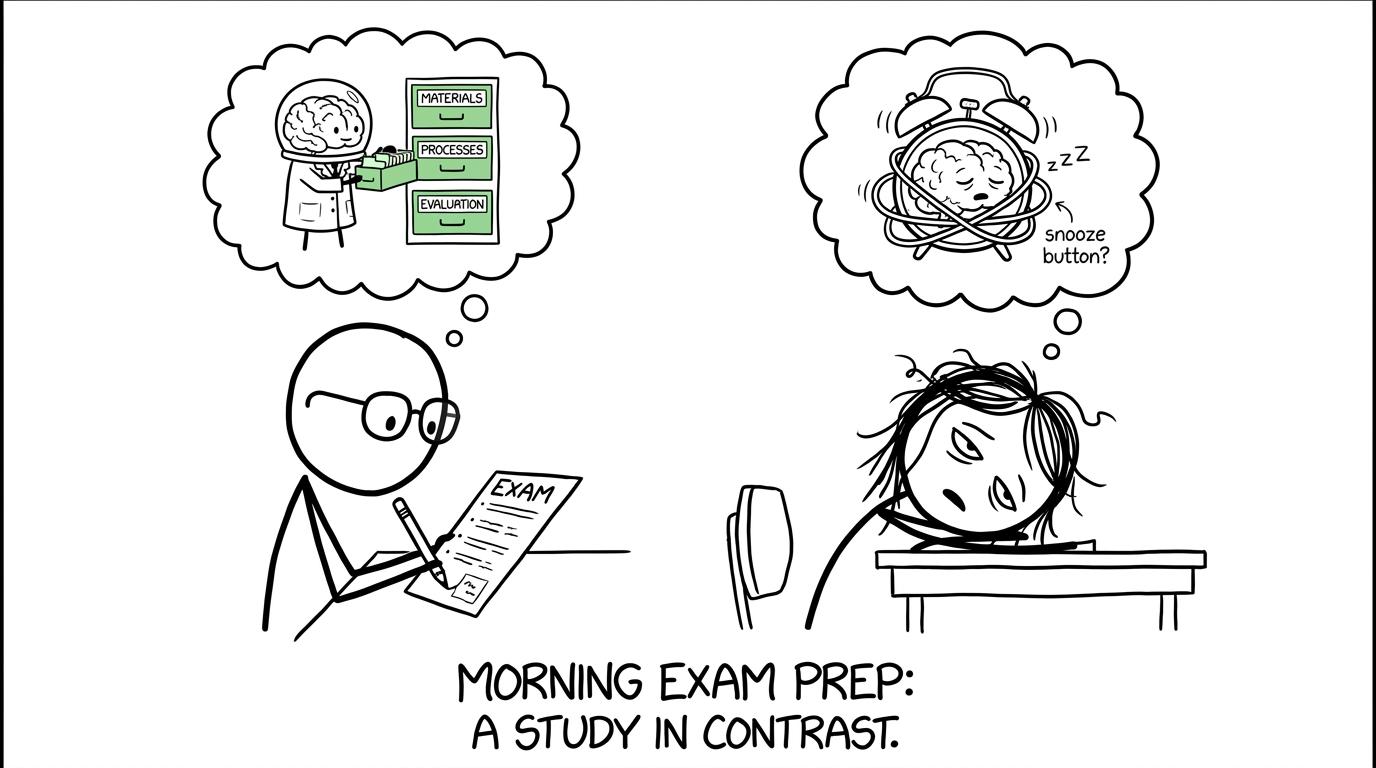 Two brain characters prepare very differently for a morning exam
Common mistakes with bedtime revision
Treating tiredness as proof of effort
Hours spent awake are not the same as hours spent learning. Judge revision by what you can retrieve and apply, not by how late the clock becomes.
Rereading instead of testing
Recognition is easier than recall. Cover the notes, answer a question and then check. A mistake found tonight becomes a useful target tomorrow.
Starting a full paper too late
Past papers deserve alert attention, realistic timing and careful marking. Complete them earlier, then use bedtime to review two or three errors. Maths students can use the advice in when to start GCSE past papers to build paper practice gradually.
Revising every topic at once
Broad late-night revision creates motion without depth. Choose one small area and leave the rest inside your plan.
Assuming sleep can compensate for weak learning
Sleep can support consolidation, but it does not manufacture understanding. You still need clear teaching, active practice, feedback and spaced revisiting.
Ignoring the next morning
The morning retrieval check completes the loop. Even a few minutes can show whether a definition or process is genuinely available.
The verdict: protect sleep and make the final minutes count
Revising GCSE Design and Technology before bed can help when it is brief, active and based on material you already understand. It hurts when it becomes anxious cramming, introduces demanding new content or pushes sleep later. The benefit comes from combining sound learning with sleep, not choosing revision instead of sleep.
Set a stopping time. Retrieve one narrow group of facts. Write down what needs another look. Then close the book.
For the maths running through Design and Technology, and for your separate GCSE maths papers, make MathsGenie your free revision starting point. Use revision lessons to understand methods, practice questions and mini tests to strengthen recall, then past papers, predicted papers, mark schemes and video solutions to turn that understanding into reliable marks. A calm plan usually beats one more exhausted hour.










