

Revising Before Bed GCSE Computer Science: Help or Harm?
Revising before bed GCSE Computer Science can aid recall, but not if it costs sleep. Plan a short, calm session that supports memory for exams.
The clock says you should stop. Your notes say there is still an entire section on networks to cover. That tension leads many students to wonder whether revising before bed GCSE Computer Science topics will help the material settle into memory or simply leave them tired the next morning.
The short answer is this: a brief, focused review before bed may support memory, provided it does not delay or disrupt sleep. Sleep helps consolidate newly learned information, but staying awake to revise for longer removes part of the very process you are hoping will make the revision stick.
Bedtime revision is therefore best used as a quiet recap, not an emergency attempt to learn the specification overnight.
The bedtime revision checklist
A useful pre-sleep session should be:
- short enough to protect your planned bedtime
- focused on one small area of the specification
- based on active recall rather than passive rereading
- completed away from your bed, if possible
- followed by a screen-free wind-down
- revisited the next day to check what you retained
If the session makes you more alert, anxious or tempted to continue indefinitely, stop. Sleep is more valuable than another tired hour of highlighting.
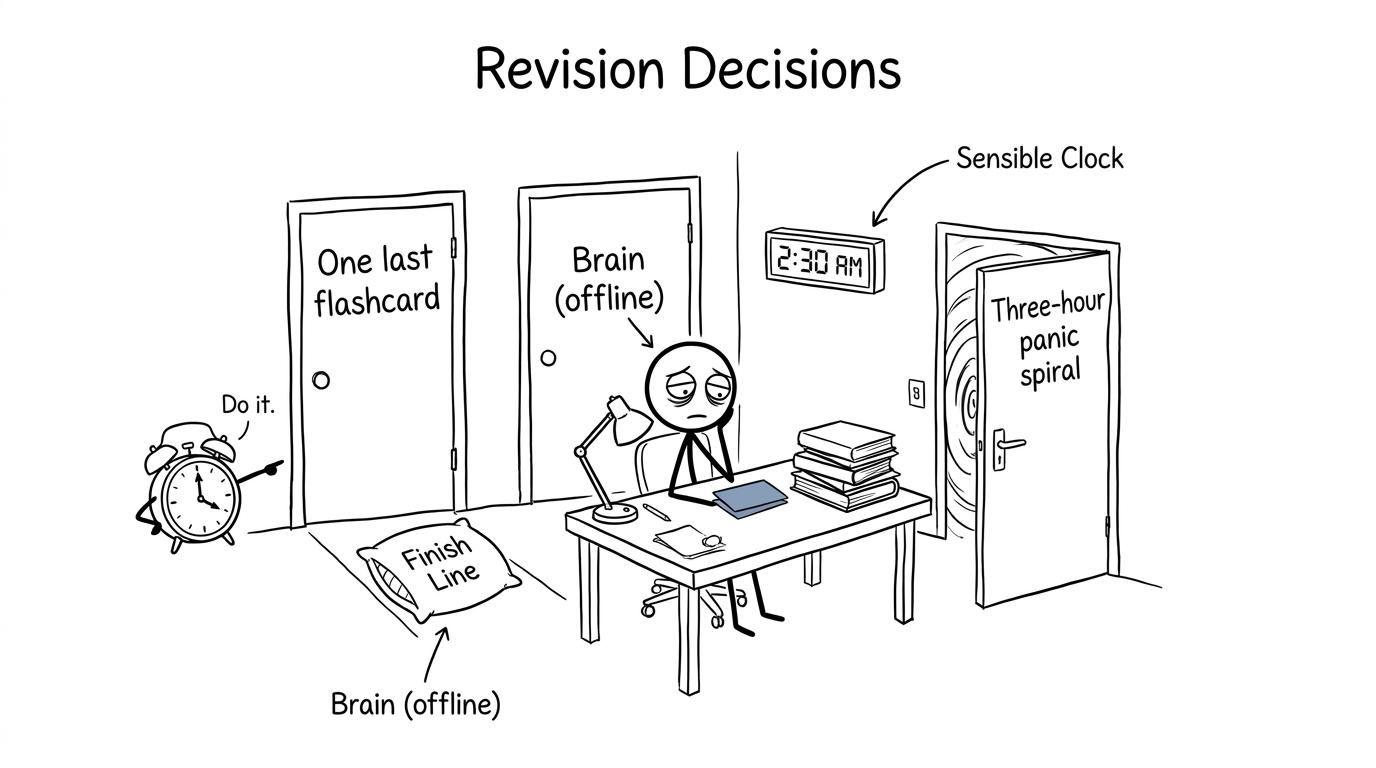 A student chooses between one flashcard and a panic spiral before bed
How sleep affects memory consolidation
Learning does not finish when you close your notebook. After information is encoded, the brain continues processing and stabilising aspects of that memory. This is known as memory consolidation, and research reviews consistently identify sleep as an important part of the process.
That does not mean everything read immediately before sleep will be remembered. Memory is affected by attention, prior knowledge, retrieval practice, sleep quality and later review. A tired glance at twenty pages is not transformed into secure knowledge simply because you went to bed afterwards.
Research involving adolescents also suggests that the timing effect can depend on the kind of memory being tested. One laboratory study found a clearer pre-sleep benefit for a procedural task than for pairs of words, while its result for declarative information was less straightforward. GCSE Computer Science uses several forms of learning: factual recall, logical reasoning, algorithm tracing and programming procedures. It would therefore be misleading to claim that one bedtime rule works equally well for every topic.
The dependable conclusion is simpler: sleep supports learning, but evidence does not justify sacrificing sleep to place more revision immediately before it.
When revising before bed may help
A short session can be useful when the difficult learning has already happened earlier. The bedtime review then acts as a final retrieval opportunity.
Good material for this session includes:
- recalling definitions such as abstraction, decomposition or authentication
- listing the stages of the fetch-decode-execute cycle from memory
- explaining the difference between RAM and secondary storage
- reviewing one sorting or searching algorithm
- checking Boolean logic terminology
- recalling common network threats and suitable prevention methods
- mentally tracing a short, familiar algorithm
These are contained tasks. They have a clear stopping point, which matters at night.
The same principle works for maths revision. A short recall check can reinforce a formula or method, but it should sit inside a wider plan using daytime practice. MathsGenie's GCSE maths revision hub helps students choose focused lessons and questions rather than opening an entire textbook without a target.
Active recall is better than another reread
Bedtime revision should require you to retrieve information. Close the book and write what you know, explain a concept aloud or answer a few flashcards before checking the source.
Rereading can feel fluent because the words are familiar. That feeling is not reliable evidence that you could produce the information in an exam. Retrieval reveals the gap while there is still time to correct it.
A practical structure is:
- choose one micro-topic
- recall it without notes
- check your response
- correct one or two gaps
- write tomorrow's first revision task
- stop at the planned time
For a similar approach to short sessions, see the twenty-minute GCSE maths revision routine. The subjects differ, but the principle transfers well: a small completed cycle is better than an ambitious session that collapses into distraction.
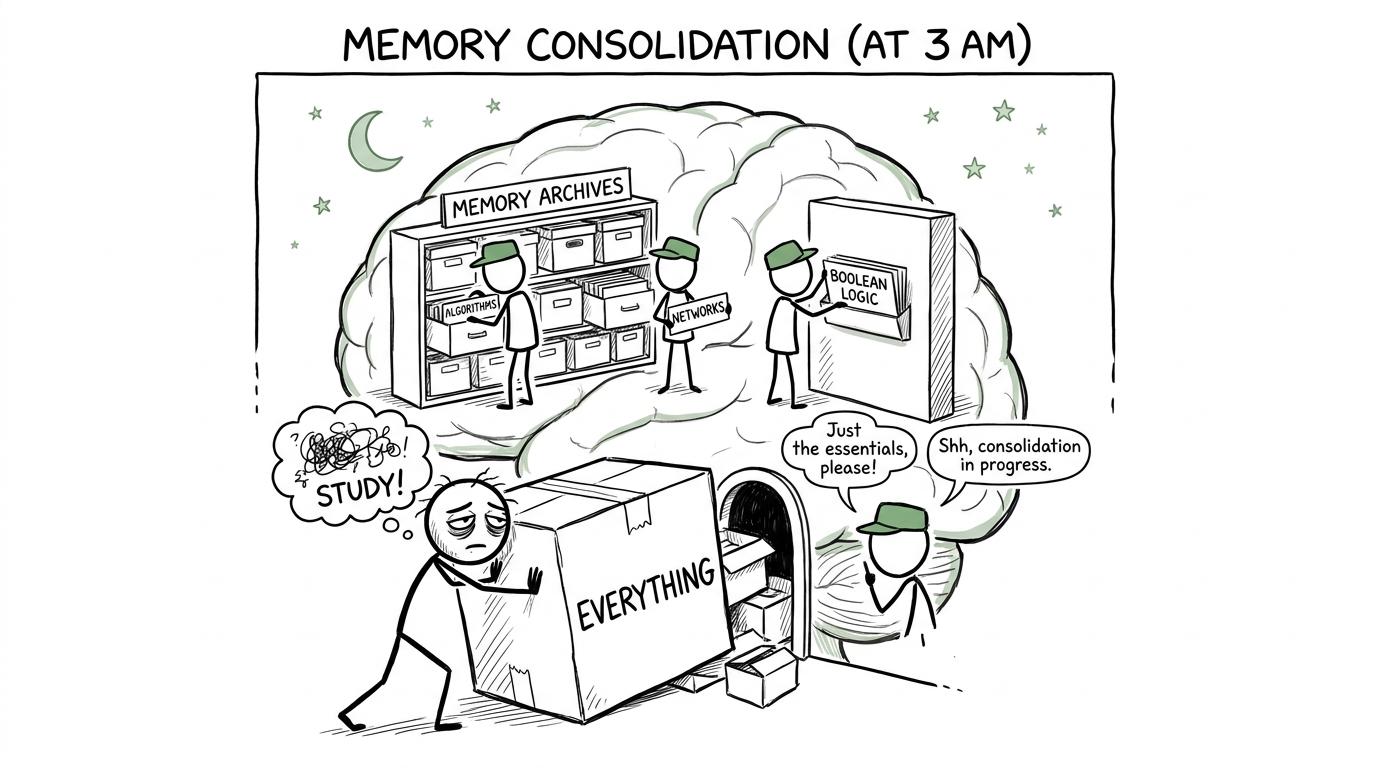 Tiny brain librarians file revision topics while a student brings a box labelled everything
When late-night revision starts to hurt
The benefit disappears when revision reduces sleep opportunity. Teenagers commonly need around 888 to 101010 hours of sleep, although individual needs vary. NHS guidance for young people emphasises regular sleep routines, a calm environment and limiting stimulating screen use before bed.
If you must wake at 7 am7\text{ am}7 am, starting a new programming unit at midnight is not a memory strategy. It is a trade: more exposure tonight for less sleep, weaker concentration and potentially poorer learning tomorrow.
Late-night revision is especially unhelpful when you are:
- repeatedly reading the same sentence
- making mistakes you would normally spot
- switching between revision and social media
- trying to learn several large topics at once
- becoming more worried with every page
- continuing only because stopping feels guilty
Fatigue changes the quality of the session. You may technically spend more time revising while doing less useful thinking.
The night before an exam is different
The final evening is not the time to rebuild the course. Confirm the examination details, pack what you need and review a small set of familiar ideas. Avoid a full paper immediately before sleep if marking it could uncover several weaknesses and trigger panic.
This is the same logic behind MathsGenie's GCSE maths night-before plan: use a defined stopping time, repair only a few important gaps and protect sleep. Computer Science students can apply that structure using their own board's specification and teacher-approved resources.
A better evening plan for Computer Science and maths
Computer Science revision should match the specification you are taking. AQA, OCR and other awarding organisations arrange content and assessment differently, while specification changes may apply to different examination years. Check your exact qualification rather than relying on a generic online topic list.
A balanced evening could contain three stages.
Do demanding work earlier
Use your most alert period for programming, unfamiliar algorithms, extended exam responses and difficult maths questions. These tasks require sustained reasoning and feedback.
If you do not know what to prioritise in maths, use a short diagnostic and follow the process in finding your weakest GCSE topics. Evidence from marked questions is a better guide than whichever chapter happens to be open.
Use the final review to retrieve
Near the end of your revision period, choose one Computer Science topic already learned. Test yourself briefly, check the answer and record anything that needs another look tomorrow.
Do not begin a long coding task. Do not open five new tabs. The purpose is to finish with a clear memory cue, not to create unfinished work.
Leave space between revision and sleep
Allow time to wind down. Paper flashcards or a short handwritten summary may be more practical than revising on a phone because the same device also carries messages, videos and notifications.
Evidence about screens is nuanced: not every small experiment has found a measurable effect from brief pre-sleep use. Nevertheless, NHS sleep guidance recommends reducing screens before bed, and removing the phone also prevents revision from quietly becoming another hour awake.
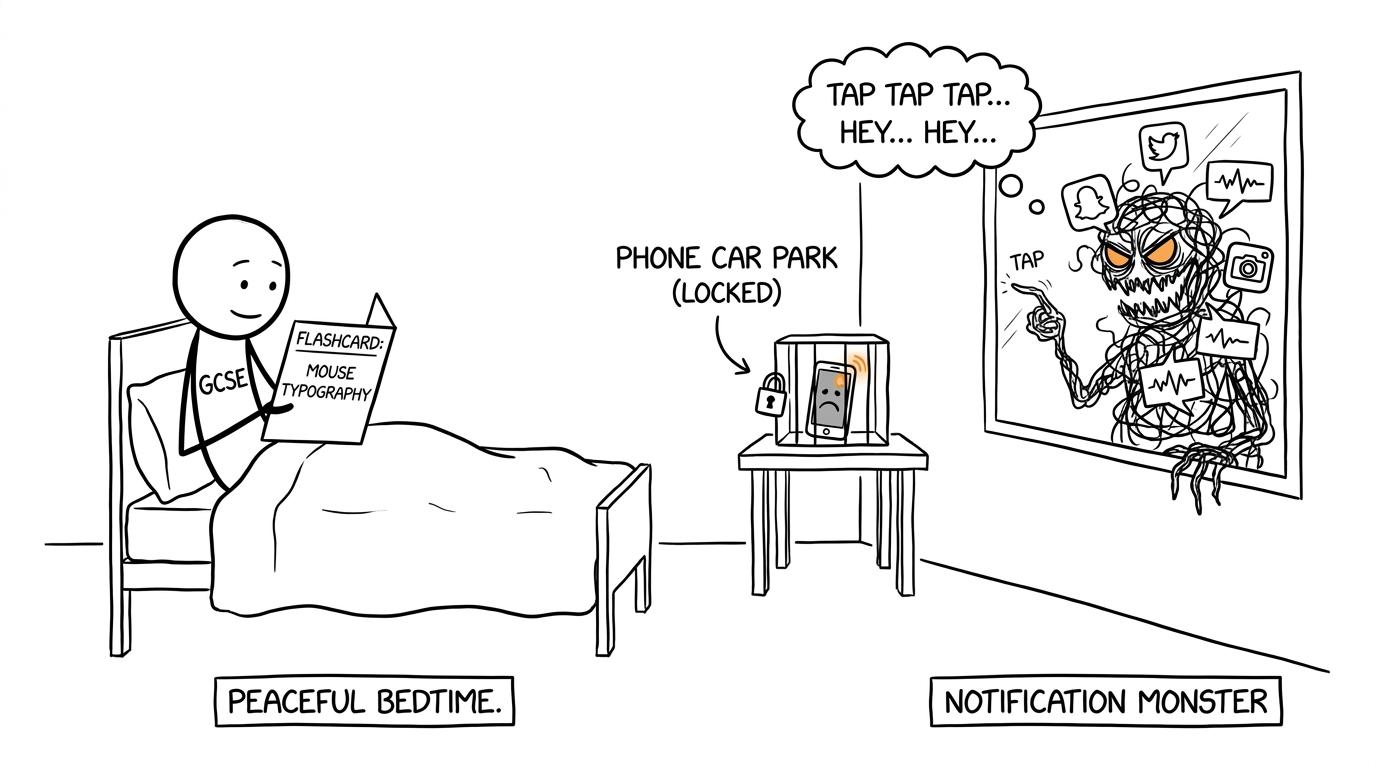 A notification monster is defeated by parking the phone across the room
Why the next-day check matters
Sleep may help stabilise a memory, but retrieval tells you whether the information is actually accessible. The following day, answer the same prompt without looking at your notes. If you cannot explain it clearly, relearn the missing part and test it again later.
This produces a stronger cycle:
learn, retrieve, sleep, retrieve again, then apply.
For maths, application should include exam-style questions and careful marking. The guide to using GCSE past papers properly explains how to turn errors into targeted revision. Students taking Pearson Edexcel can also use the organised collection of Edexcel GCSE maths past papers with mark schemes and available solutions.
One successful recall the night before is encouraging. Recall on several separated occasions is better evidence that the knowledge is becoming durable. MathsGenie's guide to stopping yourself forgetting GCSE maths content shows how next-day and later reviews fit into a spaced routine.
Common bedtime revision mistakes
Treating bedtime as a deadline for the whole course
A specification cannot be compressed into one evening. Choose a small target and carry unfinished topics into a realistic plan. The one-month GCSE maths revision plan demonstrates how spacing work removes the pressure to rescue everything at night.
Confusing exposure with recall
Seeing a definition again is not the same as producing it. Close the notes before testing yourself.
Revising in bed
If possible, revise at a desk or table and keep the bed associated with sleep. Stop fully before getting into bed rather than scrolling through notes under the duvet.
Ignoring the stopping time
A short session becomes harmful when it repeatedly extends bedtime. Set an alarm for stopping, not only for waking.
Learning from the wrong specification
Computer Science terminology and paper requirements can vary between awarding organisations and qualification versions. Confirm your board, specification code and examination year with your school.
Replacing practice with facts
Computer Science is not only a memory test. Algorithms, logic and programming require application. Bedtime recall can reinforce knowledge, but daytime practice must still develop the ability to use it.
Protect sleep and make the earlier revision count
Revising immediately before bed is neither a secret grade booster nor automatically a bad habit. It helps when it is brief, calm and built around material you already understand. It hurts when it becomes a reason to delay sleep, stare at a screen or attempt the entire course while exhausted.
Use the evening for a final retrieval check. Then stop. Let sleep do its part, and test yourself again tomorrow.
For your maths exams, build the rest of that routine with MathsGenie's free revision lessons, practice questions, mini tests, past papers, predicted papers, mark schemes and video solutions. Choose one weak topic from the GCSE maths revision area, practise it properly and finish early enough to arrive tomorrow ready to think.











