

Revise Weakest Topic First GCSE Combined Science?
Revise weakest topic first GCSE Combined Science? Usually yes. Use this session plan to fix weak areas, retain more and protect your maths revision time.

A weak topic has a peculiar weight. You can spend an entire revision session on comfortable material and still feel it waiting in the background.
So, should you revise weakest topic first GCSE Combined Science, or leave it until the end? Usually, the best approach is to complete a brief warm-up and then tackle your weakest area while your attention is still fresh. Do not spend the entire session on it, though. Finish with a short check or a more secure topic, then return to the weakness on another day.
Starting first makes a difference when it protects the difficult work from procrastination and tiredness. Revisiting later makes a difference because spaced retrieval helps learning last. The strongest plan uses both ideas rather than choosing one forever.
The short answer and revision checklist
Use this sequence for most GCSE Combined Science sessions:
- Begin with a short, familiar retrieval task.
- Move to one precisely defined weak area.
- Relearn only what is missing.
- Answer questions without notes.
- Mark immediately and classify each error.
- Finish with a brief confidence-building task.
- Re-test the weak area after a gap.
The position of the topic matters less than what you do with it. Passive rereading at the start is still passive rereading. A closed-book attempt, feedback and a later re-test are more useful than simply placing “weak topic” at the top of a timetable.
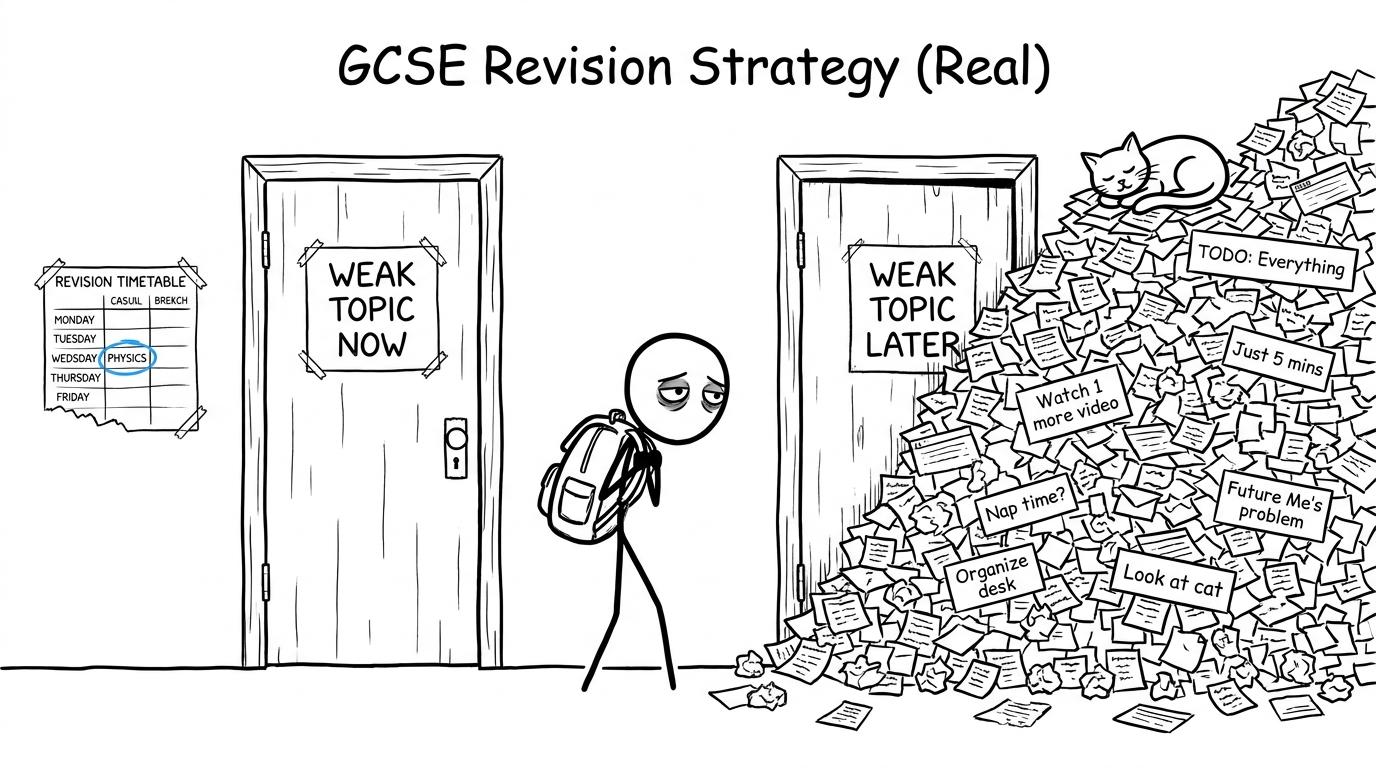 A student choosing between revising a weak topic now or later
Why your weakest topic usually belongs near the start
The end of a session is where difficult intentions often disappear. One task takes longer than expected, concentration drops, or the apparently harmless phrase “I will do it tomorrow” appears.
Putting the weakest topic near the start removes that risk. It also gives you enough time to identify why the topic is weak. That distinction matters because “I am bad at physics” is not a useful diagnosis. The actual problem might be selecting an equation, changing units, rearranging a formula, interpreting a graph or explaining a required practical.
Combined Science examinations do not assess recall alone. Across the regulated GCSE specifications, the assessment objectives cover knowledge and understanding, application, and analysis or evaluation. Questions also assess practical and mathematical skills. Your revision therefore needs to expose whether you can use an idea, not merely recognise it in your notes.
A useful rule is to begin the demanding work early, but not necessarily in the first second. A brief warm-up can help you settle before the main task.
Start with a warm-up, not a hiding place
Spend roughly five minutes recalling a few facts, definitions or methods you have met before. Keep your notes closed initially, then check your answers.
This warm-up should create momentum. It should not expand into half an hour of comfortable revision. Once you are thinking clearly, move to the weak area you selected in advance.
If calculations are contributing to the problem, use the GCSE Maths Revision hub to locate the underlying skill. Science questions frequently depend on familiar maths such as proportional reasoning, graph interpretation, standard form and changing the subject of a formula.
When doing the weakest topic last can be sensible
“Start with the hardest thing” is useful advice, but it is not a law.
If beginning with a frightening topic repeatedly stops you from beginning at all, use a short, achievable task first. The purpose is to cross the starting line, not to avoid the difficult work for the rest of the evening.
Leaving weakness-focused work until later can also make sense when:
- your first task is a timed paper that will diagnose the weakness properly;
- you need to review prerequisite knowledge before approaching the topic;
- the final task is a short retrieval check of material studied earlier;
- your concentration reliably improves after a brief warm-up;
- you are revising close to bedtime and the topic would create an unhelpful, open-ended session.
The danger is not that the topic appears last. The danger is that “last” quietly becomes “never”. Give it a fixed start time and a clear stopping condition.
For example, decide that you will complete one short diagnostic task, inspect the mark scheme and record the next action. Avoid vague promises such as “finish chemistry”.
Does the order actually affect learning?
There is no dependable rule saying that the first topic in every revision session will automatically be remembered best. Evidence on learning supports retrieval practice and returning to content after a delay. Evidence about spacing within a single session is less conclusive than evidence about spacing work across different days or lessons.
That leads to an important distinction:
- Session order manages attention, energy and avoidance.
- Retrieval and feedback reveal whether you can produce an answer independently.
- Spacing gives you another attempt after some forgetting has occurred.
The precise order can help your behaviour, but the repeated learning cycle does more of the academic work.
Research-informed guidance also warns that retrieval should not be impossibly hard. You need some opportunity for success, appropriate support and feedback. If your weakest topic is almost entirely unfamiliar, begin with a concise explanation before attempting demanding exam questions.
MathsGenie uses this learn-practise-check rhythm throughout its topic resources. If formula manipulation is the barrier, revise with the Changing the Subject of a Formula lesson, then test the skill using Changing the Subject practice questions.
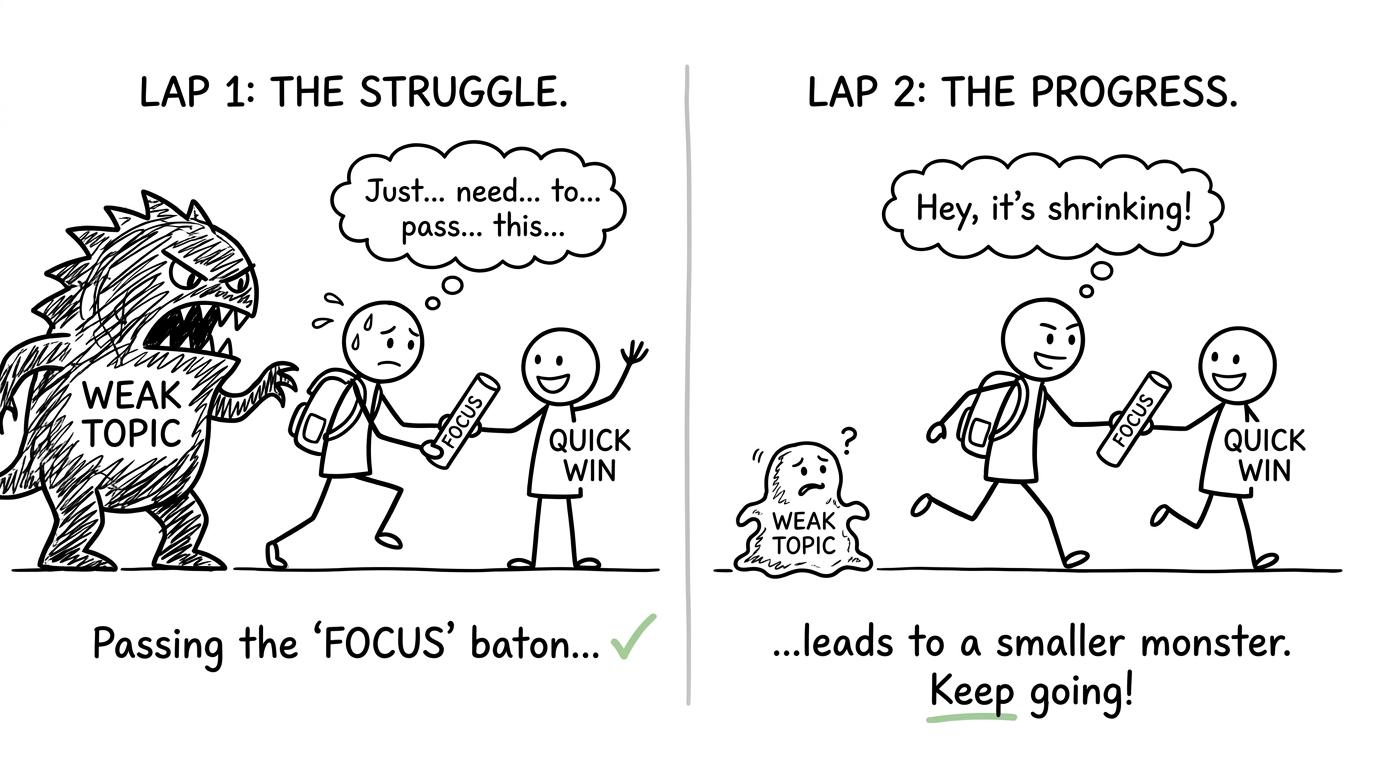 A revision relay between a weak topic and a quick win
A balanced session that tackles weakness without draining you
A sensible session has boundaries. Without them, a difficult topic can consume all available time while producing very little useful practice.
Diagnose before you revise
Choose a small set of questions from the correct Combined Science specification and tier. AQA, Edexcel, OCR and Eduqas organise content and papers differently, so use the specification and materials supplied for your board.
Attempt the questions without notes. When you mark them, label each lost mark by cause:
- missing scientific knowledge;
- failure to apply known knowledge;
- mathematical method;
- units or rounding;
- graph or data interpretation;
- practical knowledge;
- imprecise exam language;
- rushing or misreading.
This turns a broad weakness into a repairable task. MathsGenie’s guide to finding your weakest GCSE topics explains how to build a useful error log from exam evidence.
Repair the smallest useful gap
Do not respond to one difficult electricity question by scheduling “all of physics”. Identify the smallest skill that would change your next answer.
If the science is secure but algebra is blocking the marks, practise the algebra separately. Rearranging harder formulae is especially useful when equations contain powers, brackets, fractions or repeated variables.
This matters for students balancing science with GCSE maths revision. A well-chosen maths session can support both subjects. Formulae, ratios, percentages, graphs and standard form do not become different operations merely because they appear in a laboratory context.
Finish with feedback and a return date
Marking is part of revision, not an administrative task completed afterwards. Check what earned marks, correct the response and record one clear action.
Then set a return date. Re-test the area after a gap using different questions. You can use GCSE mini tests to keep maths retrieval short and manageable while continuing your science preparation.
First or last depends on the type of weakness
Not every weak topic needs the same treatment.
A knowledge gap
Place it early enough to relearn the missing idea, then retrieve it without notes. Return on another day. Merely copying a page of information can create familiarity without reliable recall.
An application gap
Start with a short recap, then spend most of the block on unfamiliar question contexts. Combined Science questions may ask you to apply knowledge or connect different areas within one response, so definitions alone are insufficient.
A mathematical gap
Separate the maths from the science briefly. Practise the pure method, then put it back into a scientific question. The government requirements for GCSE Combined Science include a substantial mathematical component, with the required weighting distributed across biology, chemistry and physics.
Use board-specific maths papers when you need wider practice. MathsGenie provides AQA GCSE Maths past papers and Edexcel GCSE Maths past papers, including mark schemes and worked solutions where available.
An exam-technique gap
If you know the content but lose marks through timing, command words or incomplete reasoning, place the topic inside a timed mixed set. Topic notes will not repair a performance problem on their own.
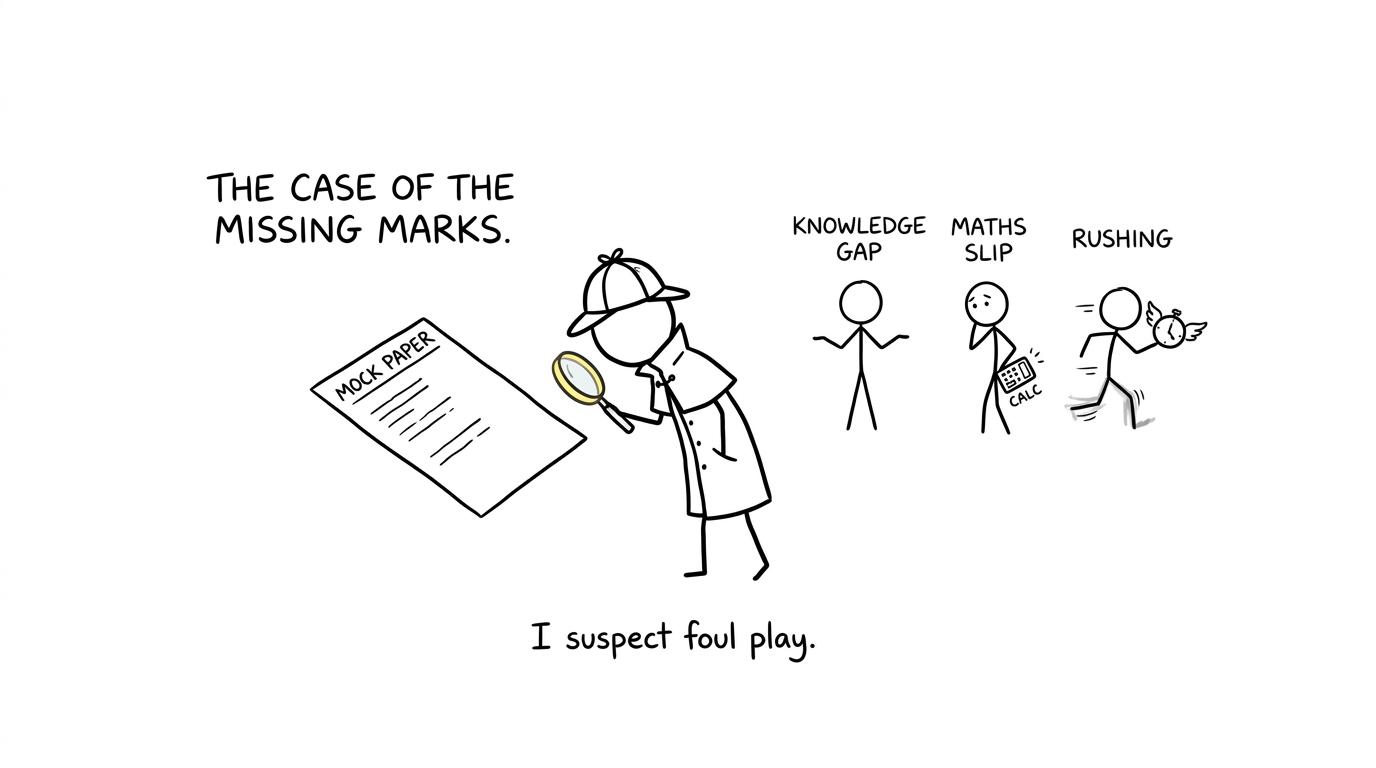 A student detective identifying the real cause of lost marks
Common mistakes when prioritising weak topics
Choosing weakness by feeling alone
The topic you dislike most is not always costing the most marks. Use marked questions, mocks and teacher feedback. Evidence is calmer than instinct.
Spending the whole session on one impossible task
Challenge is useful; helplessness is not. Narrow the topic, use a concise explanation and attempt an accessible question before increasing the difficulty.
Revising only weak areas
Secure topics fade when ignored. Keep some mixed retrieval in your week so that yesterday’s strength does not become next month’s weakness.
Reading answers instead of producing them
Recognition feels smooth, which is precisely why it can mislead you. Attempt the question before opening notes, a mark scheme or a video solution.
Correcting the answer but not the cause
Writing the model answer does not necessarily prevent the same error. Record why the mark was lost and what action would stop it happening again.
Never re-testing
A topic is not fixed because it made sense immediately after an explanation. Re-test after a delay. Maths students can use the process described in how to use GCSE past papers properly: paper, mark, fix, re-test, then move on.
Make the weak topic smaller, then start
Your weakest area should usually appear near the beginning of the session, after a brief warm-up. But the deeper answer is more useful: order affects whether difficult work gets done, while active retrieval, feedback and spaced re-testing affect whether it is learned.
Choose one micro-topic. Attempt questions before looking at the answer. Identify whether the weakness is scientific knowledge, application, practical understanding, maths or exam technique. Repair that exact gap and schedule the next check.
For the mathematical skills that run through Combined Science, make MathsGenie your free revision base. Use revision lessons to rebuild methods, practice questions and mini tests to develop accuracy, then past papers and predicted papers to test performance. Mark honestly, use the mark schemes and video solutions, and let each lost mark decide the next small step.











