Revise GCSE Statistics Alone or With Others?
Revise GCSE statistics alone or with others? Compare both methods, match each to the right topics, and build a focused plan for stronger exam practice.
Revision can become strangely social. One student wants complete silence; another understands a topic only after talking it through. Then comes the uncomfortable question: are you learning, or merely sitting near someone else who is learning?
If you are deciding whether to revise GCSE statistics alone or with others, the best answer is usually both. Solo revision is stronger for concentration, independent question practice and honest diagnosis. Revising with others is useful for explaining interpretations, challenging reasoning and uncovering misconceptions. The right choice depends on the topic and the purpose of the session.
That distinction matters. A revision method is not good because it feels productive. It is good because it helps you recall knowledge, apply it independently and earn marks under exam conditions.
The short answer: use a hybrid approach
A productive GCSE Statistics plan normally includes:
- solo sessions for learning methods and completing exam questions;
- paired or small-group sessions for explanation and comparison;
- independent timed practice before the exam;
- mark schemes and solutions to check what the examiner expects;
- a written record of errors to decide what to revise next.
Educational evidence supports planning, monitoring and evaluating your own learning. It also suggests that collaborative learning is most useful when discussion is carefully structured. In other words, independence matters, but a purposeful conversation can expose thinking that silent revision leaves hidden.
The mistake is treating this as a permanent personality choice. You do not have to become a “solo learner” or a “group learner”. Choose the arrangement that serves the task in front of you.
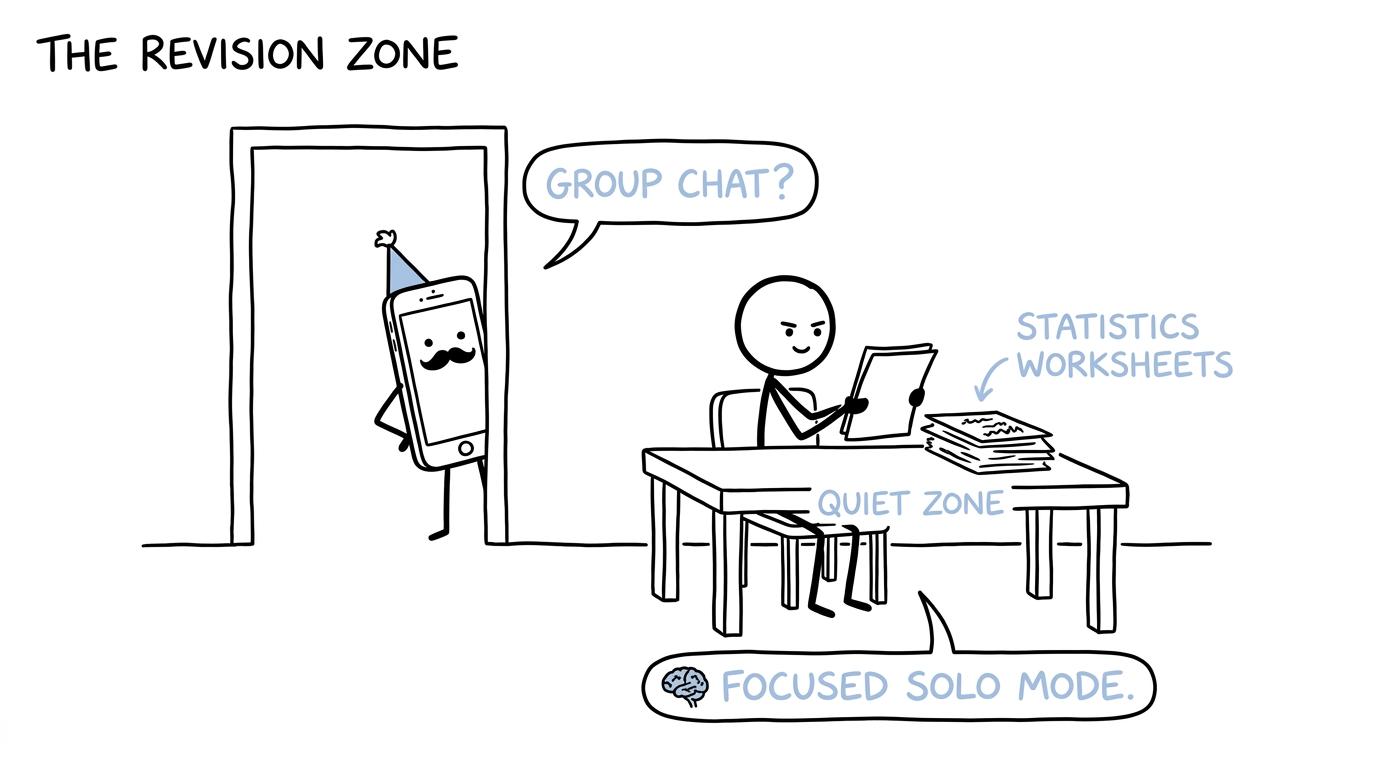 A student protecting a quiet statistics revision session from a disguised group chat
When revising GCSE Statistics alone works best
Solo revision gives you something a group cannot: nowhere to hide.
When you answer a question alone, you discover whether you can select the correct method without a hint. That is close to what the examination asks of you. No friend will whisper that a cumulative frequency graph is needed or remind you that frequency density is calculated using:
frequency density=frequencyclass width\text{frequency density}=\frac{\text{frequency}}{\text{class width}}frequency density=class widthfrequencyIndependent revision is particularly effective for topics involving a repeatable procedure, careful calculation or accurate graph construction.
Topics well suited to solo practice
These commonly include:
- calculating the mean, median, mode and range;
- finding averages from frequency tables;
- estimating the mean from grouped data;
- constructing histograms and cumulative frequency graphs;
- drawing box plots and frequency polygons;
- using tree diagrams and probability rules;
- calculating moving averages or index numbers where these appear in your specification;
- completing timed exam questions.
The exact content varies between a dedicated GCSE Statistics qualification and the statistics strand of GCSE Maths. It also varies across Edexcel, AQA, OCR and Eduqas, so follow your own specification and teacher's guidance.
For Edexcel GCSE Statistics, the GCSE Statistics revision hub brings lessons, worksheets, questions and paper resources together. Begin with one topic rather than opening a full paper before the underlying method is secure.
Why silent question practice is powerful
Reading a solution can create familiarity without recall. The page looks sensible, so the method feels known. Close the page, however, and the first step may disappear.
A better solo loop is:
- review the method briefly;
- close your notes;
- complete questions without help;
- mark your work;
- classify each lost mark;
- repeat the weak skill after a gap.
Classify errors as missing knowledge, an incorrect method, weak interpretation or an avoidable examination mistake. This turns marking into a decision about the next session rather than a verdict on your ability.
The approach in MathsGenie's guide to revising GCSE Maths without wasting time follows the same useful principle: learn, practise, mark and retest.
When revising with others works best
Statistics is not only calculation. It is also the language of evidence: whether a conclusion is justified, whether a sample may be biased and whether a graph communicates data fairly.
Those ideas often improve through conversation because you have to make your reasoning visible. Saying “the graph shows a relationship” is not enough if another student asks whether it proves causation. Explaining the distinction forces you to examine your own claim.
Topics that benefit from discussion
Paired or small-group revision can work especially well for:
- sampling methods and possible sources of bias;
- designing questionnaires;
- interpreting correlation and scatter graphs;
- comparing distributions using averages and measures of spread;
- evaluating charts, diagrams and statistical claims;
- deciding whether a conclusion is supported by the data;
- discussing assumptions and limitations;
- interpreting command words and longer written questions.
Comparison questions are ideal for this. A complete comparison may require attention to both a typical value and spread. One student may notice the median; another may notice the interquartile range, written as:
IQR=Q3−Q1\text{IQR}=Q_3-Q_1IQR=Q3−Q1The conversation does not replace the final written response. Its purpose is to improve the reasoning that eventually appears on the page.
Structure the group or it becomes a chat
A group needs a task, a time limit and individual accountability. Three students around a table are not automatically collaborating.
Try assigning rotating roles:
- Solver: attempts the question without interruption.
- Questioner: asks why each method or conclusion is justified.
- Checker: uses the mark scheme and records anything missing.
Change roles after each question. Keep the group small enough for everyone to speak and require each student to write their own final answer. This prevents the most confident person from doing all the thinking.
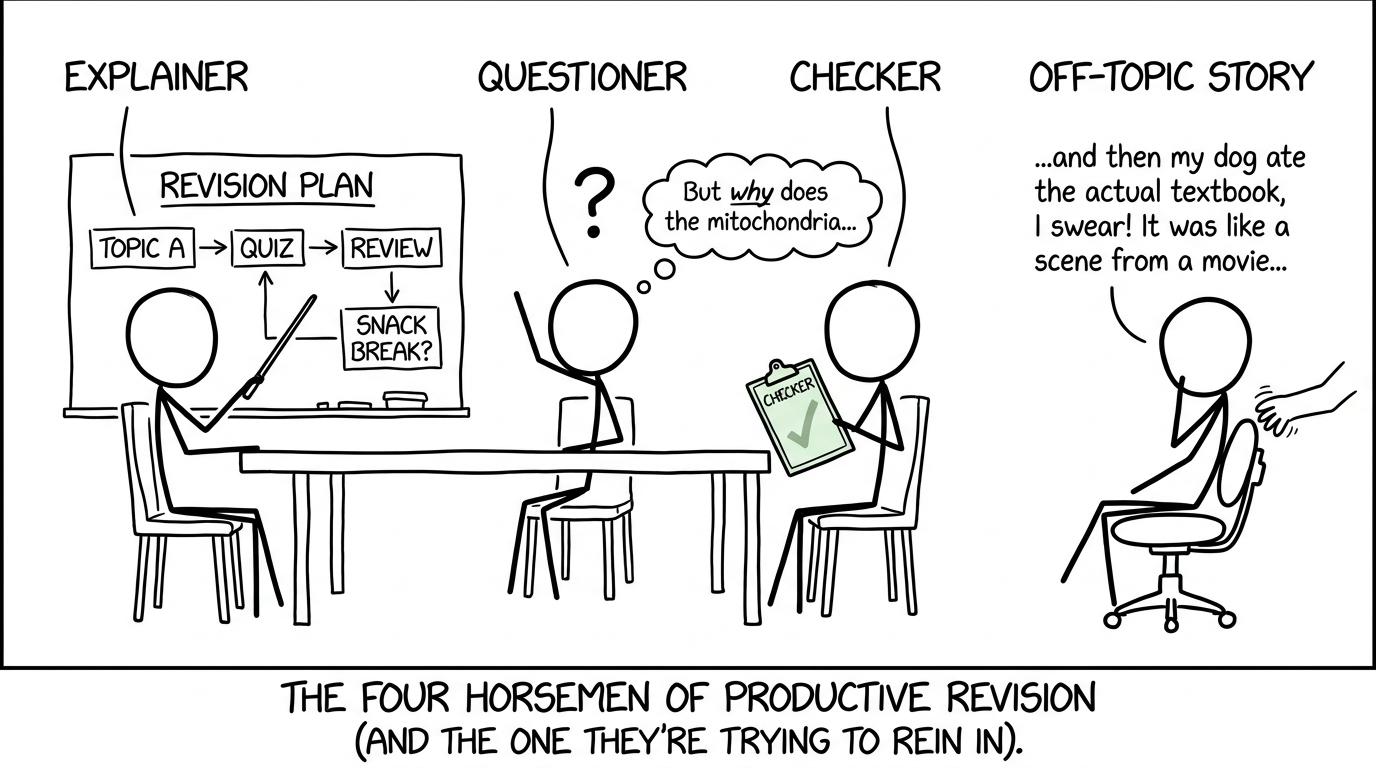 A structured revision group sends an off-topic story away on an office chair
Which revision format suits each statistics task?
| Statistics task | Best starting format | Why |
|---|---|---|
| Learning a calculation method | Alone | You can pause, repeat and test recall at your own pace. |
| Constructing graphs accurately | Alone | Careful scales, plotting and labels require sustained attention. |
| Comparing distributions | Together, then alone | Discussion reveals possible comparisons; independent writing checks exam readiness. |
| Evaluating sampling methods | Together | Questions and counterarguments expose weak assumptions. |
| Memorising definitions | Alone, then paired quiz | Private retrieval builds recall; a partner can test precision. |
| Interpreting correlation | Together, then alone | Talking clarifies reasoning, but the final explanation must be yours. |
| Completing a past paper | Alone | It recreates the independent decisions required in the examination. |
| Reviewing errors | Together if stuck | Another explanation may reveal why your original approach failed. |
This is why the strongest plan changes format rather than choosing one side. Learn privately, discuss selectively and test independently.
A practical hybrid revision session
A balanced session can be divided into three phases.
Prepare alone
Spend the opening section recalling definitions, formulae and methods without looking at your notes. Attempt a short set of questions and identify one point you cannot explain confidently.
This gives the later discussion a purpose. Instead of saying “I don't understand statistics”, you can ask a precise question about selecting a sample, interpreting skew or choosing a suitable average.
Discuss and challenge
Meet one or two classmates and compare reasoning, not merely answers. Useful prompts include:
- What does this result mean in context?
- Which evidence supports that conclusion?
- Is another interpretation possible?
- What assumption have we made?
- Which phrase would earn the interpretation mark?
Do not copy a friend's method because it sounds confident. Check it against your notes, teacher guidance or a mark scheme.
Finish independently
End by answering fresh questions alone. This is the non-negotiable part. If discussion helped, you should now be able to use the idea without prompts.
As you move towards full papers, use the Edexcel GCSE Statistics past papers under timed conditions and mark them carefully. If you are preparing after a previous attempt, the GCSE Statistics resit plan offers a useful structure for diagnosing gaps and scheduling paper practice.
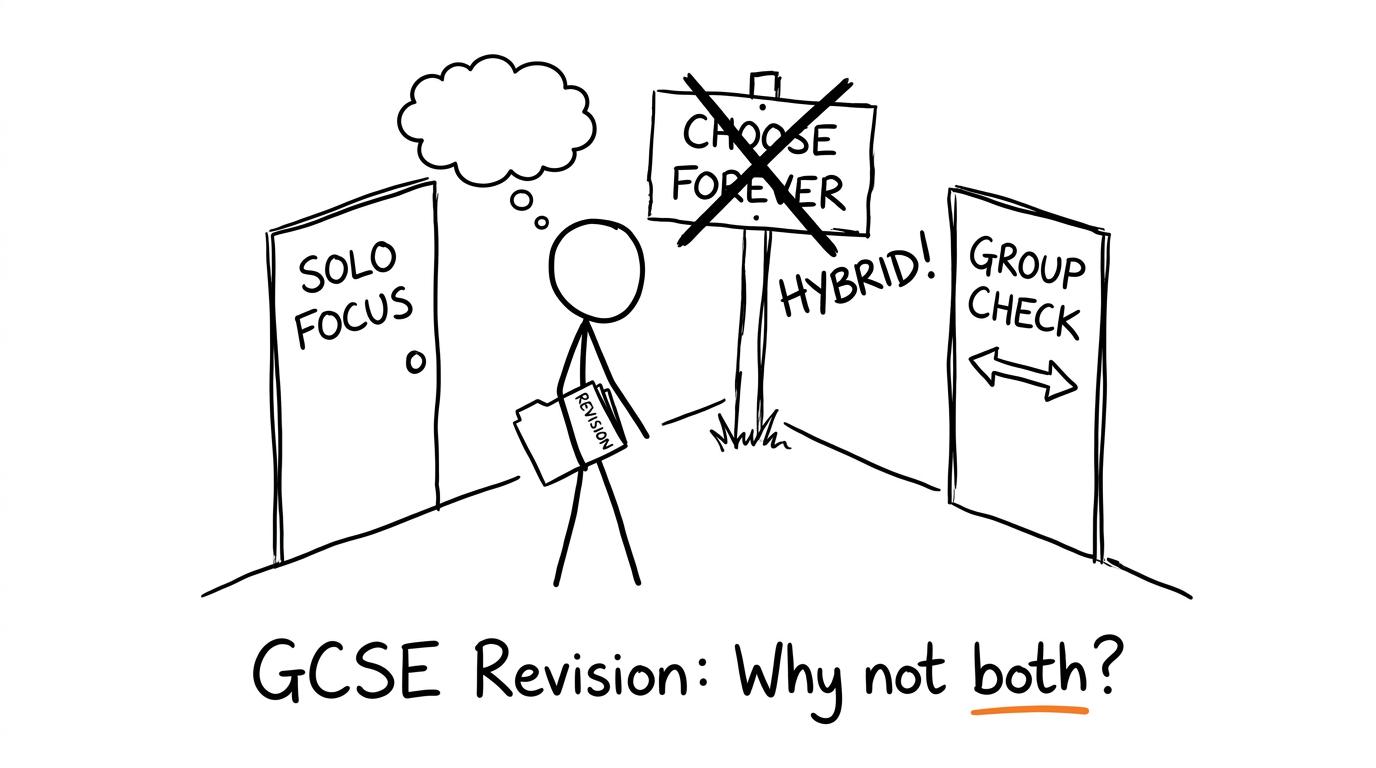 A student switches calmly between solo focus and group checking instead of choosing forever
How to tell whether a group session worked
Do not judge a session by how enjoyable or busy it felt. Use evidence.
At the end, each student should be able to:
- state what was revised;
- explain one corrected misconception;
- answer a fresh question independently;
- identify the next topic to practise;
- show written work that can be marked.
If nobody attempted questions, checked answers or recorded mistakes, the session probably produced companionship rather than revision. Companionship is valuable, but it should not be mistaken for exam preparation.
You can also use a short timed set or mini test as an exit check. Nearer the examination, GCSE predicted-topic guidance can help you prioritise recurring specification skills without pretending that any prediction is guaranteed.
Common mistakes when choosing how to revise
Revising everything in a group
Group explanation may feel reassuring, but your examination is independent. Complete enough solo work to prove that you can recognise and apply each method unaided.
Letting one person become the permanent teacher
The explainer may learn a great deal while everyone else listens. Rotate roles and require written answers from every member.
Marking only with friends
A group can agree on an answer and still be wrong. Use the official mark scheme where available, paying attention to method marks, accuracy and the detail required in interpretations.
Avoiding difficult topics when alone
Solo revision can become a tour of familiar worksheets. Use your error log to select tasks, not your mood. The uncomfortable topic is often the one with the greatest potential to recover marks.
Turning every session into a full paper
Past papers are important, but they are diagnostic tools as well as tests. If a paper reveals weak histogram interpretation, return to the relevant lesson and topic questions before attempting another paper.
Depending on last-minute discussion
A conversation the night before cannot replace repeated practice. If time is short, use a focused plan such as MathsGenie's GCSE Maths night-before checklist, then protect your sleep rather than extending an unfocused group call.
Make the method serve the next mark
The question is not really whether you should revise alone or with other people. It is whether your chosen environment makes the next piece of thinking more likely.
Work alone when you need concentration, accurate construction and independent recall. Work with others when an explanation needs challenging or a statistical conclusion deserves debate. Then return to solo questions, because understanding must eventually survive without the group.
Start with the free MathsGenie GCSE Statistics revision hub. Use revision lessons and practice questions to strengthen individual topics, then move to past papers, mark schemes, video solutions, mini tests and predicted papers where available. Put each task into your revision planner and let the evidence from your own answers decide what happens next.