Revise GCSE Religious Studies With No Quiet Space
Revise GCSE Religious Studies with no quiet space using short sessions, portable resources, active recall and realistic alternatives to working at home.
A quiet desk can start to feel like an unofficial entry requirement for GCSE success. Yet many students revise beside a television, share a bedroom, care for siblings or live in a home where uninterrupted silence simply does not happen.
If you need to revise GCSE Religious Studies with no quiet space, the answer is not to wait for perfect conditions. Build a portable routine around short periods of active recall, match each task to the noise around you and use quieter places such as school or a local library for the work that requires deeper concentration.
Your environment matters, but it does not decide your grade. A realistic system used repeatedly will usually serve you better than an ideal timetable that cannot survive an ordinary evening at home.
Your no-quiet-space revision checklist
Start with these practical steps:
- Break Religious Studies into individual beliefs, practices, themes and question types.
- Use short focus periods with one precise target.
- Prepare a portable kit containing flashcards, paper, pens and headphones or ear defenders.
- Separate tasks that tolerate noise from tasks requiring more concentration.
- Ask about study space at school, college or your local library.
- Test yourself instead of repeatedly reading notes.
- Practise planning and writing exam answers under realistic time limits.
- Protect sleep rather than trying to compensate with late-night revision.
The principle is simple: reduce the number of things that must go right before you can begin.
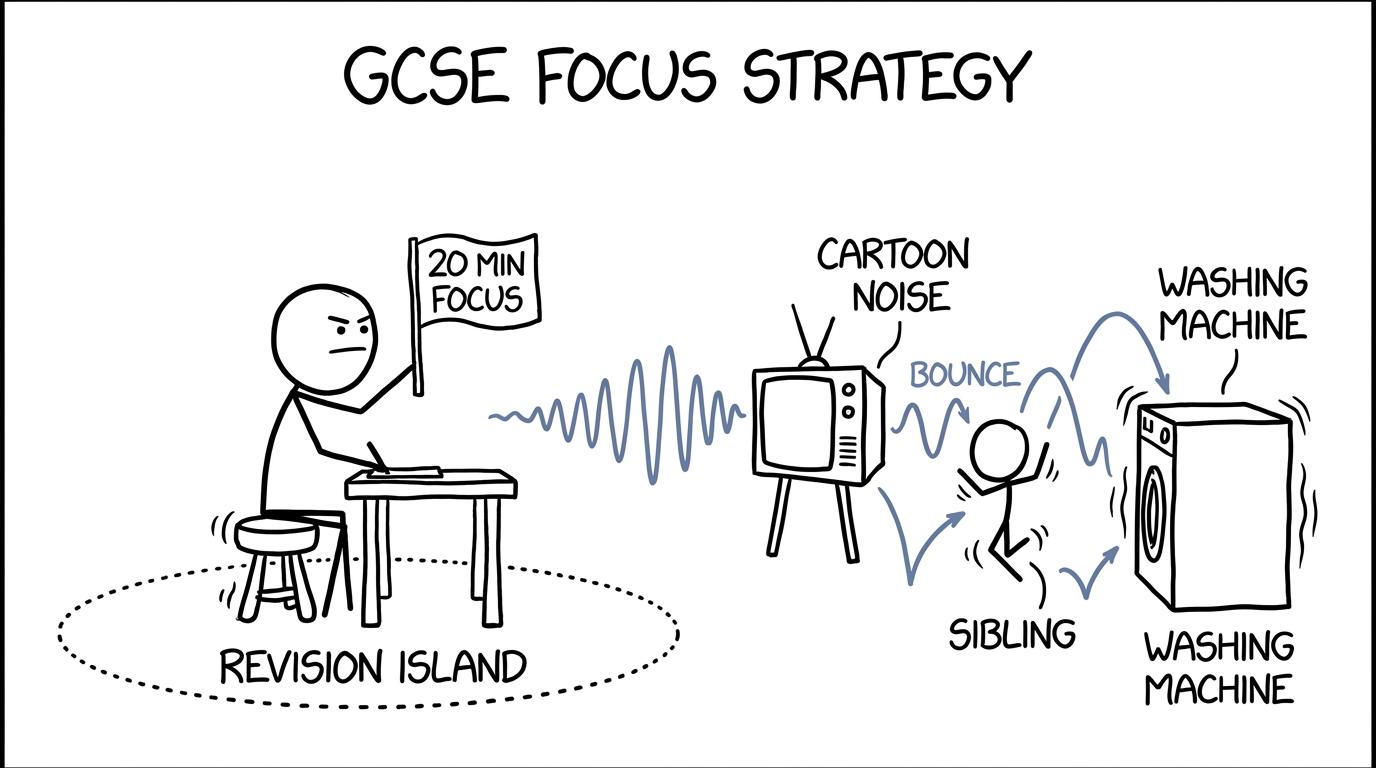 A student creating a small island of focus in a noisy home
Stop planning around a room you do not have
A plan built around two silent hours every evening will fail if those hours never exist. That failure can feel personal, even though the problem lies in the plan.
Instead, identify the conditions you actually have. Perhaps the kitchen is calmer before everyone wakes up. Maybe school remains open for a short period after lessons. There may be a public library nearby, or a relative who can offer a table once a week. Even one dependable quiet session can become the place where you complete longer exam questions.
Do not assume that school study spaces are only for sixth-form students. Ask your Religious Studies teacher, form tutor, librarian or pastoral team whether a classroom, library or homework club is available before school, at lunch or after lessons. If you use a public library, check its opening hours, computer arrangements and travel plan in advance.
At home, aim to negotiate a small boundary rather than demand complete silence. A request such as “Could I have the table with the television lower for 202020 minutes?” is specific and easier for other people to support. If that is not possible, move to a task designed for background noise.
Build revision around the GCSE Religious Studies exam
Religious Studies revision is not one activity. It contains at least two different kinds of thinking, and recognising that makes noisy-space revision much easier.
Across GCSE Religious Studies, the national assessment objectives distinguish between:
- AO1: knowledge and understanding of religion and belief, including teachings, practices, sources of authority, influences, similarities and differences.
- AO2: analysis and evaluation of religion and belief, including its significance and influence.
Across current specifications, AO1 and AO2 are each weighted at 50%50\%50%. This means memorising information is only half the job. You must also practise selecting evidence, explaining connections, considering different viewpoints and reaching justified conclusions.
Question structures differ between Edexcel, AQA, OCR and Eduqas, so use the specification and materials supplied by your teacher. Be especially careful with old online resources. For example, AQA changed the structure of its Religious Studies A questions for summer 2026 onwards. Your current specification, sample assessment materials and teacher guidance should take priority over an old revision video or worksheet.
Tasks that work reasonably well around noise
Use noisier periods for short, contained activities:
- Sort flashcards into secure, uncertain and forgotten piles.
- Recall key terms from memory.
- Match beliefs with practices or sources of authority.
- Create a quotation or teaching bank.
- Record short voice notes explaining a belief.
- Listen back to your own notes while travelling, where it is safe to do so.
- Add missing detail to an existing mind map.
- Plan one argument or counterargument in bullet points.
These tasks have clear endpoints. An interruption is inconvenient, but it does not destroy an entire hour of work.
Tasks to save for your quietest periods
Reserve limited quiet time for activities carrying a heavier mental load:
- timed extended responses;
- unfamiliar past-paper questions;
- marking and improving complete answers;
- comparing subtle viewpoints within or between religions;
- learning content you do not yet understand;
- completing a mock paper or substantial timed section.
This is revision budgeting. Silence is a limited resource, so spend it where it produces the greatest benefit.
Use a portable Religious Studies revision system
A fixed desk is helpful, but a repeatable set-up is more important. Keep your essential materials together in a folder, pencil case or small bag. Include your topic checklist, flashcards, a thin notebook, pens, headphones if appropriate and downloaded resources for occasions when internet access is unreliable.
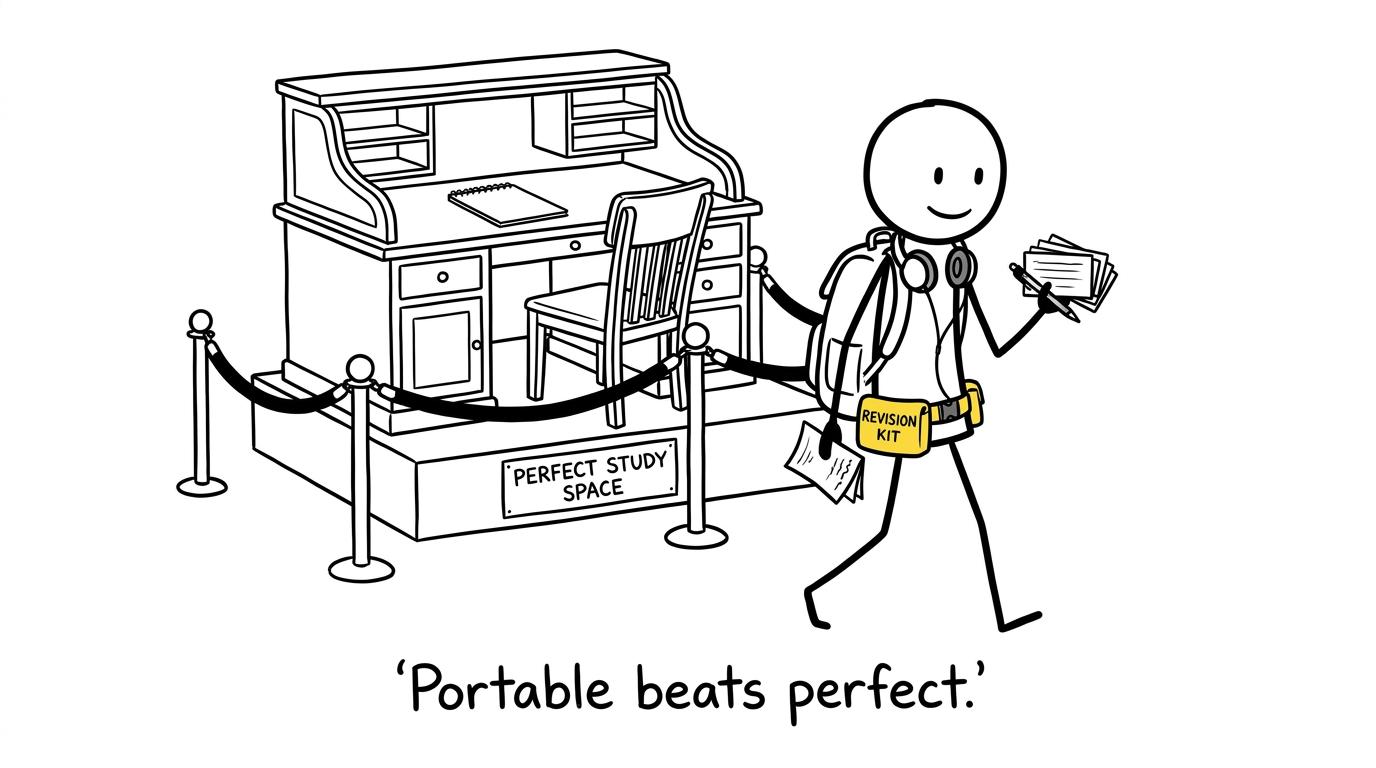 A portable revision kit defeating the mythical perfect desk
Organise the folder by your actual course rather than by vague headings. Label sections with the religions, beliefs, practices and ethical themes named in your specification. AQA students, for example, may study two religions alongside thematic material, while OCR, Edexcel and Eduqas courses have their own component structures and routes.
For every topic, create a compact retrieval sheet containing:
- essential vocabulary;
- central beliefs and teachings;
- short, accurate references to sources of authority;
- similarities and differences;
- effects on individuals or communities;
- contrasting or different viewpoints;
- possible lines of evaluation.
Do not turn this into a miniature textbook. Its purpose is to reveal what you can recall, not to store everything you have ever been taught.
Revise in short cycles that survive interruptions
Government exam-pressure guidance recommends breaking revision into manageable topics, setting time-limited targets, testing yourself and reviewing progress. That approach is especially useful when your home is unpredictable.
Try this flexible cycle:
Choose one outcome
Avoid “revise Christianity” or “do ethics”. Choose something you can finish, such as recalling the main teachings for one subtopic or planning one evaluation question.
Retrieve before checking
Close your book and write, say or sketch everything you remember. Then compare it with your notes. The uncomfortable gap between what felt familiar and what you could actually produce is valuable information.
Correct one weakness
Add the missing teaching, correct the confused definition or improve the link between evidence and argument. Keep a short list of recurring weaknesses rather than rewriting the whole page.
Retest later
Return to the same material on another day. A flashcard answered correctly once is not necessarily secure knowledge.
A session might last 151515 or 252525 minutes depending on your circumstances. There is no magical timer. The best length is one you can repeat while remaining focused, followed by a genuine short break.
Control the noise you can control
You may not be able to stop household noise, but you can reduce avoidable layers of distraction.
Put unnecessary notifications on silent or use a focus setting. If you use your phone for revision, open the resource before the session and close unrelated apps. Instrumental music, steady background sound or ear defenders may help some students, although others concentrate better without them. Test the effect on your recall rather than assuming a particular method works.
Keep safety and family communication in mind. Do not block all sound if you need to hear an alarm, a carer or something happening around you. Noise-cancelling equipment is a tool, not a requirement.
Sleep also deserves protection. NHS exam advice recommends a realistic schedule, regular breaks and asking for help when stress becomes difficult to manage. Late-night cramming may create extra minutes while weakening the attention you need the following day. Set a stopping time and treat rest as part of preparation.
Coordinate Religious Studies with maths revision
Students preparing for Religious Studies are usually balancing several GCSEs, including maths. The same noisy-home principle applies: use short sessions for recall and targeted practice, then reserve quieter periods for timed papers.
The free GCSE Maths revision hub lets you choose your exam board and find revision lessons, questions and papers without spending part of your focus time searching across different sites. If a full paper is unrealistic at home, use smaller topic sets or follow the approach in GCSE maths revision when you are stuck at a pass grade.
When quiet space is available, make it count. You could complete Religious Studies extended writing on one visit and a timed maths paper on the next. MathsGenie's guide to when to start GCSE past papers explains how to progress from mini tests and sections towards full papers.
Edexcel students can use GCSE Maths past papers with mark schemes, while the guide to using Edexcel past papers properly shows how marking should lead back to targeted practice. Near the exams, GCSE predicted papers can provide fresh maths practice, but they should supplement rather than replace official past papers.
The subjects differ, but the productive loop is similar: retrieve, attempt, mark, repair and retest.
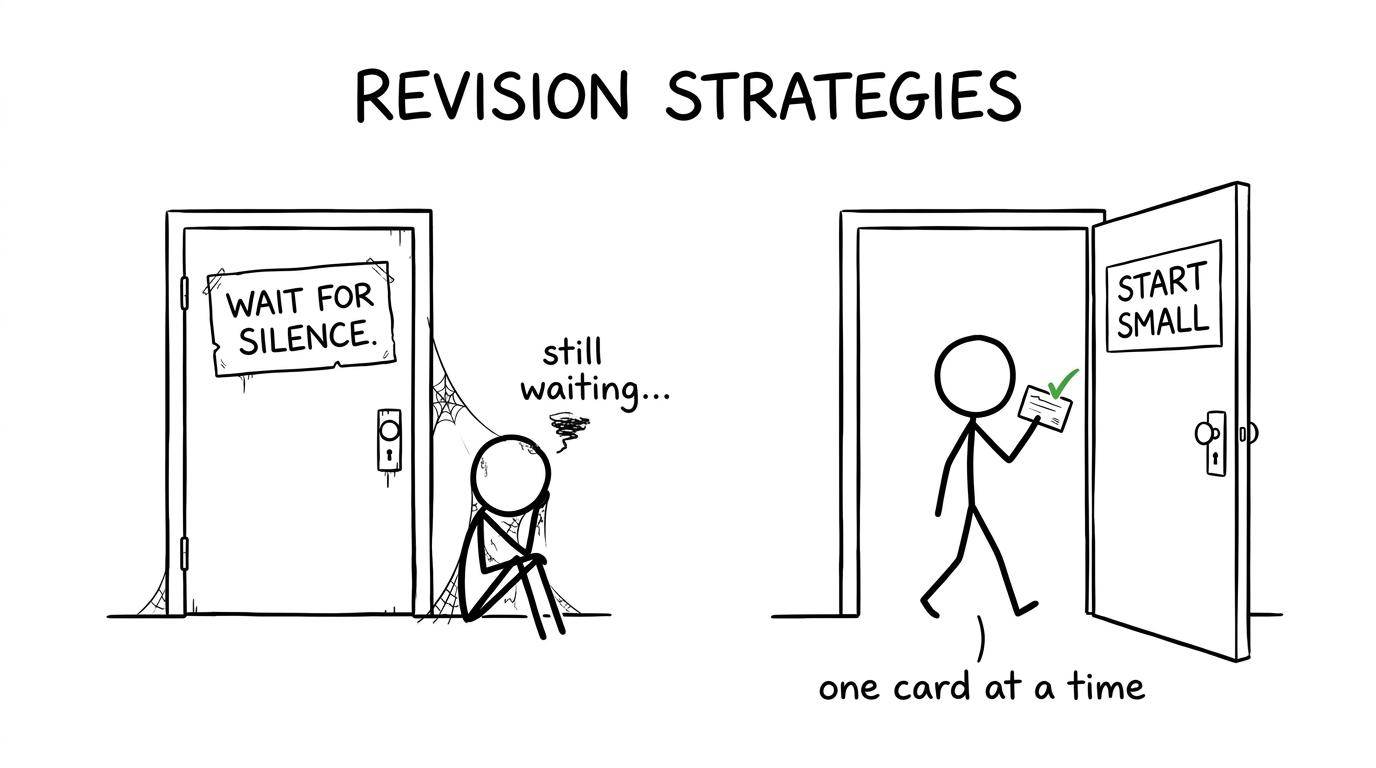 A student choosing to start small instead of waiting for silence
Common mistakes when revising without quiet space
Waiting until the house becomes silent
If silence is rare, waiting turns into avoidance. Begin with a noise-tolerant task and save demanding work for the quietest available slot.
Reading notes without retrieval
Reading can feel productive because the content looks familiar. Close the notes and produce the belief, teaching, reference or argument yourself. Recognition is not the same as recall.
Trying to cover an entire theme in one sitting
Large targets make interruptions feel disastrous. Divide each theme into knowledge, sources, viewpoints and exam questions, then complete one part at a time.
Learning quotations without understanding them
A remembered quotation is useful only when it is accurate, relevant and connected to the question. Learn what each source supports and how it may influence belief or practice. Follow your exam board's current requirements and mark schemes.
Using the same task in every environment
Flashcards may work in a busy kitchen; a timed evaluation probably will not. Match the task to the level of concentration available.
Treating lost time as a reason to give up
An interrupted session is not automatically wasted. Record where you stopped and choose the next small action. Restarting quickly is a skill of its own.
A quieter plan, even when life is noisy
The strongest revision plan is not the one with the neatest desk. It is the one that acknowledges your real home, your actual timetable and the interruptions you cannot control.
Make Religious Studies portable. Use active recall for beliefs, teachings and sources of authority. Practise AO2 evaluation when you have enough concentration to think carefully. Ask school about available space, investigate your local library and use short sessions rather than waiting for a perfect evening.
Then give the rest of your GCSE timetable the same structure. MathsGenie provides free GCSE Maths revision, practice questions, mini tests, past papers, predicted papers, mark schemes and video solutions. If an exam is close, the GCSE maths night-before plan can help you choose a calm, limited final session.
Choose one Religious Studies topic now. Set one small target. Begin with the space and time you have, not the space you wish you had.