Revise GCSE Chemistry: Can't Sit Still?
Revise GCSE Chemistry when you can't sit still using active study sprints, movement-based recall, exam questions and a realistic weekly revision plan.
The hardest part of revision is not always understanding the subject. Sometimes it is remaining in the chair long enough to begin.
If you have searched “revise gcse chemistry cant sit still”, the short answer is this: stop building your revision around long, silent sessions. Use brief active-recall tasks, move between them, mark your work immediately and revisit the same material on different days. Movement is not the enemy of learning. Unfocused activity is.
This matters for students preparing for maths exams too. GCSE Chemistry includes calculations involving ratios, percentages, standard form, graphs, formulae and proportional reasoning. Strengthening those skills can support marks across both subjects.
Your can't-sit-still revision checklist
Build each session around a small, visible outcome:
- Choose one Chemistry micro-topic, not an entire unit.
- Set a short timer that feels manageable.
- Retrieve information before opening your notes.
- Alternate sitting tasks with safe movement.
- Answer a small batch of exam-style questions.
- Check your answers using a mark scheme.
- Record one precise correction.
- Return to the topic after a gap.
The purpose is not to prove that you can concentrate for hours. It is to create a revision loop you can repeat.
Why short, active revision can work
There is an important difference between time spent near revision materials and time spent thinking.
Repeatedly reading a page may feel smooth because the information is already in front of you. Retrieval practice is harder: you close the book and try to recall the answer. Evidence reviewed by the Education Endowment Foundation supports purposeful retrieval, feedback and revisiting material after a delay. The attempt to remember is part of the learning.
That makes active recall well suited to restless revision. A useful task can be completed while standing at a whiteboard, pacing safely with flashcards or explaining a process aloud. What matters is that you must produce an answer before checking it.
Spacing matters as well. Several short encounters with electrolysis across a fortnight are generally more useful for long-term recall than one enormous evening followed by silence. Your revision does not have to look impressive. It has to return.
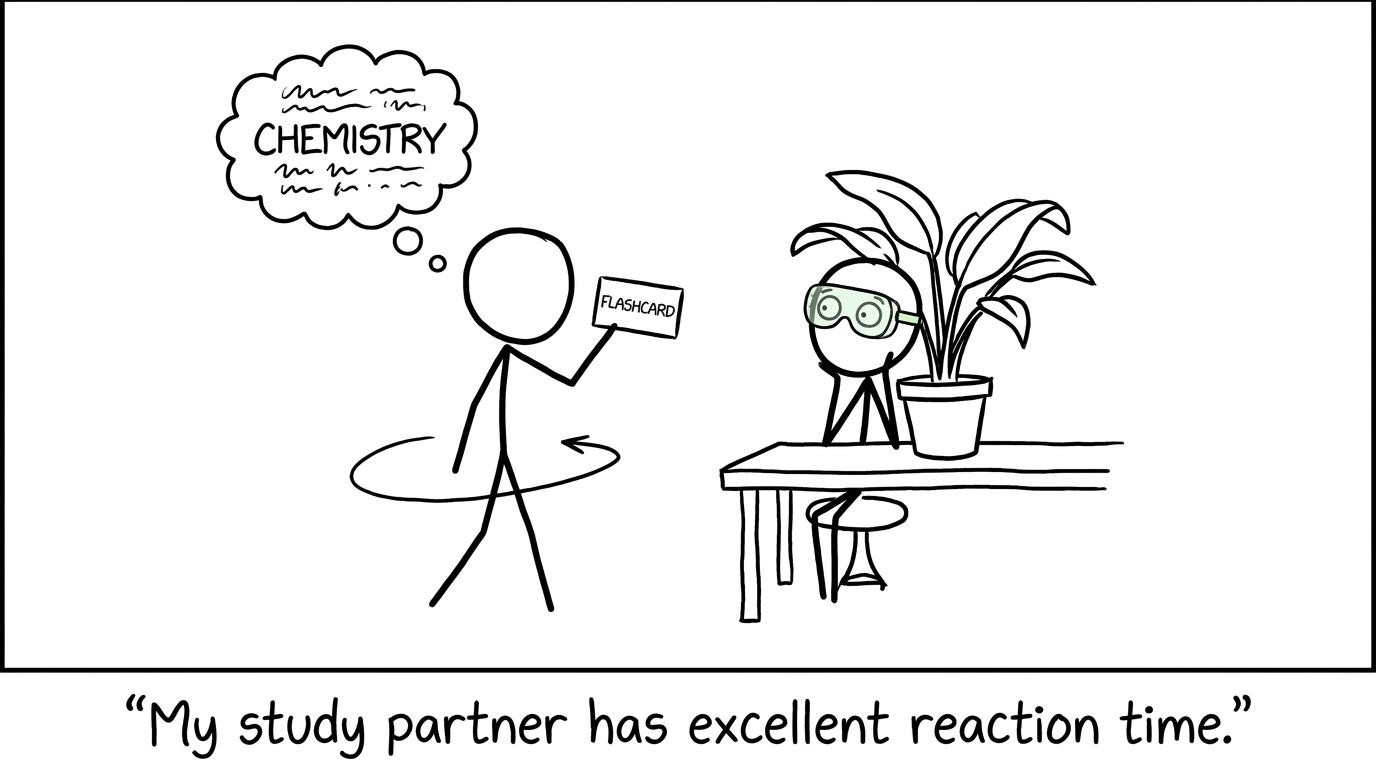 A student walking with Chemistry flashcards while a houseplant in safety goggles acts as a study partner
Build revision around movement, not against it
NHS guidance for young people recommends breaking up long periods of inactivity. That does not mean every Chemistry session should become a workout. It means you can design movement into the routine instead of waiting until restlessness ends the session.
Create revision stations
Place different tasks in different safe locations:
- flashcards at one end of the room;
- a blank sheet for blurting at a desk;
- exam questions at another surface;
- a mark scheme at the final station.
Move only when a task is complete. This gives movement a purpose and stops it becoming an escape route.
Walk and retrieve
Choose a short list of prompts and walk around a clear indoor space while answering aloud. Suitable prompts include definitions, observations from required practicals, ion tests, trends in the periodic table and cause-and-effect explanations.
Keep your phone away unless it is supplying the prompts. Do not walk beside roads while distracted, and do not attempt practical Chemistry activities at home merely to make revision more active. Required practical knowledge should be revised through your specification, school materials and exam questions; practical work itself belongs in an appropriately supervised setting.
Stand for explanations, sit for precision
Standing can work well when recalling facts or teaching a concept aloud. Sit down when you need careful calculations, graph work or extended exam answers. The aim is not constant movement. It is matching the physical setup to the type of thinking required.
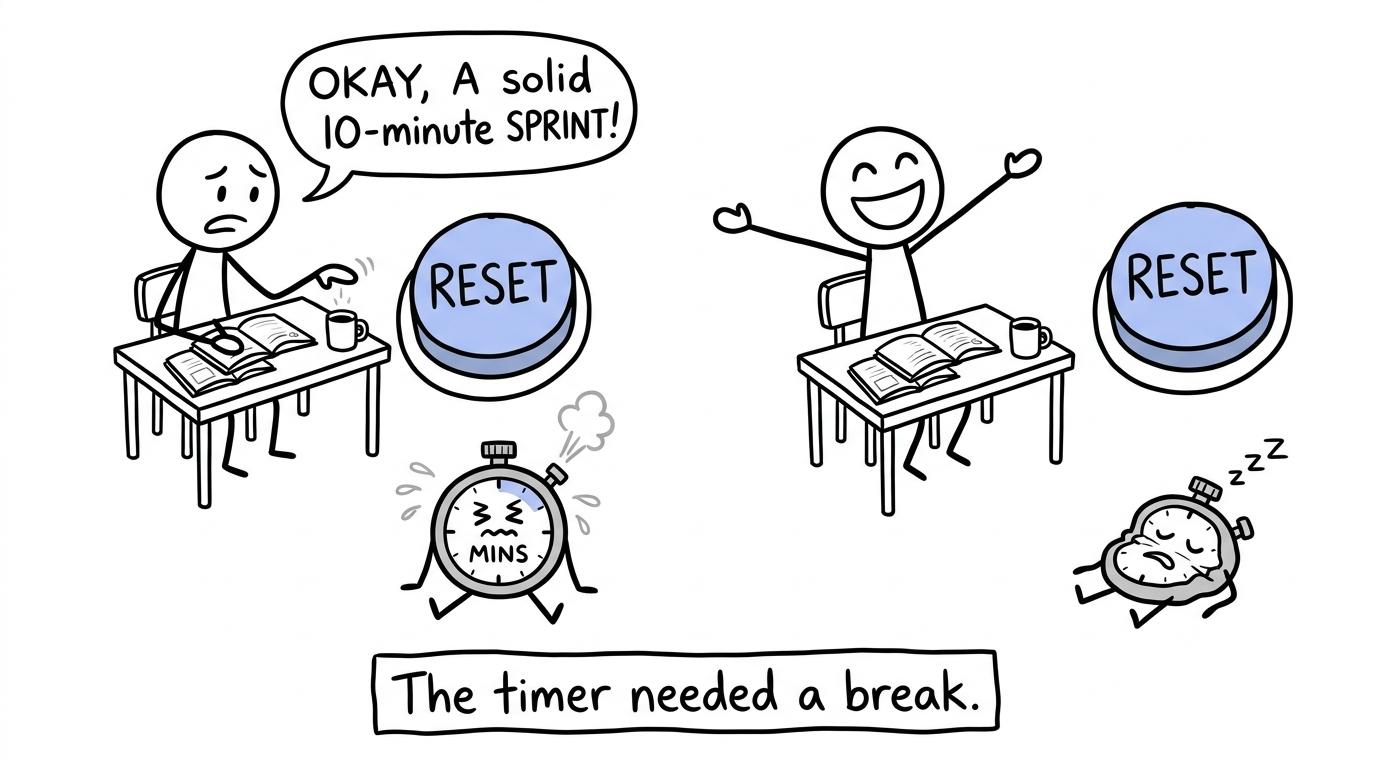 A GCSE student stretching after a short revision sprint while the timer looks exhausted
Use a revision sprint that produces evidence
A vague instruction such as “do Chemistry” creates friction. A sprint should tell you exactly what to do and when it is finished.
Try this sequence:
Retrieve
Spend a few minutes writing or saying everything you can remember about one narrow topic. Keep notes closed. A narrow topic might be ionic bonding, electrolysis, rates of reaction or one required practical.
Check
Compare your recall with reliable notes or a revision guide. Add what was missing and cross out anything inaccurate. Do not simply admire the correct answer. Name the gap.
Apply
Complete a small set of exam-style questions. The AQA GCSE Chemistry revision hub brings together lessons, questions and revision tools for foundation and higher tier students.
If you are taking Edexcel, OCR or Eduqas, use resources matched to that specification and your Combined Science or separate Chemistry route. Topic wording and required practical arrangements can differ, so check your board rather than borrowing a friend's list.
Mark and repair
Use the mark scheme immediately. For each lost mark, label the cause:
- missing knowledge;
- weak application;
- imprecise scientific language;
- calculation or unit error;
- misread command word.
Then write one action, such as “learn the test and positive result for this gas” or “practise converting units before using the formula”. Feedback keeps retrieval from reinforcing an incorrect idea.
Move, reset and return
Take a brief movement break, then either begin a different micro-topic or stop. Add the original topic to your planner for another day. The timer is a boundary, not a test of character.
Turn Chemistry calculations into movement-friendly mini tasks
Official GCSE Chemistry specifications assess mathematical skills alongside scientific knowledge. Depending on the board and topic, these can include ratios, fractions, percentages, significant figures, standard form, formula substitution, graphs, gradients and proportional reasoning.
This is useful if you are also preparing for GCSE Maths: one short skills block can serve both subjects.
Use the GCSE Maths revision hub to identify a weak method, then practise it separately from the Chemistry context. Particularly useful areas include:
- writing and simplifying ratio for reacting quantities;
- standard form revision for very large or small values;
- changing the subject of a formula when the required variable is not isolated;
- direct and inverse proportion for understanding how quantities change together.
Keep each calculation card small: one skill, a handful of questions, immediate checking. The purpose is fluency, not endurance.
When you return to a Chemistry question, write the formula, substitute with units, calculate and check whether the answer is sensible. A correct calculator display can still lose marks if the setup, unit or required rounding is wrong.
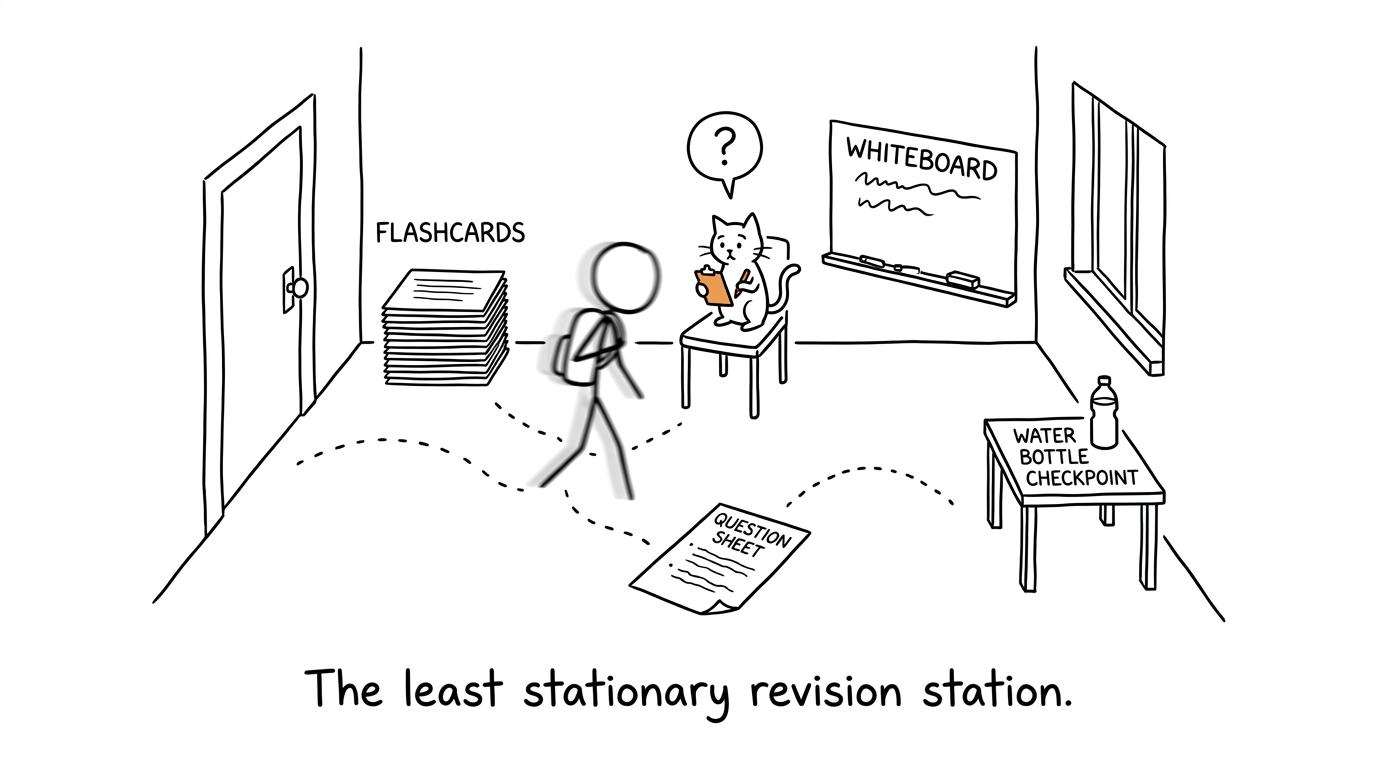 Four movement-based revision stations watched by a cat acting as an invigilator
Make past papers manageable without avoiding exam stamina
Short revision is excellent for building knowledge, but the final exam still requires sustained attention. Build towards that gradually rather than beginning with a full paper and deciding you are incapable of doing one.
Start with individual questions. Progress to a timed page, then a section, then a complete paper under the correct conditions. The guide to using AQA Chemistry past papers explains how to turn lost marks into specific skills to revisit.
For the mathematical side, GCSE Maths past-paper guidance can help you move from mini tests to timed papers. Mark schemes and video solutions matter because practice without correction can make the same error feel familiar.
During a full paper, movement has to become smaller and less disruptive. Practise putting both feet firmly on the floor, changing posture briefly, pausing for one controlled breath and then returning to the next command word. If concentration or restlessness regularly affects lessons and exams, speak to a teacher, parent, carer or your school's pastoral or special educational needs team. They can discuss support without requiring you to diagnose the cause yourself.
Common mistakes when revising Chemistry this way
Making every break open-ended
A movement break should have a boundary. Decide what you will do and when you will return before leaving the task.
Turning flashcards into reading cards
Say or write the answer before turning the card over. Recognition is not the same as recall.
Revising broad chapter names
“Organic Chemistry” is too large for one sprint. Choose one process, definition, practical method or question type.
Avoiding extended answers and calculations
Movement-based recall is useful, but it cannot replace written application. Include graph work, calculations and longer explanations in your weekly plan.
Marking only with ticks and crosses
A cross identifies a problem but does not repair it. Record why the mark was lost and what you will practise next.
Using predicted papers as predictions
Predicted papers can provide fresh exam-style practice, but they cannot tell you exactly what will appear. Use official past papers for authentic assessment material and predicted papers as an additional rehearsal tool.
A revision routine you can repeat
Good revision is often less dramatic than students expect. It is a small loop: retrieve, check, apply, mark, move and return.
If sitting still for long periods genuinely does not suit you, do not build your plan around becoming a different person overnight. Build a system that channels movement while protecting the parts that make revision effective: active recall, exam practice, feedback and spaced returns.
Start with the free MathsGenie GCSE revision resources. Use revision lessons to repair weak methods, practice questions and mini tests for short focused sessions, then progress to past papers and predicted papers. Mark your work carefully and use mark schemes or video solutions to turn each error into a next step.
You do not need a heroic evening. You need one useful sprint today, followed by another on the right day.