

Revise GCSE Art and Design Alone or With Others?
Revise GCSE Art and Design alone or with others using a practical hybrid plan for feedback, focused making, portfolio review and balanced maths revision.
You open your sketchbook intending to improve one page. An hour later, you are still deciding whether the background should be darker. Meanwhile, the maths paper on your desk has not moved.
If you are wondering whether it is better to revise GCSE Art and Design alone or with others, the practical answer is: use both, but for different jobs. Work alone when you need concentration, honest self-assessment or sustained practical making. Work with a small, purposeful group when you need fresh interpretations, constructive feedback or help explaining the development of an idea.
The strongest approach is not choosing a permanent side. It is matching the revision setting to the task.
The quick decision checklist
Choose solo revision for:
- focused drawing, photography, design or practical experimentation;
- reviewing your portfolio against the assessment objectives;
- writing annotations in your own voice;
- planning a personal response;
- practising sustained concentration;
- protecting time for maths and other GCSE subjects.
Choose revision with others for:
- discussing artists, designers, craftspeople and sources;
- testing whether your intentions are visually clear;
- receiving specific feedback on composition or development;
- comparing interpretations of an externally set starting point;
- checking whether your annotation explains decisions rather than merely describing materials.
Avoid group revision when it becomes shared procrastination, copying or an attempt to produce one collective interpretation. GCSE Art and Design assesses your own creative journey and personal response.
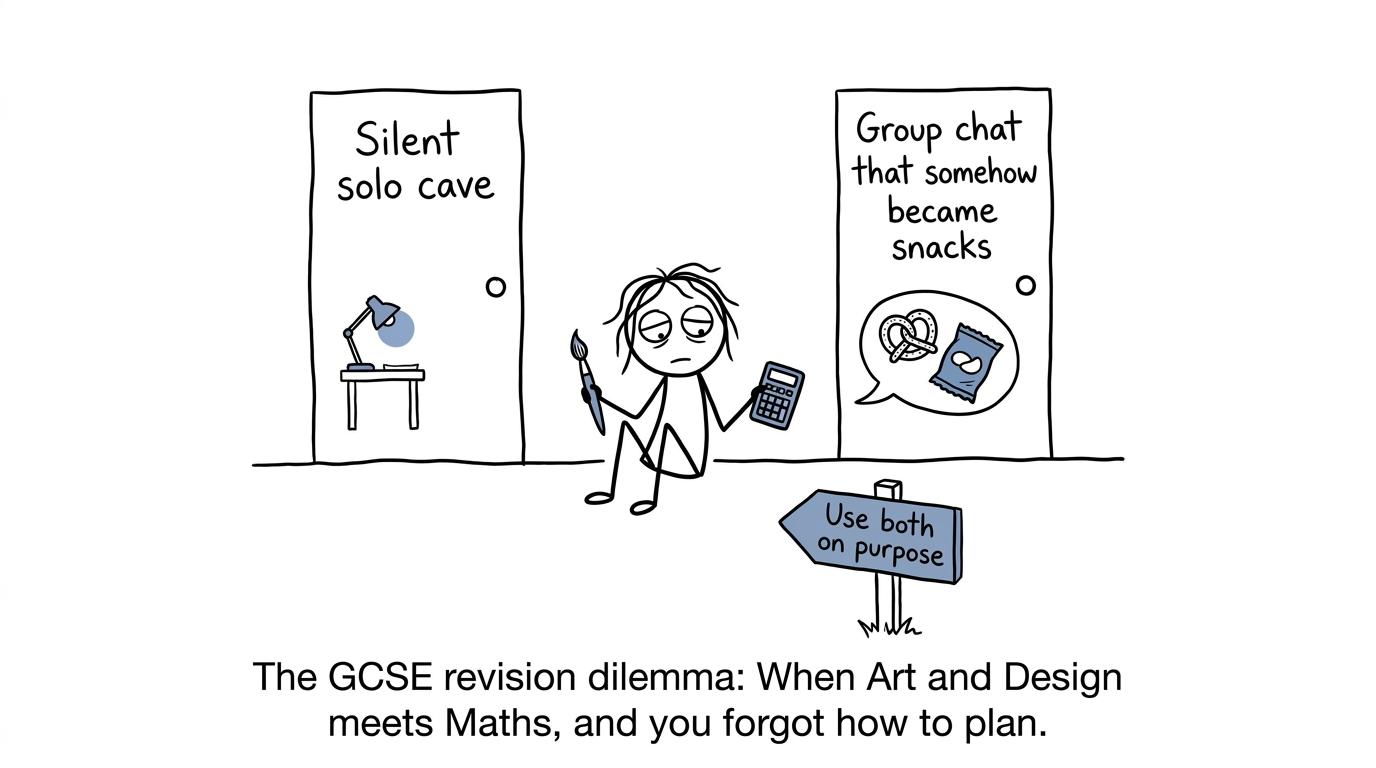 A GCSE student choosing between a silent solo cave, a distracting group and a sensible hybrid approach
What GCSE Art and Design revision really involves
Art revision can feel difficult to define because it rarely resembles memorising formulae. You are not simply learning facts for a written paper. You are improving the evidence of a creative process: investigation, experimentation, recording, refinement and presentation.
Across the current AQA, Pearson Edexcel, OCR and Eduqas specifications, GCSE Art and Design is built around a portfolio component and an externally set component. In the standard GCSE specifications, the portfolio contributes 60%60\%60% and the externally set assignment or task contributes 40%40\%40%. The externally set component includes a preparatory period followed by ten hours of supervised sustained work, although you must follow the precise instructions given by your school and exam board.
The four assessment objectives broadly ask you to:
- AO1: develop ideas through investigations and show critical understanding of sources;
- AO2: refine work by experimenting with suitable media, materials, techniques and processes;
- AO3: record ideas, observations and insights as work develops;
- AO4: present a personal and meaningful response that realises your intentions.
Each objective contributes 25%25\%25% overall. That matters because a polished final piece cannot quietly compensate for missing investigation, experimentation or recording. Revision should inspect the whole journey, not just the final outcome.
When revising GCSE Art and Design alone works best
Developing a genuinely personal response
Other people can prompt your thinking, but they cannot supply your intentions. Quiet individual work is particularly valuable when you are deciding what interests you about a theme, selecting imagery or connecting source material to your own ideas.
Ask yourself:
- What am I trying to communicate?
- Which visual decisions support that intention?
- How has the work changed because of my investigation?
- What should I test before committing to an outcome?
Writing these answers independently makes it easier to notice whether the project is yours or whether it has drifted towards somebody else’s aesthetic.
Sustained practical making
Drawing, editing photographs, refining a composition and testing materials often require uninterrupted attention. Conversation can be helpful before or after the task, but not necessarily during it.
Solo sessions also rehearse the independence required during supervised work. Exam-board rules restrict assistance during this period, so your preparation needs to leave you ready to make decisions without relying on a friend beside you. Always follow your teacher’s instructions about permitted preparatory material, equipment and conduct.
Auditing your portfolio
A quiet portfolio audit is one of the most useful forms of Art revision. Label each page or piece of evidence by the assessment objective it supports. Look for gaps rather than decorating pages that are already convincing.
This resembles diagnosing weaknesses in maths. A student may enjoy practising familiar algebra while avoiding probability; similarly, an Art student may keep polishing outcomes while neglecting source analysis. MathsGenie’s guide to finding your weakest GCSE topics explains the same evidence-led principle for maths revision: identify the gap, repair it and check again.
When revising with others adds more value
Interpreting sources and starting points
A productive discussion can reveal assumptions you did not know you had. Two students may see completely different possibilities in the same word, object or image. That contrast can widen your investigation without dictating what your final response should be.
Keep the conversation exploratory. Discuss context, visual language, possible materials and questions raised by a source. Then separate and record your own conclusions.
Receiving constructive critique
It is hard to judge work you have looked at for weeks. A classmate may notice that an intended focal point is unclear, that one experiment has greater potential than the others, or that an annotation does not explain why a decision was made.
Useful critique is specific and connected to intention. Instead of saying, “I don’t like the colour,” a reviewer might ask, “Does this colour create the mood you described?” The second response gives you something to evaluate without taking ownership of the decision.
A good group critique has simple rules:
- limit the group to a few focused people;
- let the artist explain the intention first;
- ask questions before offering solutions;
- connect comments to development, refinement or communication;
- finish with one or two actions chosen by the artist.
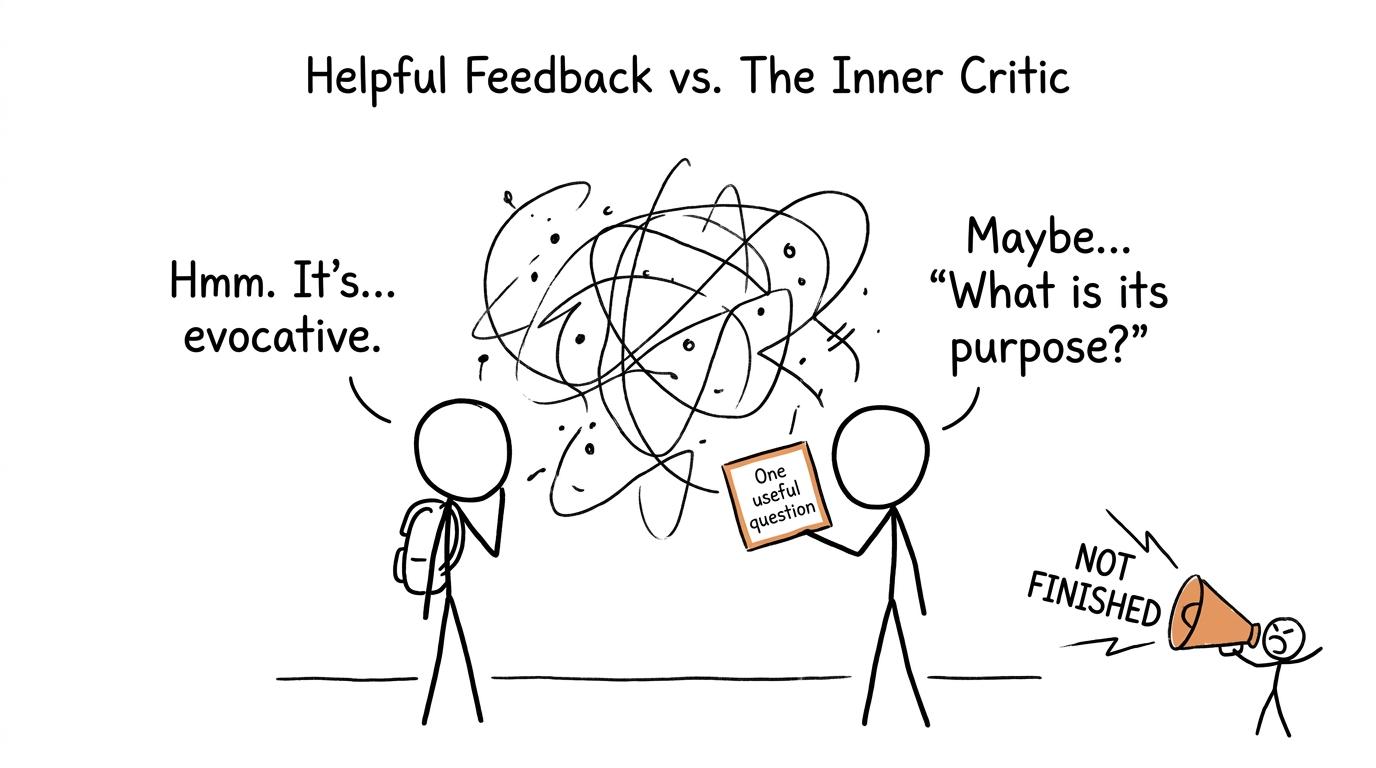 Two GCSE students offer useful critique while an oversized inner critic complains through a megaphone
Explaining your decisions aloud
If you cannot explain why you changed a material, composition or technique, your written annotation may also be too descriptive. Talking through a page can expose weak reasoning quickly.
The benefit comes from articulating your thinking, not from copying somebody else’s wording. After the discussion, close the conversation and write independently. Your annotations should sound like you and accurately reflect your process.
Which approach suits each Art and Design task?
| Revision task | Best setting | Why |
|---|---|---|
| Initial interpretation of a broad theme | Short group discussion, then solo reflection | Other viewpoints create possibilities, while the final direction remains personal. |
| Artist or designer research | Mainly solo, with occasional discussion | Independent research supports authentic decisions; discussion can test understanding. |
| Media and material experiments | Solo or alongside a focused peer | Concentration matters, but comparing technical observations can help. |
| Composition planning | Solo first, then critique | You need your own options before outside feedback becomes useful. |
| Annotation | Discuss ideas, then write alone | Conversation clarifies thinking, but the written explanation must be authentic. |
| Portfolio audit | Solo review, followed by teacher guidance | Self-assessment reveals gaps; your teacher can clarify specification requirements. |
| Preparation for sustained supervised work | Mostly solo | You need confidence making independent decisions under the required conditions. |
| Final review of visual communication | Small critique group | Fresh eyes can test whether your intended meaning is visible. |
A hybrid revision routine that protects maths time
Art can expand to fill every available evening because practical work rarely announces that it is finished. Maths has the opposite danger: it can be postponed because there is always another sketchbook page to improve.
Give each session a defined output. An Art target might be to compare three composition options, complete one material test or audit evidence for one assessment objective. “Do Art” is not a usable target.
A balanced week could contain:
- one short collaborative Art critique;
- two focused solo Art sessions;
- several shorter maths sessions built around questions and feedback;
- one review point where you adjust the next week.
For busy school days, the twenty-minute GCSE maths revision routine helps you keep mathematical fluency moving while coursework deadlines are close. For a wider structure, use the GCSE one-month maths revision plan.
The key is to make progress visible. In Art, record what you investigated, changed or resolved. In maths, complete questions, mark them and log the exact error. The GCSE Maths revision hub brings together free revision lessons, topic practice and exam resources, so you do not lose valuable time searching.
How to make group revision genuinely productive
Arrange the session before you meet. Choose one purpose, such as reviewing AO2 experiments or testing whether each person’s intentions are clear. Bring only the relevant work and set an end time.
Do not turn critique into a ranking exercise. Another student’s technical style, media choice or amount of work does not automatically make it appropriate for your project. The question is whether your evidence shows thoughtful development against the assessment objectives.
Then finish alone. Write down the feedback you accept, the feedback you reject and your reason for each choice. That final judgement converts conversation into independent learning.
The same discipline improves maths group sessions. Attempt questions independently first, compare methods afterwards and verify conclusions using reliable solutions. MathsGenie’s guide to using GCSE mark schemes as a revision coach shows how feedback should lead to a specific correction rather than a vague sense of being wrong.
Common mistakes when choosing how to revise
Working alone without seeking any feedback
Independence is valuable, but complete isolation can hide unclear intentions and missing evidence. Build in occasional teacher or peer review before deadlines become urgent.
Treating group revision as social time
A pleasant conversation is not automatically useful revision. Decide what will be reviewed, how long each person receives and what action should follow.
Copying another student’s direction
Shared research does not justify shared outcomes. Use discussion to generate questions, then pursue your own investigation and acknowledge sources appropriately.
Spending all revision time improving the final piece
A final outcome is only part of the assessed journey. Check whether your investigation, experimentation, recording and refinement make the development visible.
Allowing Art to replace maths practice
Coursework urgency can crowd out subjects with later examinations. Protect recurring maths slots, even when they are short. Use Edexcel GCSE Maths past papers for realistic practice and GCSE predicted papers nearer the examination. Mark schemes and video solutions turn each attempt into a clear next step.
Choose the setting, not a side
The best way to revise GCSE Art and Design is usually a deliberate mixture: other people help you see; solitude helps you decide. Use discussion for interpretation, questions and critique. Use independent time for personal development, practical concentration, annotation and preparation for supervised work.
Then protect the rest of your GCSE timetable. Open MathsGenie, choose the revision lesson that matches your weakest skill, complete the practice questions and test the improvement with mini tests, past papers or predicted papers. Mark your work carefully and use the video solutions when a method remains unclear.
Good revision is not about being alone or surrounded by people. It is about knowing what the next task requires and creating the conditions in which you can do it properly.










