Review Mock Mistakes GCSE Engineering: When?
Review mock mistakes GCSE Engineering with a practical timing plan: capture errors today, repair them tomorrow, then retest for stronger recall and marks.
A mock paper can feel unusually personal. You remember the questions you nearly solved, the unit conversion you noticed too late and the calculation that seemed right until the mark scheme disagreed. The natural reaction is often one of two extremes: inspect every mistake immediately, or close the paper and avoid it for several days.
If you searched review mock mistakes GCSE Engineering, the useful answer is this: record your errors on the same day, complete the detailed repair when you are calm, and retest the underlying skills after a short gap. Waiting can help you return with clearer judgement, but leaving the paper untouched for several days usually costs you useful detail and fewer opportunities to correct the problem.
The best approach is not purely immediate or delayed. It is a deliberate sequence.
The quick review checklist
Use this routine after a GCSE Engineering or maths mock:
- Same day: record every lost mark and classify the reason.
- After a short break: check the mark scheme and identify the expected method.
- Next day: repair the underlying maths or engineering knowledge.
- Within about 484848 hours: answer fresh questions on the same skill without notes.
- About one week later: revisit the error through a mini test or mixed paper.
This reflects the central lesson from current feedback research: there is no single ideal delay for every pupil and every task. Immediate feedback can stop misconceptions becoming established, while a delay can encourage effortful retrieval. What matters most is whether the feedback is specific, arrives in time to be used and leads to another attempt.
MathsGenie's guide to finding your weakest GCSE topics can help you turn a marked paper into a manageable revision list rather than a vague feeling that everything needs work.
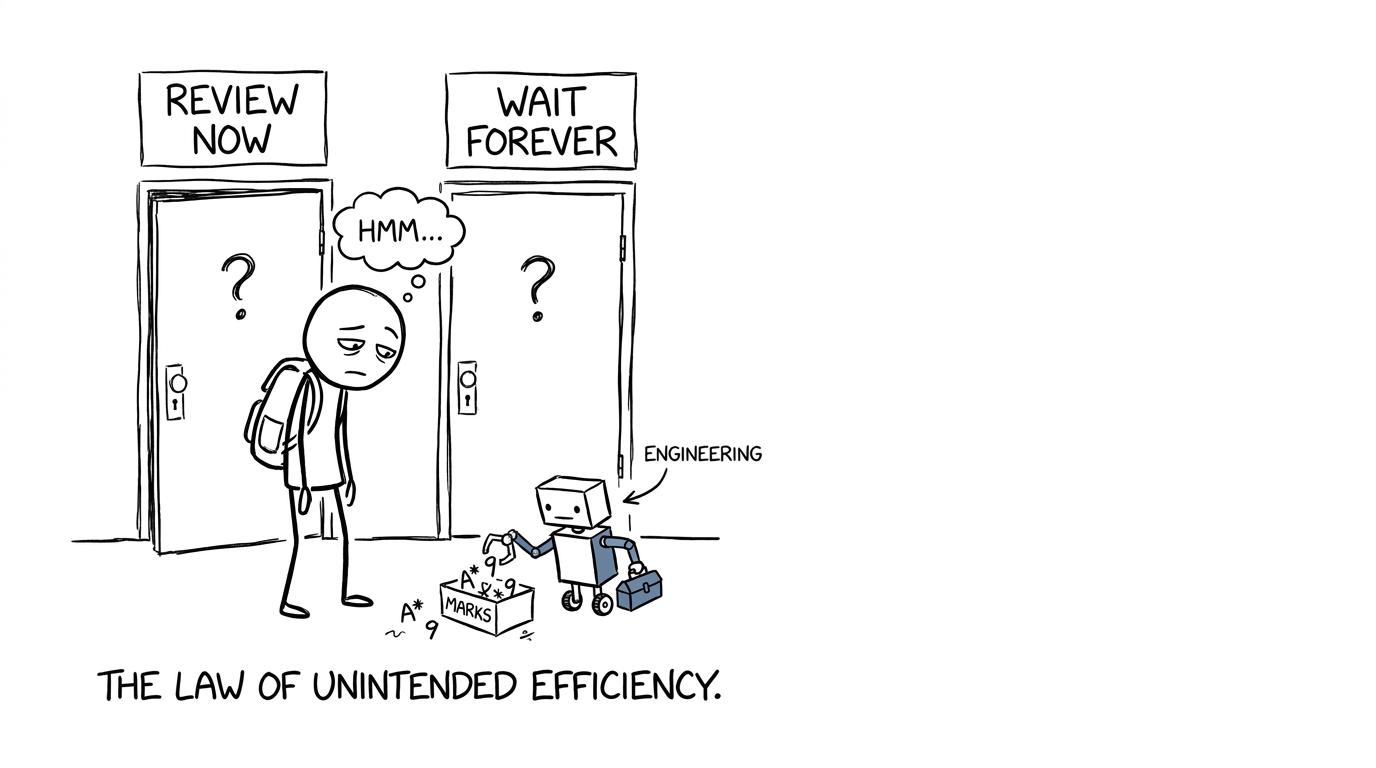 A GCSE student hesitates while a tiny robot steals loose exam marks
Why an immediate first review matters
Your memory of the attempt fades quickly. Straight after the mock, you can still remember whether you guessed, rushed, misunderstood the wording or simply ran out of time. A mark scheme cannot reveal all of that.
Suppose an engineering calculation involving density is wrong. The final answer alone does not tell you whether you:
- forgot the relationship ρ=mV\rho = \frac{m}{V}ρ=Vm;
- substituted into it incorrectly;
- used inconsistent units;
- rounded too early;
- entered the calculation incorrectly;
- or understood everything but misread what the question required.
Those are different problems. They require different repairs.
An immediate review should therefore be short and diagnostic. Add a label beside each lost mark:
- Knowledge: I did not know the fact, equation or engineering principle.
- Method: I knew the topic but could not organise the steps.
- Maths: algebra, ratio, graph work, units or calculation caused the error.
- Reading: I answered a different question from the one asked.
- Accuracy: signs, copying, rounding or calculator input went wrong.
- Timing: I could have answered but did not reach or finish the question.
Do this before looking deeply at the solution. You are capturing evidence, not trying to relearn the entire course while tired.
Why a short delay can improve the deeper review
Reviewing immediately has one weakness: recognition can masquerade as understanding. With the paper and mark scheme open, a solution may seem obvious because every prompt is still visible.
A short delay removes some of those prompts. When you return the next day, try to reconstruct the method before reading the solution. That retrieval attempt tells you more than rereading does. If you cannot recall how to begin, the gap is still real.
A delay also gives the emotion of the mock time to settle. Feedback is difficult to use when every correction feels like a judgement. The paper is more useful when you can see it as data: a record of what your current method produced under particular conditions.
However, “wait” should mean a planned pause, not indefinite avoidance. Put the repair session into a timetable. MathsGenie's GCSE maths revision timetable guide shows how to combine focused topic work with timed practice and review.
What waiting several days actually costs
There is no honest formula that converts a delay into an exact number of lost marks. The cost depends on the student, the question and what happens during the gap. Still, an unnecessary delay carries four practical costs.
You lose diagnostic detail
After several days, “I rushed because I spent too long on the graph” can become “careless mistake”. That label is too vague to change future behaviour.
Incorrect methods remain available
If you repeatedly think about the same incorrect relationship or calculation method without correction, familiarity can make it feel trustworthy. Early checking is particularly valuable where units, formula selection or algebraic rearrangement are involved.
You reduce the number of repair cycles
A mock is valuable because it can begin a sequence:
attempt→feedback→repair→retest\text{attempt} \rightarrow \text{feedback} \rightarrow \text{repair} \rightarrow \text{retest}attempt→feedback→repair→retestDelay the first useful review and there is less time for the later stages before the real examination.
Your next revision session becomes less focused
Without an error log, students often return to comfortable topics. A marked mock should decide what comes next. The MathsGenie GCSE maths revision hub provides revision lessons, question banks, worksheets and paper practice across the main exam boards, so each identified weakness can become a specific action.
How to review mock mistakes in GCSE Engineering
GCSE Engineering questions often place mathematical skills inside unfamiliar or practical contexts. In the current AQA specification, for example, mathematical understanding is integrated into engineering content. Relevant skills include ratios and percentages, unit conversion, significant figures, algebra, graphs, area, volume, density, pressure, Pythagoras and trigonometry. Other engineering or technical qualifications have their own structures, so always follow your specification and teacher's guidance.
The context matters. A student may perform a calculation successfully in GCSE Maths but struggle when the same skill is hidden inside material testing, production planning or systems data. That is not necessarily a completely new maths gap. It may be an application gap.
Use three questions for every calculation mistake:
- Could I identify the required mathematical skill?
- Could I carry out that skill accurately?
- Could I interpret the result in the engineering context?
For compound measures, revisit MathsGenie's speed and density revision guide. If changing the subject of an equation caused the difficulty, use the rearranging formulae lesson. Scale factors and three-dimensional design contexts can be reinforced through similar shapes, area and volume revision.
These resources are for repairing the mathematical component. Your engineering specification, class materials and teacher feedback remain essential for subject-specific terminology, processes and extended responses.
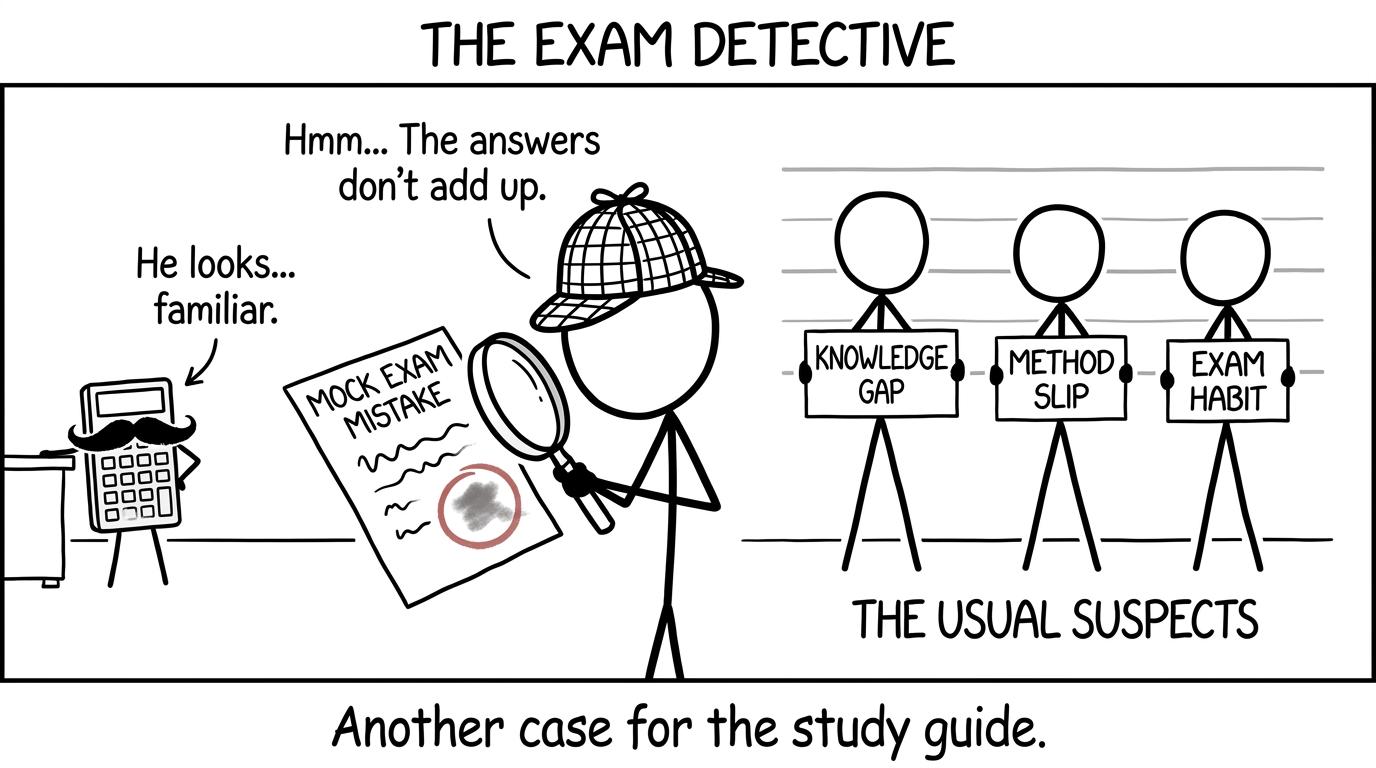 A student detective interviews three suspicious causes of mock errors
A practical three-stage review routine
Capture the evidence on the same day
Record the question, topic, marks lost and cause. Keep the note precise. “Units not converted before substitution” is actionable; “silly mistake” is not.
Also record successful answers that felt uncertain. Effective feedback is not only about errors. If a method worked but relied on guessing, it deserves checking before the next paper.
Repair one underlying weakness at a time
On the following day, cover the solution and attempt the question again. If you still cannot begin, use a short revision lesson or video solution. Then complete fresh practice questions rather than copying the original answer.
Choose a narrow skill. “Engineering calculations” is too broad. “Converting volume units before using density” gives you something you can practise and measure.
Retest without the original cues
Use a different question, ideally in a different context. If the only question you can answer is the one whose solution you have just read, the repair is not secure.
Short tests make this manageable. The Edexcel GCSE Maths mini tests provide focused timed practice, while the broader MathsGenie hub lets you select resources suited to your board and tier. The mathematical principles also transfer to engineering calculations even when the wording and assessment context differ.
How to use the mark scheme properly
A mark scheme is not merely an answer sheet. It shows which stages receive credit, which notation is accepted and where accuracy is required.
Compare it with your working and ask:
- Where was the first meaningful difference?
- Did I choose the wrong method or execute the right method badly?
- Was working required to access method marks?
- Did my final value have appropriate units and precision?
- What single instruction would prevent this error next time?
Write that instruction in your error log. Then close the mark scheme and reattempt the task.
As exams approach, use GCSE past-paper timing guidance to decide when to move from topic repairs into full timed papers. Predicted papers can sharpen final preparation, but they are most useful after identified weaknesses have been addressed.
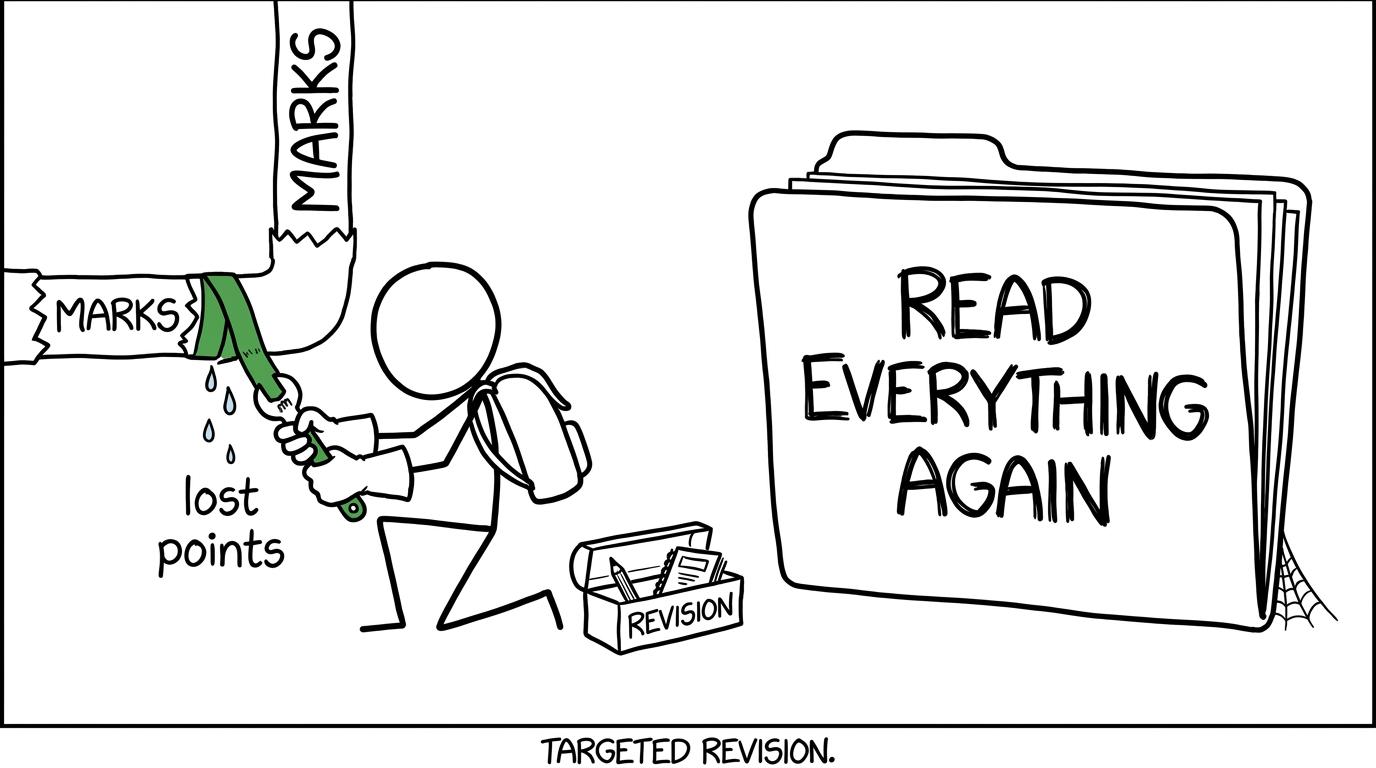 A student repairs a leaking marks pipe with a small revision toolkit
Common mistakes when reviewing a mock
Waiting until the score feels less disappointing
A brief emotional reset is sensible. An open-ended delay is not. Decide exactly when the review will happen before putting the paper away.
Correcting answers without identifying causes
Writing the model answer beside your own work creates a tidy paper, not necessarily better understanding. Classify the failure first.
Calling every accuracy error careless
Repeated calculator slips, missing units or premature rounding are habits. A habit deserves a checking routine, not a dismissive label.
Rereading instead of attempting
Solutions feel easier when visible. Cover them, retrieve the method and answer a fresh question.
Revising the whole topic after one narrow error
Broad revision can waste time. Repair the smallest skill that explains the lost marks, then test it in context.
Ignoring timing and question interpretation
Knowledge is only one part of exam performance. Record questions you abandoned, misunderstood or spent too long answering. Those patterns need timed practice rather than another page of notes.
The best answer is a sequence, not a deadline
You do not need to choose between reviewing every detail immediately and waiting several days. Use the strengths of both approaches.
Capture the evidence while the experience is fresh. Pause long enough to return calmly. Repair the weakness through active practice. Retest after a gap. Then revisit it inside a mixed paper.
That sequence turns a mock from a verdict into a design test. The purpose is not to admire the mark or fear it. It is to locate the part that failed, change it and test the improved version.
Start with the free MathsGenie GCSE revision resources. Use revision lessons and video solutions to rebuild methods, practice questions and mark schemes to correct errors, mini tests to check individual skills, and past papers or predicted papers to see whether the repair survives exam conditions. Your mock has already shown you where to begin. The next step is to use that evidence while it can still change the outcome.