

Review Mock Mistakes GCSE Computer Science: When?
Review mock mistakes GCSE Computer Science straight away or wait? Learn the best mark-fix-retest routine and what delaying feedback can cost.
A mock paper can feel unusually heavy once it has been marked. The score is visible, every mistake appears permanent, and the easiest response is to close the booklet and promise to look tomorrow.
If you are deciding when to review mock mistakes GCSE Computer Science, the best practical answer is this: identify and begin correcting mistakes on the same day you receive useful feedback, then retest yourself after a short gap. Waiting a few hours to regain perspective can help. Leaving the paper untouched for several days usually cannot.
The same principle is especially valuable for GCSE maths. A mock is not simply a forecast of your grade. It is a map of where marks are leaking, through missing knowledge, weak methods, inaccurate execution or exam pressure. The sooner that evidence becomes an action, the more useful the mock becomes.
The short answer: repair now, retrieve later
Use this checklist whenever a marked mock is returned:
- Capture mistakes immediately: record the topic, marks lost and likely cause.
- Check the feedback carefully: use the mark scheme, teacher comments or a video solution.
- Correct important misconceptions that day: do not repeatedly rehearse an incorrect rule.
- Avoid copying complete answers without thinking: reconstruct the method yourself.
- Retest the same skill later: return the next day and again later in the week without notes.
- Turn patterns into a revision plan: prioritise repeated or high-cost errors.
This is not really a choice between immediate and delayed review. The strongest routine uses both for different purposes. Immediate correction protects accuracy; delayed retrieval checks whether the correction has lasted.
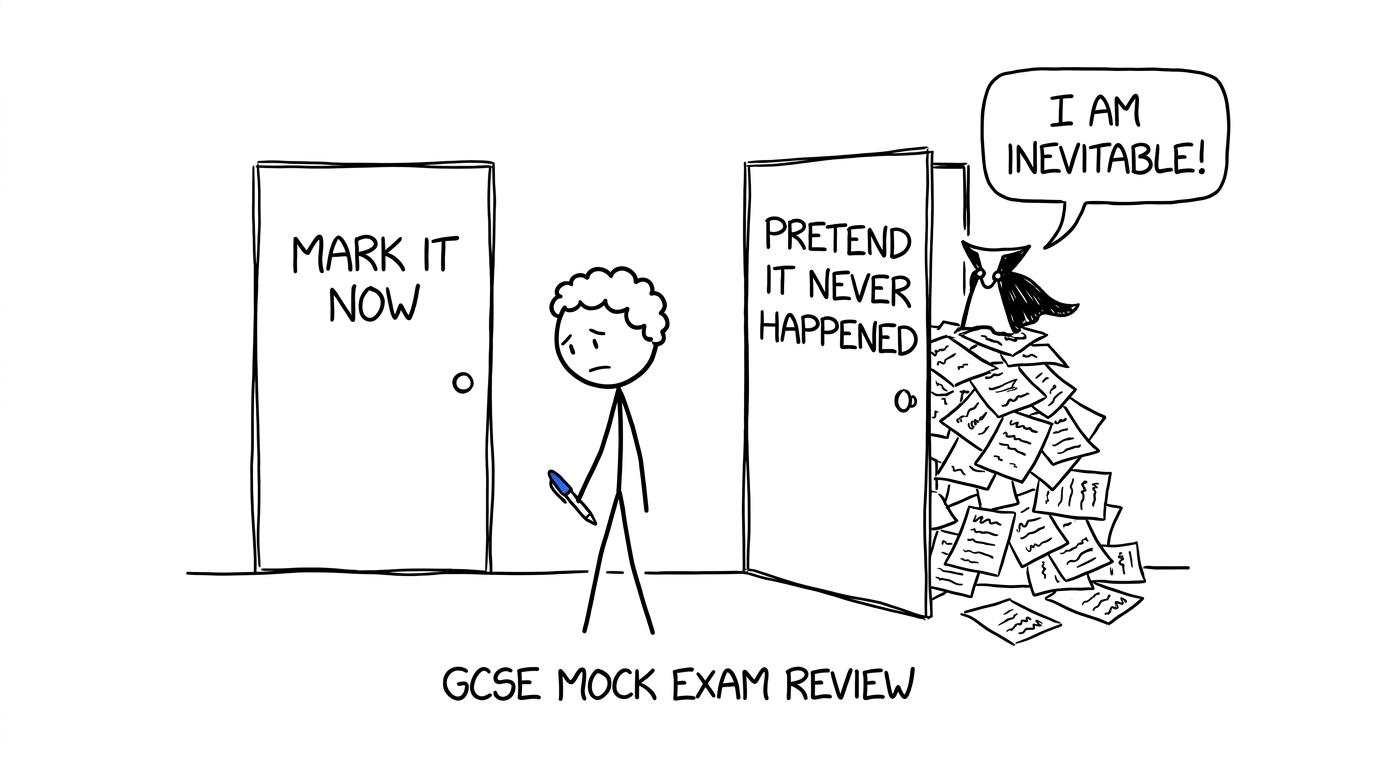 A student choosing between marking a mock now and hiding it behind a door
What research says about feedback timing
Research does not support one rigid feedback time for every learner and task. Education Endowment Foundation guidance explains that feedback can be effective during learning, immediately afterwards or after a short delay. It recommends choosing the timing according to the task, the pupil and what the feedback needs to achieve.
That distinction matters. Immediate feedback may stop a misconception becoming familiar. A short delay, meanwhile, can require you to retrieve the method rather than merely recognise the answer in front of you. Research on retrieval practice also consistently supports the value of attempting to recall information, receiving feedback and revisiting it over time.
For mock revision, this suggests a two-stage approach:
- Immediate diagnosis and correction while you can still remember your decisions.
- Delayed, closed-book reattempts to test durable understanding.
The purpose of feedback is not to make a page look corrected. It is to change what you can do next time. A useful review therefore ends with another attempt, not a coloured collection of ticks and crosses.
What waiting a few days actually costs
A delay does not erase all learning. Reviewing later is still far better than never returning to the paper. But an unnecessary delay creates several practical costs.
You forget why you chose the wrong approach
Immediately after a mock, you may remember whether you guessed, misread a command word, rushed a calculation or genuinely lacked the knowledge. Several days later, the written answer remains but the thinking behind it becomes harder to reconstruct.
That lost context weakens your diagnosis. You might label a maths error as carelessness when the real problem was not recognising the topic. You might treat a Computer Science answer as a memory failure when you actually misunderstood how to apply the concept.
Incorrect ideas remain unchallenged
An uncorrected misconception can continue appearing in homework and revision. This is particularly risky where topics connect. In maths, a weak algebraic step can damage work on graphs, ratio or geometry. In Computer Science, confusion about variables, iteration or Boolean logic can affect several programming questions.
The cost is not simply time passing. It is extra opportunities to repeat the wrong model.
The next action becomes less specific
Fresh feedback naturally suggests a precise task: revise one topic, practise one question type or improve one stage of a method. After a delay, that clarity often turns into the vague instruction to “revise maths”. Broad intentions are easy to postpone and difficult to measure.
MathsGenie’s guide to finding your weakest GCSE topics explains how to convert lost marks into focused topic priorities rather than revising everything equally.
Avoidance becomes a habit
The emotional part matters too. A disappointing mark can make immediate review uncomfortable. Yet each day of avoidance makes opening the paper feel like a larger event. A brief pause may restore perspective; an undefined pause gives anxiety room to grow.
If you feel overwhelmed, spend five minutes recording the questions and topics, then stop. Return later that day or the following morning for the full repair. You preserve the evidence without forcing a long session when you are too frustrated to think clearly.
The best mock-review routine for GCSE students
Capture the evidence before revising
Start by marking accurately. Use the official scheme where available, and distinguish a correct final answer from a complete, mark-worthy method. Maths students can practise this process with Edexcel GCSE Maths past papers and mark schemes or OCR GCSE Maths past papers.
For every lost mark, record:
- the topic;
- the type of error;
- why it happened;
- the smallest useful next action.
A simple set of categories works well: knowledge, application, method, accuracy, communication and time pressure. GCSE Computer Science specifications assess more than factual recall, including the application of knowledge and analysis of computational problems. Maths mocks also separate what you know from whether you can apply it accurately under exam conditions.
For a fuller paper routine, read how to use GCSE past papers properly.
Fix misconceptions while the reasoning is accessible
Now correct the mistakes that reveal faulty knowledge or method. Read only enough explanation to rebuild the missing idea, then close the explanation and produce the answer independently.
MathsGenie’s GCSE maths revision hub brings together revision lessons, topic questions, mini tests, predicted papers and past papers. That makes it easier to move directly from a mock error to the relevant skill instead of starting another whole paper.
Do not try to repair every weakness in one sitting. Prioritise errors that:
- appeared more than once;
- affected several marks;
- block other topics;
- reveal that you could not begin the question;
- are likely to recur because the underlying method is insecure.
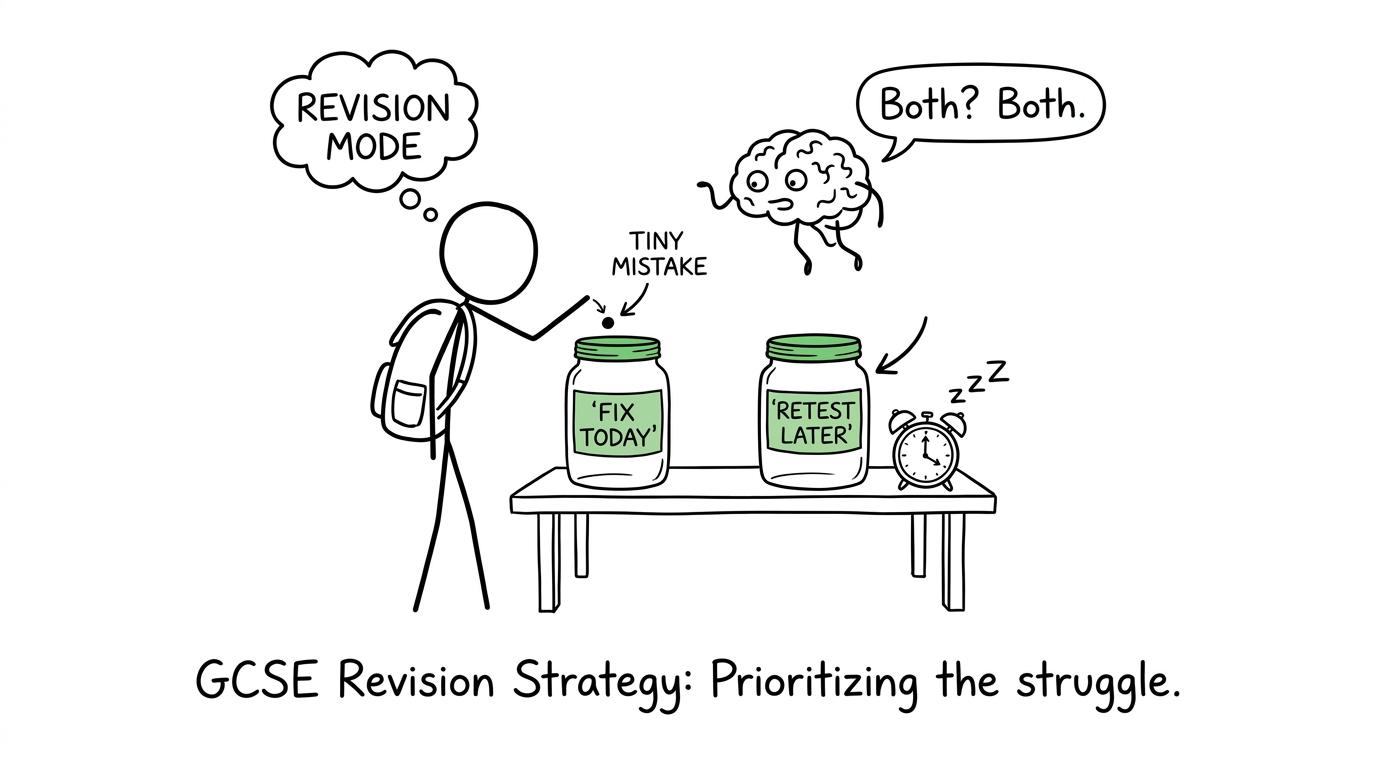 A brain recommending both immediate correction and later retesting
Retest after the answer is no longer familiar
An immediate correction can create false confidence because the mark scheme is still in working memory. The delayed attempt reveals whether you have actually learnt the idea.
On the next day, answer a similar question without notes. Later in the week, try the original question or a short mixed test. If you still need a prompt, the gap is not closed yet. Return to the lesson, practise again and schedule another check.
This combination of feedback and spacing is central to stopping yourself from forgetting GCSE maths content. It also prevents the common cycle of understanding a correction on Monday and losing the same marks in Friday’s test.
Use the result to plan, not judge yourself
A mock score is a snapshot created under particular conditions. The error pattern is more useful than the total because it tells you what can change.
Choose your two or three largest mark-loss patterns for the week. Give each one a revision lesson, targeted practice and a short retest. If schoolwork is busy, the twenty-minute GCSE maths revision routine provides a manageable structure for learning, questions, marking and logging the next action.
When should you deliberately wait?
Waiting can be sensible when immediate review would be low quality. Take a short break if you are exhausted after a full mock, too upset to process feedback calmly, or still waiting for the correct mark scheme or teacher explanation.
You may also want to attempt an uncertain question again before seeing its answer. That extra retrieval effort can reveal what you genuinely remember. Set a firm return time, however. “Tomorrow after school” is a plan; “later” is avoidance with better branding.
Do not delay where the error involves a foundational misconception, where another assessment is close, or where you are about to practise the same topic again. In those situations, fast correction reduces the chance of repeating the fault.
Common mistakes when reviewing mock papers
Looking only at the total mark
A score tells you how the paper went, not why. Two students with the same mark may need completely different revision. Analyse the lost marks by topic and cause.
Copying the mark scheme
Copying creates a neat page but weak evidence of learning. Read the scheme, hide it, then reconstruct the shortest complete response in your own reasoning. MathsGenie’s guide to using GCSE mark schemes to improve sets out a practical attempt-mark-fix-retest cycle.
Calling every error careless
“Careless” is often too vague to change behaviour. Replace it with a precise cause: skipped a line, misread the unit, entered brackets incorrectly, omitted a keyword or spent too long on an earlier question.
Redoing the question immediately and stopping there
An instant reattempt is useful, but the answer may still be familiar. Add a later closed-book test so that success depends on retrieval rather than recognition.
Starting another full paper before repairing the first
More papers do not automatically mean more progress. If the same gaps remain, another mock simply measures them again. The real revision happens between papers: lesson, targeted questions, feedback and retest.
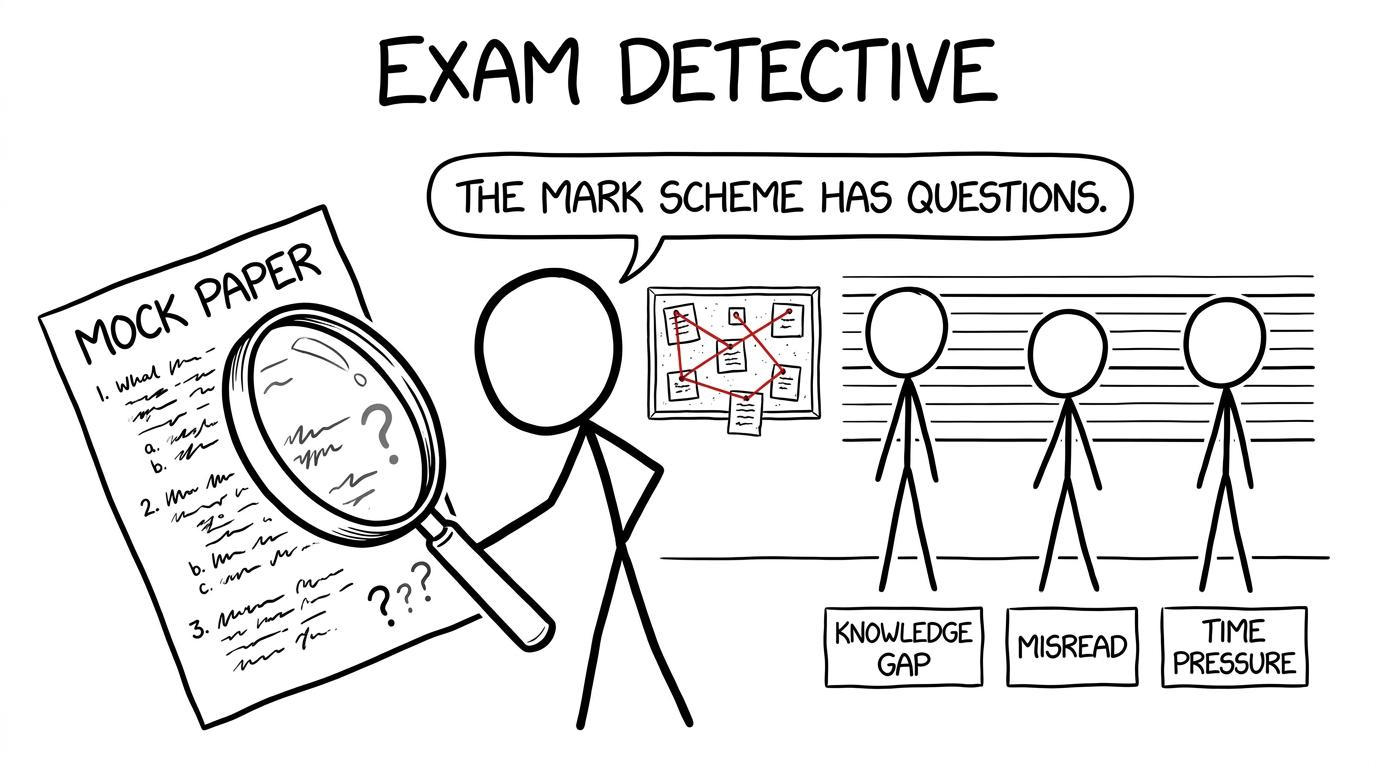 A mock-paper detective interviewing knowledge gaps, misreading and time pressure
Turn every mock into the next revision step
You do not need to choose between reviewing immediately and waiting several days. Capture and correct while the evidence is fresh, then deliberately wait before testing yourself again. That gives you the accuracy benefits of prompt feedback and the memory benefits of spaced retrieval.
Whether the paper is GCSE Computer Science, Edexcel maths, AQA, OCR or Eduqas, the principle is stable: mark, diagnose, repair, retest. A mock only predicts the future if nothing changes afterwards.
Start with MathsGenie’s free GCSE maths revision resources. Use revision lessons and practice questions to repair weak topics, mark honestly with mark schemes and video solutions, then pressure-test the improvement using mini tests, past papers and predicted papers. Open your latest mock, choose the most expensive mistake, and turn it into today’s next action.











