Review Mock Mistakes GCSE Biology: Now or Later?
Review mock mistakes GCSE Biology with a two-stage routine: check errors promptly, repair weak skills, then retest after a short, useful delay.
A mock paper can sit on your desk for days without becoming easier to open. The mark feels final, the red pen feels personal, and waiting promises a calmer version of you who will somehow know exactly what to do.
If you are wondering when to review mock mistakes GCSE Biology, the practical answer is: check and classify mistakes as soon as you are calm enough to think clearly, ideally on the same day, but save some of the re-attempting for later. Immediate feedback helps you connect each correction to your original reasoning. A delayed, closed-book retest then shows whether the correction lasted.
That principle applies particularly well to GCSE maths. Mark promptly, repair the method, then revisit it after a gap. You do not need to choose between immediate review and delayed practice. They perform different jobs.
The short answer: use a two-stage review
A reliable mock-review routine looks like this:
- Decompress briefly: take a short break if the mock has left you frustrated or tired.
- Mark promptly: use the correct paper and mark scheme while your reasoning is still recoverable.
- Classify each lost mark: identify whether it came from missing knowledge, weak application, an inaccurate method, poor communication or time pressure.
- Make one repair: check the relevant explanation and complete a small amount of focused practice.
- Retest later: attempt the question or skill without notes after roughly 222 to 333 days.
- Check again: revisit persistent weaknesses about a week later.
Research on feedback timing does not produce one universal winner in every learning context. Both immediate and delayed feedback can support retention, and outcomes vary with the task, the quality of the feedback and what the learner does afterwards. The safest conclusion for revision is not simply “sooner is always better”. It is that feedback must be specific, usable and acted upon.
This is why the two-stage approach works so well. Prompt marking preserves useful information about your thinking. Delayed retrieval tests whether you can now work independently.
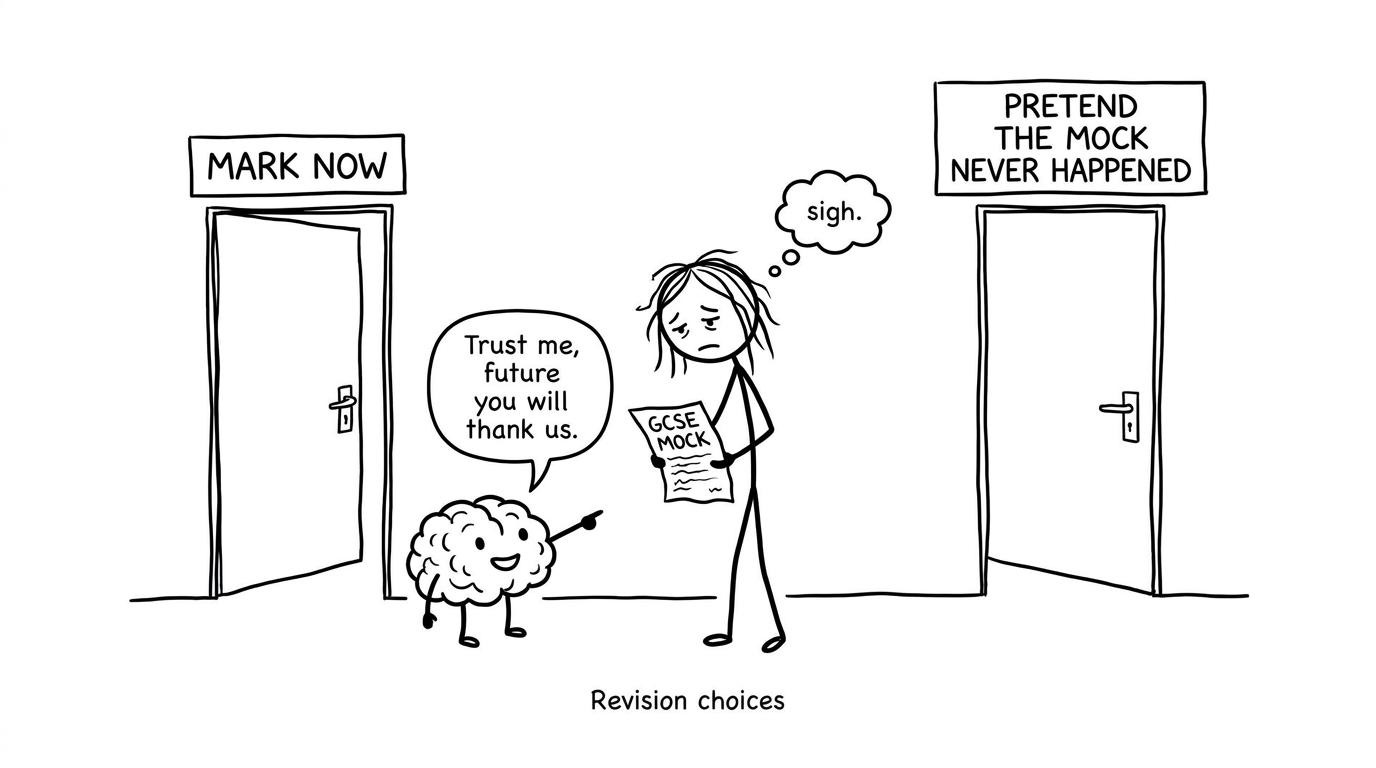 A tired student choosing between marking now and hiding from the mock
Why reviewing immediately usually helps
Straight after a mock, you still have access to something the mark scheme cannot show: the path you took.
You may remember that you guessed a biological keyword, misunderstood a graph or knew a maths method but could not finish it. A few days later, the page remains, but much of that mental evidence has gone. You can see what you wrote without remembering why you wrote it.
Prompt review therefore improves diagnosis. It helps you distinguish between:
- not knowing the required content;
- knowing it but failing to retrieve it;
- applying it in the wrong context;
- misreading the command word or instruction;
- making an arithmetic or algebraic slip;
- running out of time.
These problems require different repairs. Rereading notes may help with a knowledge gap, but it will not necessarily correct poor graph interpretation or a habit of omitting working.
In GCSE Biology, questions assess more than factual recall. Across current specifications, assessment objectives include demonstrating knowledge, applying knowledge and analysing or evaluating information. A mock score can therefore hide several different weaknesses. The same is true in maths, where a final incorrect answer may conceal a missing method, a single accuracy error or an incomplete explanation.
Use the advice in GCSE mark schemes for Biology and maths to identify the smallest change that would have earned the next mark. That is more useful than copying the entire mark scheme.
Why waiting a few days can still be useful
A delay becomes valuable when it is used for retesting, not avoidance.
Suppose you read a correction immediately and then reproduce it while the answer remains visible. That can feel fluent, but fluency is not proof that the knowledge is secure. You need a later attempt in which the answer is no longer sitting in short-term memory.
The Education Endowment Foundation's guidance on retrieval practice emphasises active attempts to recall information, alongside feedback that prevents incorrect ideas from becoming embedded. Its metacognition guidance also supports planning, monitoring and evaluating learning within specific subject content.
For students, that leads to a simple distinction:
- Immediate review asks: what went wrong and what should replace it?
- Delayed retrieval asks: can I now do this without support?
MathsGenie's guide to finding your weakest GCSE topics uses the same underlying idea: diagnose from evidence, practise the weakest area and then retest it. You can organise those return dates with the free MathsGenie revision planner, rather than trusting yourself to remember every correction.
What does delaying the review actually cost?
Waiting is not automatically harmful. The cost depends on what happens during the gap.
You lose access to your original reasoning
After several days, you may no longer remember whether an answer came from confident knowledge, partial recall or a guess. That makes your error log less precise.
In maths, this matters when the final answer alone does not reveal the cause. Perhaps you chose an unsuitable method, entered something incorrectly on a calculator or rounded too early. The sooner you inspect the working, the easier it is to locate the first point of failure.
You may repeat the same misconception
If you practise related questions before checking the mock, an incorrect rule can travel with you. Retrieval practice should include feedback because repeatedly retrieving incorrect information risks strengthening the wrong response.
Prompt correction reduces this risk. The goal is not to stare at mistakes for hours. It is to stop an unreliable idea from becoming your default.
You lose possible revision cycles
A correction made today can be retested in a few days and checked again next week. A correction postponed until next week leaves less room for that cycle before the real examination.
The cost of delay is therefore often an opportunity cost. It is not simply the passing of time; it is the loss of chances to repair, forget slightly, retrieve and strengthen the skill.
The review can feel larger than it is
Avoided tasks often grow in the imagination. A paper containing several errors begins to feel like proof that an entire subject is weak. Prompt classification usually makes the problem smaller: perhaps the lost marks cluster around two topics and one exam habit.
 Cartoon mistakes trying to escape towards a calendar marked later
A practical routine for Biology and maths mocks
Start once you are calm enough to be accurate. That might be immediately after a break, later the same afternoon or the following morning. If you are angry, exhausted or likely to mark carelessly, a short pause is sensible. Waiting several days merely because the score feels uncomfortable is less useful.
Mark before relearning
Use the official mark scheme supplied by your school or exam board. Award marks for what is actually present, not what you meant to write.
For maths practice, choose papers matching your board and tier. MathsGenie provides organised collections of Edexcel GCSE Maths past papers and AQA GCSE Maths past papers, with mark schemes and worked or video solutions where available.
Label the cause, not just the topic
Beside every lost mark, use a brief category:
- Knowledge: the fact, definition, formula or method was missing.
- Application: you knew the content but could not use it in context.
- Process: the method began correctly but broke down.
- Communication: the explanation, units, terminology or working were incomplete.
- Reading: you answered a different question from the one asked.
- Timing: you rushed, guessed or left the item unfinished.
The category determines your next action. A topic label such as “algebra” or “homeostasis” is often too broad to guide tomorrow's revision.
Repair only the important gaps
Do not try to relearn the whole specification in one sitting. Prioritise mistakes that lost several marks, appeared repeatedly or reveal a foundational misunderstanding.
For maths, begin at the GCSE Maths revision hub, choose the precise revision lesson and complete focused practice questions. If the issue is exam technique rather than content, watch the video solution and compare the structure of your working rather than merely checking the final answer.
Retest without the correction visible
After a short gap, attempt a parallel question or redo the relevant part without notes. Do not memorise a sentence from a mark scheme without understanding how it answers the question.
If you succeed independently, schedule one later check. If you fail again, the first repair was not sufficient. Return to the underlying lesson, ask your teacher about the misconception and practise the smallest relevant skill.
The broader guide to using GCSE past papers properly explains how to turn this cycle into a repeatable paper routine.
When should you wait before looking?
There are a few good reasons to pause:
- you are too upset to mark objectively;
- you are mentally exhausted after a full examination day;
- your teacher has asked the class not to discuss a secure mock paper;
- the mark scheme is unavailable or you are unsure which version applies;
- your teacher wants to review the paper with you first.
In these cases, preserve the useful evidence. Before putting the paper away, make a brief note of questions you guessed, sections where time became difficult and answers about which you felt uncertain. Do not search for secure assessment materials or share questions that your school has asked you to keep confidential.
A pause should have an endpoint. Put the review into your planner for the next available session. Rest is a strategy; indefinite postponement is not.
 A student returning calmly to face a cheeky exam question
Common mistakes when reviewing mock papers
Focusing only on the total mark
A total records performance on one paper under one set of conditions. It does not explain the next action. Look underneath it for repeated topics, skill types and exam habits.
Copying correct answers without thinking
A copied answer creates a tidy page, not necessarily a stronger memory. Close the mark scheme and explain the correction in your own words before attempting another question.
Treating every mistake as carelessness
“Careless” is often too vague. Name the behaviour: skipped a line, misread a scale, omitted a unit, rounded early or failed to check whether the answer was sensible. Specific diagnoses can produce specific habits.
Redoing the question immediately and stopping there
An immediate successful attempt may reflect fresh exposure to the answer. Retest after a delay to see whether the method or knowledge can be retrieved independently.
Revising everything that appeared on the paper
Mock review should narrow your plan. Choose the few weaknesses with the greatest effect on marks, repair them and then check them again. MathsGenie's GCSE predicted papers can later provide unfamiliar exam-style combinations, but they are most useful when followed by the same careful review process.
The best timing is a loop, not a moment
The question is not really whether to review immediately or wait. It is what each stage of the review is meant to achieve.
Mark and diagnose promptly, once you are calm enough to think. Correct the most important misconceptions before they accompany you into more practice. Then create a genuine delay and retest without notes. That later struggle is not evidence that the first review failed; it is the moment when you discover whether learning has become retrievable.
Start with one paper today. Mark it, identify the two largest marks leaks and use MathsGenie's free revision lessons, practice questions, mark schemes and video solutions to repair them. Schedule a mini test or repeat attempt, then move on to past papers and predicted papers when the underlying skills are stronger.
A mock is not a verdict. It is a message. Its value depends on how quickly and intelligently you answer it.