

Review Exam After Sitting GCSE Drama: Is It Worth It?
Review exam after sitting GCSE Drama with a calm debrief. Learn when reflection helps, when to stop and how to refocus on GCSE maths revision.
The exam hall door closes, someone asks what you wrote for the final question, and suddenly the whole paper begins playing again in your head. If your search was “review exam after sitting GCSE Drama”, the short answer is this: a brief, controlled review can help, but repeatedly reconstructing your answers usually cannot change your result and may distract you from the next exam.
The useful question is not, “Did I get every answer right?” You cannot know that reliably from a hurried conversation outside the exam hall. Ask instead, “Is there anything from that experience that will help me perform better next time?”
That distinction matters especially during GCSE exam season, when Drama may be followed by maths, English or science within days. Your attention is limited. Spend it where it can still influence your marks.
The quick post-exam checklist
Immediately after your GCSE Drama written exam:
- check whether there is a practical issue you need to report;
- note one thing that went well;
- record one transferable lesson about timing or exam technique;
- avoid comparing complete answers with friends;
- do not share specific exam content online;
- eat, drink and take a proper break;
- move your attention to the next paper.
If your next exam is maths, open the GCSE Maths Revision hub, choose your board and tier, and decide on one realistic task. A short piece of focused practice is more valuable than an evening spent trying to remember every sentence you wrote in Drama.
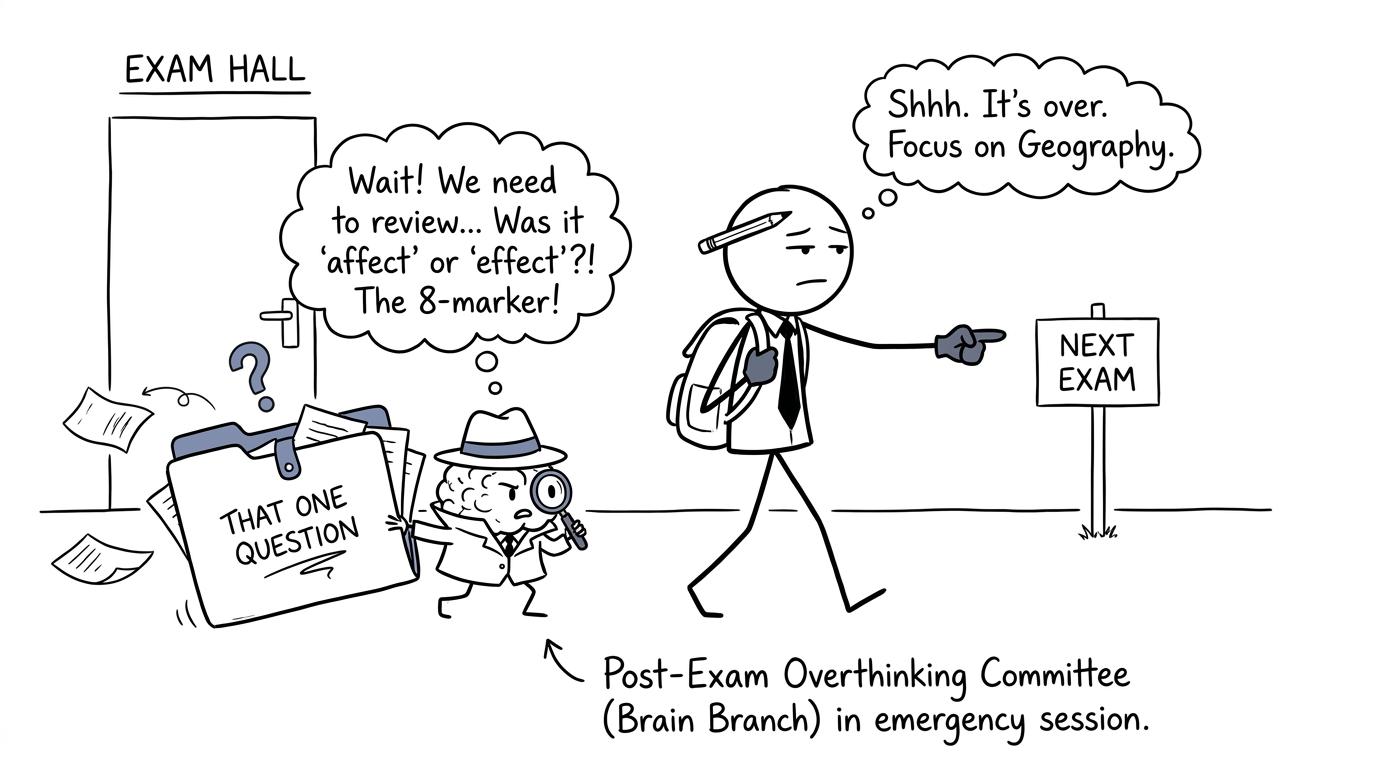 A student leaves the exam while a tiny detective brain tries to reopen the paper
Why replaying the Drama exam feels so tempting
Drama examinations ask you to make judgements. You may have analysed performers, explained design choices, interpreted a set text or evaluated live theatre. Unlike a short calculation, an extended response rarely produces an obvious moment when you know it is completely correct.
That uncertainty invites reconstruction. You remember a phrase you omitted. A friend mentions lighting when you discussed sound. Someone claims the examiner “wanted” a particular interpretation.
None of this is dependable marking evidence.
GCSE Drama specifications also differ between exam boards. AQA, Edexcel, OCR and Eduqas do not arrange every component, question or permitted resource in the same way. For example, the published AQA, Edexcel and OCR specifications each give the written examination a substantial but not complete share of the qualification. Your result therefore reflects the assessment structure for your board, including relevant non-examined or practical components, rather than one remembered moment alone.
Students outside the exam hall also do not have the full mark scheme, standardisation guidance or your complete script. A different answer is not automatically a better answer. In Drama, two responses may use different theatrical choices while both remaining valid if they are specific, justified and connected to the question.
When reviewing your GCSE Drama exam can help
A post-exam review has value when it produces a clear action and then ends.
You identify a practical concern
Tell a teacher, invigilator or exams officer promptly if something happened that may need recording. Examples include illness, a significant disturbance, a problem with the paper, or an issue involving agreed access arrangements.
This is different from worrying that an answer was weak. Schools need factual information about genuine examination incidents, and it is better to raise a concern promptly than rely on memory much later.
You notice a transferable exam habit
Perhaps you spent too long on an early response and rushed the final section. Perhaps you did not check the command word carefully enough. Maybe you remained focused despite feeling nervous.
These observations can help in maths because exam technique travels between subjects. Useful notes might include:
- check the marks before deciding how long to spend;
- underline the precise instruction;
- leave space and return rather than becoming stuck;
- keep enough time for the final questions;
- show relevant evidence or working clearly.
Turn the observation into one behaviour. If pacing was the issue, your next revision task should involve timed practice. MathsGenie’s guide to starting GCSE past papers at the right time explains how to build from short sections towards complete papers.
Your teacher has planned a formal debrief
A later classroom review can be useful when your teacher is working from authorised materials and the purpose is learning rather than predicting individual grades. This is more reliable than an improvised discussion immediately after the examination.
By then, the emotion of the day has usually faded. You can examine question interpretation, planning and subject terminology without trying to reconstruct your script word for word.
When it is better to leave the exam alone
Stop reviewing when the conversation no longer changes what you can do next.
If you are repeatedly estimating marks, searching for unofficial answers or asking several people whether your interpretation was acceptable, the review has become rumination. You are circling uncertainty rather than learning from it.
NHS exam-stress guidance encourages students to discuss what went well and then focus on the next test instead of dwelling on things that cannot be changed. That does not mean pretending the exam felt perfect. It means giving disappointment a boundary.
Try a simple stopping rule: allow a short debrief, write down any useful action, and then close the subject for the day. If another student wants a detailed answer comparison, it is reasonable to say that you are moving on.
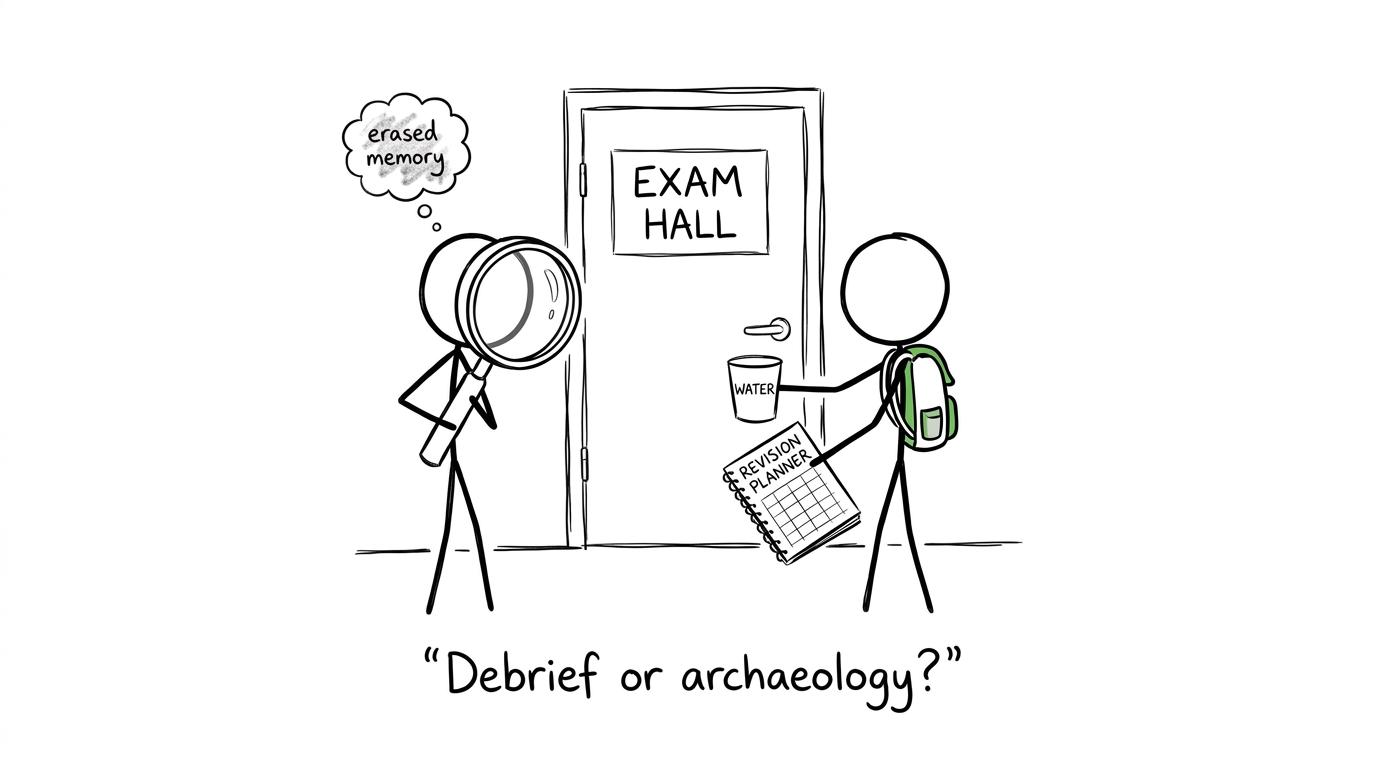 Two students wonder whether their post-exam debrief has become archaeology
Be careful when discussing exam content online
A private reflection about your own performance is not the same as publishing the paper.
JCQ guidance tells candidates not to buy, request or share examination and assessment content, pass on rumours, or share work that must remain independent. If you receive material that appears to be live assessment content, tell a teacher. If you are uncertain about what may be discussed, check with your school rather than relying on a social media post.
The safest approach after the Drama exam is to avoid posting exact questions, extracts, answers or photographs of materials. This is particularly important because candidates may not all sit assessments under identical circumstances or at the same moment.
You can still say that the paper felt challenging or that you are relieved it is finished. Keep the conversation general and responsible.
How to turn the experience into better maths revision
A Drama debrief is only useful to a maths student if it changes the next step. Do not switch from analysing one completed exam to vaguely “doing some maths”. Choose a task that addresses the behaviour you noticed.
If timing was difficult
Complete a timed section, mini test or half paper. The aim is not to exhaust yourself immediately after another exam. It is to practise making decisions while the clock is visible.
If you are studying Edexcel, the Edexcel GCSE Maths past papers include papers and mark schemes that can be used under timed conditions. Students using AQA, OCR or Eduqas can select their board through the main revision hub.
If one difficult question unsettled you
Practise moving on deliberately. During a maths paper, an unfinished question does not erase the marks already earned elsewhere. Train yourself to mark the question, continue, and return later with a clearer head.
The twenty-minute GCSE maths revision routine is useful on crowded exam-week evenings because it keeps the task small: recall, practise, mark and choose the next micro-topic.
If uncertainty caused the stress
Replace guessing with evidence. Sit a maths mini test or paper section, use the mark scheme, and label the exact reason for each lost mark. The guide to finding your weakest GCSE topics shows how to turn errors into a focused practice list.
That is a better review cycle than asking whether the whole paper was “good” or “bad”. It gives you something precise to repair.
If you need structure for the remaining exams
Update your plan rather than creating an ambitious new one. Protect sleep, include breaks and choose a manageable revision block. The GCSE maths revision timetable and one-month maths revision plan can help you balance topic practice with timed papers.
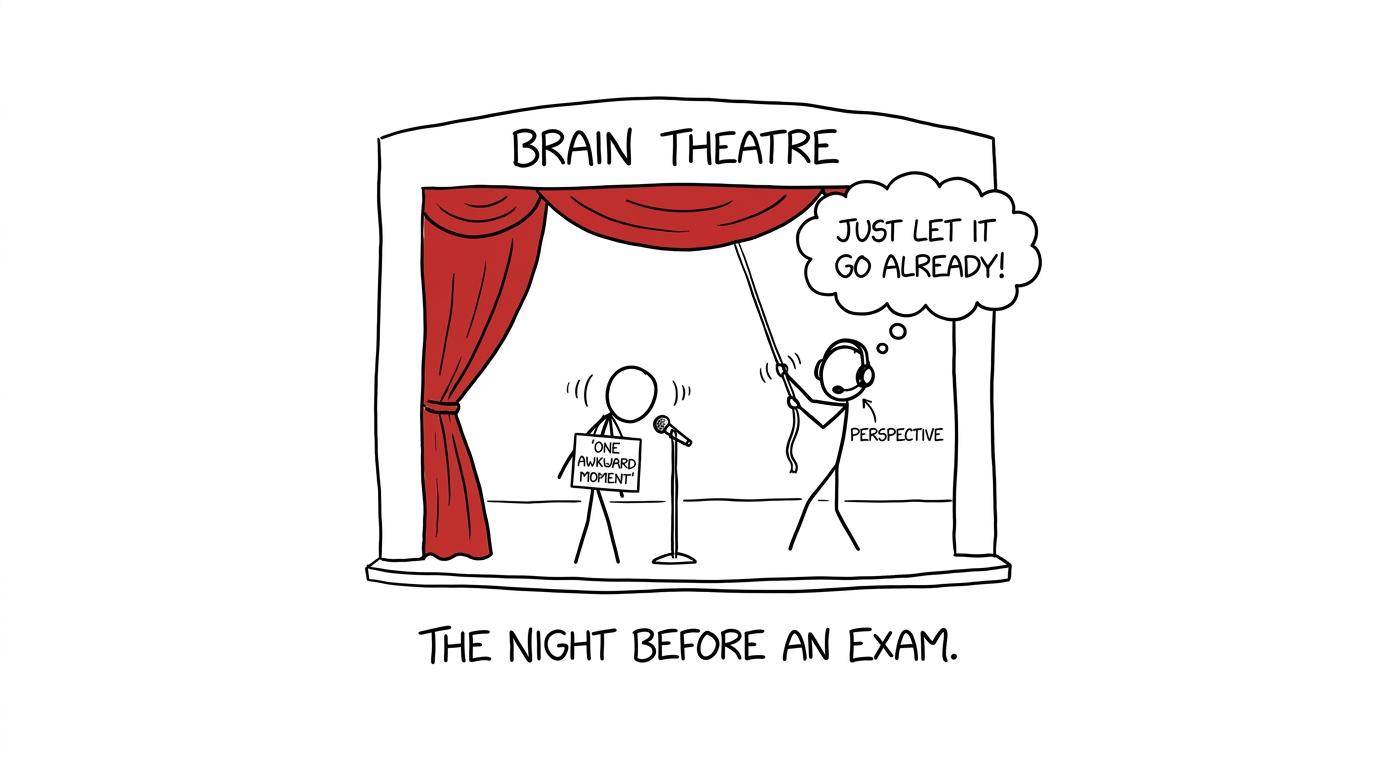 A repeated awkward exam moment keeps returning for another theatrical curtain call
Common mistakes after sitting a GCSE exam
Treating friends as the mark scheme
A confident answer is not necessarily a correct one, and a different dramatic interpretation is not automatically wrong. Avoid turning an uncertain conversation into a predicted result.
Focusing only on the weakest moment
Memory is selective after a stressful event. One rushed paragraph can become the story of the entire paper, even though the examiner marks the complete script and your final qualification may include several components.
Writing a detailed reconstruction
A short note about timing can be useful. Recreating every answer consumes time without providing reliable feedback, particularly when you cannot compare it with your marked script.
Posting questions or answers online
Do not share specific assessment content or rumours. Follow JCQ instructions and ask your teacher if you are unsure about the rules.
Using the debrief to avoid the next subject
Post-exam analysis can feel productive because it concerns schoolwork. But if your next paper is maths, attention should soon return to content you can still improve. If forgetting methods is the problem, use the GCSE maths retention guide to combine retrieval, spaced practice and exam questions.
Close the paper and invest in the next one
It can be worth reviewing your GCSE Drama exam straight after sitting it, but only briefly. Check for practical concerns, recognise what went well, capture one transferable lesson and stop. Repeatedly replaying answers cannot alter the script now in the examiner’s hands.
The most useful post-exam skill is not perfect recall. It is knowing when reflection has finished its job.
Then move forward. Use MathsGenie’s free revision lessons to refresh a method, practice questions and mini tests to expose gaps, and past papers or predicted papers to develop timing. Mark your work carefully with mark schemes and use video solutions when a method is unclear. One completed exam belongs to the past; your next revision decision can still shape the marks ahead.











