Retake GCSE Engineering After Sixth Form
Retake GCSE Engineering after sixth form: understand AQA rules, NEA, college enrolment, exam centres, fees and your practical route forward.
Leaving sixth form can make an unfinished qualification feel strangely permanent. Your timetable disappears, your old exams officer becomes harder to reach, and the usual advice to “ask your school” no longer sounds simple.
The short answer is that you may be able to retake GCSE Engineering after sixth form, but the route is more restricted than an ordinary GCSE resit. AQA GCSE Engineering, specification 885288528852, allows resits within the life of the qualification, yet the specification is not available to private candidates. Because it also contains supervised non-exam assessment, you will normally need a school or college prepared to enrol and support you, rather than an exam-only private centre.
That distinction is the most important part of the process. Find the right centre before paying for tuition, starting a project or assuming that an independent exam entry will be accepted.
Your GCSE Engineering retake checklist
Before making plans, confirm each of these points:
- Find the exact qualification title, exam board and specification code on your results statement or certificate.
- Check whether you previously certificated for the complete qualification.
- Ask your former school whether it can enter and support you again.
- Contact colleges that currently teach AQA GCSE Engineering 885288528852.
- Explain that the specification is not available to private candidates.
- Ask whether your previous non-exam assessment mark can be carried forward.
- Confirm the exam series, centre deadline, total fees and identity requirements.
- Discuss access arrangements at the beginning, not shortly before the exam.
- Do not begin a new engineering project until the centre has approved the assessment arrangements.
The first conversation should be about eligibility and assessment, not revision. There is little value in preparing brilliantly for an entry that a centre cannot make.
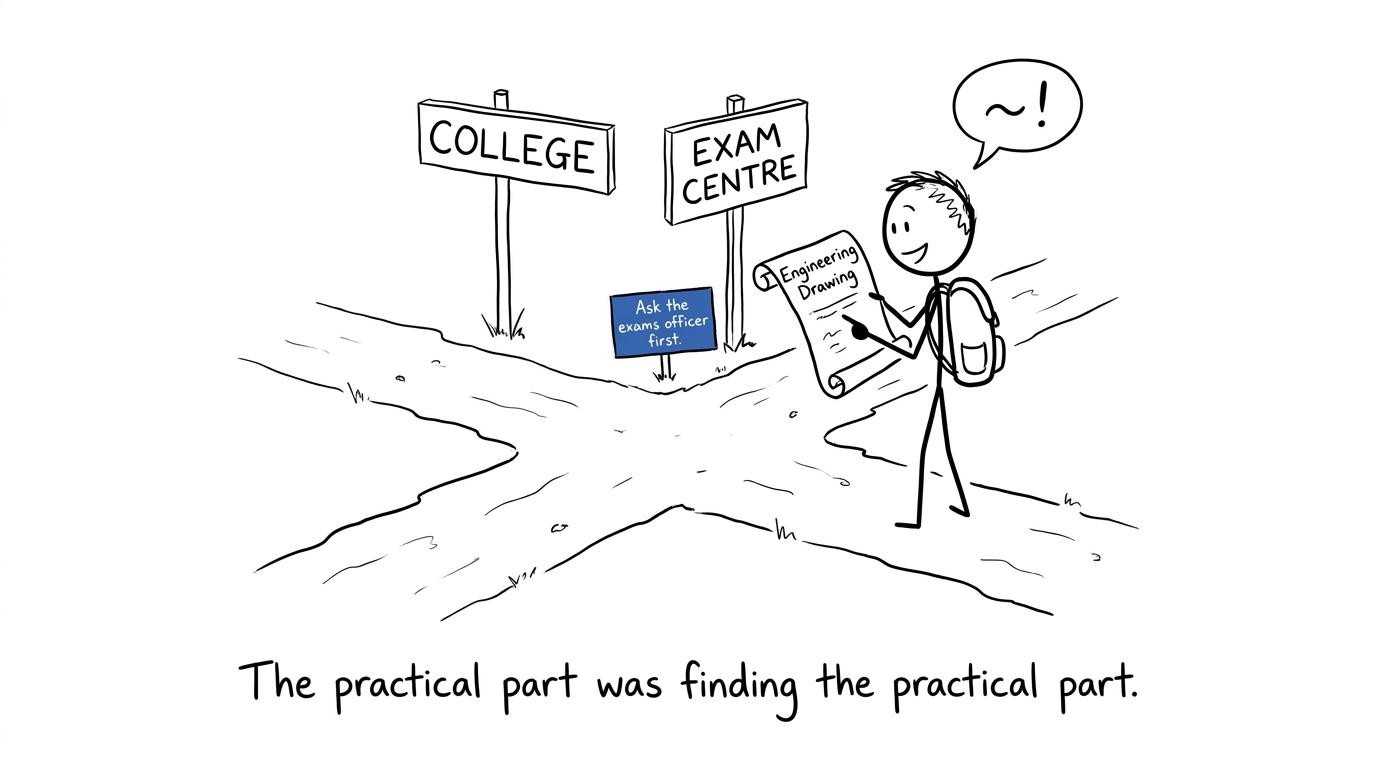 A student choosing between a college and an exam centre after sixth form
Why this is not a normal private GCSE resit
A private candidate studies independently but sits an assessment through an approved school, college or examination centre. That model works for many exam-based qualifications: the centre makes the entry, checks the candidate’s identity and provides the examination room.
GCSE Engineering is different. Under the current AQA specification, it is a linear qualification containing both a written paper and non-exam assessment, usually shortened to NEA. The assessment weighting is:
| Component | Weighting | Maximum raw mark |
|---|---|---|
| Written paper | 60%60\%60% | 120120120 |
| Practical engineering NEA | 40%40\%40% | 808080 |
AQA states that all assessments must be completed at the end of the course and in the same series. The written paper is therefore only one part of the award. The NEA involves responding to an AQA brief, developing a working prototype and producing a concise portfolio. It must be supervised, authenticated, marked and administered under the specification’s rules.
Most importantly, AQA’s GCSE Engineering specification explicitly says that it is not available to private candidates. A private exam centre advertising GCSE entries generally is not automatically able to enter you for this particular subject.
The realistic routes after leaving sixth form
Return to your former school or sixth form
Your previous centre is the sensible first contact because it may still hold your candidate records and assessment information. Ask for the exams officer rather than relying on a general reception enquiry.
Explain:
- the qualification and specification code;
- the year in which you originally took it;
- whether you received an overall result;
- why you want to retake it;
- whether you hope to carry forward your NEA mark.
The school is not required to accept you. However, it is well placed to establish what evidence and marks remain available and whether an entry is administratively possible.
Enrol at a college that teaches the qualification
If your former school cannot help, look for a further education college or other approved centre that currently delivers AQA GCSE Engineering. You may need to enrol on an appropriate course rather than pay only for an examination seat.
Ask the college whether it will treat you as an enrolled learner and take responsibility for every component. A centre needs appropriate staff, facilities and assessment procedures; willingness to host the written paper alone is not enough.
Do not assume the course will be free. The special post-161616 funding rules commonly associated with GCSE English and maths do not automatically apply to an optional Engineering resit. Eligibility and charges depend on your age, circumstances, course and provider, so request written confirmation.
Approach an approved private examination centre carefully
The JCQ centre finder can identify centres that accept private candidates, and some centres advertise engineering qualifications. This is useful as a starting list, but it does not override the rules of specification 885288528852.
Ask the centre a precise question: Can you enter a former student for AQA GCSE Engineering 885288528852, given that AQA says it is unavailable to private candidates?
If the answer is yes, request an explanation of your enrolment status and how the NEA will be supervised, authenticated and submitted. Never rely only on a website’s broad subject list. The qualification might be a vocational engineering award rather than the GCSE you intend to retake.
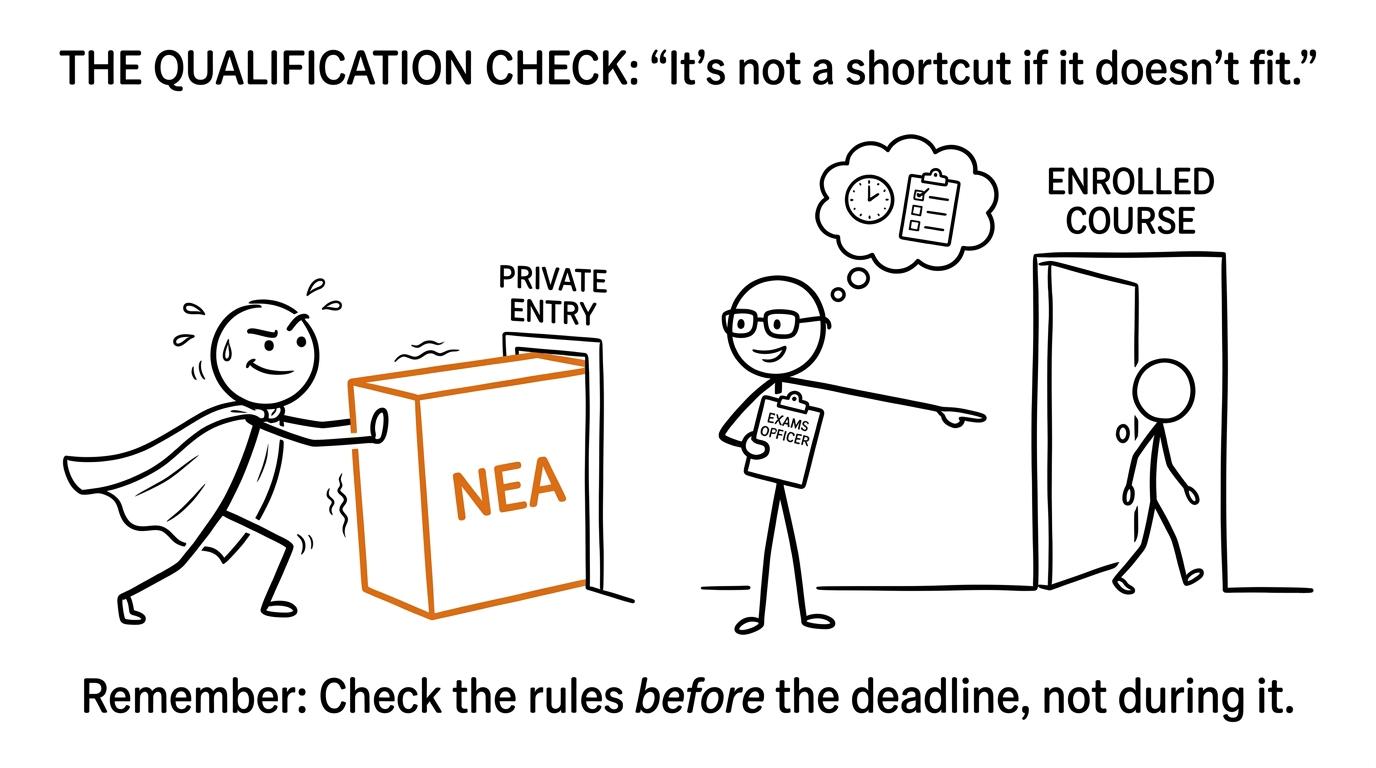 An NEA box meeting the limits of a private examination entry
Can your previous NEA mark be carried forward?
Current AQA entry information indicates that where a candidate has previously certificated, the GCSE Engineering NEA result can be carried forward. This could remove the need to repeat the practical component, but it does not turn the qualification into one available through an ordinary private entry.
The entering centre must verify that the result is eligible and use the correct entry arrangement. Ask it to check directly with AQA before promising you a place.
If you did not certificate previously, no eligible mark can be found, or you want to replace the existing NEA result, the situation becomes harder. A new project must use the correct live brief and be completed under approved conditions. Work produced independently before joining a centre may not be capable of authentication.
This is why “I will complete the coursework at home and bring it in” is not a safe plan.
When can you take the written paper?
AQA GCSE Engineering is normally assessed in the summer series. Unlike GCSE mathematics and English Language, it does not have the familiar November resit opportunity.
Contact centres well in advance. Awarding organisations have official entry deadlines, but centres usually impose earlier internal deadlines. Late entries may attract extra charges, while NEA arrangements require substantially more preparation than booking a desk for a written paper.
Once entered, check your statement of entry carefully. Your name, date of birth, qualification code and component details should all be correct. You may also need your Unique Candidate Identifier and photographic identification. If you require access arrangements, raise them while arranging the entry because the centre needs time to gather evidence and complete the required process.
Make sure you are retaking the right qualification
“Engineering” can describe several different qualifications. Your previous course might have been:
- AQA GCSE Engineering;
- GCSE Design and Technology;
- a Level 111/Level 222 vocational engineering award;
- a BTEC or Cambridge National qualification;
- another technical certificate offered alongside GCSEs.
These are not interchangeable. They can have different awarding organisations, assessment structures, resit rules and availability dates. Check the complete title and specification number before approaching a centre.
Also ask why the qualification is needed. If an apprenticeship, college or employer has specified GCSE Engineering, request the exact entry requirement. If it simply wants evidence of technical learning, an available vocational qualification may be acceptable, but only the receiving organisation can confirm that.
How GCSE maths supports Engineering revision
Engineering questions often place familiar mathematics inside an unfamiliar product, drawing or manufacturing context. The calculations may involve ratio, tolerances, scale, area, volume, graphs, units or percentage change. The context looks technical, but the underlying skill is often standard GCSE maths.
Begin with the MathsGenie GCSE maths revision hub and identify the skills that feel unreliable. The best order for learning GCSE maths topics provides a sensible route through number, ratio, algebra, graphs and measures.
Geometry deserves particular attention because engineering drawings depend on dimensions, scale and spatial reasoning. The similar shapes, area and volume lesson can strengthen the relationship between lengths, areas and volumes. You should also be comfortable rearranging general relationships such as:
density=massvolume\text{density}=\frac{\text{mass}}{\text{volume}}density=volumemassand
percentage change=changeoriginal amount×100%.\text{percentage change}=\frac{\text{change}}{\text{original amount}}\times 100\%.percentage change=original amountchange×100%.These are not tricks to memorise in isolation. They are ways of describing how quantities relate.
Use the MathsGenie resources collection for mini tests, practice materials and predicted papers. Although predicted maths papers are not predictions for Engineering, they help maintain the accuracy and fluency that technical calculations require. The guide to GCSE maths topics that appear regularly is another useful way to prioritise core skills.
Build a revision plan around confirmed arrangements
Once a centre has confirmed your entry, organise revision in three strands:
Specification knowledge
Use the exact AQA specification to list the engineering content assessed by the written paper. Do not revise from an old course title or assume that a general engineering textbook matches specification 885288528852.
Mathematical fluency
Choose one weak maths topic at a time. Learn the method, complete practice questions, mark them and revisit errors. The GCSE maths revision timetable guide explains how to turn this into a repeatable weekly routine.
Timed assessment practice
Use official Engineering papers where available, then review them against their mark schemes. For broader maths stamina, follow the advice on when to begin GCSE past papers. MathsGenie’s Edexcel GCSE maths predicted papers can provide additional timed calculation practice, even if your Engineering qualification is with AQA.
Common mistakes when arranging the retake
Assuming every GCSE permits a private entry. AQA GCSE Engineering specifically does not.
Confusing an exam centre with a teaching centre. Hosting written exams does not necessarily mean a centre can support Engineering NEA.
Starting a new project independently. The correct brief, supervision and authentication arrangements must be established first.
Assuming an old NEA mark will transfer automatically. The centre must confirm your certification history and use the correct entry option.
Searching only for “Engineering GCSE”. Always include the awarding organisation and specification code.
Waiting until the public entry deadline. Colleges and centres can close their own entries earlier, particularly where practical assessment is involved.
Expecting the resit to be funded like English or maths. Ask about tuition, examination, administration and materials charges before committing.
Take the next practical step
Retaking GCSE Engineering after sixth form begins with one administrative fact: AQA allows resits, but specification 885288528852 is not open to ordinary private candidates. Your best route is therefore to contact your former school and colleges that actively teach the qualification, asking whether they can enrol you and take responsibility for the written paper and NEA.
While those conversations happen, keep strengthening the maths beneath the engineering. Use MathsGenie’s free revision lessons, practice questions, mini tests and mark schemes to repair individual skills. Then build confidence with past papers, predicted papers and video solutions. A qualification may involve complicated arrangements, but revision improves through a much simpler pattern: learn, practise, check and return.