

Can You Retake GCSE Astronomy After Sixth Form?
Retake GCSE Astronomy after sixth form: learn how private entries, required observations, exam centres, fees and summer assessments work across the UK.
Leaving sixth form can make the exam system feel as though it has closed behind you. Your old school handled entries, timetables and paperwork; now there is no exams officer waiting down the corridor.
The reassuring answer is that you can retake GCSE Astronomy after sixth form. You will usually enter as a private candidate through an approved school, college or independent exam centre. The difficult part is not your age or the fact that you have left education. It is finding a centre willing to enter you for Pearson Edexcel GCSE Astronomy and arrange the qualification's compulsory observational activities.
This guide explains the process, the questions to ask and how to prepare without wasting a year on an incomplete entry.
GCSE Astronomy retake checklist
Before committing to a course or paying a centre, confirm that:
- you are entering Pearson Edexcel GCSE Astronomy, specification code 1AS0
- the centre accepts private candidates for this particular subject
- your entry includes both written papers
- the centre can support and confirm the required aided and unaided observations
- you know the centre's internal entry deadline and total fee
- any access arrangements are discussed at the start
- you are preparing for the summer exam series
- your revision follows the current specification rather than an older course
Start with the Edexcel GCSE Astronomy revision hub, where you can see the course structure and organise your preparation around the correct qualification.
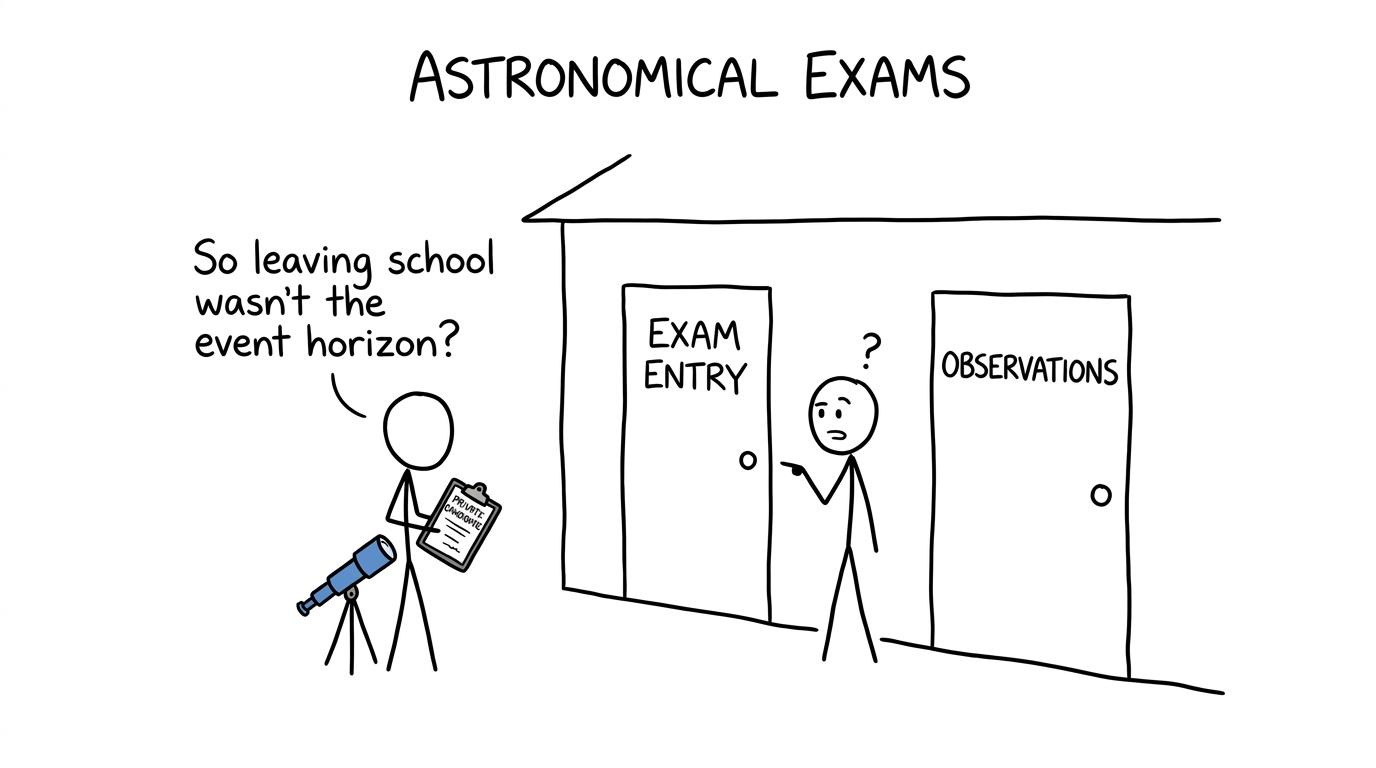 A former student discovers that leaving school is not an astronomical event horizon
How resitting GCSE Astronomy works after leaving school
Once you are no longer enrolled at the centre entering you, you are normally treated as a private candidate. You cannot enter yourself directly with Pearson. An approved exam centre must make the entry, administer the examinations and complete the necessary qualification paperwork.
The centre might be:
- your former school or sixth form
- a further education college
- another local secondary school
- an independent college
- a specialist private exam centre
- an approved distance-learning provider with assessment arrangements
Your former school is worth asking first, especially if it already teaches Astronomy. However, schools and colleges are not required to accept private candidates. A centre may also accept private candidates for popular subjects such as GCSE maths while declining Astronomy because of its observational requirements.
That distinction matters. Do not ask only, "Do you accept private candidates?" Ask whether the centre accepts private candidates for Pearson Edexcel GCSE Astronomy 1AS0 and can administer every requirement attached to it.
Which exam board and papers will you take?
The current UK GCSE Astronomy qualification is offered by Pearson Edexcel. It is a linear, non-tiered GCSE, so there is no foundation or higher tier decision. References to AQA, OCR and Eduqas are relevant when selecting GCSE maths resources, but they are not interchangeable Astronomy specifications.
The qualification has two externally examined papers:
- Paper 1: Naked-eye Astronomy, covering Topics 1 to 8
- Paper 2: Telescopic Astronomy, covering Topics 9 to 16
Each paper lasts 111 hour 454545 minutes, carries 100100100 marks and contributes 50%50\%50% of the qualification. Questions can include multiple-choice items, calculations, graphs, short answers and extended responses.
All assessment must be completed in the same May/June series. GCSE Astronomy is not normally available as a routine November resit. The exceptional November Astronomy papers visible from 2020 and 2021 should not be taken as evidence of a continuing autumn opportunity.
Because the qualification is linear, a retake means entering for the complete qualification and sitting both papers again. You cannot preserve the mark from one previous paper and replace only the other.
Use the GCSE Astronomy past papers and mark schemes to become familiar with both halves of the course.
The observation requirement is the crucial detail
GCSE Astronomy is assessed through written examinations, with no separately marked controlled assessment. Nevertheless, every candidate must undertake at least one unaided observation and one aided observation selected from the specification.
An unaided observation uses the naked eye. An aided observation uses suitable equipment or imaging methods. These activities develop skills such as planning, recording, analysing and evaluating astronomical observations. Knowledge of observational skills is then assessed within the written papers.
The entering centre must submit an Observation Statement confirming that reasonable steps have been taken to ensure the activities were completed. In recent exam series, the submission deadline has been 15 April, although you must check the deadline for the year in which you enter.
This is why finding a desk for the written exams is not enough. A general private exam centre may be able to invigilate two papers but may not be willing to oversee observations or submit the declaration.
Before paying, obtain a written answer to these questions:
- Who will approve my observational activities?
- How and where will I complete them?
- What records must I keep?
- Who submits the Observation Statement?
- Is this service included in the quoted fee?
- What happens if weather prevents the planned observation?
Never assume that a distance-learning course automatically includes examination entry or observation support. Tuition, exam entry and practical administration can be separate services.
Finding a college or private exam centre
The Joint Council for Qualifications provides a private-candidate centre search, but its results are a starting point rather than a guarantee. Centres control their own subject availability, capacity, fees and internal deadlines.
Contact several centres early. Astronomy entries require more discussion than a straightforward written-only subject, and places can be limited.
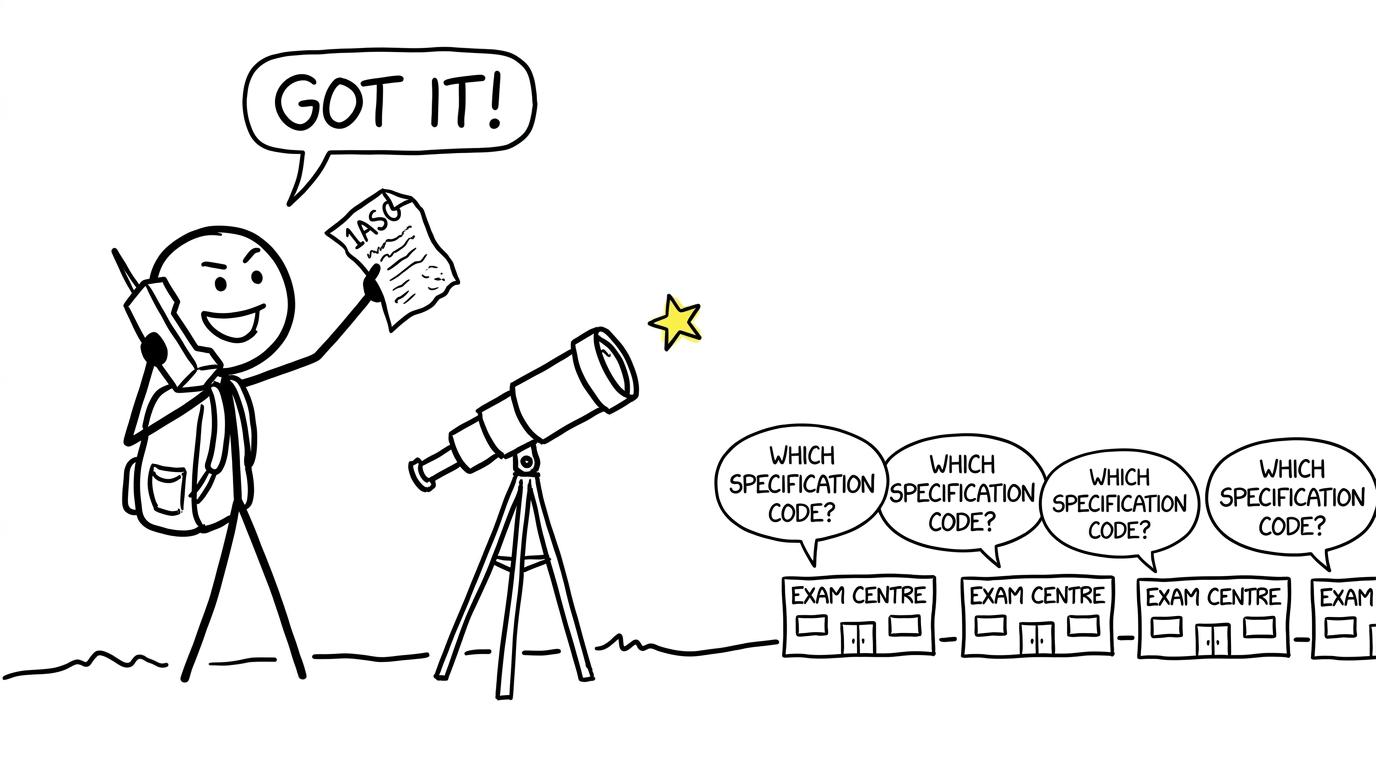 A private candidate finally learns the importance of specification code 1AS0
What to include in your first message
Give the exams officer enough information to answer properly:
- your full name and date of birth
- the qualification: Pearson Edexcel GCSE Astronomy
- specification code: 1AS0
- the summer series you want to enter
- confirmation that you are a private retake candidate
- whether you have already completed relevant observations
- whether you require access arrangements
- your previous Unique Candidate Identifier, if available
Ask for the total cost, including awarding-body entry charges, administration, invigilation and observation-related support. Fees are set by individual centres and can vary considerably, so a quoted total is more useful than an advertised basic entry fee.
Why you should register early
Awarding organisations publish formal entry dates, but centres often impose earlier internal deadlines. They need time to verify your identity, process payment, arrange access requirements and decide how the observational work will be handled.
Late entries may cost more, and a centre can stop accepting candidates once it reaches capacity. A sensible approach is to begin contacting centres during the autumn before the summer examination series rather than waiting until revision is nearly complete.
If you need extra time, supervised rest breaks, a reader or another access arrangement, raise it immediately. The new centre must assess and process the arrangement under the applicable rules; support does not simply transfer because you received it at your previous school.
What maths do you need for GCSE Astronomy?
At least 20%20\%20% of GCSE Astronomy marks assess mathematical skills. This means numerical confidence is not an optional extra. You may need to work with:
- standard form and very large distances
- angles, scale drawings and angular measurements
- ratios and proportional reasoning
- rearranging equations
- interpreting tables and graphs
- gradients and rates of change
- units and conversions
- significant figures
- calculator methods
Astronomy itself is non-tiered, but your GCSE maths background may have been foundation or higher tier. That does not prevent you from entering. It simply tells you where some revision may be needed.
Begin with the free MathsGenie GCSE and A Level maths resources, then use the best order for learning GCSE maths topics if your number, algebra or graph skills feel rusty. The goal is not to relearn every GCSE maths topic. It is to make the mathematical tools used in Astronomy reliable.
A practical revision strategy for a private retake
Independent revision becomes easier when each session has a visible purpose. Divide the specification into Paper 1 and Paper 2 topics, then classify each topic as secure, developing or weak.
A useful weekly rhythm is:
- learn or review one specification section
- answer focused questions without notes
- mark the work and record precise errors
- revisit one associated maths skill
- complete a timed section from a past paper
- return to mistakes several days later
The GCSE maths revision timetable guide explains how to turn a broad syllabus into manageable weekly blocks. If the exam is approaching, adapt the structure in the one-month GCSE revision plan rather than attempting unfocused daily rereading.
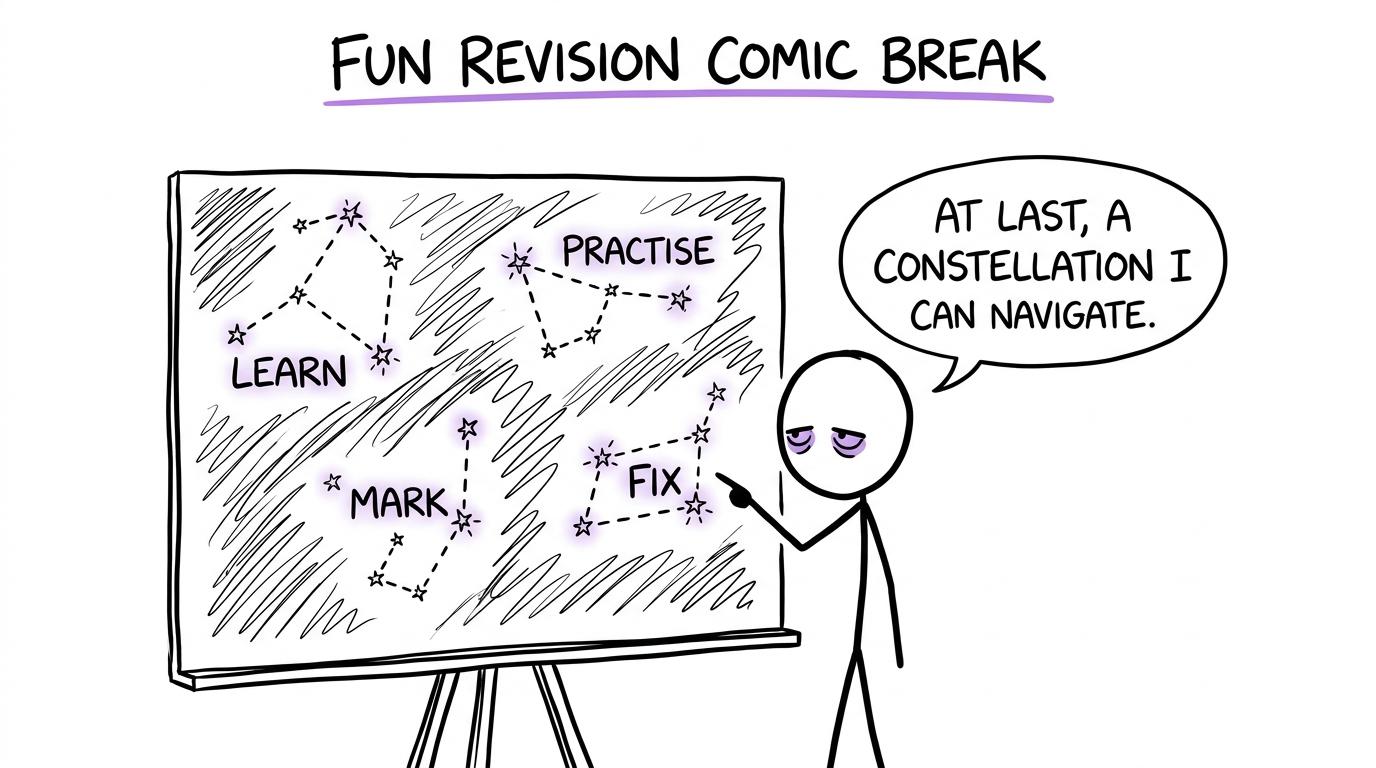 A revision planner transformed into a navigable constellation
Past papers should come later in the cycle, once you have covered most of the specification. Sit each Astronomy paper for the full 111 hour 454545 minutes, mark it honestly and separate lost marks into four categories: missing knowledge, mathematical error, weak explanation or poor time management.
For additional maths exam stamina, MathsGenie's Edexcel GCSE maths predicted papers provide timed calculation practice. They do not replace Astronomy papers, but they can strengthen the algebra, graph and number skills that support them.
Common mistakes when arranging an Astronomy retake
Booking written papers without checking observations
This is the most serious administrative mistake. Confirm that the centre will support both observations and submit the required statement before paying.
Revising an old specification
Older Astronomy materials may use different unit codes, assessment structures or controlled assessment arrangements. Check that resources refer to specification 1AS0.
Expecting a November resit
Plan for May/June unless Pearson explicitly publishes different availability for your chosen year. Waiting for an assumed autumn series could delay the qualification by a full year.
Assuming all GCSEs have foundation and higher papers
GCSE Astronomy is non-tiered. Both papers can assess a broad range of demand, so do not restrict revision according to your former GCSE maths tier.
Leaving access arrangements until the exam period
Access arrangements require evidence, assessment and centre processing. Discuss them while arranging the entry, not after receiving the timetable.
Completing papers without analysing mistakes
A total mark tells you where you are. It does not tell you what to do next. Use the same diagnose-and-repair approach described in the GCSE maths resit revision plan: mark, classify, revise and retest.
Your next step
Leaving sixth form changes who manages the paperwork, but it does not remove your opportunity to earn or improve GCSE Astronomy. Find an approved centre, name the exact specification, confirm the observation arrangements and secure your summer entry early. Only then should the qualification feel real in your calendar.
Once your entry is settled, let MathsGenie provide the structure. Use the free Astronomy revision materials, past papers and mark schemes alongside GCSE maths revision lessons, practice questions, mini tests, video solutions and predicted papers. The sky may be wide, but your next action should be small: contact one centre, open one specification topic and begin.











