

Remote Learning: GCSE Engineering Results
Remote learning GCSE engineering results rose during teacher assessment, then fell as exams returned. Explore the data and rebuild the maths skills that matter.
A results chart can tell two stories at once. One story says GCSE Engineering grades rose sharply while schools were disrupted. The other says many students lost classroom time, workshop access and face-to-face support. Both can be true.
The remote learning GCSE engineering results data does not show that school closures made students better at engineering. It mainly shows what happened when normal examinations were cancelled, assessment methods changed and practical learning became harder to deliver. Once examinations and pre-pandemic grading returned, results moved much closer to their earlier level.
For students preparing for GCSE maths now, the useful lesson is not to worry about a past cohort. It is to recognise which mathematical skills were most vulnerable during remote learning and to rebuild them deliberately.
GCSE Engineering results at a glance
The broad pattern is clear:
- Schools in England were closed to most pupils for substantial periods in 2020 and early 2021.
- Normal summer GCSE examinations did not take place in 2020 or 2021.
- Grades were based on centre assessment in 2020 and teacher assessment in 2021.
- The proportion of GCSE Engineering entries receiving grade 444 or above rose sharply during those years.
- Examinations returned in 2022, with transitional grading.
- Pre-pandemic grading standards returned in 2023, with protection for the disrupted cohort.
- Grading operated normally again in 2024 and 2025.
The important distinction is simple: results measure awarded grades, while attainment describes what students knew and could do. During the pandemic, the relationship between the two changed because the assessment system changed.
What the GCSE Engineering data shows
JCQ and EngineeringUK subject data provide the following pattern for UK GCSE Engineering entries. Grade 4/C4/C4/C is used because England reports numerical grades while Wales and Northern Ireland have retained lettered grading in relevant qualifications.
| Summer | Assessment context | Engineering entries at grade 4/C4/C4/C or above |
|---|---|---|
| 2019 | Examinations before the pandemic | 52.5%52.5\%52.5% |
| 2020 | Centre-assessed grading | 77.1%77.1\%77.1% |
| 2021 | Teacher-assessed grading | 79.1%79.1\%79.1% |
| 2022 | Examinations with transitional grading | 71.3%71.3\%71.3% |
| 2023 | Return to pre-pandemic standards | 57.4%57.4\%57.4% |
| 2024 | Normal examinations and grading | 55.2%55.2\%55.2% |
The increase from 2019 to 2021 was:
79.1%−52.5%=26.6 percentage points 79.1\%-52.5\%=26.6\text{ percentage points} 79.1%−52.5%=26.6 percentage pointsThat is a large movement, but it should not be interpreted as a sudden improvement in engineering knowledge. The 2020 and 2021 grades were produced under exceptional arrangements, using evidence such as mock examinations, class assessments and completed non-exam assessment.
The latest JCQ data for all UK entries reports that 61.5%61.5\%61.5% achieved grade 4/C4/C4/C or above in 2025, compared with 55.2%55.2\%55.2% in 2024. However, entries fell from 3,0183{,}0183,018 to 2,4762{,}4762,476. With a relatively small and changing subject cohort, annual percentages can move because the group taking the qualification has changed, as well as because performance has changed.
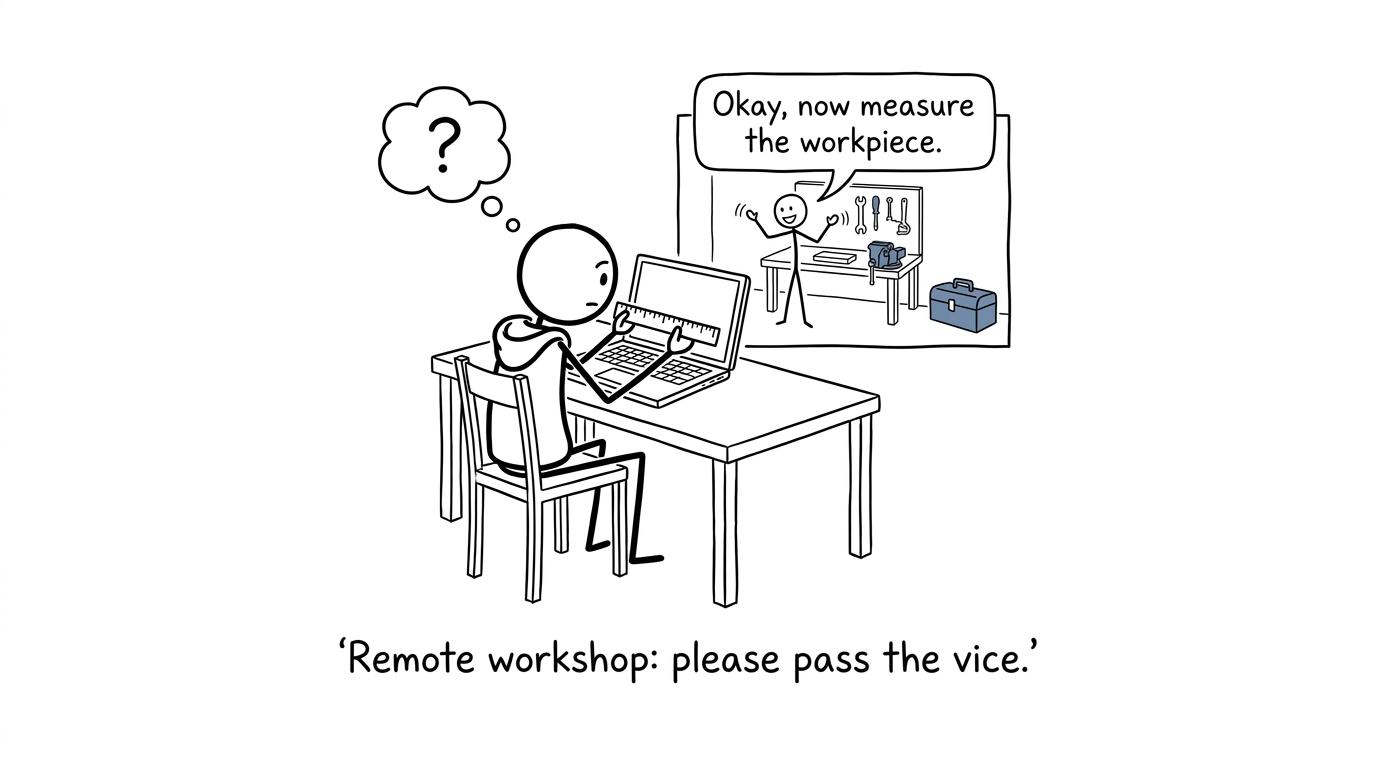 A student discovers the difficulty of running a workshop through a laptop
Why grades rose while learning was disrupted
This is the apparent contradiction at the centre of the data. Ofqual’s research found that the quality and quantity of learning generally declined during the pandemic, yet awarded grades increased.
The explanation lies in assessment rather than one single change in student ability.
Examinations were cancelled
Students sitting GCSEs in summer 2020 and 2021 did not complete the usual national examination series. In 2021, teachers determined grades from a range of evidence and students were assessed on content they had been taught.
This protected students from being examined in the normal way after highly uneven disruption. It also means that the resulting grade distributions are not directly comparable with examination years.
Evidence was produced in different settings
A national examination gives students the same paper under standardised conditions. Teacher assessment used evidence produced across schools, lessons, mock examinations and non-exam assessment. Quality assurance was applied, but the process was necessarily different.
Ofqual reported that overall GCSE outcomes at grade 777 and above increased from 20.7%20.7\%20.7% in 2019 to 28.5%28.5\%28.5% in 2021. At grade 444 and above, the national figure increased from 67.1%67.1\%67.1% to 76.9%76.9\%76.9%. Engineering followed the same broad direction, although its movement was larger.
Practical subjects faced particular barriers
Engineering is not simply a written body of knowledge. Students may need access to tools, materials, manufacturing processes, specialist software and supervised practical environments.
ONS research found that remote learners generally covered less material than pupils learning in school, with a particularly large reduction in arts subjects including design and technology. Ofqual’s review also identified disruption to practical skills where students could not access equipment.
A demonstration can be watched online. The judgement developed by measuring, making, testing and correcting a physical outcome is harder to replace.
How remote learning affected the maths behind engineering
Ofqual’s review found that secondary leaders were particularly concerned about fractions, trigonometry and mathematical problem solving. These are not isolated classroom topics. They are part of the language of engineering.
Students may need to:
- use ratio and proportional reasoning;
- convert between units accurately;
- interpret graphs and technical information;
- calculate area, surface area and volume;
- apply Pythagoras’ theorem and trigonometry;
- rearrange formulae;
- work with speed, density and pressure;
- judge whether an answer is realistic.
For example, the relationships
density=massvolume \text{density}=\frac{\text{mass}}{\text{volume}} density=volumemassand
pressure=forcearea \text{pressure}=\frac{\text{force}}{\text{area}} pressure=areaforcerequire more than remembering a formula. You must recognise the quantities, use consistent units and rearrange the relationship when a different variable is required.
The MathsGenie speed and density revision resources bring these connected rates together. Students who need to rebuild proportional reasoning can also revisit the ratio revision guide.
Engineering drawings create another important connection. A scale of 1:501:501:50 means that one unit on the drawing represents 505050 of the same units in reality. The scale drawings revision guide helps turn that definition into reliable exam technique.
What has changed since school closures?
The assessment system has moved through three distinct stages.
In 2022, examinations returned, but Ofqual used a transitional approach intended to produce outcomes between 2019 and 2021 levels. Engineering’s grade 4/C4/C4/C rate fell to 71.3%71.3\%71.3%, still well above its 2019 figure.
In 2023, grading returned to pre-pandemic standards, with system-level protection recognising the disruption experienced by that cohort. Engineering’s grade 4/C4/C4/C rate fell to 57.4%57.4\%57.4%, much closer to 2019.
Normal grading continued in 2024 and 2025. This makes recent results more useful than 2020 or 2021 when considering current examination standards. It does not mean every effect of the pandemic disappeared at once, but the unusual awarding arrangements did.
Students should therefore use current specification materials, rather than assuming pandemic-era outcomes reveal what grade boundaries will be. Grade boundaries are set after marking and can change between series. MathsGenie’s AQA GCSE Engineering grade boundaries show how the required raw marks have varied over time.
What the figures cannot prove
The results provide evidence of a pattern, not a controlled experiment.
They cannot isolate the effect of remote teaching from:
- cancelled examinations;
- centre- and teacher-assessed grading;
- changes to assessment evidence;
- differences in practical access;
- uneven disruption between students and schools;
- changing entry numbers and cohort composition;
- transitional grading in 2022.
It would therefore be too strong to say that remote learning caused a particular percentage-point fall or rise. A more accurate conclusion is that remote learning disrupted the acquisition of mathematical and practical skills, while alternative assessment produced higher awarded grades in 2020 and 2021.
That distinction matters. Data becomes misleading when correlation is asked to do the work of causation.
A revision response that works now
You cannot change how earlier cohorts were assessed. You can make your own mathematical foundation stronger.
Start with the GCSE maths revision hub, select your board and confirm whether you are taking foundation or higher tier. Edexcel, AQA, OCR and Eduqas cover the same national GCSE maths content, although their specifications organise and examine it differently.
Use this short cycle:
- Diagnose: complete a mini test or timed paper section.
- Classify: decide whether each lost mark came from knowledge, accuracy, units or interpretation.
- Repair: use one revision lesson and a focused set of practice questions.
- Retest: answer fresh questions without notes.
- Mix: place the skill inside a past paper once it feels secure.
Geometry is especially valuable for students interested in engineering. The shape revision collection covers areas including bearings, surface area, volume, Pythagoras and trigonometry. Higher-tier students can extend this through similar shapes involving area and volume.
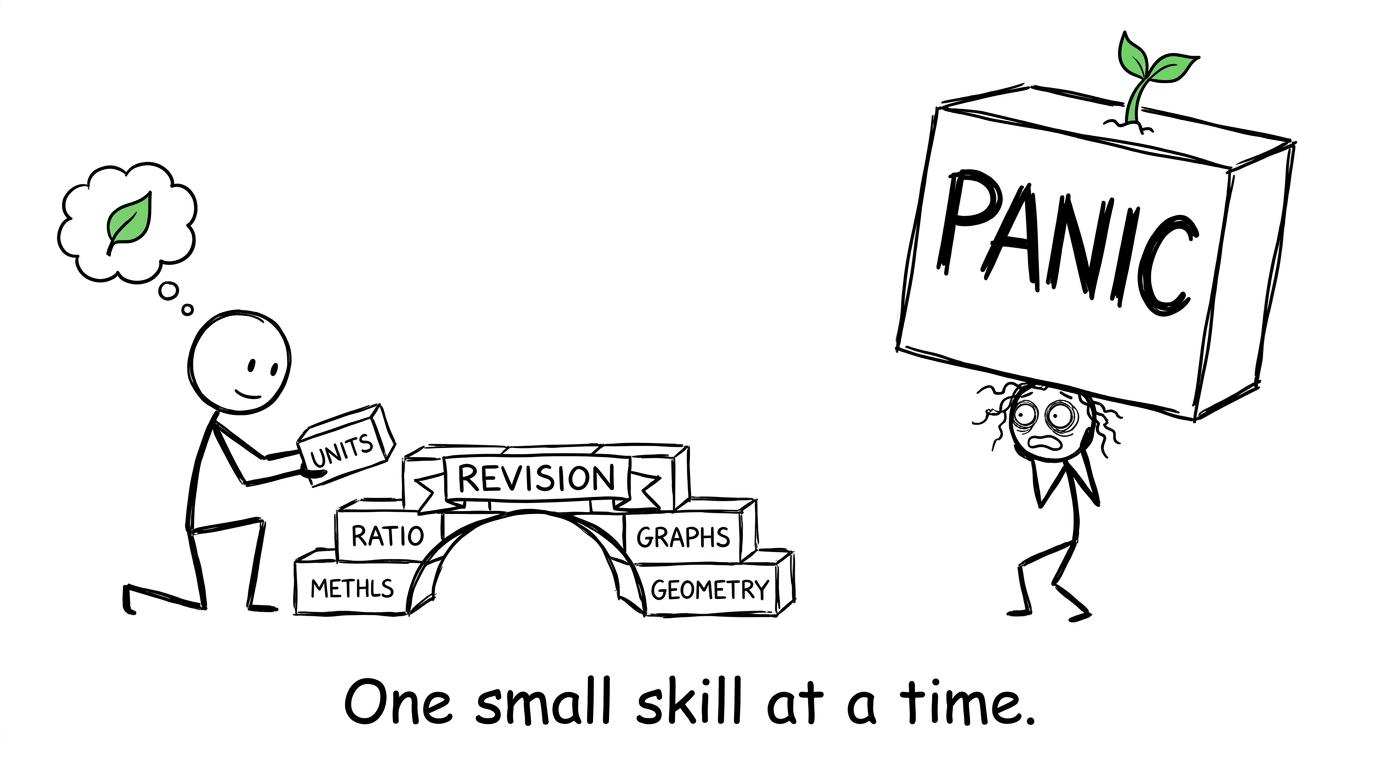 A student builds revision one small skill at a time
Common mistakes when reading the results
Treating higher grades as proof of more learning
Grades rose during alternative assessment, while authoritative research identified lost learning. Awarded outcomes and underlying attainment were not moving in the same way.
Comparing percentages without checking assessment conditions
The 2019 and 2024 results came from normal examinations. The 2021 results came from teacher assessment. Placing them in one graph is useful, but treating them as identical measurements is not.
Calling grade 444 a guaranteed pass for every purpose
Grade 444 is commonly described as a standard pass in England. Colleges, apprenticeships and employers can still set their own entry requirements, and arrangements differ across UK jurisdictions.
Ignoring the size of the cohort
GCSE Engineering has far fewer entries than subjects such as maths. Changes in who takes the qualification can have a noticeable effect on national percentages.
Revising only the formula sheet
Engineering-related maths depends on interpretation, units and multi-step reasoning. Knowing that V=lwhV=lwhV=lwh is not enough if measurements use inconsistent units or the required dimension is unclear.
The lasting lesson
Remote learning affected GCSE Engineering in two different ways. It reduced access to normal teaching, equipment and practical experience, while emergency assessment arrangements protected students from sitting conventional examinations after unequal disruption. That is why grades rose before moving back towards pre-pandemic patterns when examinations returned.
For today’s student, the response is reassuringly practical. Build the maths one skill at a time. Use revision lessons to understand, practice questions to gain fluency, mini tests to expose gaps and mark schemes to learn where marks are awarded. Then use past papers and predicted papers to develop timing and independence.
Begin with the free MathsGenie GCSE revision resources, or follow the efficient GCSE maths revision method. The past cannot be re-sat. Your next question can, and that is where improvement begins.










