Regret Picking GCSE Chemistry? What to Check
Regret picking GCSE Chemistry? Understand the workload, maths, practicals and misconceptions to check before choosing separate chemistry at GCSE.
Choosing GCSE options can feel strangely permanent. A subject that looked interesting in Year 9 may feel very different once equations, practical methods and unfamiliar terminology arrive together. If you regret picking GCSE Chemistry, the short answer is this: chemistry is demanding because it combines detailed knowledge, abstract models, mathematical reasoning and practical analysis. But difficulty is not the same as a bad decision.
Before changing course or assuming you cannot succeed, identify the precise source of the problem. It may be the volume of content, the calculations, the way questions are worded or simply an ineffective revision routine. Each needs a different response.
A quick checklist before choosing GCSE Chemistry
Check these points with your teacher because schools organise science options differently:
- Are you choosing separate sciences, sometimes called triple science, rather than GCSE Chemistry entirely on its own?
- Which exam board does your school use: AQA, Edexcel, OCR or Eduqas?
- Will you study foundation or higher tier, and when is that decision normally made?
- How many lessons will separate chemistry add to your timetable?
- Do you enjoy explaining why reactions happen, not merely watching practical demonstrations?
- Are you prepared to learn chemical formulae, practical methods and precise scientific vocabulary?
- How comfortable are you with ratios, percentages, graphs, standard form and rearranging equations?
- What happens if you later want to move between separate and combined science?
This distinction matters. In many English schools, science is part of the core curriculum, while the option is whether to take separate GCSEs in Biology, Chemistry and Physics or a combined science route. Arrangements vary by school, so never make the decision from an option-booklet title alone.
Why some students regret picking GCSE Chemistry
There is no reliable national ranking of reasons students regret an option. However, several concerns follow directly from what GCSE Chemistry specifications require and commonly make the course feel different from what students expected.
The subject is more abstract than the practical demonstrations suggest
Colour changes, flames and reactions are memorable. They are also only the visible surface of chemistry.
The examined course asks you to explain matter using particles too small to see. You must connect atomic structure, electron arrangements, bonding and intermolecular forces to observable properties. Later topics depend on earlier ones: weak understanding of bonding can make electrolysis, rates and organic chemistry harder.
That creates a particular kind of frustration. A student may remember the classroom demonstration but struggle to explain it using the model expected by the mark scheme. Chemistry rewards precise causal chains rather than vague descriptions such as “the particles react more”.
There is substantial content to remember
Separate chemistry includes ideas beyond those studied in combined science, although the exact organisation varies between specifications. Students may need to retain reaction patterns, ion tests, equations, conditions, practical methods and explanations of unfamiliar situations.
The problem is not just quantity. Different facts are easy to confuse. A test for a gas is not the same thing as a test for an ion; a word equation is not a balanced symbol equation; an observation is not an explanation.
Passive rereading makes this workload look manageable because the page feels familiar. The weakness appears when the book closes. If you dislike self-testing, correcting errors and revisiting old topics, chemistry can become uncomfortable quickly.
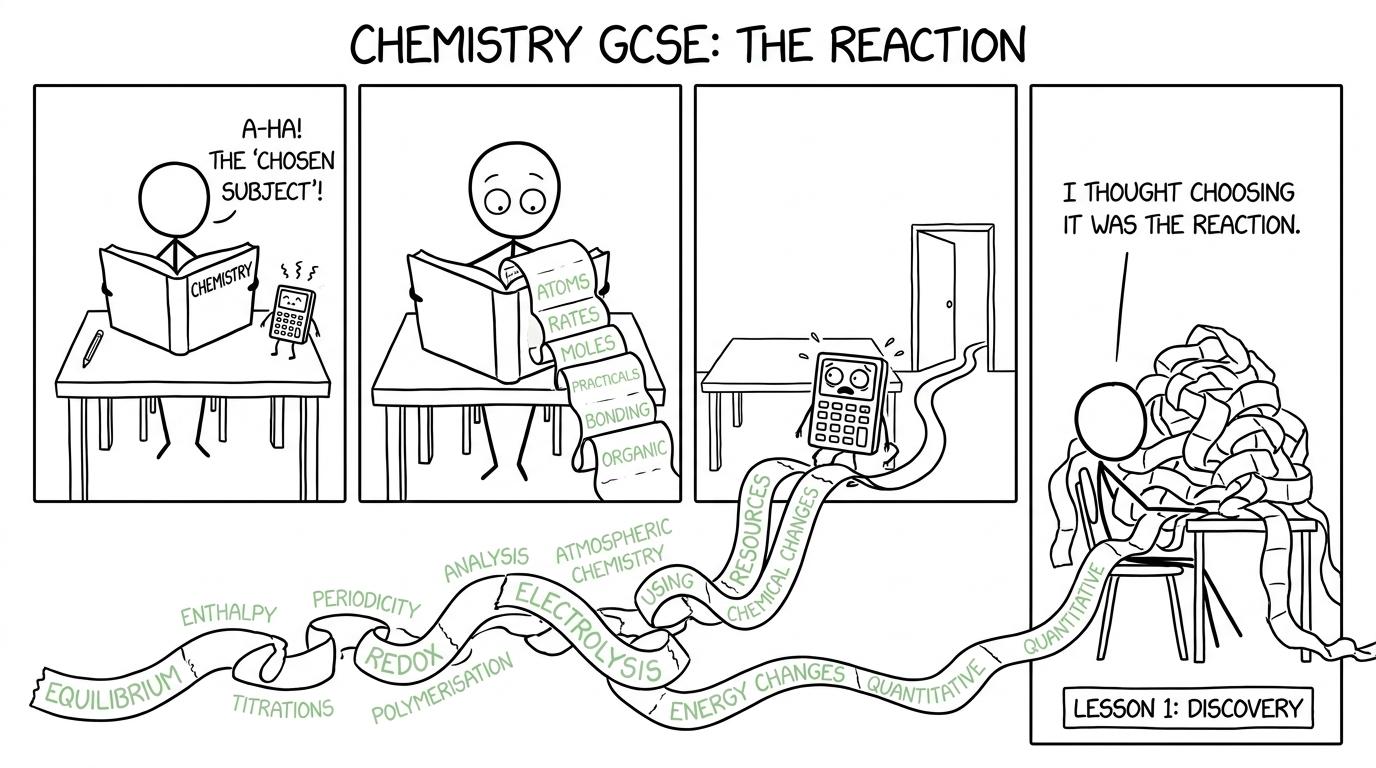 A student discovers that a chemistry textbook has rather more topics than expected
The maths is easy to underestimate
Official GCSE science subject content requires chemistry students to use mathematical skills including decimals, standard form, ratios, fractions, percentages, significant figures, means, graphs, substitution and changing the subject of an equation. The required maths does not go beyond the corresponding GCSE Maths tier, but chemistry adds an unfamiliar scientific context.
Quantitative chemistry can involve relationships such as:
amount in moles=massMr\text{amount in moles}=\frac{\text{mass}}{M_r}amount in moles=Mrmassand
concentration=amount of solutevolume\text{concentration}=\frac{\text{amount of solute}}{\text{volume}}concentration=volumeamount of soluteThe calculation is often not the true obstacle. Students lose direction because they must select the relationship, convert units, interpret a chemical equation and present the answer appropriately.
This is where maths revision pays twice. Secure percentage skills support percentage yield and composition. Confident ratio revision helps with balanced equations and reacting quantities. Standard form becomes important when quantities are extremely large or small.
If calculations are the main reason you regret the option, that is useful news. It identifies a repairable skills gap rather than proving that you are “bad at chemistry”.
Practical work is examined in writing
Students sometimes choose chemistry because they enjoy experiments, then discover that practical skills must also be explained on paper.
Current specifications require practical experience, but the organisation differs. AQA lists eight required practical activities for separate chemistry. Edexcel identifies eight mandatory core practicals. OCR uses Practical Activity Groups and requires learners to complete the specified practical experience. Questions can assess apparatus, variables, measurements, safety, results, graphs and improvements to a method.
For AQA, questions drawing on required practical knowledge account for at least 15%15\%15% of the qualification marks. That does not mean simply memorising eight scripts. You may need to apply practical understanding in a new situation.
A practical that felt straightforward in the laboratory can therefore produce a demanding written question months later. Students should record the purpose, variables, method, expected observations, sources of uncertainty and safety decisions while the activity is still fresh.
Precise language matters
Chemistry contains pairs of terms that sound similar but are not interchangeable: atom and ion, intermolecular force and covalent bond, concentrated and strong, accuracy and precision.
This can make marking feel unforgiving. Usually, however, the mark scheme is protecting a scientific distinction. The solution is not to produce longer answers. It is to learn the smallest accurate explanation that links cause to effect.
The same discipline helps in maths. A correctly labelled graph, visible substitution and appropriate units make reasoning easier to follow. Browse the GCSE maths topics by board and tier to identify the transferable skills your chemistry course assumes.
What to check before you commit
Read the actual specification outline
Do not choose from the word “chemistry” alone. Ask for the exam board and compare separate chemistry with your school’s combined science route. Look at the additional topics, lesson allocation and assessment structure.
AQA, Edexcel, OCR and Eduqas meet national requirements but organise and describe content differently. Your school may also set entry guidance based on internal assessments and timetable capacity.
Inspect questions, not just topic names
A topic called “rates of reaction” may sound familiar. Its examination questions can require graph interpretation, evaluation of a method and particle-level explanation in the same sequence.
Look at a few representative questions with your teacher. You are not testing whether you already know the answers. You are checking whether you are willing to learn that style of thinking.
Diagnose your maths honestly
You do not need to be the strongest mathematician in your year. You do need a plan for weaknesses in number, algebra and graphs.
Start from the Edexcel GCSE Maths revision hub, or select the equivalent board from MathsGenie. Use short topic sessions rather than vaguely “doing maths”. The best order for learning GCSE maths topics is helpful if several foundations need rebuilding.
Think about the whole timetable
One difficult subject can be manageable. Several content-heavy options competing for the same evenings can be harder.
Consider how you currently organise homework, retrieval practice and assessment preparation. Do not base the decision only on a future career, friendship group or one enjoyable lesson. Chemistry can support later scientific study, but choosing it does not commit you to becoming a chemist, and not choosing separate chemistry does not make your other GCSEs less valuable.
If you already regret choosing it
First, separate emotion from evidence. “I hate this” after one difficult test is different from a sustained mismatch across several topics and assessments.
Use a simple review:
- List the marks lost by category: knowledge, application, maths, practical understanding or exam technique.
- Choose the two largest categories.
- Practise those skills in short, focused sessions.
- Re-test them using a different question set.
- Speak to your chemistry teacher before considering any course change.
MathsGenie’s guide to finding your weakest GCSE topics provides a useful diagnostic method. For calculation confidence, try GCSE maths mini tests and mark them carefully.
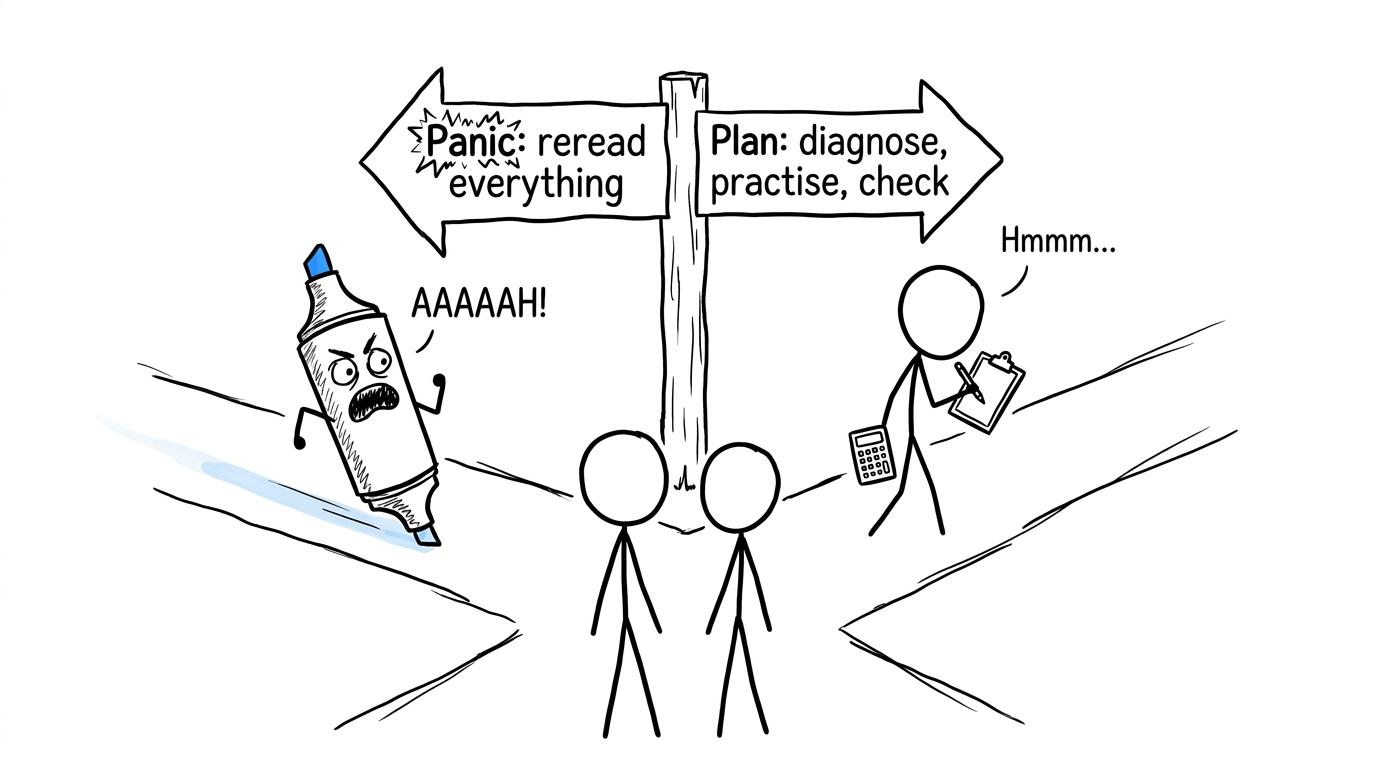 A calm revision plan defeats a runaway highlighter
Do not change an option without discussing deadlines, consequences and alternatives with your school. A move may be possible early in the course but difficult later because teaching time and content differ.
Common mistakes when deciding or revising
- Assuming practical enjoyment guarantees course enjoyment. Examination chemistry also requires abstract explanation, calculation and extended written reasoning.
- Believing combined science contains no chemistry. Combined science still includes substantial chemistry; separate science generally adds breadth or depth and leads to a distinct GCSE Chemistry grade.
- Treating one low mark as a final verdict. Diagnose whether the issue was knowledge, maths, wording or preparation before judging the subject.
- Ignoring units and significant figures. A correct numerical method can still produce an incomplete scientific answer.
- Memorising calculations without understanding the quantities. Learn what each term and unit represents before substituting values.
- Rereading instead of retrieving. Close the notes, recall the method or explanation, then check it.
- Using predicted papers as predictions of exact questions. They are best treated as fresh practice. MathsGenie’s GCSE Maths predicted papers should be marked and followed by targeted revision.
Turn regret into a better decision
GCSE Chemistry can feel regrettable when the real course does not match the imagined one. The subject is not simply experiments, and its challenge is not simply memorisation. It asks you to move between particles, equations, evidence, calculations and practical methods.
That combination may be exactly what you enjoy. If it is not, finding out before committing is sensible rather than negative. Check your school’s route, read the specification outline, inspect real question styles and assess your willingness to practise the required maths.
If you have already chosen chemistry, begin with evidence rather than panic. Use MathsGenie’s free revision lessons and practice questions to strengthen percentages, ratio, algebra and graphs. Then use mini tests, past papers, predicted papers, mark schemes and video solutions to make those skills dependable for your maths exams and transferable to science.
One honest diagnostic session is more valuable than another evening spent worrying about the option. Open MathsGenie, choose the weakest underlying maths skill and make the next mark easier to earn.