Redo GCSE Further Maths Mock Timed: Is It Worth It?
Redo GCSE Further Maths mock timed or review it first? Learn when a full resit helps, when it wastes revision time, and how to plan for exam day.
A mock paper can feel strangely unfinished after it has been marked. You can see the lost marks. You may even recognise the methods you should have used. The tempting response is to start the clock and do the whole thing again.
If you are asking whether to redo GCSE Further Maths mock timed, the short answer is: usually not immediately. Reviewing the first attempt, repairing the specific weaknesses and then testing yourself on fresh questions is normally a better use of revision time. A complete timed reattempt becomes valuable later if timing, stamina or decision-making caused a significant part of the problem.
The distinction matters. Reviewing builds mathematical ability. Timed papers test whether that ability survives exam pressure. You eventually need both, but not always in the same session.
The quick decision checklist
Redo the entire mock under timed conditions if:
- you left several questions unfinished because you ran out of time;
- you struggled to choose which questions to attempt first;
- concentration dropped noticeably during the paper;
- you have since revised the topics that caused difficulty;
- enough time has passed for the paper to feel less familiar;
- you need to practise the exact calculator or non-calculator conditions.
Review the first attempt instead if:
- you could not start several questions because you did not know the methods;
- most lost marks came from one or two weak topics;
- you still remember many answers from the marking process;
- the examination is close and your revision time is limited;
- you have an unused paper that would give a more honest test.
The best default sequence is review, repair, retest and then complete a fresh timed paper.
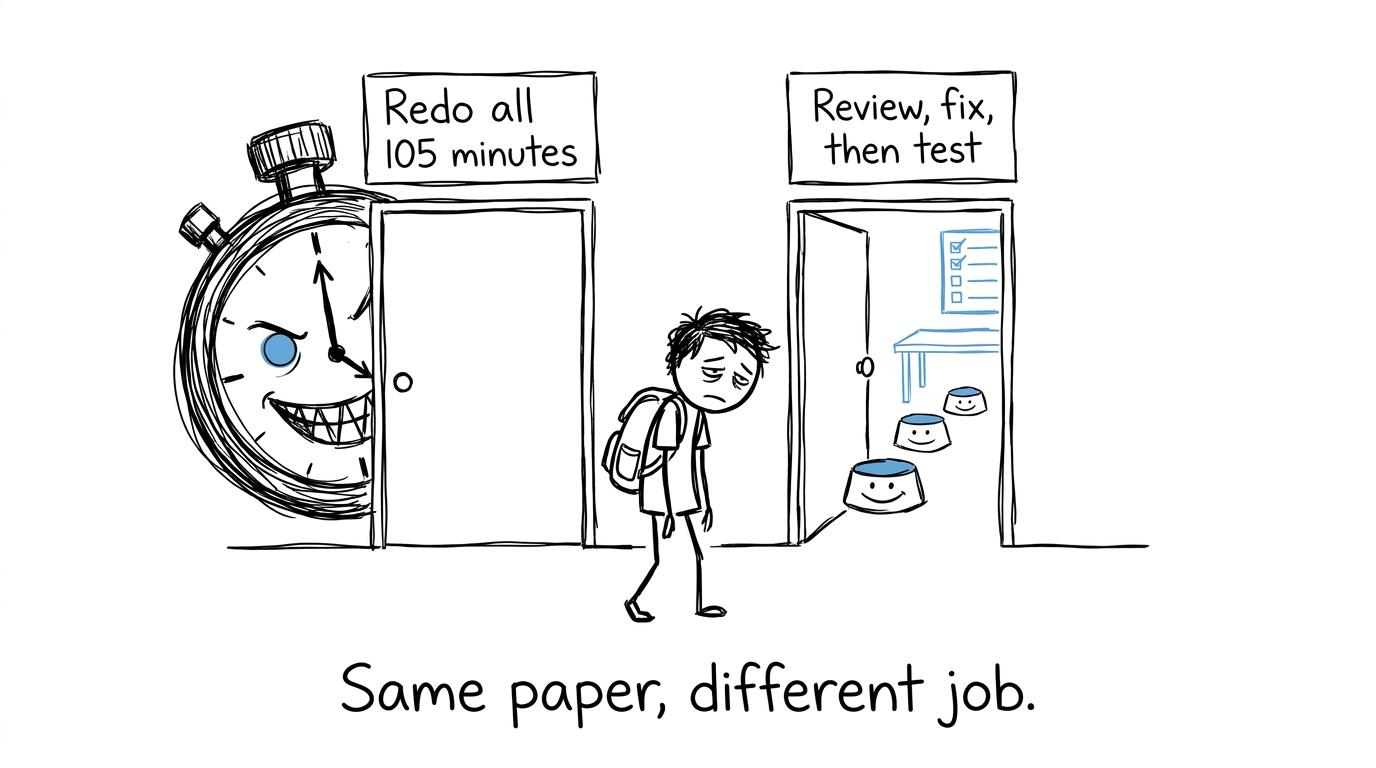 A student choosing between repeating a whole mock and reviewing before retesting
Understand which Further Maths qualification you take
“GCSE Further Maths” is often used informally, but schools enter students for different qualifications. Check the title, awarding body and paper code with your teacher before copying timings or calculator rules from somebody else.
For example, the current AQA Level 2 Certificate in Further Mathematics is a linear qualification with two papers. Paper 1 is non-calculator and Paper 2 permits a calculator. Each paper is worth 808080 marks and lasts 111 hour 454545 minutes. The qualification is not divided into foundation and higher tiers.
OCR Additional Mathematics is different: it is a Level 3 Free Standing Maths Qualification with its own specification and assessment structure. It should not be treated as another version of the AQA paper. Your school might also use a shortened, adapted or internally produced mock, so follow the time printed on that particular paper.
Students taking AQA can find the correct papers, mark schemes and available solutions in the AQA GCSE Further Maths past papers collection. Matching the paper to your actual qualification is the first part of realistic practice.
Why reviewing the first attempt usually comes first
A completed mock contains more useful information than its total mark suggests. It shows where your performance broke down. The important task is to identify why.
Classify every lost mark under one of these headings:
- Knowledge: you did not know the relevant fact, definition or method.
- Method: you recognised the topic but could not organise a valid solution.
- Accuracy: the approach was sound, but algebra, arithmetic or notation failed.
- Interpretation: you misread the instruction, diagram or required form.
- Timing: you could probably answer the question but did not reach or finish it.
This prevents a common mistake: treating every incorrect answer as a timing problem. A faster attempt will not repair an insecure method. It may simply produce the same error sooner.
Use the mark scheme to inspect what was actually rewarded, including intermediate method marks. Then use a video solution or revision lesson where you cannot explain the missing step independently. The process in how to use past papers properly is equally useful for a Further Maths mock: mark, diagnose, repair and retest.
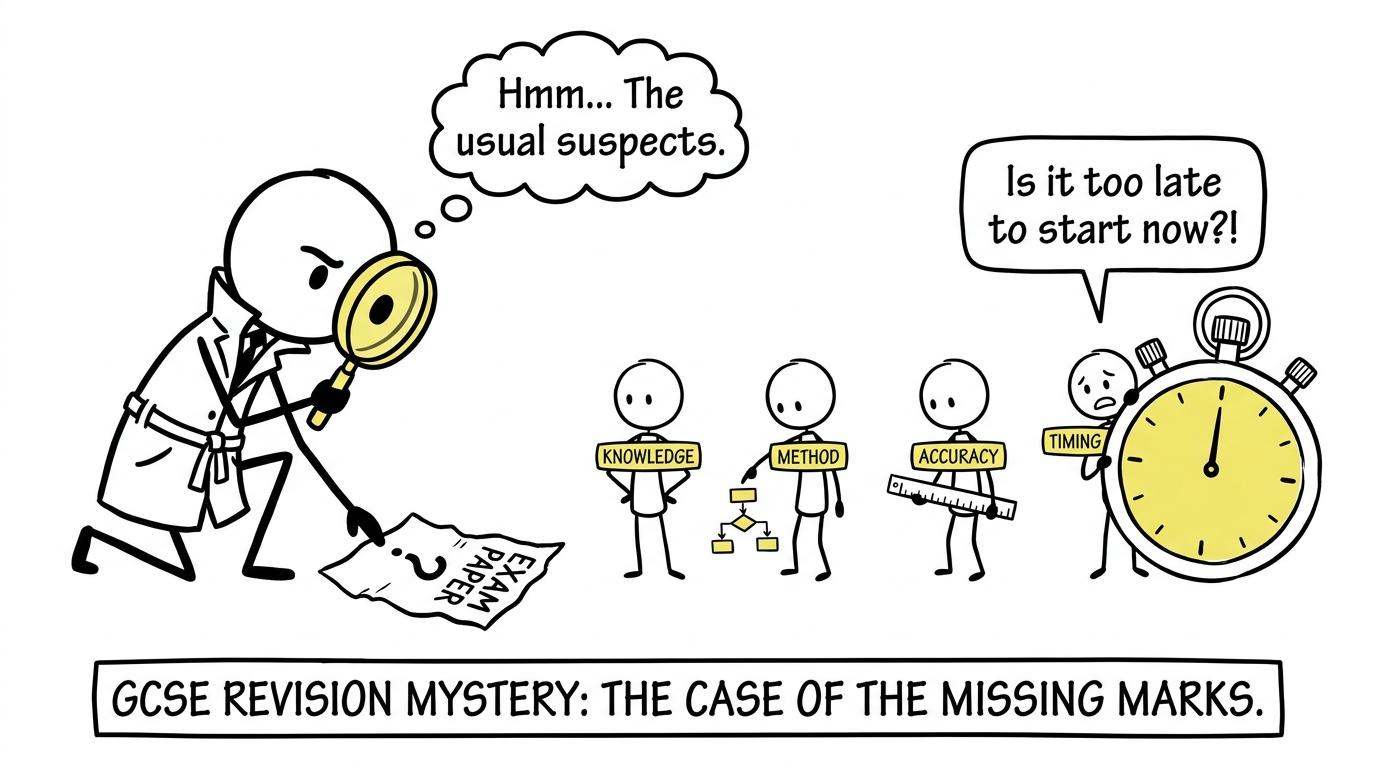 A mock-paper detective questioning knowledge, method, accuracy and timing
When a full timed redo is genuinely worthwhile
A full reattempt has a specific purpose: it tests whether you can execute improved methods while managing a complete paper. It is not the most efficient way to learn those methods for the first time.
Timing was the main weakness
A timed redo can help if blank final pages, rushed working or abandoned questions show that time management cost marks. Pay attention to checkpoints rather than staring continuously at the clock. Record where you were at several stages and whether difficult questions trapped you for too long.
For an AQA paper lasting 105105105 minutes and carrying 808080 marks, the crude average is
10580=1.3125\frac{105}{80}=1.312580105=1.3125minutes per mark. This is only a planning guide. Some short questions should take less time, while demanding proofs or multi-stage problems may need longer. The useful habit is moving on before one question consumes the time needed for several accessible marks.
You need to build concentration
Knowing Further Maths in a quiet ten-minute practice set is not quite the same as sustaining careful algebra for an entire paper. A full sitting can reveal whether handwriting deteriorates, checking disappears or frustration from one question affects the next.
That is why official guidance for exam-like school assessments emphasises independent work, appropriate supervision, no revision notes and timing equivalent to the intended assessment. At home, recreate what you reasonably can: a clear desk, phone elsewhere, correct equipment and no pausing.
If you have approved access arrangements, practise using them as directed by your school. The goal is to rehearse your real conditions, not to prove that you can work without support to which you are entitled.
You have repaired the underlying gaps
A redo is most informative after targeted revision. Suppose the first paper exposed weaknesses in algebraic fractions, functions and differentiation. Revisit the appropriate specification content, complete focused questions and confirm that you can use each method without notes. For overlapping algebra skills, MathsGenie’s algebraic fractions revision guide can help secure the GCSE foundation beneath more demanding questions.
Only then should you ask whether the complete performance has improved.
Why repeating the same paper can mislead you
The second mark will often rise. That does not automatically mean your unseen-paper performance has risen by the same amount.
You may remember an answer, the shape of an argument or the point at which you previously went wrong. That familiarity reduces the demand of choosing a method. The score is therefore evidence of improved execution, but it is not a clean prediction of what will happen on a fresh paper.
To avoid false confidence, separate two questions:
- Can I now complete this corrected paper accurately and on time?
- Can I transfer the improvement to unfamiliar questions?
The repeated mock answers the first question. A fresh past paper, predicted paper or mixed set answers the second. Transfer is the stronger evidence.
A better revision cycle than simply resitting
A productive cycle can be completed over several days.
Audit the marked mock
Mark strictly and create a short error log. Record the topic, error type, marks lost and one next action. The guide to finding your weakest GCSE maths topics explains how to turn paper evidence into priorities rather than revising whatever feels comfortable.
Repair the highest-value weaknesses
Choose the small number of weaknesses responsible for the most lost marks. Use revision lessons and practice questions, then attempt new questions without looking at the solution. The GCSE Maths revision hub is useful for strengthening prerequisite algebra, graphs and trigonometry alongside your dedicated Further Maths work.
Retest in short timed sections
Do not jump straight from correction to another long paper. Start with a short timed set containing the skills you repaired. This reveals whether the method can now be retrieved under pressure.
MathsGenie’s GCSE mini tests can provide short practice for overlapping GCSE skills, although they do not replace a Further Maths paper or its specification.
Use a fresh complete paper
Once the short retests are secure, sit an unused Further Maths paper under the correct conditions. This is a better measure of transfer, timing and stamina than an immediate repeat.
You can still return to the original mock later. If you do, treat it as a fluency check rather than an independent prediction of your grade.
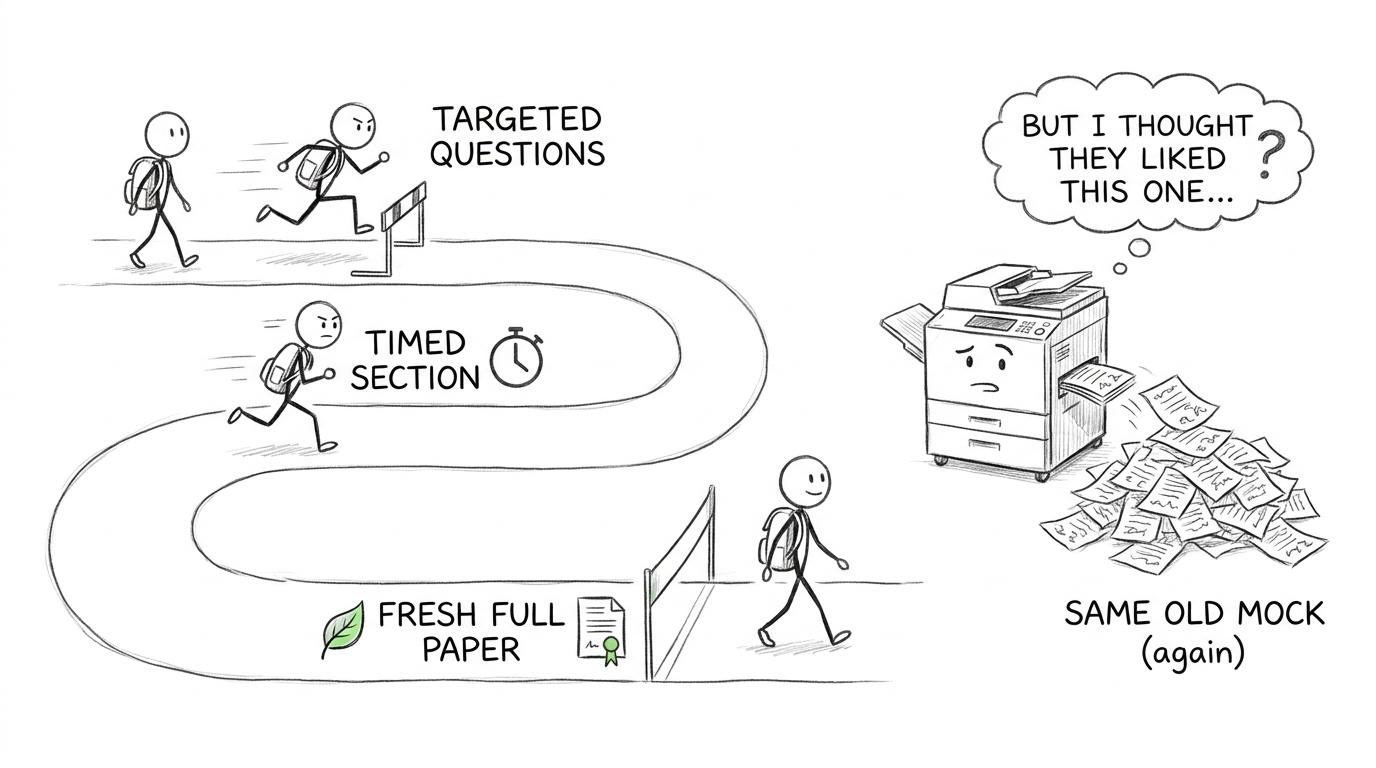 A revision track moving from targeted questions to a fresh full paper
How to fit the mock into your revision plan
When the examination is several weeks away, spend more time repairing knowledge and less time repeatedly sitting full papers. Gradually increase timed, mixed practice as the exam approaches. A structured GCSE maths revision timetable can help you balance topic work, marking and paper practice.
If schoolwork and other subjects leave little time, use the same logic in smaller sessions. The twenty-minute maths revision routine shows how active questions and immediate marking can keep progress moving between longer paper sessions.
Do not measure revision only by hours or completed papers. A better question is: what can I now do independently that I could not do before?
Common mistakes when redoing a Further Maths mock
Reattempting before reviewing
This repeats the test without changing the knowledge being tested. Mark, diagnose and repair first.
Giving yourself remembered marks
If you recall an answer without being able to reconstruct the reasoning, the topic is not secure. Require complete working where the question or mark scheme expects it.
Timing every revision activity
Time pressure is useful for performance practice, not for the first careful attempt at understanding a difficult method. Learn accurately before trying to become fast.
Comparing raw marks from unequal papers
A school mock, specimen paper and past paper may differ in difficulty or coverage. Compare error patterns and topic security as well as totals. Grade boundaries also vary by paper series and qualification.
Ignoring calculator and paper rules
Use the equipment permitted for the exact component. A calculator attempt does not realistically rehearse a non-calculator paper.
Doing the paper but postponing the marking
The value of practice comes from the feedback loop. Mark while your decisions are still fresh enough to analyse.
Make the next paper more useful than the last
Redoing an entire mock under timed conditions can be worthwhile, but only when it answers a real question about timing, stamina or exam technique. If the first attempt mainly exposed gaps in knowledge, reviewing and repairing those gaps gives a better return. Then test the repair on unfamiliar material.
Start with MathsGenie’s free AQA Further Maths past papers, mark schemes and available solutions. Combine them with revision lessons, practice questions and short tests for weak prerequisite skills. As the examination approaches, add fresh past papers and predicted papers under realistic conditions.
The aim is not to become brilliant at one familiar mock. It is to become ready for the paper you have not seen yet.