- How algebraic fractions work like ordinary fractions.
- How to simplify them by factorising and cancelling.
- How to divide algebraic fractions safely.
- How to solve equations and ratio problems involving algebraic fractions.
An algebraic fraction is just a fraction where the numerator, the denominator, or both contain algebra.
The numerator is the top of a fraction. The denominator is the bottom of a fraction.
Algebraic fraction
An algebraic fraction is a fraction made from algebraic expressions, such as x+3x−2\frac{x+3}{x-2}x−2x+3 or x2+5xx2−4\frac{x^2+5x}{x^2-4}x2−4x2+5x.
The big idea is that algebraic fractions follow the same rules as number fractions: you simplify by cancelling common factors, not random terms.
Factor
A factor is something being multiplied. For example, in 3(x+2)3(x+2)3(x+2), the factors are 3 and x+2x+2x+2.
Only cancel factors
You can cancel a bracket or expression only when it is multiplying the whole numerator and the whole denominator.

Simplifying by cancelling a common factor
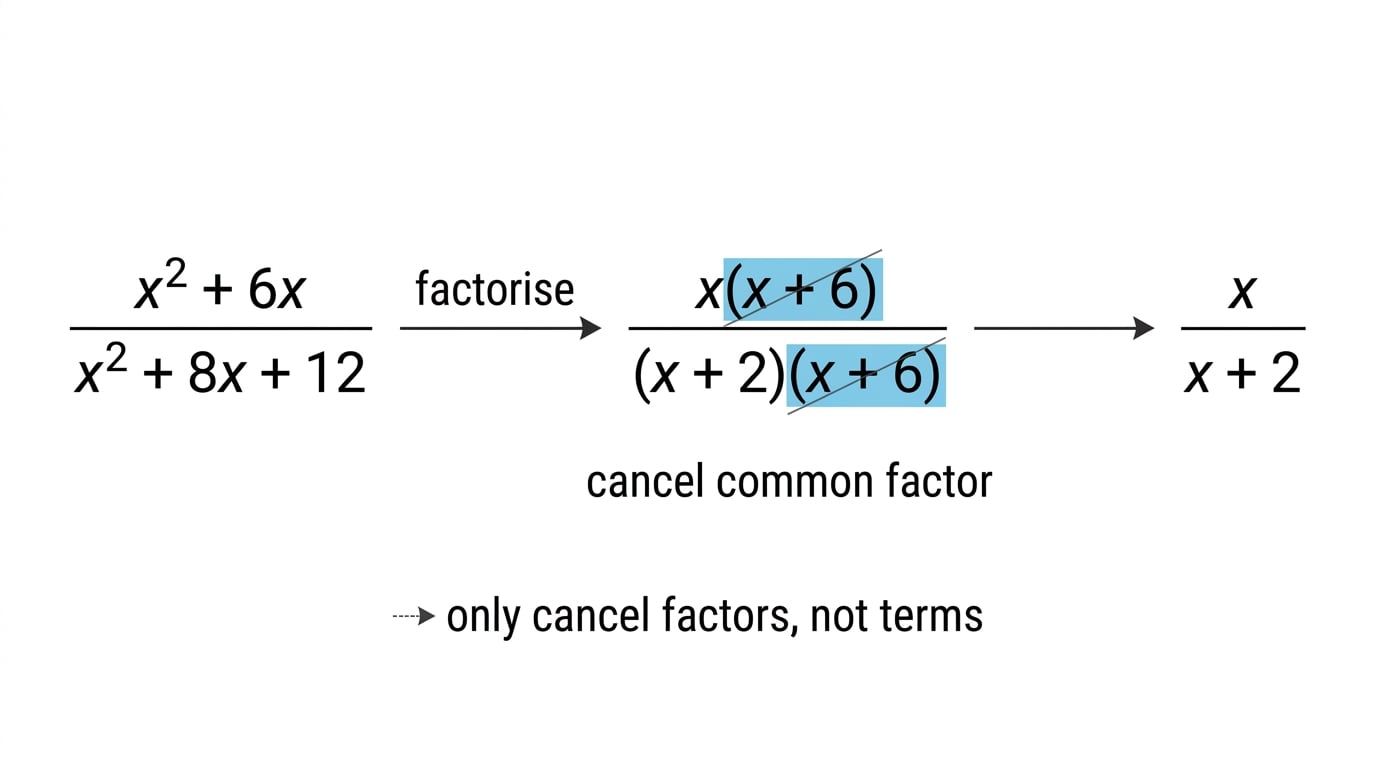
Simplify fully x2+6xx2+8x+12\frac{x^2+6x}{x^2+8x+12}x2+8x+12x2+6x.

-
Factorise the numerator by taking out the common factor xxx:
x2+6x=x(x+6)x^2+6x=x(x+6)x2+6x=x(x+6)
-
Factorise the denominator by finding two numbers that multiply to 12 and add to 8:
x2+8x+12=(x+2)(x+6)x^2+8x+12=(x+2)(x+6)x2+8x+12=(x+2)(x+6)
-
Rewrite the fraction using these factors:
x2+6xx2+8x+12=x(x+6)(x+2)(x+6)\frac{x^2+6x}{x^2+8x+12}=\frac{x(x+6)}{(x+2)(x+6)}x2+8x+12x2+6x=(x+2)(x+6)x(x+6)
-
Cancel the common factor x+6x+6x+6:
xx+2\frac{x}{x+2}x+2x
Cancelling terms
Do not cancel part of a sum. In x+4x2−16\frac{x+4}{x^2-16}x2−16x+4, you cannot cancel the xxx with x2x^2x2 or the 4 with 16. Factorise first.
Factorising means rewriting an expression as a product, which means a multiplication.
You will often need these three patterns:
- Common factor: 3x2+9x=3x(x+3)3x^2+9x=3x(x+3)3x2+9x=3x(x+3)
- Quadratic factorising: x2+7x+10=(x+5)(x+2)x^2+7x+10=(x+5)(x+2)x2+7x+10=(x+5)(x+2)
- Difference of two squares: x2−25=(x−5)(x+5)x^2-25=(x-5)(x+5)x2−25=(x−5)(x+5)
Difference of two squares
A difference of two squares has the form a2−b2a^2-b^2a2−b2 and factorises to (a−b)(a+b)(a-b)(a+b)(a−b)(a+b).
Using a difference of two squares
Simplify fully 4x2+16xx2−16\frac{4x^2+16x}{x^2-16}x2−164x2+16x.

-
Factorise the numerator by taking out the common factor 4x4x4x:
4x2+16x=4x(x+4)4x^2+16x=4x(x+4)4x2+16x=4x(x+4)
-
Factorise the denominator as a difference of two squares:
x2−16=(x−4)(x+4)x^2-16=(x-4)(x+4)x2−16=(x−4)(x+4)
-
Rewrite the fraction:
4x2+16xx2−16=4x(x+4)(x−4)(x+4)\frac{4x^2+16x}{x^2-16}=\frac{4x(x+4)}{(x-4)(x+4)}x2−164x2+16x=(x−4)(x+4)4x(x+4)
-
Cancel the common factor x+4x+4x+4:
4xx−4\frac{4x}{x-4}x−44x
Cancelled factors still mattered originally
If a factor in the denominator is cancelled, the original denominator still could not be zero. In most simplifying questions you give the simplified fraction, but remember this when solving equations.
Sometimes a question asks you to write the answer in a form like ax+bx+c\frac{ax+b}{x+c}x+cax+b.
Here, aaa, bbb, and ccc are integers, meaning whole numbers, including negative numbers and zero.
The method is still the same: factorise, cancel common factors, then match the form.
Writing in the form requested
Write 2x2+11x+5x2+6x+5\frac{2x^2+11x+5}{x^2+6x+5}x2+6x+52x2+11x+5 in the form ax+bx+c\frac{ax+b}{x+c}x+cax+b.

-
Factorise the numerator:
2x2+11x+5=(2x+1)(x+5)2x^2+11x+5=(2x+1)(x+5)2x2+11x+5=(2x+1)(x+5)
-
Factorise the denominator:
x2+6x+5=(x+1)(x+5)x^2+6x+5=(x+1)(x+5)x2+6x+5=(x+1)(x+5)
-
Rewrite the fraction:
2x2+11x+5x2+6x+5=(2x+1)(x+5)(x+1)(x+5)\frac{2x^2+11x+5}{x^2+6x+5}=\frac{(2x+1)(x+5)}{(x+1)(x+5)}x2+6x+52x2+11x+5=(x+1)(x+5)(2x+1)(x+5)
-
Cancel the common factor x+5x+5x+5:
2x+1x+1\frac{2x+1}{x+1}x+12x+1
-
Match it to ax+bx+c\frac{ax+b}{x+c}x+cax+b, so a=2a=2a=2, b=1b=1b=1, and c=1c=1c=1.
Check your factorising
After factorising, quickly expand your brackets in your head. If they do not return to the original expression, fix the factorising before cancelling.
To divide by a fraction, multiply by its reciprocal.
Reciprocal
The reciprocal of a fraction is the fraction turned upside down. For example, the reciprocal of x+1x−3\frac{x+1}{x-3}x−3x+1 is x−3x+1\frac{x-3}{x+1}x+1x−3.
Keep, change, flip
Keep the first fraction, change division to multiplication, and flip the second fraction.
Dividing algebraic fractions
Simplify fully 2x+4x−3÷x2+5x+6x2−3x\frac{2x+4}{x-3}\div\frac{x^2+5x+6}{x^2-3x}x−32x+4÷x2−3xx2+5x+6.

-
Factorise everything first:
2x+4=2(x+2)2x+4=2(x+2)2x+4=2(x+2)
x2+5x+6=(x+2)(x+3)x^2+5x+6=(x+2)(x+3)x2+5x+6=(x+2)(x+3)
x2−3x=x(x−3)x^2-3x=x(x-3)x2−3x=x(x−3)
-
Rewrite the division as multiplication by the reciprocal:
2(x+2)x−3×x(x−3)(x+2)(x+3)\frac{2(x+2)}{x-3}\times\frac{x(x-3)}{(x+2)(x+3)}x−32(x+2)×(x+2)(x+3)x(x−3)
-
Cancel the common factors x+2x+2x+2 and x−3x-3x−3:
2xx+3\frac{2x}{x+3}x+32x
Forgetting to flip
When dividing algebraic fractions, only the second fraction is flipped. The first fraction stays exactly where it is.
An equation is a statement that two expressions are equal. When fractions are involved, the usual aim is to remove the denominators.
A common denominator is an expression that all the denominators divide into. Multiplying every term by the common denominator clears the fractions.
Solving an algebraic fraction equation
Solve 3x+2+4x+7=1\frac{3}{x+2}+\frac{4}{x+7}=1x+23+x+74=1.

-
Exclude values that make denominators zero:
x≠−2,x≠−7x\neq -2,\quad x\neq -7x=−2,x=−7
-
Multiply every term by the common denominator (x+2)(x+7)(x+2)(x+7)(x+2)(x+7):
3(x+7)+4(x+2)=(x+2)(x+7)3(x+7)+4(x+2)=(x+2)(x+7)3(x+7)+4(x+2)=(x+2)(x+7)
-
Expand both sides:
3x+21+4x+8=x2+9x+143x+21+4x+8=x^2+9x+143x+21+4x+8=x2+9x+14
-
Collect all terms on one side:
0=x2+2x−150=x^2+2x-150=x2+2x−15
-
Factorise and solve:
(x+5)(x−3)=0(x+5)(x-3)=0(x+5)(x−3)=0
x=−5orx=3x=-5\quad\text{or}\quad x=3x=−5orx=3
-
Check neither answer was excluded, so the solutions are x=−5x=-5x=−5 and x=3x=3x=3.
Multiply every term
If an equation has three terms, all three must be multiplied by the common denominator — not just the fractions on one side.
A ratio compares two quantities. A statement like A:B=C:DA:B=C:DA:B=C:D can be rewritten as AB=CD\frac{A}{B}=\frac{C}{D}BA=DC.
Then you can cross multiply, which means multiplying each numerator by the opposite denominator.
Solving a ratio equation
Given that x+4:x+1=x+8:3x+2x+4:x+1=x+8:3x+2x+4:x+1=x+8:3x+2, find the possible values of xxx.

-
Rewrite the ratio as a fraction equation:
x+4x+1=x+83x+2\frac{x+4}{x+1}=\frac{x+8}{3x+2}x+1x+4=3x+2x+8
-
Exclude values that make denominators zero:
x≠−1,x≠−23x\neq -1,\quad x\neq -\frac{2}{3}x=−1,x=−32
-
Cross multiply:
(x+4)(3x+2)=(x+8)(x+1)(x+4)(3x+2)=(x+8)(x+1)(x+4)(3x+2)=(x+8)(x+1)
-
Expand both sides:
3x2+14x+8=x2+9x+83x^2+14x+8=x^2+9x+83x2+14x+8=x2+9x+8
-
Collect terms and factorise:
2x2+5x=02x^2+5x=02x2+5x=0
x(2x+5)=0x(2x+5)=0x(2x+5)=0
-
Solve and check the excluded values:
x=0orx=−52x=0\quad\text{or}\quad x=-\frac{5}{2}x=0orx=−25
In the exam
-
Factorise every numerator and denominator before you cancel anything.
-
Cancel only common factors, especially brackets such as x+3x+3x+3.
-
When solving, write down excluded values first, then multiply every term by the common denominator.
Check yourself
-
Can you explain why x+4x2−16\frac{x+4}{x^2-16}x2−16x+4 simplifies only after factorising the denominator?
-
When dividing two algebraic fractions, which fraction do you flip?
-
In an equation like 5x−1+2x+3=1\frac{5}{x-1}+\frac{2}{x+3}=1x−15+x+32=1, what values of xxx must be excluded before solving?