Redo GCSE Art and Design Coursework: The Rules
Redo GCSE Art and Design coursework with confidence. Learn when changes, resubmissions and resits are allowed under current GCSE assessment rules.
A nearly finished sketchbook can create an uncomfortable thought: what if the work you submitted months ago no longer represents what you can do now? If you want to redo GCSE Art and Design coursework, the short answer is that you can often improve portfolio work before your school's final deadline, but you cannot automatically replace it whenever you choose. After submission, the position depends on the assessment stage, your exam board and whether you are resitting the qualification.
The most useful first step is simple: speak to your art teacher and exams officer before changing, removing or recreating anything. GCSE Art and Design is assessed through controlled non-exam assessment, so authentication, supervision and submission rules matter as much as artistic ambition.
The rules at a glance
Before opening a new sketchbook or remaking a final piece, check which situation applies:
- Your portfolio is still in progress: improvement is often possible with your teacher's agreement.
- The internal school deadline has passed: late changes may be refused, even if the awarding body's deadline is later.
- Marks have been submitted: you normally cannot independently replace work.
- You want to redo the externally set assignment: the supervised outcome cannot usually be recreated informally after the event.
- You have already received your result: this becomes a resit question, and exam-board rules vary.
- You disagree with the marking: use your centre's internal review or post-results process rather than altering the work.
In official specifications, what students commonly call coursework is usually named the Portfolio, Personal Portfolio or Component 1. Across AQA, Pearson Edexcel, OCR and Eduqas, this component normally contributes 60%60\%60% of the qualification. The externally set component normally contributes the remaining 40%40\%40% and includes a 101010-hour supervised period.
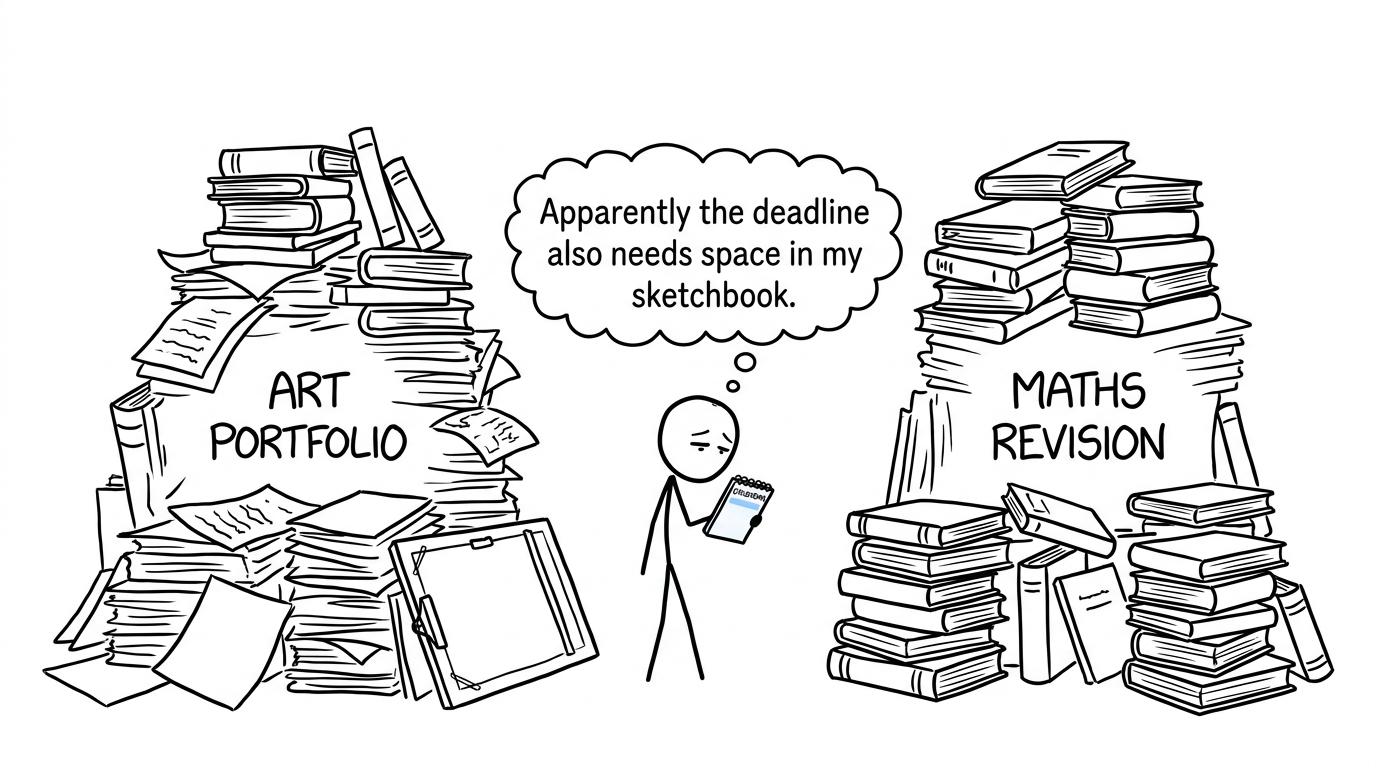 A student balancing an art portfolio and maths revision with a tiny calendar
Can you redo GCSE Art and Design coursework before submission?
Usually, you can continue developing and refining portfolio work while the component remains live and your school permits it. That might involve improving observations, testing materials, strengthening connections to relevant artists, recording decisions more clearly or replacing a weak outcome.
This is not necessarily a complete restart. Art portfolios are assessed as evidence of a creative journey. A polished final image cannot compensate for missing investigation, experimentation or recording, while an imperfect experiment may provide useful evidence of development. Before discarding anything, ask which assessment objective the existing work supports.
Your teacher controls how the assessment is organised within the centre. A school may establish an internal deadline earlier than the awarding body's mark-submission deadline so that teachers have time to mark, internally standardise and prepare work for moderation. Missing that internal deadline does not create an automatic right to extra time.
There is another constraint: the work must remain authentically yours. Current JCQ and awarding-body guidance requires centres to supervise and authenticate non-exam assessment. Work completed away from school may be accepted only where your teacher can confidently establish that it is your own. Secretly replacing a piece at home could therefore make authentication harder rather than improve your position.
What feedback can your teacher give?
An art teacher can teach techniques, discuss the assessment objectives and guide the development of a project within the applicable rules. However, the submission must remain the student's own response. A teacher cannot produce the work, dictate every improvement or certify work that cannot be authenticated.
Ask focused questions such as:
- Which assessment objective has the least convincing evidence?
- Is this piece still part of my selected portfolio?
- May I refine it before the internal deadline?
- Does any replacement work need to be completed under supervision?
- When will the portfolio be considered finally submitted?
Those questions turn a vague feeling of disappointment into an actionable decision.
Can you change work after the deadline?
Once your centre has closed the component for marking, you should assume that changes require explicit permission. Do not remove pages, edit digital files or substitute an artwork without speaking to your teacher.
After centre marks have been submitted to the awarding body, candidates cannot normally reopen their portfolios simply because they think another version would earn more marks. The work may already have been selected for external moderation, and allowing one student to revise it would undermine consistent assessment conditions.
If you believe the school has applied its marking procedures incorrectly, ask about its internal review of marking process. Centres must provide a route for candidates to request a review of internally assessed marks before those marks are submitted, subject to the centre's published deadline and procedure. A review examines whether marking procedures and the assessment criteria were applied properly. It is not extra time to improve the portfolio, and a reviewed mark can potentially stay the same, rise or fall.
After results are published, any post-results application must normally be made through the school or college. External moderation checks a centre's marking, so it is not the same as having one individual artwork casually remarked on request.
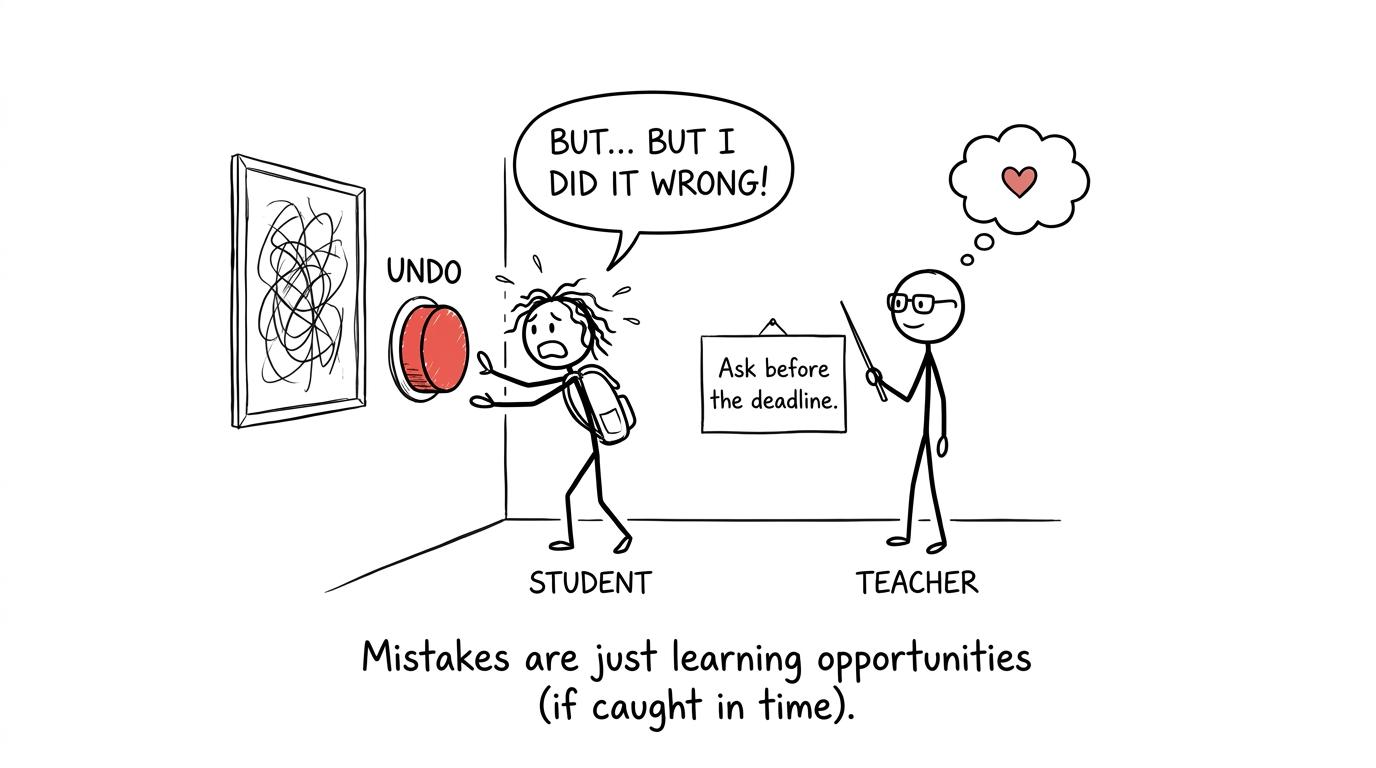 A student looking for an undo button while a teacher points towards the deadline
Can you redo the externally set assignment?
The externally set assignment is different from ordinary portfolio development. Students receive starting points from the awarding body, complete preparatory work and then realise their response during a supervised period, normally lasting 101010 hours.
You cannot usually take the supervised outcome home after the event and remake it as though it had been produced under the original conditions. The centre must preserve the required controls and authenticate the work.
If illness, disruption or another serious circumstance affected the assessment, tell your school immediately. The correct route may involve the awarding body's procedures for absence, special consideration or lost and damaged work. It is not an informal redo arranged solely between a student and teacher.
A formal resit is also different. Because externally set themes change between assessment series, a resitting student may need to complete the new assignment rather than resubmit the previous supervised component.
What happens if you resit GCSE Art and Design?
A resit means being entered for the qualification in a later assessment series. It is not simply opening your old coursework after results day and adding a few pages.
The precise requirements depend on the awarding body and the specification in force at the time of entry. Pearson Edexcel's current administrative guidance states that Personal Portfolio components can be improved and resubmitted, while the Externally Set Assignment must be retaken because its theme changes each year. Current Eduqas guidance says that students resitting the qualification must retake all components.
Requirements for AQA and OCR entries should be confirmed directly by your centre using the current specification and administration guidance. Carry-forward arrangements, available assessment opportunities and entry conditions can change. Your school must also be willing and able to supervise, authenticate, mark and submit the work. Some qualifications are not available to private candidates, so do not assume that keeping an old sketchbook guarantees an independent resit route.
Ask the exams officer to confirm in writing:
- which components must be entered;
- whether an existing portfolio mark can be carried forward;
- whether portfolio work may be improved and resubmitted;
- which externally set task applies;
- the centre's supervision and authentication arrangements;
- entry fees and internal deadlines.
This is one of those situations where a five-minute conversation can prevent weeks of unnecessary work.
Decide whether redoing the work is worthwhile
Wanting to improve a piece and needing to improve the assessed portfolio are not always the same thing. Look at the whole submission, not only the artwork you like least.
A sensible review should consider whether the change would add clearer evidence of investigation, experimentation, recording or a meaningful personal response. It should also consider time. GCSE students are usually balancing Art and Design with several written subjects, including foundation or higher tier maths.
If the portfolio deadline is close to a maths paper, protect time for both subjects. The GCSE Maths revision hub brings lessons, practice questions and papers together, while the GCSE twenty-minute revision routine can keep maths active during a demanding art deadline.
Use evidence rather than anxiety. In art, ask your teacher which assessment objective needs attention. In maths, use a mini test or paper to find your weakest GCSE topics. A specific weakness can be repaired. A general sense that everything is bad usually leads to an unnecessary restart.
Make a controlled improvement plan
If your teacher confirms that changes are allowed:
- identify the exact evidence that needs strengthening;
- agree what may be changed and where it must be completed;
- preserve useful developmental work;
- record sources and explain relevant decisions;
- set a stopping point before the internal deadline;
- keep regular maths revision sessions in your timetable.
Students with several weeks remaining can adapt the one-month GCSE maths revision plan. If exams are much closer, the one-week maths revision plan provides a more focused structure.
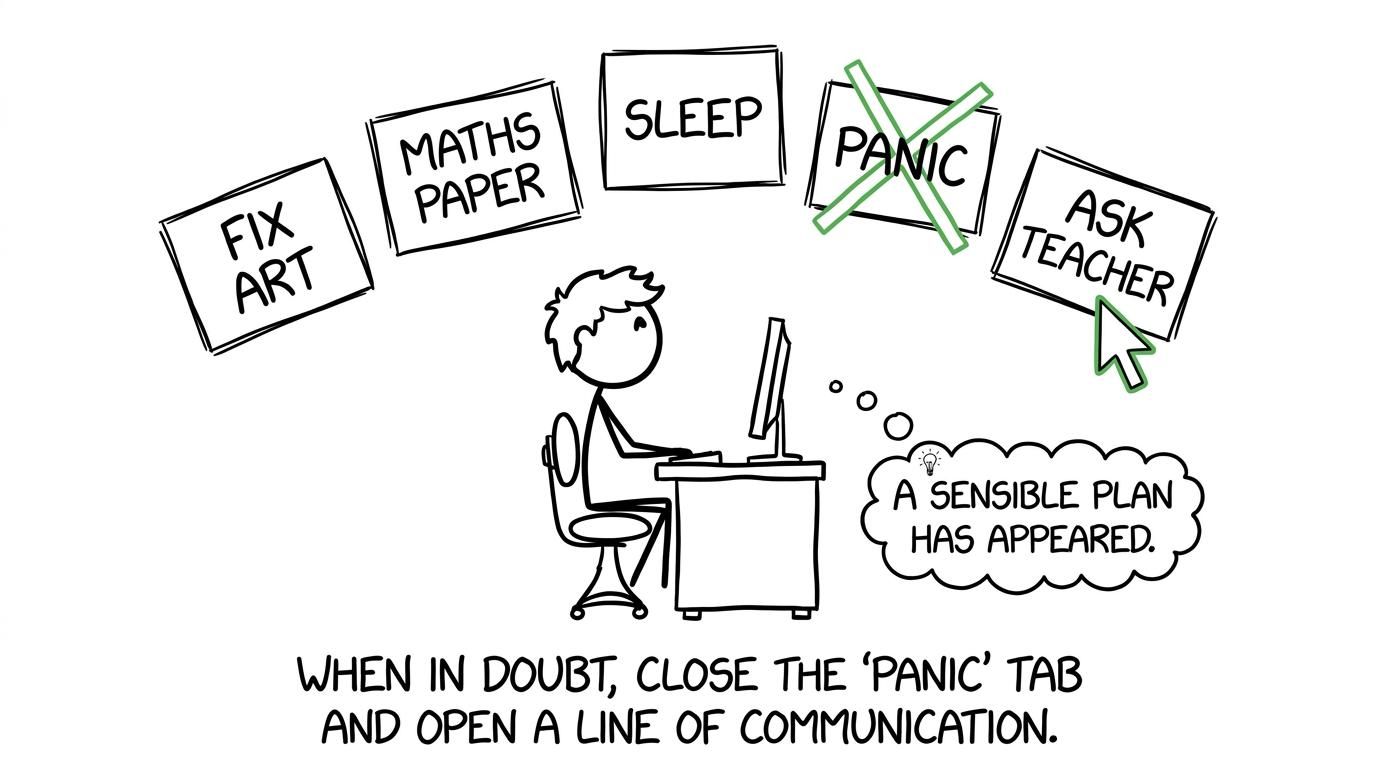 A student closes the panic tab and chooses the ask teacher tab
Common mistakes when trying to redo coursework
Starting again without permission
A complete restart may remove useful assessment evidence and create authentication problems. Agree the changes with your teacher first.
Confusing the school deadline with the awarding-body deadline
The centre needs time for marking, standardisation and moderation administration. Its earlier internal deadline can still be binding.
Treating the final piece as the entire portfolio
GCSE Art and Design rewards the documented process as well as the realised response. Development, experimentation and recording matter.
Trying to recreate supervised work at home
An externally set outcome produced under supervised conditions cannot simply be replaced by an unauthenticated home version.
Assuming every exam board has the same resit rule
Pearson Edexcel, AQA, OCR and Eduqas do not necessarily handle improved portfolios, carried-forward results and retaken components identically. Check the current rule for your precise specification.
Allowing art changes to consume every revision hour
Perfection has no natural finishing point. Use an agreed deadline, then return to your other subjects. The GCSE exam week checklist helps keep final maths preparation calm, while the GCSE maths topics by board and tier guide can clarify what still needs attention.
Make the next decision, not every decision
You may be allowed to refine or replace GCSE Art and Design portfolio work before submission, but the permission comes through your school and the assessment rules. After marks are submitted, your options are usually a formal review process or a later resit rather than an informal redo. The externally set assignment remains controlled and may have to be taken again using a new theme.
Speak to your art teacher first, then ask the exams officer to verify the current rules for your board. Once you know what is genuinely possible, give the art improvement a clear boundary and protect the rest of your revision timetable.
MathsGenie can take the decision-making out of the maths side. Start with free revision lessons and practice questions, check progress using mini tests, then move to past papers and predicted papers with mark schemes and video solutions. One portfolio decision should not be allowed to hide every other opportunity to improve your grades.