

How to Recover From a Bad GCSE Dance Mock
Recover from bad GCSE Dance mock results with a calm review, targeted practice and a realistic plan that protects your wider GCSE maths revision time.
A disappointing mock result can make months of effort feel invisible. The mark arrives, confidence drops, and suddenly every other exam feels more threatening too. But to recover from bad GCSE Dance mock results, you do not need a dramatic reinvention. You need to identify where the marks went, ask for precise feedback and turn that information into a small number of actions you can repeat.
That matters particularly when you are also preparing for GCSE maths. Dance and maths look very different, but recovery follows the same pattern: diagnose the gap, practise the relevant skill, check the result and try again. A mock is useful precisely because there is still time for that cycle to work.
Your recovery checklist
Start with these actions:
- Wait until the initial disappointment has settled before analysing the result.
- Confirm which part of the GCSE Dance course the mock assessed.
- Compare your work with the assessment criteria, not another student's mark.
- Ask your teacher for the two or three changes most likely to gain marks.
- Separate knowledge gaps from performance, writing and exam-technique problems.
- Schedule short, specific practice rather than promising to "revise more".
- Re-test the same skills after feedback.
- Protect time for your other subjects, including GCSE maths.
The purpose is not to pretend the mark was good. It is to stop one result from making decisions for you.
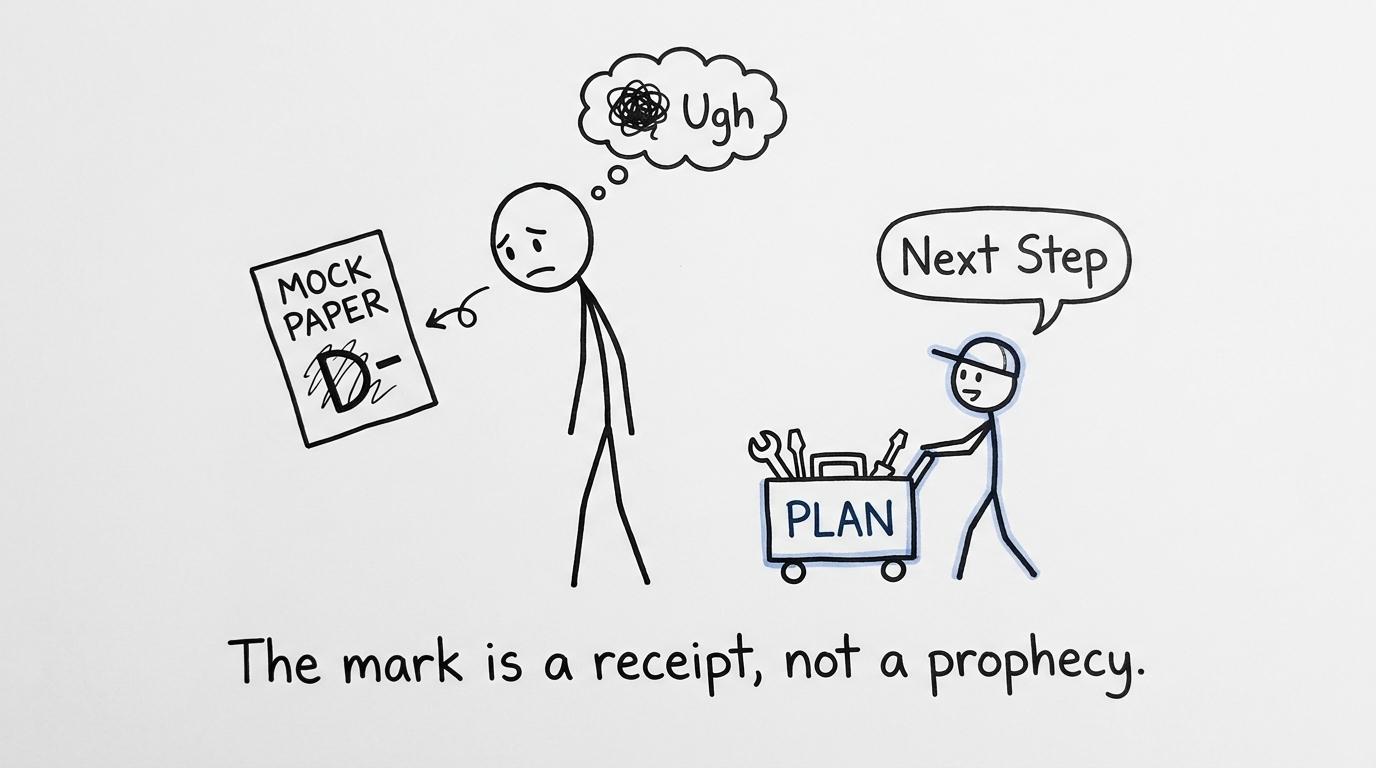 A student discovers that a mock mark is a receipt rather than a prophecy
Understand what the mock actually measured
A school mock is an internal assessment. Its format, timing and grade boundaries may not reproduce the final qualification exactly, so ask your teacher what was assessed and how the result was calculated.
Under the regulated GCSE Dance framework, performance and choreography each account for 30%30\%30% of the qualification, while the examination accounts for 40%40\%40%. On the current AQA specification, the practical component is therefore worth 60%60\%60% overall. The Dance Appreciation paper lasts 111 hour 303030 minutes and is marked out of 808080.
This distinction changes your response. A weak written mock does not automatically mean your practical work is equally weak. A disappointing performance assessment does not prove that your knowledge of professional works is poor. You can only make a useful plan once you know which evidence the mark represents.
If your school follows AQA, identify whether the assessment concerned:
- performance skills;
- choreography;
- knowledge of choreographic processes and performing skills;
- critical appreciation of your own work; or
- critical appreciation of professional works.
Students following a different course should use their own current specification and teacher guidance. Do not revise from a generic checklist when the criteria are board-specific.
Turn the mark into a diagnosis
A total mark tells you where you finished. It does not tell you what to do next.
Look through the marked paper, observation notes or practical feedback and classify each lost mark. Useful categories include:
- Knowledge: a fact, term, feature or professional work was not known accurately.
- Application: you knew the content but did not connect it to the question or choreographic intention.
- Analysis: you described what happened without explaining its effect.
- Evaluation: you gave a judgement without supporting evidence.
- Performance: physical, technical, expressive or mental skills were inconsistent.
- Exam technique: you misread the command word, gave too little detail or managed time poorly.
For a written assessment, you can calculate the proportion of available marks gained using:
Percentage score=marks gainedmarks available×100\text{Percentage score}=\frac{\text{marks gained}}{\text{marks available}}\times 100Percentage score=marks availablemarks gained×100However, the error categories are more valuable than the percentage. Two students can receive the same total while needing completely different revision.
This is also the right way to review a maths mock. The MathsGenie GCSE maths revision hub lets you move from a weak area to revision lessons, practice questions, mini tests and papers. Instead of writing "bad at algebra", identify the exact difficulty, such as rearranging formulae or solving simultaneous equations.
Ask for feedback you can act on
"How can I improve?" is reasonable, but it is broad. Better questions make it easier for your teacher to give usable guidance:
- Which assessment objective cost me the most marks?
- Was my main weakness knowledge, explanation, analysis or evaluation?
- Which practical skill should I prioritise in the next rehearsal?
- Can you show me where my response stopped meeting the next mark-band descriptor?
- What should I produce or demonstrate next week to show improvement?
Effective feedback should direct your next action. Educational research reviewed by the Education Endowment Foundation supports feedback that is specific, clear and focused on the task or learning process. Feedback becomes valuable when the student has an opportunity to use it.
Write each important comment as an instruction. "Analysis lacks depth" might become "name the movement or production feature, explain its effect and connect it to choreographic intention". "Projection is inconsistent" might become "rehearse one section while maintaining focus and commitment, then record and review it with my teacher's criteria".
Build a recovery plan that fits real life
The temptation after a poor result is to create an enormous timetable. It feels serious. It is often impossible to sustain.
Choose no more than three immediate priorities. Each one should include a skill, an activity and a check:
- Skill: the precise weakness you are addressing.
- Activity: what you will do during the session.
- Check: how you will know whether it improved.
For written Dance revision, an activity might involve recalling key information without notes, planning an extended response or comparing your answer with the teacher's marking guidance. For practical work, it might involve focused rehearsal, video review where permitted, mental rehearsal or applying one piece of teacher feedback.
Research on learning supports retrieval practice and spaced practice. In simple terms, trying to recall knowledge is generally more useful than repeatedly looking at it, while returning to material across several sessions is preferable to relying on one long burst. Feedback remains important so that inaccurate recall does not become embedded.
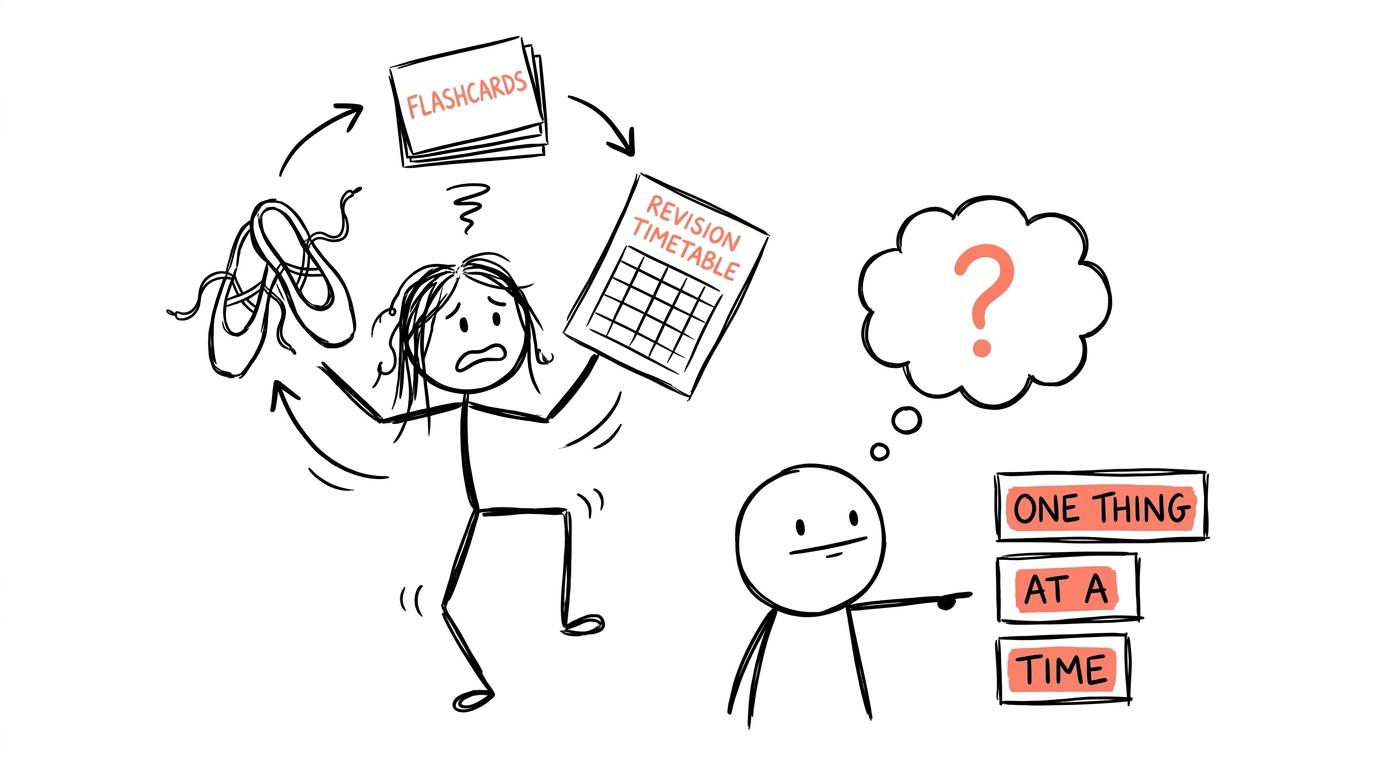 A student learns to handle revision one box at a time
Use short feedback loops
A practical weekly rhythm could include:
- one session to review feedback and relearn missing content;
- one session to practise without support;
- one later session to check whether the skill can still be recalled or performed;
- a brief teacher check where possible.
The gap between sessions matters. Immediate improvement can come from familiarity; delayed success is stronger evidence that learning is becoming secure.
Maths revision benefits from the same structure. The guide to using GCSE past papers at the right stage explains why papers should diagnose weaknesses rather than merely produce another score. If time is short, the GCSE one-week maths revision plan offers a manageable framework.
Protect your maths revision after a Dance setback
A bad mock can distort priorities. You may devote every spare evening to the subject that frightened you most, even when other exams carry urgent needs of their own.
Start by mapping fixed commitments: lessons, rehearsals, deadlines and rest. Then allocate focused blocks to the weaknesses revealed by each mock. Do not let "Dance revision" or "maths revision" occupy an entire evening without a defined outcome.
For maths, confirm your exam board and tier before choosing material. Edexcel, AQA, OCR and Eduqas assess shared national content, but their paper structures and presentation differ. The GCSE maths topics by exam board and tier guide can help you organise the correct content.
If a maths mock has also gone badly, begin with a small diagnostic task rather than another exhausting full paper. Students who feel stuck around a pass grade can use this focused GCSE maths recovery approach to identify a manageable shortlist of weaknesses.
Your timetable should respond to evidence, not panic. A weaker subject may need more time, but every session should have a purpose.
Practise actively rather than hiding in notes
Rereading can feel reassuring because everything looks familiar. The difficulty appears when the notes close.
Use active tasks instead:
- recall terminology and examples before checking notes;
- answer unfamiliar questions under a time limit;
- plan responses from command words;
- explain why a feature communicates choreographic intention;
- rehearse a selected passage with one technical or expressive focus;
- revisit corrected work after a delay.
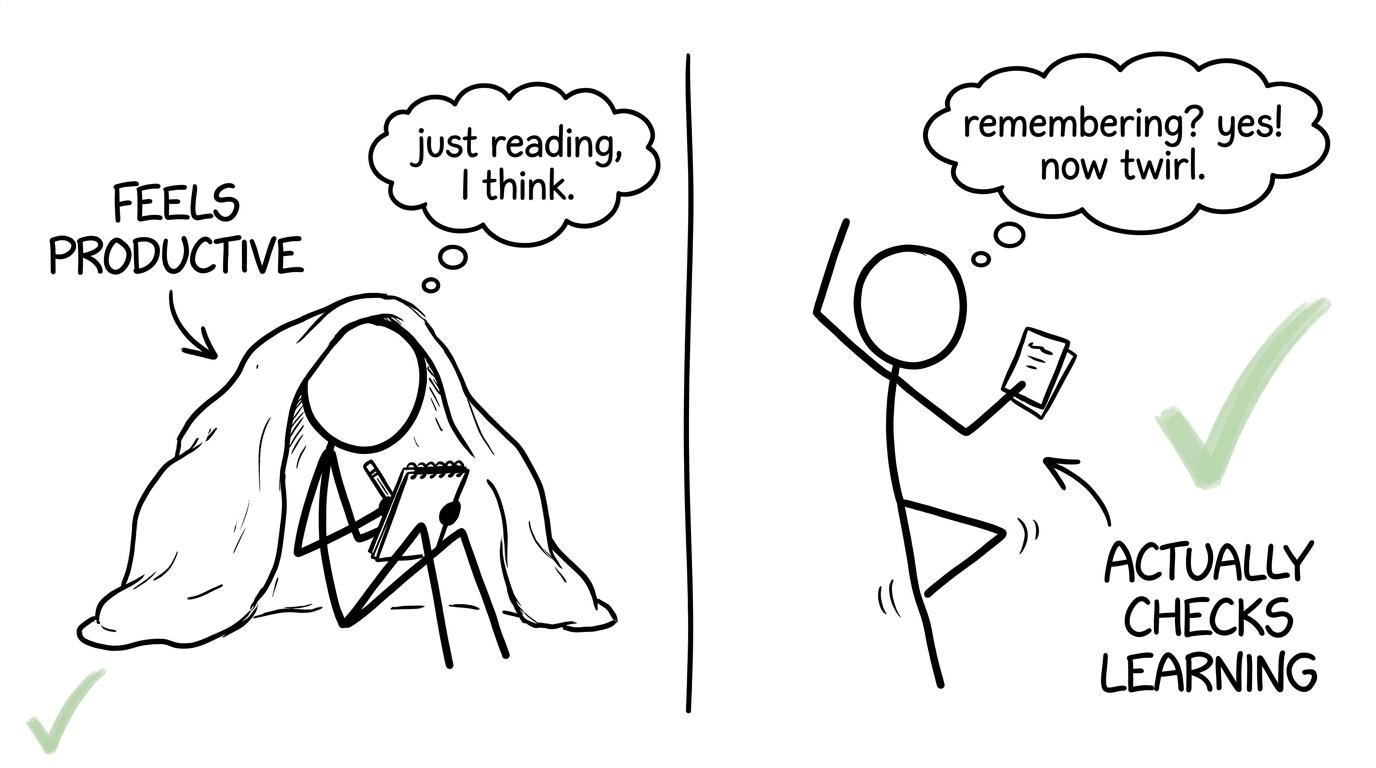 Rereading notes meets the less comfortable power of active recall
In maths, active practice means attempting questions before opening the solution. The guide to using Edexcel GCSE past papers properly shows how to mark, diagnose and reattempt questions. Nearer the examinations, GCSE predicted-topic guidance can help prioritise practice, but predictions should supplement the specification rather than replace it.
Common mistakes after a bad GCSE Dance mock
Treating the grade as a prediction
A mock reflects performance on particular tasks at a particular time. It can reveal risk, but it is not a fixed verdict on your final grade.
Trying to repair everything at once
A list of fifteen weaknesses creates motion without focus. Select the few issues that cost the most marks or affect several parts of the course.
Ignoring the assessment objective
More facts will not automatically improve an answer that lacks analysis. More rehearsal time will not necessarily repair a specific issue with timing, alignment or projection. Match practice to the criterion.
Collecting feedback without using it
Highlighted comments are not improvement. Redraft, rehearse, reattempt or explain the corrected idea from memory.
Sacrificing every other subject
GCSE preparation is a portfolio of competing demands. Protect regular maths practice and avoid leaving full recovery until the night before. If an exam is close, use a calm GCSE maths night-before plan rather than attempting an unrealistic cram.
Make the next result more informative
Recovery is not the moment you feel confident again. It is the moment your actions become more precise.
Take the mock apart. Identify the component, translate feedback into instructions and practise only the skills that the evidence says need work. Then check those skills again. That process can improve Dance preparation while also protecting the time and attention required for maths.
For your next maths session, open the free MathsGenie GCSE revision hub, choose your exam board and tier, and identify one exact weakness. Use a revision lesson, complete the practice questions, check the mark scheme and return to the skill later with a mini test. As exams approach, add past papers, predicted papers and video solutions.
One disappointing mock does not need a heroic response. It needs an honest one, followed by a plan small enough to begin today.











