Ready for GCSE Polish Early Sitting? The Real Test
Ready for GCSE Polish early sitting? Use this evidence-based checklist to test all four skills, choose the right tier and protect your wider revision.
Being able to chat comfortably with family can make GCSE Polish look straightforward. Then the first timed listening paper arrives. The recording moves on, the question demands a precise detail, and everyday fluency suddenly feels different from examination readiness.
If you are wondering whether you are ready for GCSE Polish early sitting, the short answer is this: you need consistent evidence across listening, speaking, reading and writing, not simply confidence in conversation. You must also understand the specification, perform under timed conditions and prepare without weakening your maths or other GCSE subjects.
Early entry can be sensible. But being keen is not the same as being ready.
The early-entry readiness checklist
Before agreeing to an early sitting, you should be able to answer yes to most of these statements:
- I know my exact exam board, specification and tier.
- I have completed timed assessment in all four language skills.
- My performance is consistent across several papers or mock tasks.
- I can write accurately in Polish without relying on autocorrect.
- I can translate in both directions under examination conditions.
- I can handle an unfamiliar role-play, photo card and conversation.
- A qualified teacher has assessed my work against the mark scheme.
- My school or exam centre can administer the speaking assessment.
- Preparing for Polish is not damaging my maths, English or science revision.
- I have a clear reason for entering early beyond wanting to finish quickly.
One weak area does not automatically mean you should wait. A pattern of weak areas probably does.
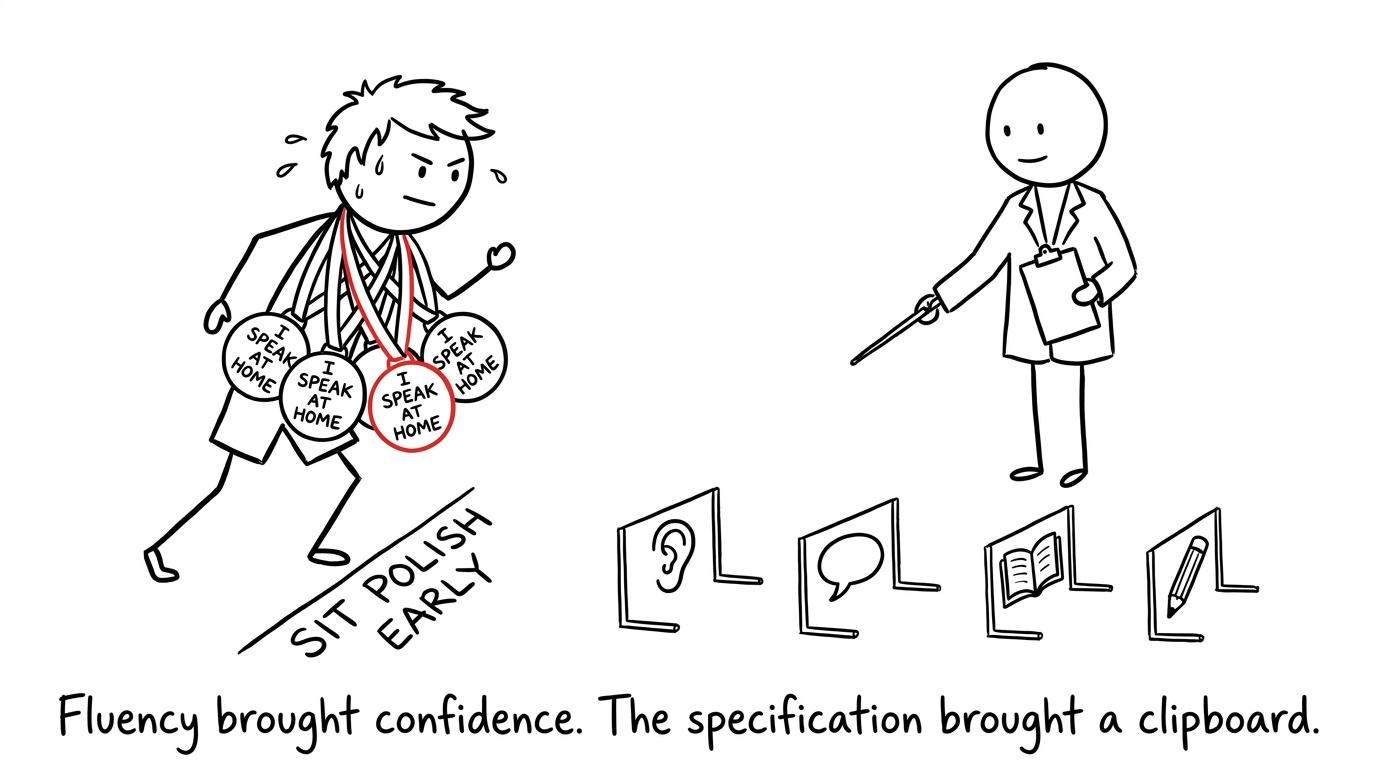 A fluent student discovers that the specification has its own clipboard
Know what GCSE Polish actually assesses
Your first task is to confirm the qualification with your school or exams officer. For example, the current AQA GCSE Polish qualification is specification 868886888688. It is a linear qualification, so all assessments are completed at the end of the course and in the same examination series.
There are four equally weighted skills:
| Assessment | What it tests | Weighting |
|---|---|---|
| Listening | Understanding and responding to spoken Polish | 25%25\%25% |
| Speaking | Communicating and interacting in Polish | 25%25\%25% |
| Reading | Understanding written Polish, including translation | 25%25\%25% |
| Writing | Communicating accurately in writing, including translation | 25%25\%25% |
AQA offers Foundation tier, covering grades 111-555, and Higher tier, covering grades 444-999. All four assessments must be taken at the same tier.
This structure matters because everyday language ability is often uneven. You might speak naturally but read slowly. You might understand Polish television but struggle to spell accurately. You might write well yet lose marks because your response does not address every bullet point.
Readiness means that no single quarter of the qualification is being carried by the other three.
The signs that you are genuinely ready
Your results are repeatable
One excellent mock is encouraging. It is not enough on its own.
A stronger sign is that you can complete several assessments, on different days and with unfamiliar material, while remaining within a similar performance range. The precise grade boundaries can change between examination series, so readiness should not rest on scraping above one historical boundary once.
Ask a teacher to review a body of evidence rather than your best piece. That evidence should include timed work, not polished homework completed with dictionaries, family support or spelling tools.
The same principle strengthens maths revision. The MathsGenie guide to finding your weakest GCSE topics explains how to log lost marks, identify patterns and re-test them. Apply that evidence-first approach to Polish too.
Your formal Polish matches your spoken Polish
Students who use Polish at home may have an important advantage in listening and spontaneous conversation. However, the examination also rewards accurate writing, appropriate register, developed responses and control of language.
You should be able to:
- use Polish spelling and punctuation accurately;
- express ideas across different time frames;
- give and justify opinions;
- respond to every part of a task;
- distinguish informal family language from a more appropriate written register;
- translate meaning rather than replacing each word mechanically.
If you regularly know what you want to say but cannot write it accurately, you are close to being ready, not necessarily ready now.
You can cope with unfamiliar material
Memorising model answers can create an illusion of progress. The real paper will not reproduce your prepared script exactly.
A ready student can adapt familiar vocabulary to an unfamiliar photograph, question or situation. During speaking practice, you should be able to recover when a question is unexpected. During listening, you should recognise distractors, changes of opinion and negative expressions instead of matching the first familiar word you hear.
This is why unseen assessment matters. Ask a teacher or suitable tutor to select material you have not practised before and administer it under realistic conditions.
Your speaking is spontaneous, not merely rehearsed
For AQA, speaking includes a role-play, photo card and general conversation. At Higher tier, the recorded assessment lasts 101010-121212 minutes, plus supervised preparation time. Foundation speaking lasts 777-999 minutes, plus preparation.
You should be able to sustain responses, communicate clearly and react to follow-up questions. A perfectly memorised opening followed by silence when the wording changes is evidence of preparation, but not yet of secure readiness.
You can finish within the official timings
Time pressure changes performance. A student who can produce an excellent writing response in two hours has not yet demonstrated readiness for a paper lasting considerably less.
Complete whole components using the official timing for your tier. Keep dictionaries, phones, translation software and autocorrect out of reach. Mark afterwards, not during the task.
Maths students face the same transition from knowing to performing. MathsGenie's guide on when to start GCSE past papers shows why timed papers should follow targeted learning rather than replace it.
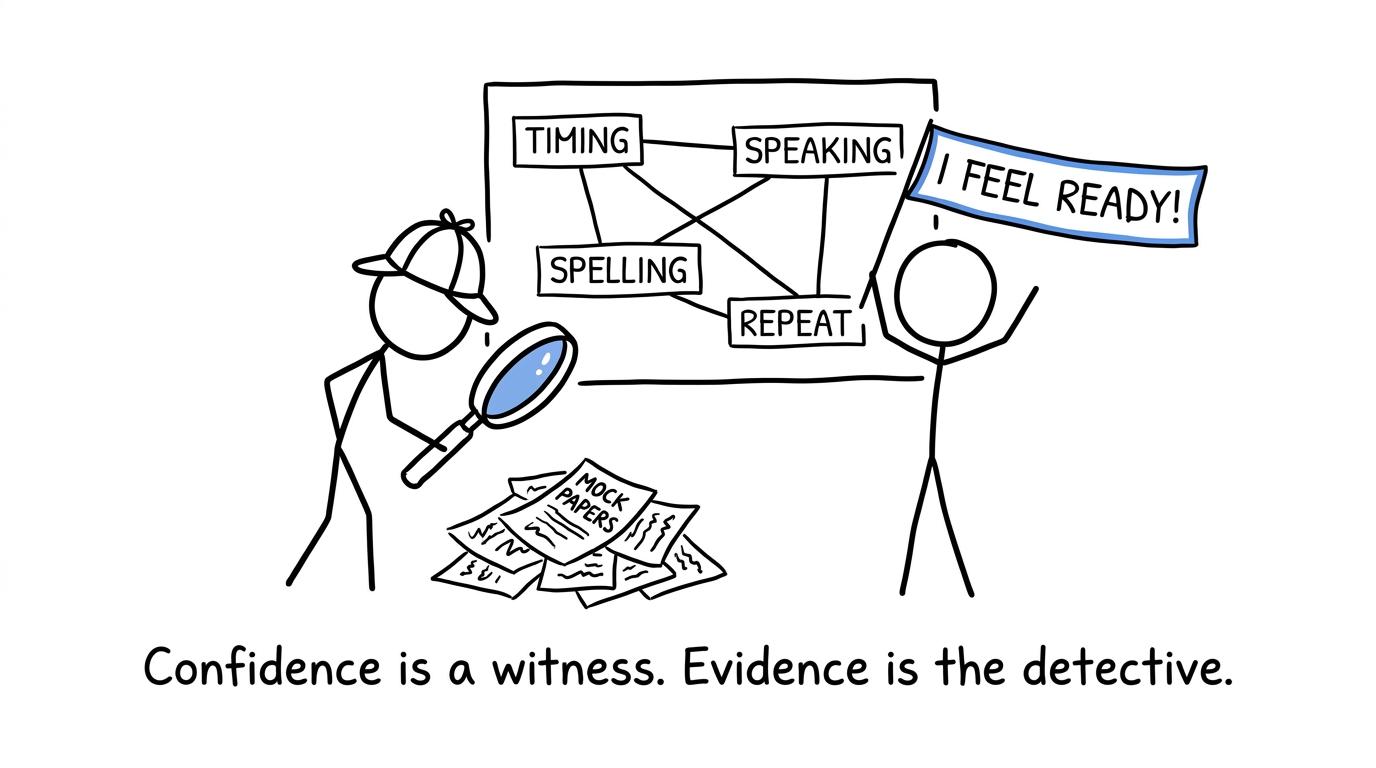 A student detective chooses evidence over a banner saying I feel ready
A practical readiness test
Use a four-stage review before making the final decision.
Gather assessment evidence
Complete at least two unseen, timed attempts in each skill where suitable materials and assessment arrangements are available. Speaking should be conducted by someone who understands the official requirements and marking criteria.
Do not calculate a reassuring average that hides a serious weakness. Because each skill contributes 25%25\%25%, examine the four results separately.
Classify every lost mark
Place mistakes into useful categories:
- language knowledge;
- misunderstanding the question;
- spelling or grammatical accuracy;
- weak development;
- translation accuracy;
- timing;
- examination technique.
A mistake log turns a vague feeling into a revision plan. MathsGenie's advice on using past papers properly uses the same cycle: sit, mark, diagnose, repair and re-test.
Repair and re-test
Spend several weeks addressing the weakest categories, then attempt fresh material. Improvement that survives a second unseen test is stronger evidence than improvement visible only in corrected work.
Ask for an independent judgement
A Polish-speaking relative can help you practise, but examination readiness should ideally be judged by a teacher or tutor familiar with the current specification and mark scheme. Ask a direct question: "What evidence suggests I should enter now rather than wait?"
The answer should refer to assessed skills, tier and consistency, not simply fluency or enthusiasm.
Protecting your maths and wider GCSE revision
Early entry has an opportunity cost. Every hour spent preparing Polish is an hour unavailable for another subject. That cost may be worthwhile, but it should be visible.
Check your current maths position using the GCSE Maths revision hub. Choose the correct board, Edexcel, AQA, OCR or Eduqas, and use mini tests or topic questions to find out whether your foundation and higher-tier skills are secure.
If Polish preparation repeatedly displaces urgent algebra, ratio or geometry work, reconsider the timing. The GCSE maths topics by board and tier guide can help you see how much content still needs attention.
A balanced weekly plan might contain Polish speaking and writing practice alongside short maths repair sessions. MathsGenie's guide to self-studying GCSE maths offers a useful structure for combining lessons, practice questions and timed assessment without revising at random.
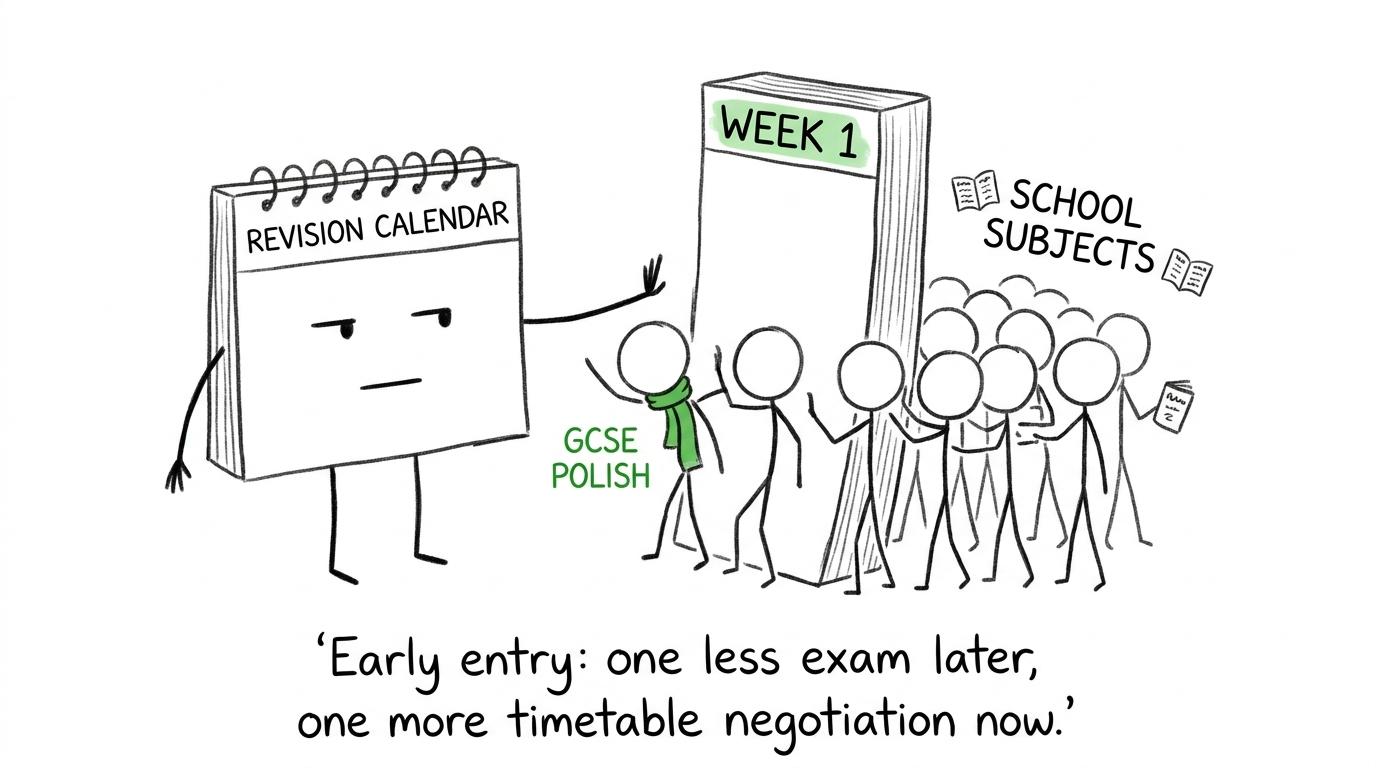 GCSE Polish negotiates for space in a crowded revision calendar
Practical arrangements to confirm early
Academic readiness is only half the decision. Your school or approved exam centre must make the entry and arrange the assessments correctly, including speaking.
Confirm:
- whether the centre offers your chosen Polish specification;
- whether it can conduct and record the speaking assessment;
- which tier you will enter;
- the entry deadline and any applicable fees;
- the dates of written papers and the speaking window;
- whether access arrangements need to be organised;
- how an early entry or later resit could affect school decisions and performance measures.
Private candidates must enter through an approved centre. Not every centre accepts private candidates or offers every language, so investigate well before the examination series. Dates, fees and arrangements can change, making your exams officer the right source for your own entry.
Common mistakes when deciding to sit early
Treating bilingualism as automatic examination readiness
Speaking Polish at home is valuable, but the GCSE assesses four distinct skills. Formal writing and translation can expose gaps hidden by fluent conversation.
Choosing Higher tier because it sounds more impressive
Tier choice should reflect assessed evidence. Higher tier provides access to grades 444-999, while Foundation provides access to grades 111-555. Ask which paper gives you the most appropriate challenge and the strongest chance of demonstrating what you know.
Using familiar papers repeatedly
Scores rise when questions become recognisable. Keep some unseen material for a genuine final check.
Ignoring the speaking arrangements
A willing exam centre, suitable teacher-examiner and correct recording process are essential. Do not assume that a written-paper entry automatically resolves the speaking component.
Sacrificing core GCSE preparation
An early Polish qualification should reduce future pressure, not create immediate problems elsewhere. Monitor your maths performance with mini tests and past papers. The guide to how many GCSE past papers to complete explains why careful review matters more than rushing through a large pile.
Make the decision from evidence, not momentum
The best reason to sit GCSE Polish early is not that you are impatient to collect the qualification. It is that repeated, realistic assessment shows you can already meet the standard while maintaining the rest of your GCSE programme.
Discuss the evidence with your Polish teacher, exams officer and parent or carer. Confirm the specification and practical arrangements. Then look honestly at your wider timetable.
MathsGenie can keep the maths side of that timetable clear and manageable. Start with the free GCSE Maths revision resources, use revision lessons and practice questions to repair gaps, then test yourself with mini tests, past papers and predicted papers. Mark schemes and video solutions show where marks were lost, while the revision planner helps you protect time for every subject.
Enthusiasm gets you to the starting line. Evidence tells you when to run.