Should You Read the GCSE Geography Specification?
Read GCSE Geography specification strategically: learn what is assessed, spot required skills and turn the official document into a focused revision plan.
A revision guide tells you what somebody thinks you need to know. The official specification tells you what the exam board can assess.
That distinction matters. If you plan to read GCSE Geography specification documents yourself, the short answer is yes; but you do not need to read every administrative paragraph from beginning to end. A focused reading can reveal required content, geographical skills, fieldwork expectations, assessment objectives and optional topics that a condensed guide may simplify or overlook.
The specification is best used as a map, not a textbook. It shows the boundaries of the course. Your lessons, notes, questions and past papers then help you learn what lies inside them.
The short checklist
Before opening the document, make sure you know:
- your exam board: AQA, Pearson Edexcel, OCR or Eduqas;
- the exact qualification or route, such as Edexcel Geography A or Geography B;
- which optional topics your school teaches;
- the case studies and named examples selected by your teacher;
- the fieldwork enquiries you completed;
- the current issue or version of the specification;
- which papers you will sit and what each paper assesses.
Do not revise from a specification belonging to the wrong board or route. The broad subject may look familiar, but paper structures, options, command words and required detail can differ.
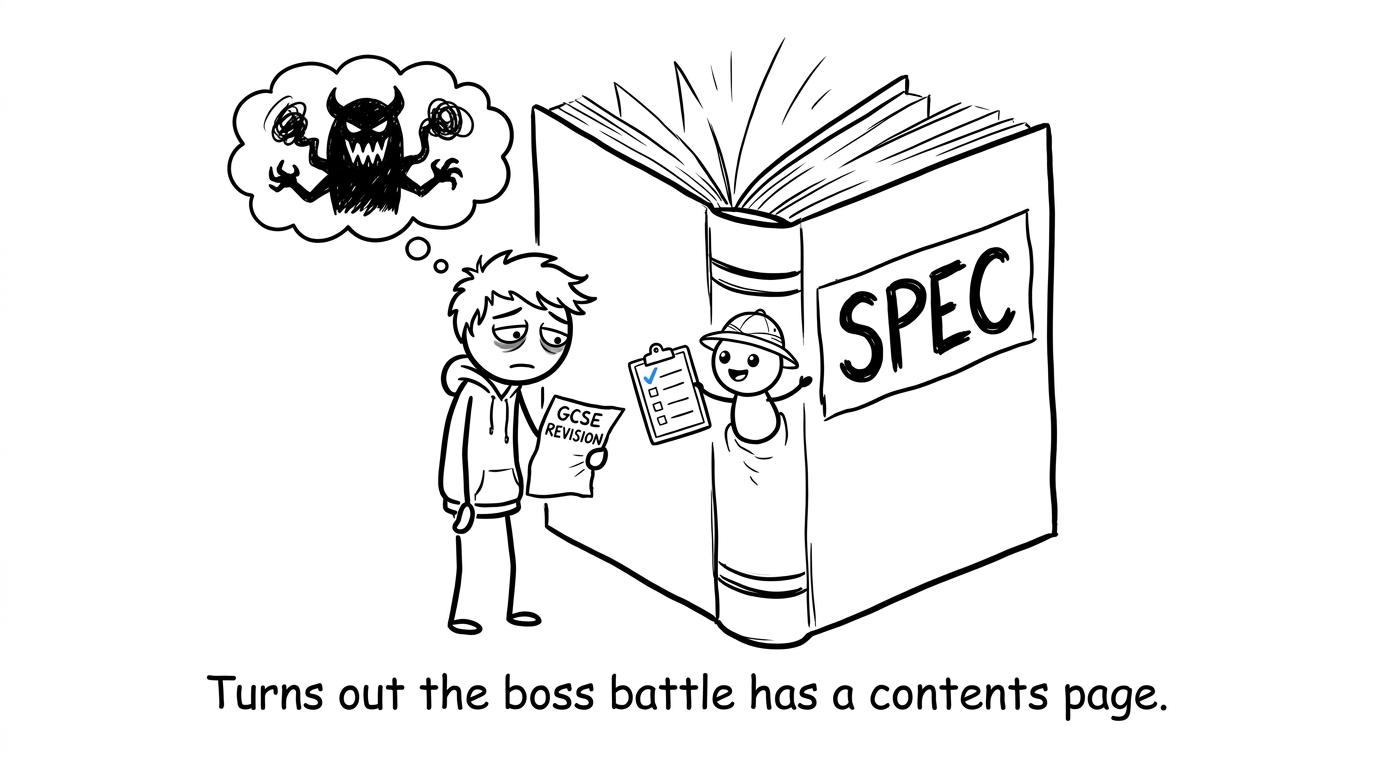 A student discovers that the specification has a useful contents page
What you gain from reading the official specification
You see the precise boundary of assessable content
Revision guides have limited space. They often turn a detailed requirement into a friendly heading such as “river landscapes” or “urban change”. The official document usually breaks that heading into the processes, relationships, examples and skills students are expected to understand.
That extra precision helps you distinguish three things:
- content that is explicitly required;
- detail added by a teacher or guide to improve understanding;
- interesting material that is not central to your examination.
This does not mean that every bullet point becomes a standalone question. Examiners can combine knowledge, sources and unfamiliar contexts. It does mean the wording gives you a reliable checklist against which to audit your revision.
Look carefully at verbs and qualifiers. Phrases such as “understand”, “assess”, “evaluate”, “use an example” and “study a case study” signal different kinds of preparation. A topic name alone does not tell you whether you need recall, explanation, application or judgement.
You discover skills hidden behind topic headings
Geography is not only a collection of facts about coasts, cities and climate. Official GCSE subject requirements include maps, fieldwork, geographical enquiry, graphical information and quantitative data. Specifications then explain how these appear within a particular qualification.
Depending on your board, you may need to interpret scale, distance, coordinates, contours, cross-sections, photographs, graphs, GIS material and statistical information. You may also meet calculations involving percentages, percentage change, averages, range or other specified techniques.
These are areas where maths revision can support geography. Confidence with rac{ ext{part}}{ ext{whole}} \times 100, scale, ratio, units and graph interpretation reduces the amount of attention consumed by calculation during a geography paper. The GCSE Maths revision hub provides free lessons, topic questions, mini tests and exam-board resources for strengthening those foundations.
A guide may demonstrate a few familiar graphs. The specification helps you check the full range of skills for which you are responsible.
You understand how fieldwork is really assessed
Students sometimes remember the field trip but not the enquiry process. The official requirements make clear that fieldwork is more than recalling where you went.
For GCSE Geography qualifications regulated in England, official subject content requires fieldwork in contrasting environments and assessment through the examinations. Fieldwork accounts for 15%15\%15% of the overall assessment weighting, divided between application and skills. Your board's specification explains how that requirement is organised within its papers.
You therefore need to understand stages such as:
- forming a suitable question or hypothesis;
- selecting locations and sampling methods;
- collecting qualitative and quantitative data;
- presenting and analysing results;
- identifying anomalies;
- reaching evidence-based conclusions;
- evaluating methods, reliability and limitations.
Reading the relevant pages can expose gaps that ordinary topic revision misses. You might remember using a questionnaire but be less certain about sampling bias. You might remember measuring a river but not why repeated measurements improved reliability.
You see the architecture of the examination
The specification or assessment overview identifies the papers, their broad content and the kinds of response required. This prevents a common revision error: treating every topic as if it will be assessed in exactly the same way.
For example, AQA's current GCSE Geography structure separates the physical environment, human environment and geographical applications across three written papers. Its official materials state that geographical skills can be assessed throughout the written examinations. Other boards arrange their content differently, and Pearson Edexcel offers distinct Geography A and Geography B qualifications.
That is why generic advice is not enough. Always compare it with your own current specification and exam-board updates. If a paper duration or arrangement changes, the latest official version takes priority over an old guide, saved PDF or video.
The same principle applies in maths. The GCSE Maths topics by exam board and tier guide explains why shared national content does not make every board's papers identical.
What the specification does not give you
The specification is authoritative, but it is not designed to teach the whole course to a student working alone.
It usually will not provide:
- a full explanation of each geographical process;
- memorable case-study knowledge tailored to your class;
- enough exam-style practice;
- complete model responses for different mark tariffs;
- feedback on whether your reasoning is convincing;
- a revision sequence based on your personal weaknesses.
This is why relying only on the document is inefficient. A phrase such as “the formation of coastal landforms” defines a destination; it does not necessarily teach the sequence of processes clearly enough for an extended answer.
The best system uses several layers. The specification defines scope. Lessons and revision materials build understanding. Practice questions test retrieval and application. Mark schemes reveal how credit is awarded. Past papers develop timing and judgement.
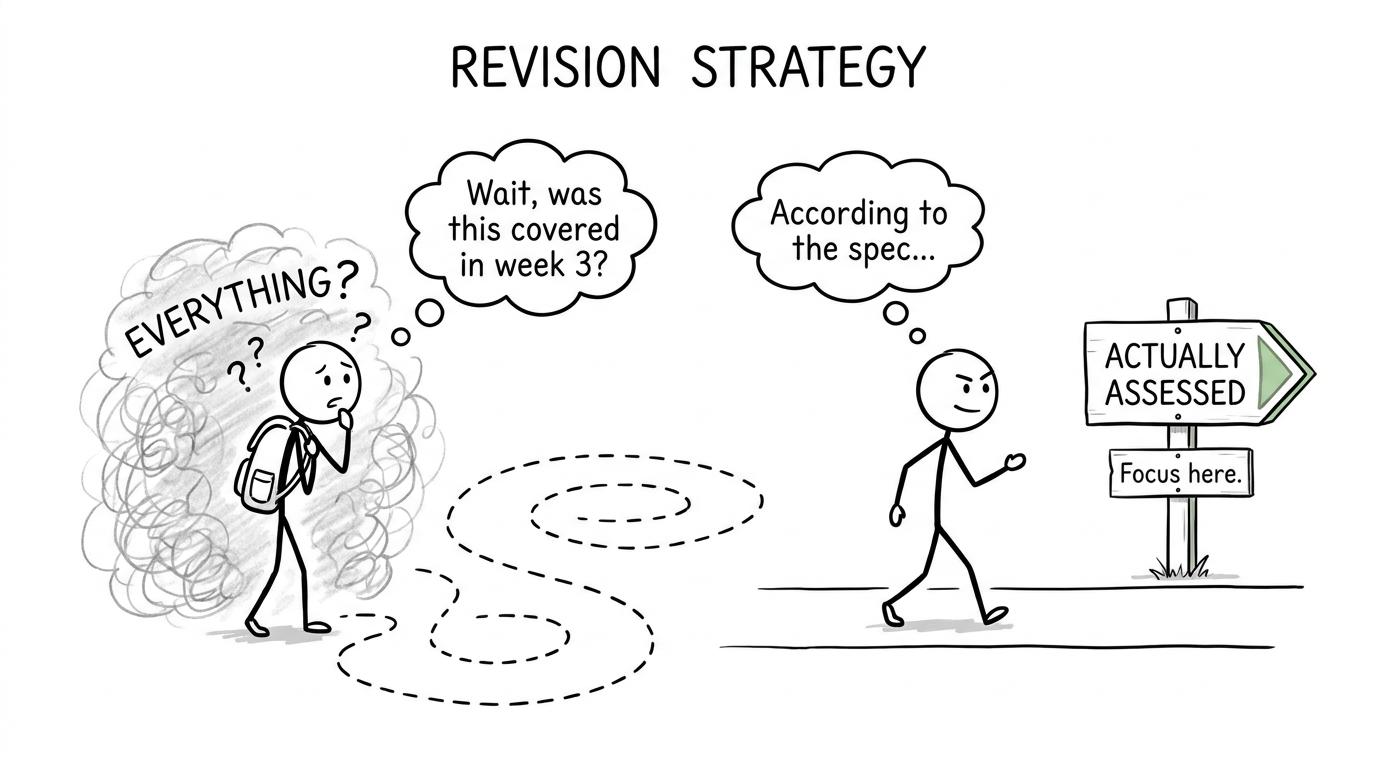 One student follows the assessed-content signpost while another revises everything
How to read the GCSE Geography specification efficiently
Begin with the assessment overview
Do not start automatically on the first page. Find the assessment section and identify:
- the number of papers;
- the content assigned to each paper;
- paper weightings and marks;
- fieldwork and pre-release arrangements, where relevant;
- question styles and extended-response expectations.
Then locate the subject-content pages. Highlight only the route and options taught by your school. Ask your teacher if you are uncertain, particularly where the specification offers a choice of physical landscapes, resource topics or geographical enquiries.
Convert requirements into an audit
Create three columns beside each relevant statement:
- secure;
- partly secure;
- not yet secure.
Be strict. “Secure” should mean that you can explain or apply the idea without copying notes, not merely that the wording looks familiar.
Turn broad requirements into prompts. If the document requires interpretation of OS maps, your prompt might ask whether you can use scale, grid references, contours and relief. If it requires evaluation of fieldwork, check whether you can discuss validity, reliability, sampling and realistic improvements.
This resembles a sensible maths topic audit. MathsGenie's guide to the best order for learning GCSE Maths topics shows how a large specification becomes more manageable when it is turned into a sequence rather than treated as one enormous list.
Match the audit to evidence
A coloured checklist can create confidence without proof. Test each judgement against something observable:
- a closed-book explanation;
- a diagram drawn from memory;
- a source-based question;
- a timed extended response;
- a past-paper question and its mark scheme.
If the task exposes a weakness, return to the relevant lesson and then retest it. For the numerical side of geography, MathsGenie's free GCSE Maths resources can help with percentages, averages, graphs, ratio and scale.
A structured timetable also prevents specification reading from consuming your entire revision session. The one-month GCSE Maths revision plan offers a useful model: diagnose, practise, mark, revisit and test under timed conditions. The same cycle transfers well to geography.
Should you read every page?
Usually, no.
Read the sections that affect what you learn and how you are assessed. These normally include the assessment overview, your chosen subject content, geographical skills, fieldwork requirements and assessment objectives. Briefly scan the rest so that you understand the document, but do not spend valuable revision time absorbing administrative information intended mainly for schools and teachers.
A sensible first pass may take less than an hour if you know your route and options. Later, return to individual sections when planning a topic or checking whether a revision resource is complete.
The highest return comes from reading selectively and acting on what you find.
Common mistakes when using a specification
Downloading the wrong qualification
“GCSE Geography” is not specific enough. Confirm the board, qualification title, code and route. Edexcel Geography A and Geography B are not interchangeable, while OCR and Eduqas also publish distinct qualification materials.
Treating every option as compulsory
Specifications often display choices so teachers can design a course. Your school may teach only one option from a list. Revising every available landscape or resource topic wastes time unless your qualification requires them all.
Using an old saved copy
Exam boards can publish amended issues or assessment updates. Check the current official qualification page rather than trusting the first PDF in your downloads folder.
Confusing recognition with knowledge
Reading a bullet point and thinking “I remember that” is not retrieval. Close the document and explain the idea, use it with an unfamiliar source or answer a question.
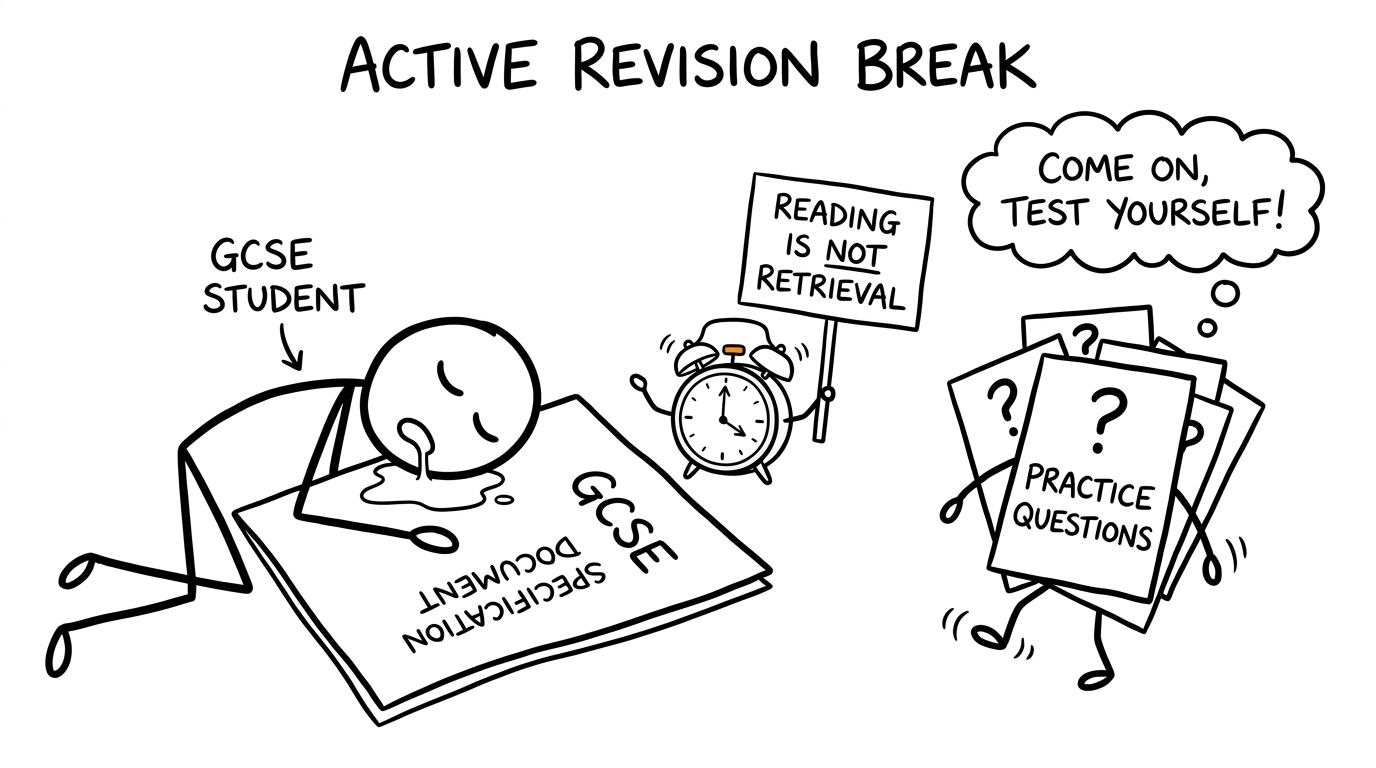 A specification cannot transfer knowledge through a pillow
Ignoring your school's chosen examples
A specification may require examples or case studies without prescribing every place. Your teacher's course plan determines which ones you have studied. Use the official wording and your class materials together.
Replacing practice with document reading
The specification can diagnose what to revise, but it cannot reproduce examination pressure. In maths, Edexcel GCSE Maths past papers let students practise under timed conditions and check official mark schemes or solutions. Geography revision needs the same habit using the correct papers from your own board.
The verdict: use it as a map, not the journey
It is worth reading the full GCSE Geography specification selectively. You gain an exact view of assessable content, required geographical skills, fieldwork expectations, options and paper structure. You also become less dependent on somebody else's interpretation of the course.
But reading is only the beginning. The document becomes valuable when you turn its requirements into questions, test them and repair the weaknesses you uncover.
That lesson matters for maths revision too. Start with the MathsGenie GCSE Maths hub, choose your exam board and tier, then move from revision lessons to practice questions, mini tests and past papers. When you need fresh examination-style practice, use the GCSE predicted papers alongside past papers rather than instead of them.
A specification tells you where the boundaries are. Focused practice is what helps you cross the finish line.