Read GCSE Engineering Specification: Is It Worth It?
Read GCSE engineering specification documents strategically to uncover examinable maths, assessment rules and details that revision guides may simplify.
A specification can look like the least inviting document in your revision folder. It is long, formal and written for teachers as much as students. Yet if you want to read GCSE engineering specification material yourself, the short answer is yes, but you do not need to read every line with equal attention.
The official document gives you something a revision guide cannot: the precise boundary of what may be assessed. For maths in engineering, it identifies the equations, units and skills you are expected to use. A guide then does the different job of teaching those skills clearly.
The most effective approach is not specification or revision guide. It is specification for direction, followed by lessons, questions and papers for progress.
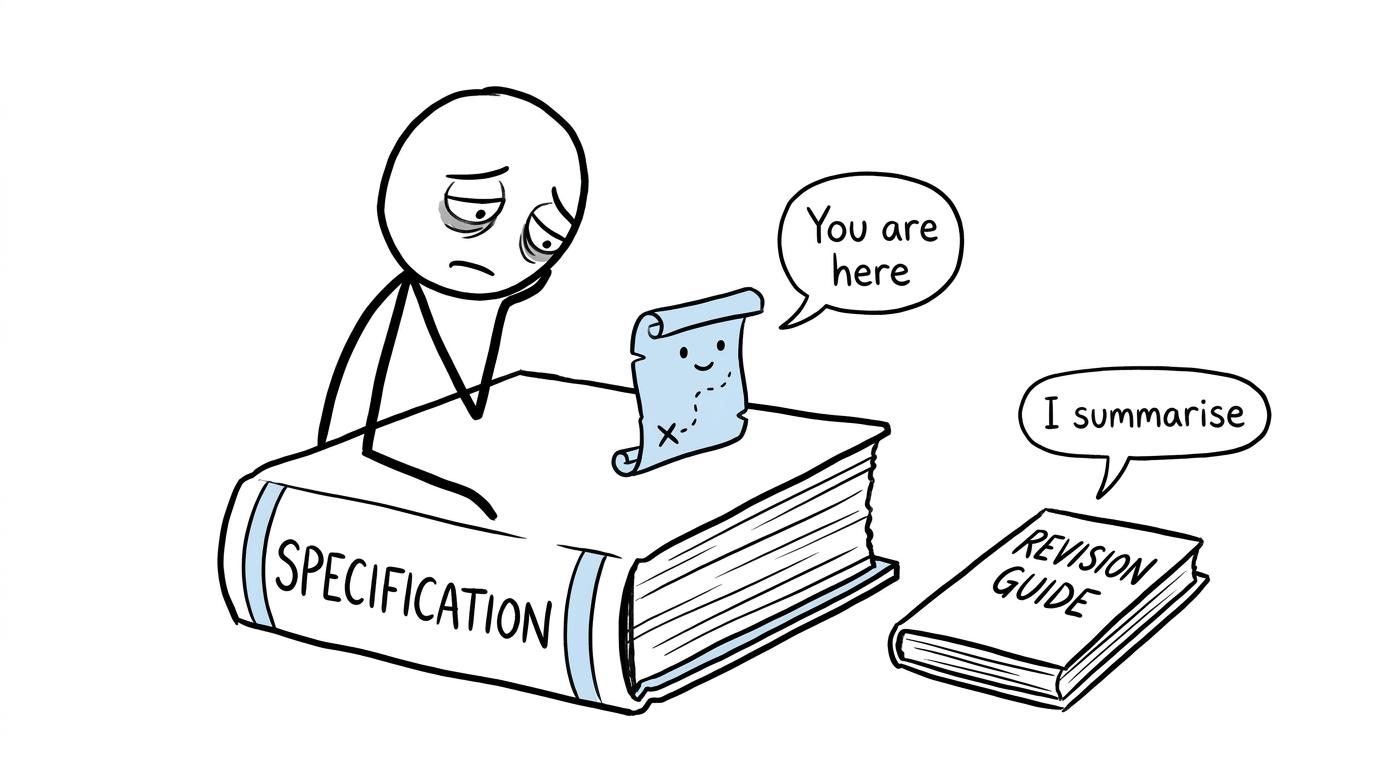 A student discovers that the specification is a map rather than a monster
The quick specification-reading checklist
Before opening a lengthy PDF, decide what you are looking for:
- Confirm the exact qualification title, exam board and specification code.
- Read the assessment overview and component weightings.
- Find the subject-content headings and additional guidance.
- Locate the mathematical understanding appendix.
- List every equation, unit and mathematical skill.
- Check the non-exam assessment requirements and marking criteria.
- Turn the information into a short revision checklist.
- Use questions and mark schemes to test whether you can apply it.
For AQA GCSE Engineering, the relevant code is 885288528852. If your school calls its course “engineering”, do not assume that this is automatically your qualification. Some schools offer vocational engineering or engineering design qualifications instead. Ask your teacher or check the title and code on school documents before revising from any specification.
What the official GCSE Engineering specification actually tells you
The specification is the exam board’s formal account of the qualification. It explains the assessable content, assessment objectives, examination structure, non-exam assessment and administrative rules.
For AQA GCSE Engineering 885288528852, the written paper lasts 222 hours, carries 120120120 marks and contributes 60%60\%60% of the qualification. The non-exam assessment carries 808080 marks and contributes the remaining 40%40\%40%. The qualification is linear, so the assessments are completed in the same examination series.
The three assessment objectives are also revealing:
- AO1 covers knowledge and understanding and contributes 25%25\%25%.
- AO2 covers applying knowledge, understanding and skills and contributes 50%50\%50%.
- AO3 covers analysing and evaluating evidence and contributes 25%25\%25%.
That balance matters. Half the qualification is attached to application. Simply remembering the name of a material or equation is not enough; you must be able to use knowledge within an engineering context.
A revision guide may summarise this as “learn, apply and evaluate”. The specification shows the official weighting behind that advice.
What you gain by reading it yourself
You see the exact limits of the course
Revision guides simplify. Usually, that is helpful. The danger is that simplification can make all content appear equally important or leave out a small clarification that changes what a question can demand.
The official subject-content tables often contain an additional-information column. This can define the expected depth, connect mathematical skills to particular engineering topics or limit the complexity of a system that may appear in an examination.
Those details are valuable because specifications do not merely list topics. They draw boundaries around them.
You uncover the complete engineering maths list
AQA’s mathematical understanding appendix brings together the equations and mathematical skills that can be assessed in an engineering setting. The equations cover areas including geometry, materials, forces, electricity and mechanisms.
Examples include:
A=L×W A=L\times W A=L×W V=L×W×H V=L\times W\times H V=L×W×H Ac=πr2 A_c=\pi r^2 Ac=πr2 ρ=mV \rho=\frac{m}{V} ρ=Vm σ=FA \sigma=\frac{F}{A} σ=AF ε=Δll \varepsilon=\frac{\Delta l}{l} ε=lΔl I=VR I=\frac{V}{R} I=RVThe list also includes pressure, Young’s modulus, factor of safety, resistance in series, gear ratio and mechanical advantage. These equations should be checked directly against the current document for your qualification rather than copied from an old guide.
The mathematical skills extend beyond substitution. They include ratio, fractions, percentages, standard form, significant figures, means, Pythagoras’ theorem, trigonometry, rearranging equations and interpreting gradients.
That list can sharpen your GCSE Maths revision. If standard form feels uncertain, use MathsGenie’s standard form revision resources. If changing the subject is the problem, revisit rearranging harder formulae.
You notice where units are part of the skill
Engineering calculations describe physical quantities, so a correct number without the correct unit may be incomplete or meaningless.
The specification identifies units such as millimetres, metres, kilograms, tonnes, newtons, volts and ohms, alongside SI prefixes and conversions. It also expects students to communicate calculations appropriately.
This is where specification reading can expose a quiet weakness. A student may understand a formula but still lose marks through inconsistent units, premature rounding or confusion between area and volume conversions.
The GCSE Maths revision hub provides board-specific topic resources for Edexcel, AQA, OCR and Eduqas, allowing you to repair those underlying skills at the correct foundation or higher tier level.
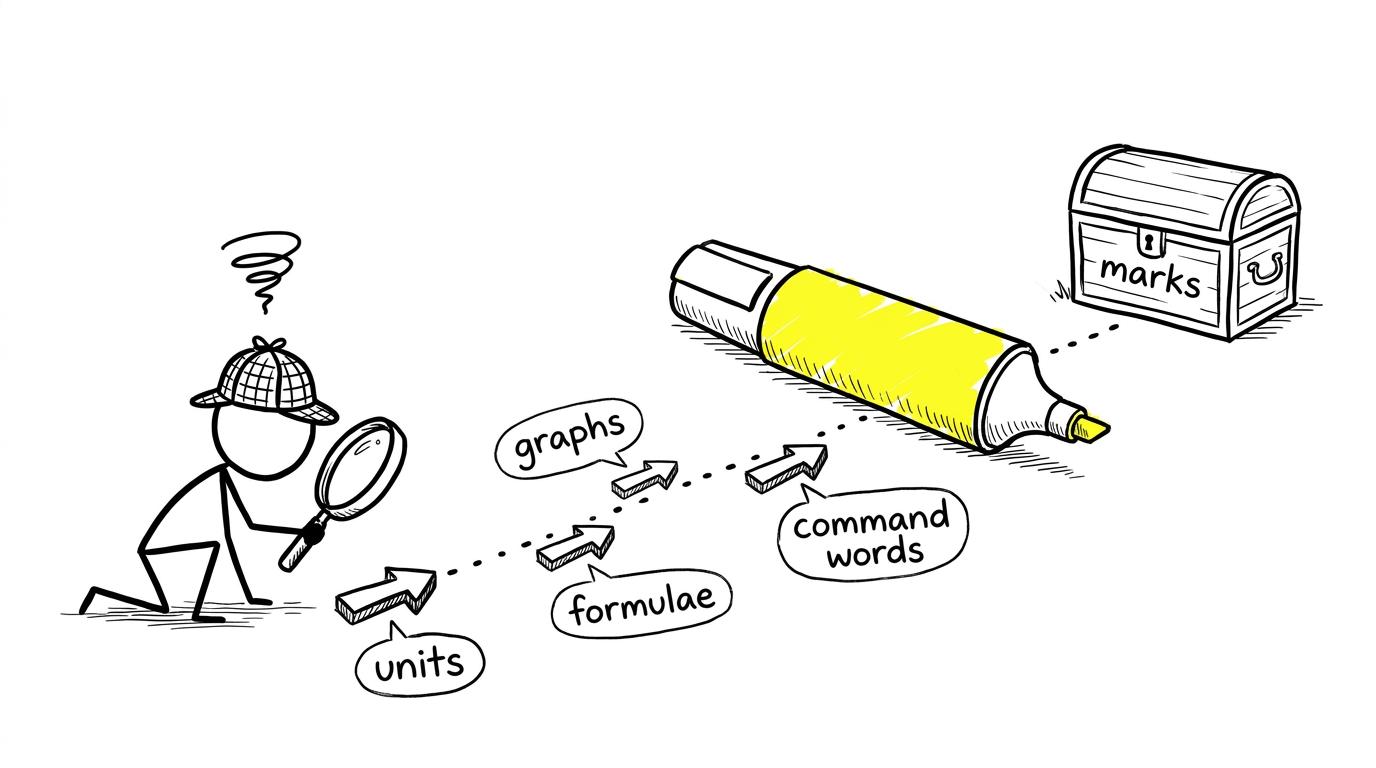 A student detective follows specification clues towards examination marks
You understand the role of the non-exam assessment
The specification does more than describe the written examination. It explains what the engineering project must assess and how work is divided across marking criteria.
Reading these criteria helps you understand why planning, modelling, communication, manufacture, quality control, testing and evaluation all matter. It also shows that attractive presentation cannot compensate for missing technical evidence.
However, your teacher must remain your main source of guidance for the non-exam assessment. Exam boards impose rules about task setting, supervision, authentication and permitted support. The specification helps you understand the framework; it does not give you permission to seek inappropriate assistance with assessed work.
What a revision guide still does better
An official specification is authoritative, but authority and teachability are different things.
The document tells you that you need to rearrange equations. It does not necessarily teach you a memorable method. It tells you that you need to interpret graphs. It does not supply enough graduated practice to make that skill automatic.
A strong revision resource provides:
- explanations in student-friendly language;
- questions arranged by difficulty;
- repetition of important techniques;
- mark schemes and complete solutions;
- mixed practice under time pressure;
- feedback that reveals why an answer lost marks.
This is why reading alone has limited returns. Recognition feels like knowledge, but an examination asks for retrieval and application. You only discover whether a method is secure when the notes are closed.
Use the GCSE Maths topics by board and tier to connect the engineering requirements to your wider maths course. MathsGenie’s guide to the best order for learning GCSE Maths can then help if several prerequisite skills need attention.
How to read GCSE Engineering specification documents efficiently
Start with the assessment pages
Read the “specification at a glance” and scheme of assessment first. Record the duration, marks, weighting and question types for each component.
This prevents a common revision error: spending time according to how large a topic looks in a guide rather than how the qualification is actually assessed.
Scan the content before reading closely
Read headings and table labels first. Mark sections as:
- secure;
- partly secure;
- unfamiliar;
- requiring teacher clarification.
Do not highlight entire paragraphs. A specification covered in colour is still not a revision plan.
Build a mathematical audit
Create separate checklists for equations, units and skills. For each item, ask:
- Can I recall or recognise it?
- Can I rearrange it where required?
- Can I select consistent units?
- Can I apply it in an unfamiliar context?
- Can I explain what my result means?
This converts formal wording into decisions. The specification tells you what exists; the audit tells you what to do next.
Test the audit against questions
A specification cannot reveal which errors you make under pressure. Questions can.
Use short topic practice first, then mixed papers. MathsGenie’s GCSE predicted papers can provide fresh maths practice near the examination, but they should supplement official past papers rather than replace them.
After each paper, classify lost marks as knowledge, method, units, accuracy or interpretation. The guide to starting GCSE past papers explains how to move from short diagnostic work to full timed papers.
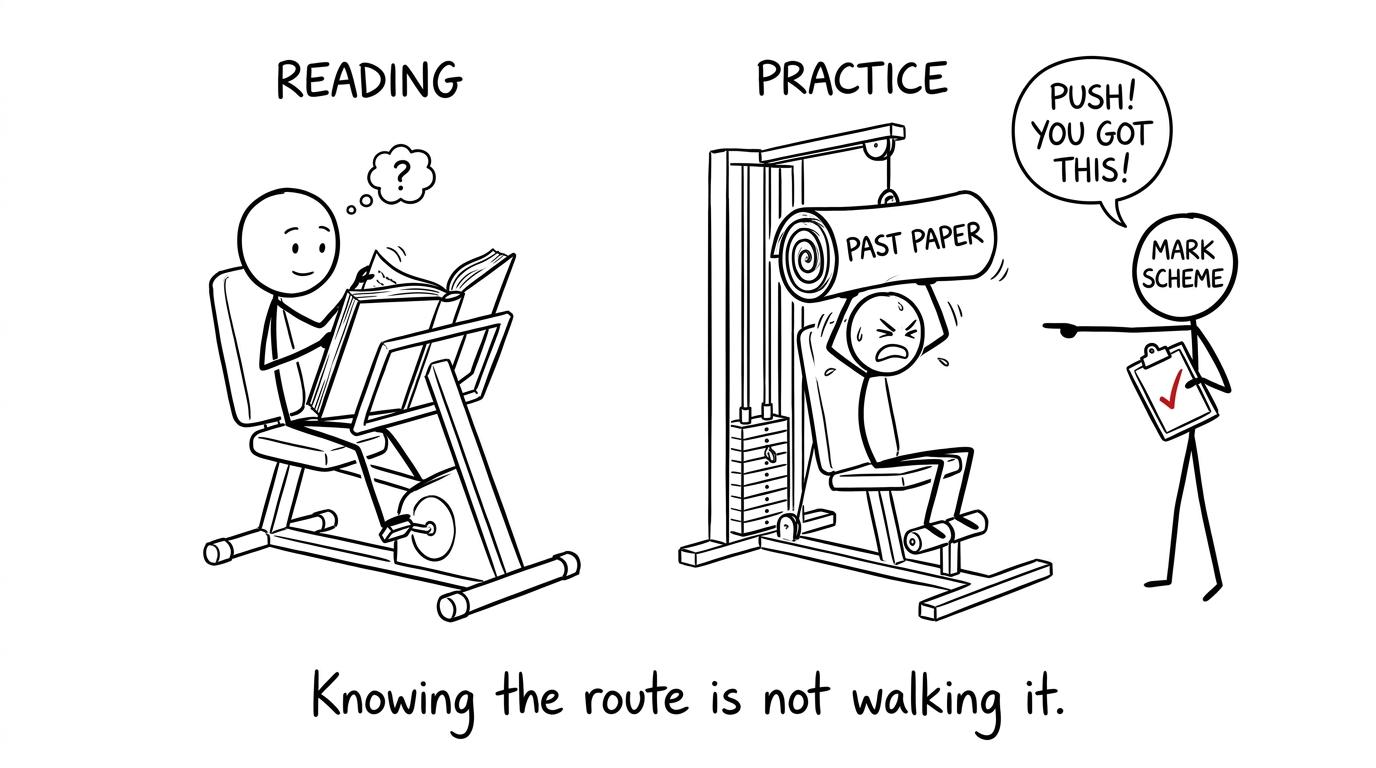 In a revision gym, reading shows the route while practice builds the strength
Common mistakes when using the specification
Reading the wrong qualification
A course described informally as engineering may have a different awarding body, title or level. Confirm the code before downloading anything. Do not assume that Edexcel, AQA, OCR and Eduqas documents are interchangeable.
Treating the specification as a textbook
The document defines content but rarely teaches it in the most accessible sequence. If a line is unclear, turn to a lesson or ask your teacher rather than repeatedly rereading the same formal wording.
Making a checklist but never practising
Ticking “trigonometry” because you recognise the word proves very little. Your checklist should be evidence-based: only mark a skill secure after answering suitable questions without help.
Ignoring additional information and appendices
Students often read the main topic headings and miss the columns or appendices where mathematical expectations, equations and limits are clarified. Those sections are among the strongest reasons to consult the original document.
Assuming GCSE Maths exam arrangements automatically apply
Your GCSE Maths course may be foundation or higher tier, but AQA GCSE Engineering has its own assessment structure. Likewise, information about formula sheets for GCSE Maths does not automatically change the requirements of Engineering. Check the current instructions for each separate qualification.
The verdict: read selectively, then act
It is worth reading the full GCSE Engineering specification once, but “reading the full document” should mean understanding its structure and carefully examining the student-relevant sections, not memorising administrative pages.
What you gain is precision: the exact content boundary, the assessment balance, the complete mathematical expectations and details a guide may compress. What you do not gain automatically is fluency. That comes from solving questions, checking mark schemes and correcting mistakes.
Use the specification as your map. Then make MathsGenie your free revision base: choose focused revision lessons, practise topic questions, use mini tests to check recall, and build examination confidence with past papers, predicted papers, mark schemes and video solutions. A map becomes valuable when it changes the next step you take.