Read GCSE Bengali Specification: Is It Worth It?
Read GCSE Bengali specification advice: see what the official document reveals, what revision guides miss, and how to use it without wasting exam time today.

A specification can look like the least inviting document in your revision folder. It is long, formal and written partly for teachers. Yet if you want to read GCSE Bengali specification material for yourself, the short answer is yes, but you do not need to study every page.
The official specification is most useful as a map. It confirms exactly what can be assessed, how the papers are structured, which topics and grammar you need, and what changes between foundation and higher tier. A revision guide usually explains the course more comfortably. The specification defines it more precisely.
For a busy student also preparing for GCSE maths, the best approach is a focused skim followed by active revision. Spend around 202020 to 303030 minutes extracting the useful information, then return to vocabulary, speaking, translation and exam practice.
The quick verdict
Reading the full specification is worthwhile if you use it to answer specific questions:
- Am I taking AQA GCSE Bengali or a different qualification?
- Am I entered for foundation or higher tier?
- What papers will I sit, and how much is each worth?
- Which themes and grammar requirements can be assessed?
- What does each assessment objective reward?
- Are there details my revision guide has simplified or omitted?
You do not need to memorise administrative information intended for schools. Nor should reading the specification replace practice. Think of it as checking the route before starting a journey: useful once, but not a reason to remain beside the map.
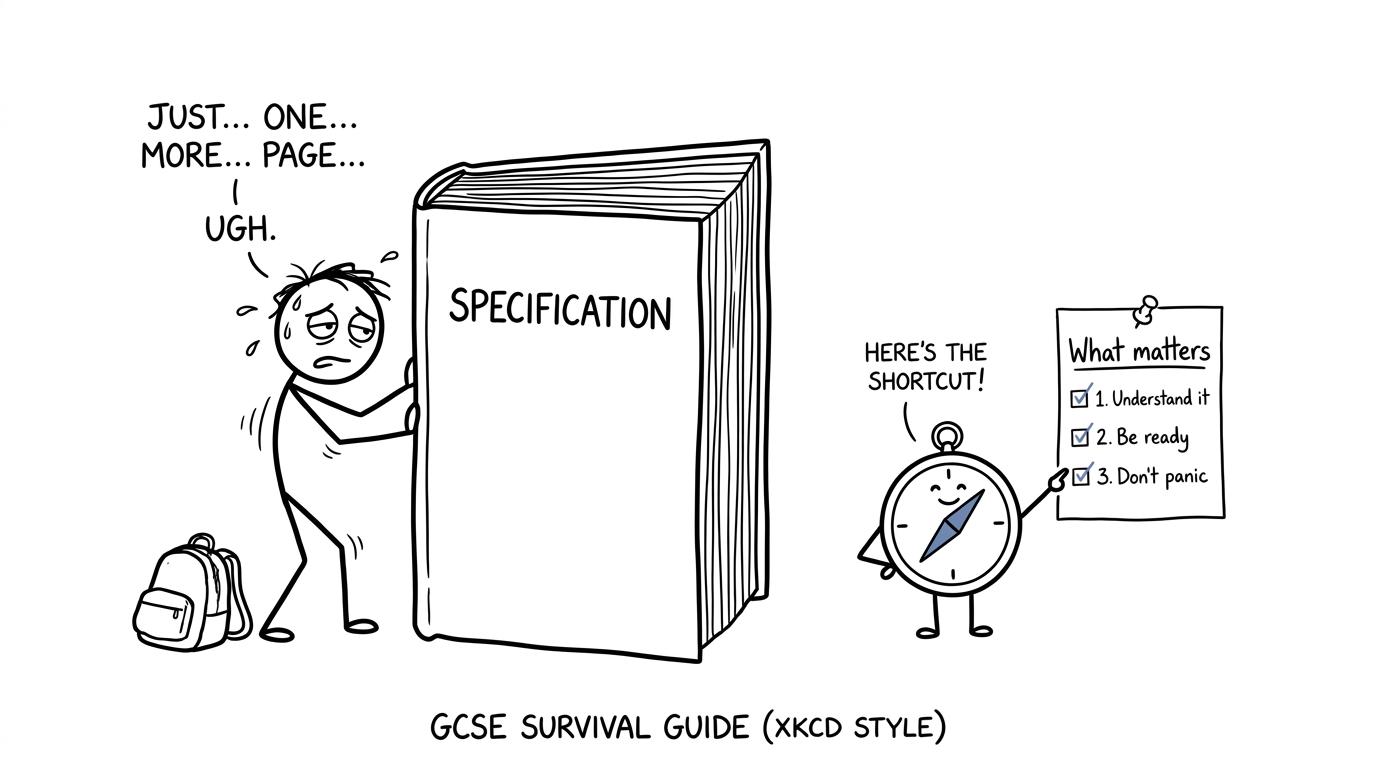 A student discovers that a specification is more useful as a compass than a novel
First, confirm which qualification you are taking
This is the most important reason to consult the official document. In England, the current regulated domestic GCSE Bengali qualification is AQA GCSE Bengali, specification code 863886388638. Pearson also offers an International GCSE in Bangla, but that is a different qualification with a different assessment structure.
Do not assume that “Bengali”, “Bangla”, GCSE and International GCSE all refer to interchangeable courses. Check the exam board and specification code with your teacher, examination officer or recent mock paper before downloading anything.
The same habit matters in maths. Edexcel, AQA, OCR and Eduqas cover broadly comparable GCSE mathematical content, but paper structures and supporting materials differ. The GCSE Maths revision hub lets you select the correct board rather than revising from a vaguely similar course.
A guide may mention the exam board on its cover. The specification tells you the exact qualification it supports.
What the official AQA specification tells you
At the time of writing, AQA GCSE Bengali is a linear qualification. Students complete all assessments at the end of the course and take four papers:
- listening
- speaking
- reading
- writing
Each skill contributes approximately 25%25\%25% of the overall qualification. This balance is easy to overlook if your revision has been dominated by vocabulary lists or written tasks. The specification makes the consequence clear: neglecting one language skill means neglecting roughly one quarter of the assessment.
The qualification has foundation tier, covering grades 111 to 555, and higher tier, covering grades 444 to 999. All four papers must be taken at the same tier and in the same examination series. That is not a small administrative detail. It affects the grammar, task demand, paper length and revision materials you should use.
A good guide may summarise these facts. Reading the official version removes ambiguity.
You see the whole content boundary
The AQA specification groups the course into three themes:
- identity and culture
- local, national, international and global areas of interest
- current and future study and employment
Within those themes sit topics such as family relationships, technology, free time, customs and festivals, social and global issues, travel, education and career ambitions.
This gives you something a general guide cannot always provide: a complete boundary. If a topic is in the specification, it deserves a place in your revision. If your notes contain a large section that does not connect to the stated content, it may be useful language practice, but it should not displace an obvious gap.
The same principle improves maths revision. A broad label such as “algebra” is too vague to guide a useful session. You need to identify the precise skill that is weak. The guide to finding your weakest GCSE topics explains how to turn lost marks into a focused list rather than revising everything equally.
You discover what “knowing Bengali” means in the exam
Fluency in everyday conversation is valuable, but it does not automatically cover every assessed skill. The specification distinguishes between understanding spoken language, communicating in speech, reading different texts and writing accurately for different purposes.
It also provides tier-specific grammar requirements. These lists are especially useful for students who speak Bengali at home. Familiarity can make a sentence sound right without making its grammatical structure easy to explain or reproduce accurately under examination conditions.
By checking the grammar section, you can compare your natural language ability with the structures the assessment expects. This may reveal that your main need is not basic communication but formal accuracy, translation, unfamiliar contexts or control of written forms.
A guide is generally better for learning those structures. The specification is better for checking whether your guide has covered them.
You understand the assessment objectives
The four assessment objectives align with the four language skills:
- AO1 assesses listening
- AO2 assesses speaking
- AO3 assesses reading
- AO4 assesses writing
That sounds obvious, but assessment objectives help you interpret your marks. A disappointing result is not simply evidence that you are “bad at Bengali”. It may point to one specific mode of communication.
This is the same shift that makes maths revision productive. A total mark tells you how the paper went; the individual questions tell you what to do next. MathsGenie’s guide to using GCSE past papers properly builds revision around the cycle of attempting, marking, repairing and retesting.
The specification identifies the skills. Past papers reveal how those skills are tested. Mark schemes show what earns credit. You need all three perspectives.
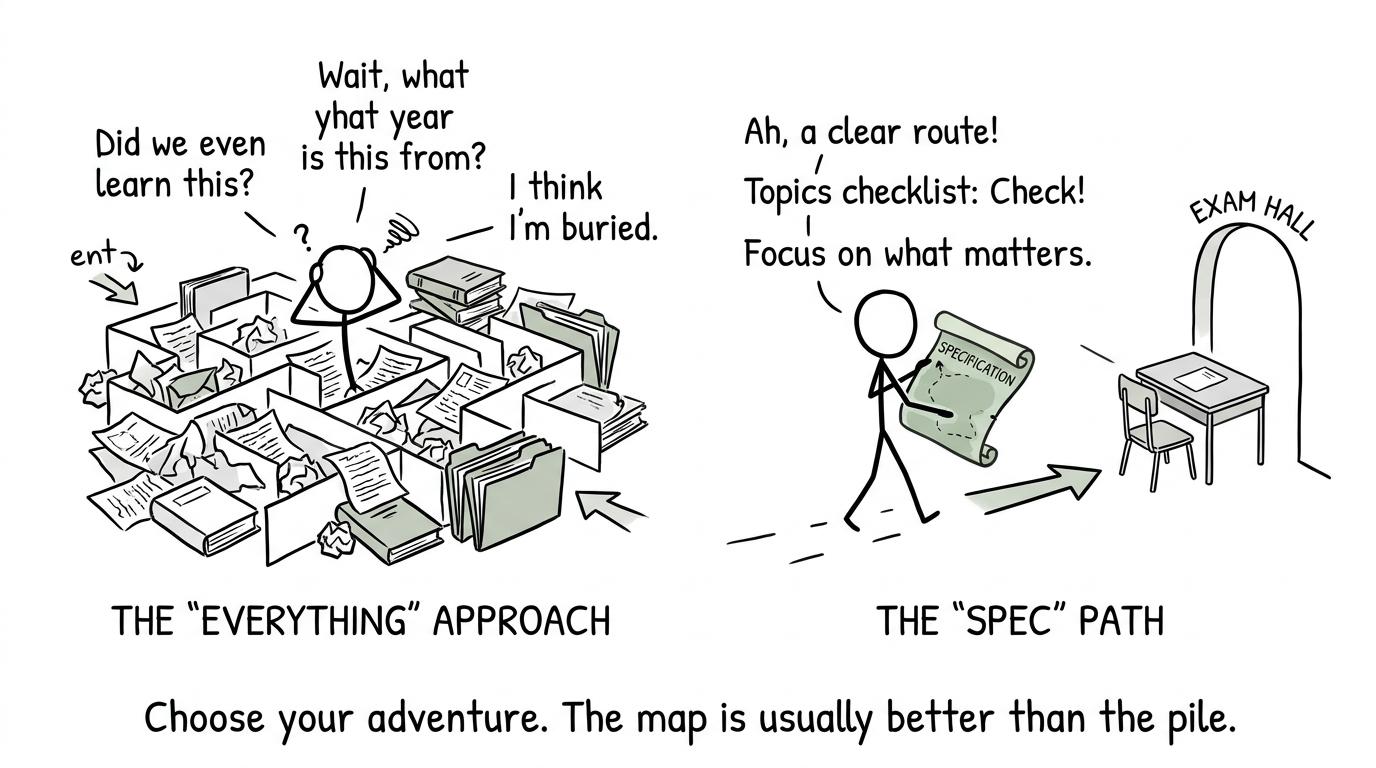 One student follows the specification map while another revises absolutely everything
What a revision guide does better
Official does not mean ideal for every purpose. Specifications are designed to define qualifications accurately, not to provide the smoothest student explanation.
A strong revision guide is usually better for:
- organising vocabulary into manageable sets
- explaining grammar in student-friendly language
- modelling speaking and writing structures
- supplying practice activities
- turning broad themes into revision sessions
- helping you recall content quickly
The right question is therefore not “specification or guide?” It is “what job should each resource do?”
Use the specification for coverage and accuracy. Use a guide or lesson for explanation. Use questions and papers for performance. Use mark schemes for feedback.
That sequence also works for maths. The best order for learning GCSE maths topics moves from foundations towards exam technique, while Edexcel GCSE mini tests provide shorter checks when a full paper would be excessive.
How to read the specification without wasting time
Do not begin at page one and treat the document like a novel. Open it with a purpose.
Check the identity of the course
Write down the exam board, qualification title, specification code and tier. If any of these are uncertain, ask your school before building a revision plan.
Extract the paper structure
Create a one-page summary of the four components, their weighting and the main task types. Keep it beside your revision timetable so that one comfortable skill does not consume all your time.
Turn themes into a coverage checklist
Mark each topic as secure, developing or weak. Keep this honest. Recognising a topic title is not the same as being able to understand it in speech, discuss it and write about it.
Compare the grammar lists with your resources
Use the foundation or higher section that applies to your entry. Highlight unfamiliar requirements and take those to your teacher or revision guide for explanation.
Stop reading and start practising
Once the document has answered your questions, close it. The specification describes performance; it does not create performance. That comes from retrieval, speaking aloud, listening practice, writing, translation and feedback.
If several subjects are competing for your time, a realistic timetable matters more than an ambitious one. The GCSE maths revision timetable guide shows how to combine focused topic sessions with timed practice and review. On particularly busy days, the 20-minute GCSE revision routine offers a smaller repeatable structure.
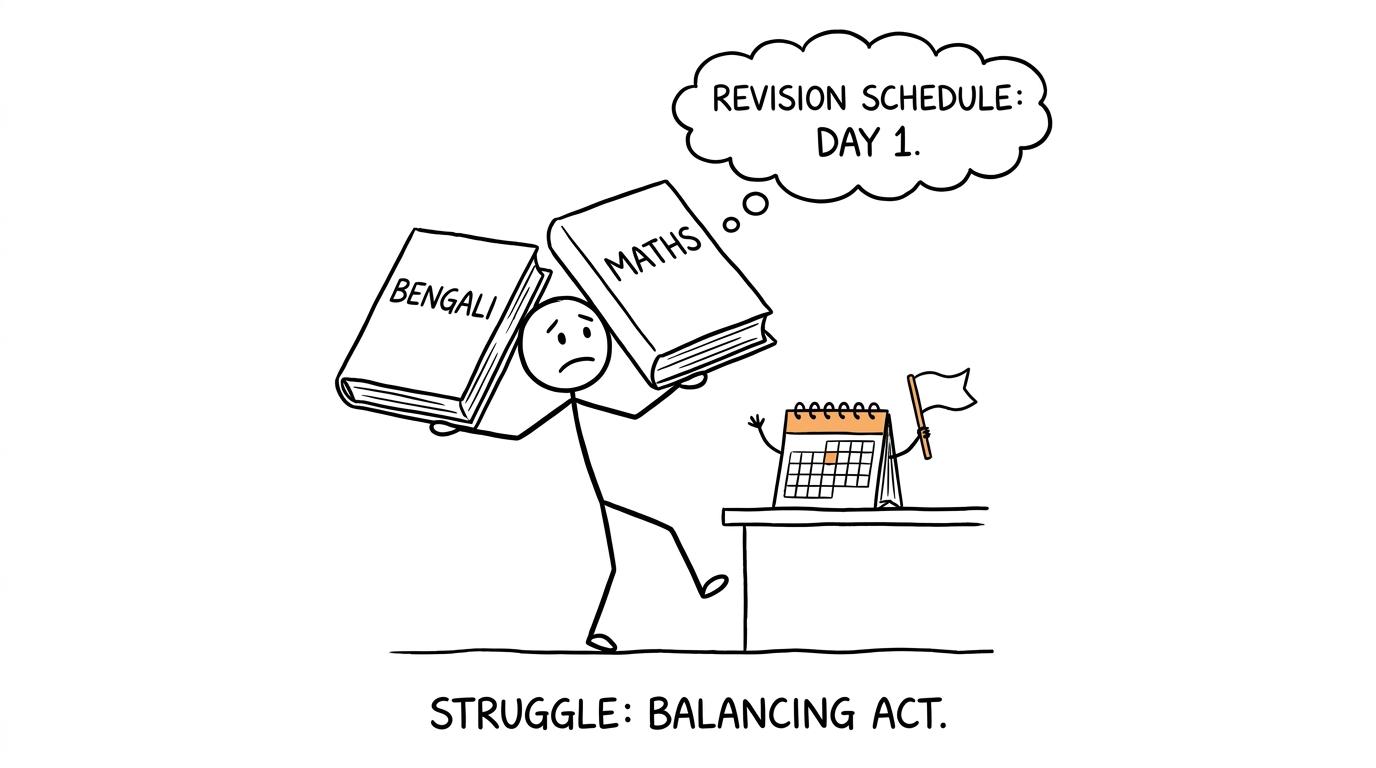 A GCSE student attempts to balance Bengali, maths and a very opinionated calendar
When reading the whole document is especially valuable
A closer reading is sensible if you are preparing independently, taking Bengali outside your normal school timetable, changing exam board or relying on older materials. It is also useful when you speak Bengali confidently but have had limited formal teaching in grammar or examination technique.
In those situations, the specification acts as quality control. It helps you test whether your resources genuinely match the qualification rather than merely sharing its subject name.
Read more selectively if your teacher has already provided an accurate course overview, a complete topic checklist and current assessment guidance. Even then, checking the official paper structure and content lists yourself can prevent misunderstandings.
Common mistakes when using the specification
Reading the wrong qualification
AQA GCSE Bengali and Pearson International GCSE Bangla are not the same course. Match the title and code, not just the language name.
Treating every page as equally useful
Students usually gain most from the overview, subject content, grammar and assessment sections. Administrative rules written for centres rarely deserve the same attention.
Assuming the specification teaches the course
A list of grammar requirements cannot replace an explanation, just as a maths content statement cannot teach you how to solve an unfamiliar problem.
Confusing coverage with competence
Ticking every theme only proves that you have encountered it. Test whether you can listen, speak, read and write about it without excessive support.
Spending revision time on reading rather than doing
Passive reading feels orderly because nothing can go wrong. Practice feels less comfortable because it exposes gaps. The second feeling is more useful.
Using predictions as a substitute for full coverage
Predicted material can focus final practice, but it cannot guarantee what will appear. This applies across subjects. MathsGenie’s guide to GCSE predicted topics explains why predictions should sit alongside specification coverage and past-paper evidence.
The specification is a map, not the journey
So, is it worth reading the full GCSE Bengali specification yourself? Yes, selectively. You gain certainty about your qualification, tier, papers, themes, grammar and assessment objectives. Those details help you judge whether a guide is complete and whether your revision time reflects the real exam.
But the greatest return comes from what you do next. Turn the content into a checklist, identify gaps, practise each assessed skill and use feedback to decide your following session.
Apply the same discipline to maths. Start with the free MathsGenie GCSE revision hub, choose your board and tier, and move between revision lessons, practice questions, mini tests, past papers, predicted papers, mark schemes and video solutions. The specification tells you where the boundaries are. Deliberate practice is what moves you within them.