Podcasts and Audiobooks for GCSE Music: Do They Help?
Podcasts audiobooks GCSE Music: learn when audio revision helps, where it falls short, and how to combine listening with recall and focused exam practice.
Revision audio has an attractive promise: put on your headphones, press play and learn while walking, travelling or tidying your room. If you searched for podcasts audiobooks GCSE Music, the useful answer is simple: listening can help, but it works best as a supplement rather than your main revision method.
Audio is well suited to revisiting musical vocabulary, historical context, set works and descriptions of what you should listen for. It cannot fully prepare you to analyse unfamiliar extracts, interpret notation, complete dictation, construct extended responses or respond under timed exam conditions. Those skills require active listening, writing and feedback.
That distinction matters for students balancing Music with GCSE Maths. Both subjects reward knowledge, but neither exam simply asks whether the material sounds familiar. You must retrieve it and use it.
The quick verdict
Use podcasts or audiobooks when you want to:
- revisit terminology and contextual knowledge;
- hear musical concepts explained in different words;
- prepare your attention before listening closely to a set work;
- make productive use of a journey or short walk;
- identify topics that need deeper revision later.
Do not rely on them to replace:
- focused listening to musical extracts;
- score reading and notation practice;
- dictation questions;
- timed written responses;
- past-paper questions and mark-scheme feedback;
- performance or composition practice.
A helpful rule is: audio introduces or refreshes; retrieval and exam practice prove that you know it.
Why listening feels like effective revision
Listening is smooth. The presenter explains an idea, it makes sense, and you recognise the terminology. That recognition can feel like secure knowledge.
But recognition and recall are not the same. In an examination, the explanation is no longer playing through your headphones. You may need to identify texture in an unfamiliar extract, describe how dynamics create an effect, compare two passages or connect a musical feature to its context. The answer has to come from you.
Research on educational podcasts suggests that well-designed audio can support learning and may perform comparably with traditional resources in some settings. However, much of that research involves university students or professional education rather than GCSE Music candidates. There is not strong evidence that passively listening to podcasts alone will improve GCSE Music grades.
The broader evidence for retrieval practice is much stronger. Classroom research consistently supports asking learners to bring information to mind rather than merely reviewing it again. For revision audio, that means pausing, recalling, answering and checking.
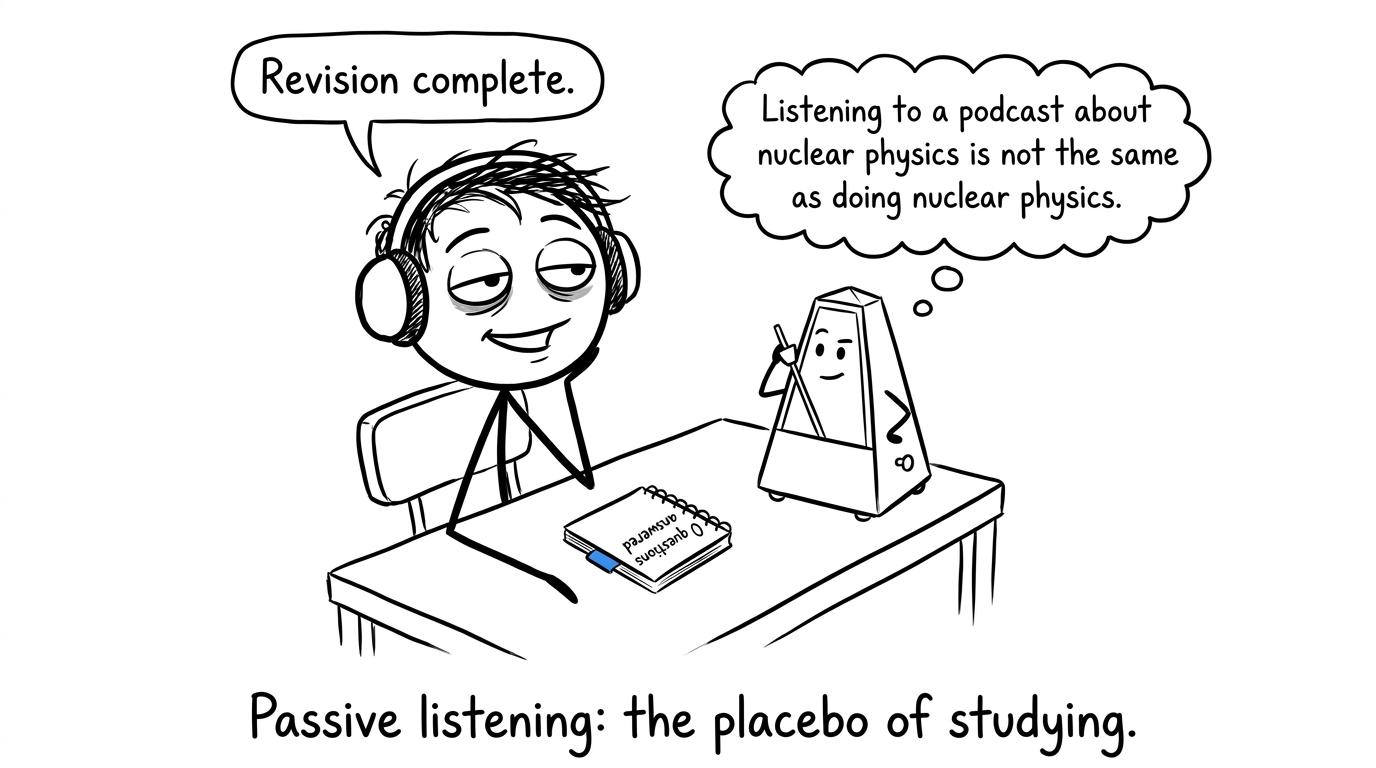 A student celebrates completing revision while an unimpressed notebook records no questions answered
Why audio has a genuine place in GCSE Music
GCSE Music is unusually compatible with audio because listening is part of the subject itself. Across Edexcel, AQA, OCR and Eduqas, students encounter an assessed listening or appraising component. The precise structure, terminology, set works and areas of study depend on the specification, so always check the requirements for your board.
For AQA, OCR, Eduqas and Edexcel GCSE Music, the listening or appraising component contributes 40%40\%40% of the qualification. That does not mean any kind of listening will prepare you for it. An audiobook about film music and an examination extract accompanied by targeted questions demand very different levels of attention.
Audio can strengthen musical vocabulary
Terms such as syncopation, homophonic, chromatic, ostinato and cadence become more useful when you can connect the word to something you hear. A clear podcast explanation may help you organise these ideas and distinguish similar terms.
The next step must be application. After hearing a term explained, listen to relevant music and decide whether the feature is actually present. Then express your judgement in an exam-ready sentence.
Podcasts can support contextual understanding
A focused episode may help you revisit the circumstances surrounding a set work, genre or musical tradition. This can make musical choices easier to understand rather than leaving them as isolated facts.
Check that the content matches your current specification. A polished programme may discuss the right composer but the wrong work, or explore interesting details that your exam does not require. Use your specification, teacher guidance and official course materials to decide what deserves revision time.
Repeated listening can improve familiarity
Revisiting an explanation after several days may help you notice what you have forgotten. Yet repeating an entire episode is often inefficient. Try recall first, then replay only the section needed to correct the gap.
That principle also supports maths revision. MathsGenie’s guide to stopping forgotten GCSE content explains how retrieval, spacing and checking can turn review into something measurable.
Where podcasts and audiobooks fall short
The limits of audio become clear when you compare it with the actual demands of the examination.
Audio commentary is not aural analysis
A presenter may tell you that a passage uses imitation. In the exam, you may have to recognise that feature independently while following a score or considering several possible answers. The first activity supplies the judgement; the second requires you to make it.
Use spoken audio as preparation, then move to extracts without commentary. Ask yourself about melody, harmony, tonality, rhythm, metre, texture, timbre, dynamics, structure and context as appropriate to your specification.
Audiobooks rarely match a specification closely
A general book about classical music, popular music or composing may be interesting and valuable. It is unlikely to follow your exam board’s exact areas of study, vocabulary or question styles.
That makes audiobooks better for enrichment and broad understanding than for final exam preparation. Before committing several hours, check the contents against your course. If only one chapter is relevant, listen selectively.
Listening cannot replace written output
GCSE Music examinations include written responses. Depending on the board, these may range from single words and short answers to comparisons and extended writing. You need to select precise evidence, use appropriate terminology and answer the command word.
You cannot develop that skill entirely in your head. Write answers, mark them and improve them. The same reality applies in Maths: understanding a video is not equivalent to producing a correct method. The MathsGenie GCSE Maths revision hub combines explanations with questions because practice is where understanding becomes usable.
How to turn listening into active revision
The difference between background noise and revision is what you do after pressing pause.
Choose one narrow purpose
Do not begin with “I am revising Music”. Choose a specific goal, such as recalling features of a set work, distinguishing two textures or reviewing the context of one area of study.
A narrow goal helps you reject episodes that are interesting but irrelevant. It also makes it possible to test whether the session worked.
Use a listen, pause, retrieve, check cycle
Listen to a short section, then pause before the presenter summarises it. Without looking at notes:
- state the main idea aloud;
- write three useful terms;
- explain how you might recognise the feature in an extract;
- create one possible exam question;
- check your response against reliable course materials.
If your recall is weak, replay the relevant passage rather than restarting the whole episode.
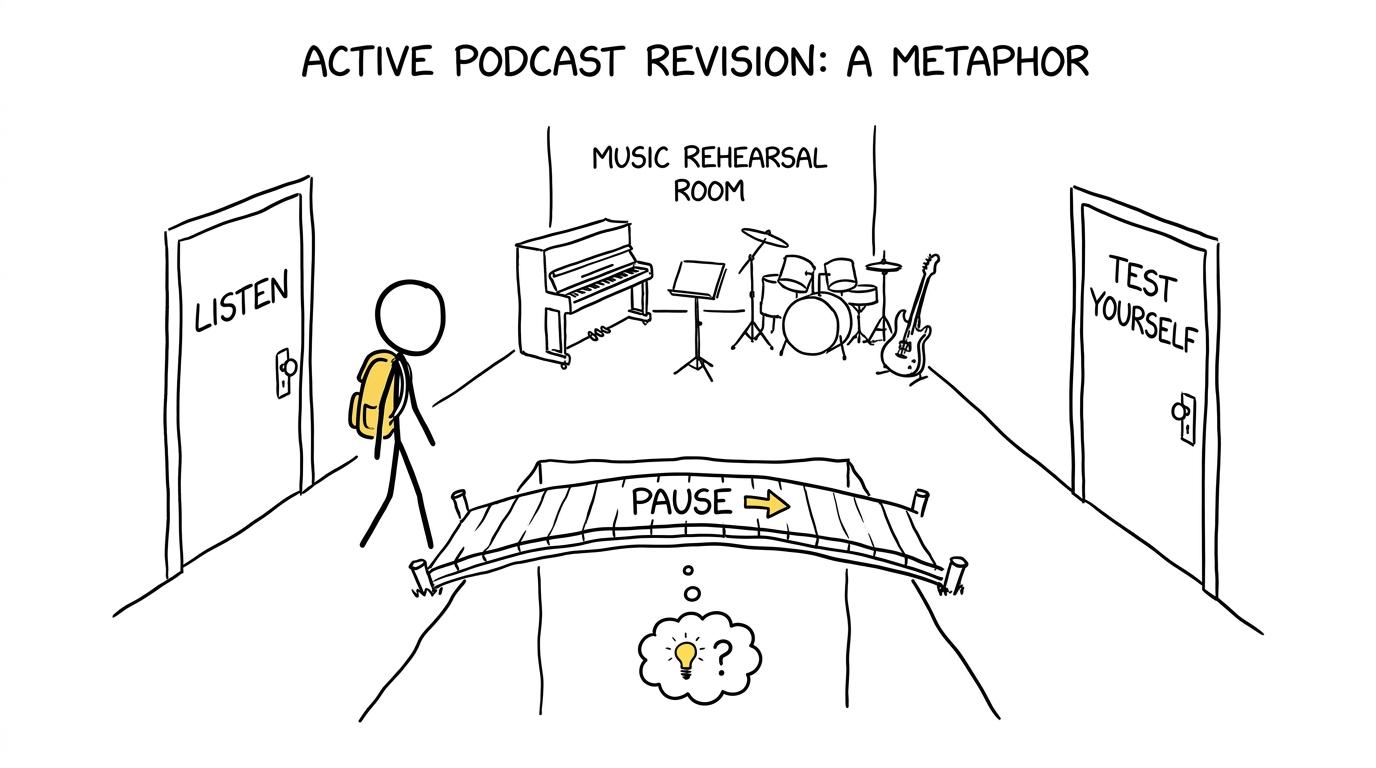 A student discovers that listening and self-testing are connected by a pause bridge
Finish with an exam-shaped task
An effective session should end in the format the examination expects. That might mean labelling a score, answering listening questions, completing a short dictation task or writing a comparison under timed conditions.
Mark the work promptly. Record whether the problem was missing knowledge, inaccurate listening, vague vocabulary or poor question interpretation. MathsGenie’s method for finding weak GCSE topics uses the same principle: dropped marks are evidence about what to practise next.
Building audio into a balanced revision timetable
Podcasts work best in the margins of a plan, not at its centre. You might use a short episode during a journey, then complete focused listening and written practice at your desk later.
A balanced Music session could contain:
- brief recall before opening any resource;
- a selected audio segment;
- focused listening to an appropriate musical extract;
- an exam-style written response;
- marking and one recorded correction.
Keep separate records for knowledge, aural skills and written technique. Feeling confident about historical context does not necessarily mean that you can identify musical features accurately.
When Music, Maths and other subjects compete for time, plan by task rather than by vague subject blocks. The GCSE one-month maths revision plan shows how short retrieval, focused practice and regular paper work can coexist. For busier days, the 20-minute maths revision routine offers a smaller repeatable structure.
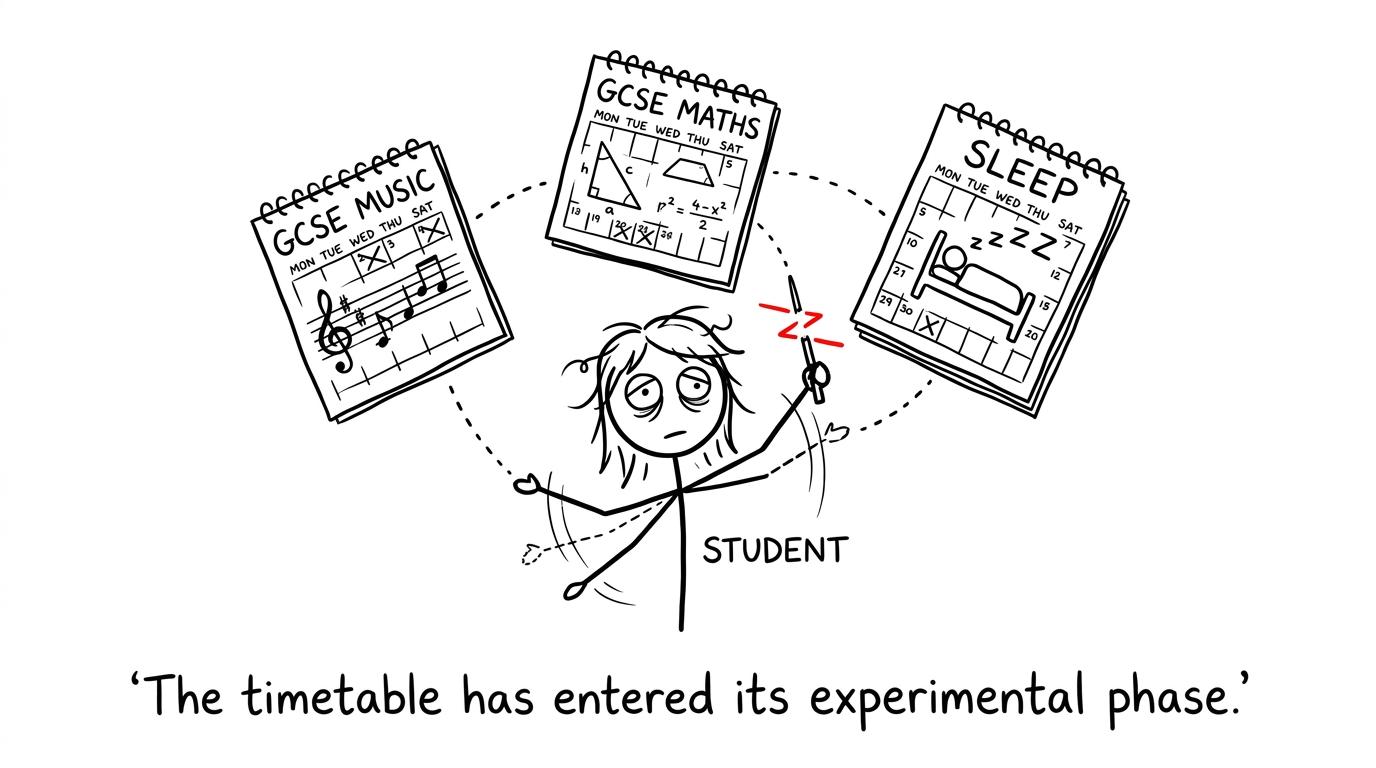 A student conducts a chaotic orchestra of Music revision, Maths revision and sleep calendars
Common mistakes with audio revision
Playing episodes while doing demanding work
Listening while answering Maths questions, writing an essay or scrolling through social media divides attention. Save revision audio for a quiet journey, a simple routine task or a dedicated listening session.
Measuring progress in hours listened
Finishing four episodes proves that four episodes played. It does not prove that you can recall their content. Measure completed retrieval questions, accurate musical observations and improved exam responses instead.
Choosing entertainment over specification relevance
An engaging presenter can keep you listening to material that will not help with your paper. Check the episode title, description and content against your exam board’s specification before investing time.
Making notes without testing them
Transcribing the presenter can become another passive activity. Turn notes into questions, cover the answers and retrieve them later.
Replacing all other revision with audio
Listening cannot train every assessed skill. Keep score work, unfamiliar extracts, timed writing, performance, composition and teacher feedback in the plan.
Using the same method for Music and Maths
Audio can explain a mathematical method, but Maths improvement requires written problem-solving. Use MathsGenie’s free revision lessons and practice questions together, then test your timing with past papers. If an exam is close, a calm GCSE Maths night-before plan is more useful than filling every remaining minute with audio.
Make listening earn its place
Podcasts and audiobooks can genuinely help with GCSE Music when they refresh relevant knowledge, sharpen vocabulary and lead directly into retrieval or listening practice. They are much less effective when they become pleasant background sound mistaken for completed revision.
The best test is not whether an episode felt useful. It is whether, after pausing it, you can identify, explain and apply what you heard.
Build that same honesty into Maths revision. Start with MathsGenie’s free revision lessons, answer the practice questions, use mini tests to expose gaps and move towards past papers and predicted papers. Mark your work carefully with the available mark schemes and use video solutions when a method is unclear. Pressing play can begin a revision session; active practice is what finishes it.